1 Kings 8:22-30 – Solomon’s Prayer of Dedication

Then Solomon stood before the altar of the Lord in the presence of all the assembly of Israel and spread out his hands to heaven. He said, “O Lord, God of Israel, there is no God like you in heaven above or on earth beneath, keeping covenant and steadfast love for your servants who walk before you with all their heart, the covenant that you kept for your servant my father David as you declared to him; you promised with your mouth and have this day fulfilled with your hand. Therefore, O Lord, God of Israel, keep for your servant my father David that which you promised him, saying, ‘There shall never fail you a successor before me to sit on the throne of Israel, if only your children look to their way, to walk before me as you have walked before me.’ Therefore, O God of Israel, let your word be confirmed, which you promised to your servant my father David.

“But will God indeed dwell on the earth? Even heaven and the highest heaven cannot contain you, much less this house that I have built! Regard your servant’s prayer and his plea, O Lord my God, heeding the cry and the prayer that your servant prays to you today; that your eyes may be open night and day toward this house, the place of which you said, ‘My name shall be there,’ that you may heed the prayer that your servant prays toward this place. Hear the plea of your servant and of your people Israel when they pray toward this place; O hear in heaven your dwelling place; heed and forgive. (New Revised Standard Version)

I grew up in rural Iowa, a place with lots of gravel roads. In the seasons of Spring and Fall, the thawing and re-freezing lead to some impressive ruts in those roads. It’s difficult to avoid them since they nearly dominate the driving space. 

With our prayers, there are seasons of life where we can slip into ruts – times where focused wrestling in prayer is set aside by just going along with the rut of prayer with the same lifeless words and phrases. There are Christians who pray wonderful prayers… over and over again with almost no thought to it, continually saying the same things anytime they pray.

In today’s Old Testament lesson, we have a prayer of Solomon at the dedication of the Lord’s temple. The two aspects of this prayer that jump out to me are: 

  1. Solomon reminded God of divine promises to the covenant people.
  2. Solomon reminded God of who God is. 

Solomon, as the wisest person to ever live, did not believe that somehow God forgot about promises made or had some sort of divine dementia about theology proper. Instead, Solomon prayed with the kind of prayer that God delights to hear. 

“Prayer does not change God, but it changes him who prays.”

Søren Kierkegaard 

God enjoys hearing us pray. The Lord likes it when we pray according to the promises given us. God adores when we pray with a focused understanding of whom we are praying to.

So, then, in our prayers, it is good to emulate the example of King Solomon. Know the promises of God contained in Holy Scripture and pray they will be confirmed in our lives, families, churches, and world. 

Also, pray with the intention of declaring God’s inherent nature, attributes, and character. Acknowledge the basic trait of God’s steadfast love. Believers serve a big God whose hugeness is continually above all things, and whose work is always continuing according to divine decrees and words. 

One way of moving our prayers out of the ruts of familiar language and thoughts is to journal them. Writing our prayers can become for us an act of worship as we slow down enough to craft a response to God that is thoughtful and connects us with him beyond the rote and routine.

In its simplest definition prayer is a conversation between the one who is praying and the one to whom those prayers is directed. So, whenever we craft a written or spoken prayer, it’s good to get out of a rut by:

  • Using language and words that are meaningful to you.
  • Making your intentions clear by stating exactly what you need or want.
  • Taking your time and not rushing.
  • Lighting candles, burning incense, or creating a special sacred space for prayer. 

Thank you Lord God for the opportunity of prayer and worship. Thank you that I can put aside uncertainties of this world and rest and rely upon the certainties of your good promises. Thank you that we can bring to your feet all the hurts and fears that trouble us and leave them there knowing that your strength and assurance are all that we require. May all your people find peace, healing, wholeness, and joy in your presence, through Jesus Christ, your Son, our Savior, who with you and the Holy Spirit exist as one God, now and forever. Amen.

1 Samuel 2:1-10 – A Hope Fulfilled

Then Hannah prayed:

“My heart rejoices in the Lord!
    The Lord has made me strong.
Now I have an answer for my enemies;
    I rejoice because you rescued me.
No one is holy like the Lord!
    There is no one besides you;
    there is no Rock like our God.

“Stop acting so proud and haughty!
    Don’t speak with such arrogance!
For the Lord is a God who knows what you have done;
    he will judge your actions.
The bow of the mighty is now broken,
    and those who stumbled are now strong.
Those who were well fed are now starving,
    and those who were starving are now full.
The childless woman now has seven children,
    and the woman with many children wastes away.
The Lord gives both death and life;
    he brings some down to the grave but raises others up.
The Lord makes some poor and others rich;
    he brings some down and lifts others up.
He lifts the poor from the dust
    and the needy from the garbage dump.
He sets them among princes,
    placing them in seats of honor.
For all the earth is the Lord’s,
    and he has set the world in order.

“He will protect his faithful ones,
    but the wicked will disappear in darkness.
No one will succeed by strength alone.
    Those who fight against the Lord will be shattered.
He thunders against them from heaven;
    the Lord judges throughout the earth.
He gives power to his king;
    he increases the strength of his anointed one.” (New Living Translation)

This is the song of Hannah, a woman unable to conceive children. She offered a heartfelt petition to God for a child. Hannah’s prayer was answered. A thousand years later, Mary, the mother of Jesus, took this same song, reworked it, and personalized it, to voice and sing her own praise to God. (Luke 1:46-55)

Hannah dared to hope. It might seem from the perspective of one who has never struggled with being childless that offering a prayer for children is easy. However, when hope has been dashed and all seems impossible, putting oneself out there to ask, even to beg, is downright hard. In the fear of having what little hope remains be crushed, it is far easier to stay away from God and keep the prayers to oneself.

Hannah actively sought divine help and risked praying and emoting. The Lord heard. Hannah’s weeping turned to singing. And, like Mary’s Magnificat, Hannah quickly moved from her own experience to the experiences of people everywhere. Hannah focused on the God of the impossible and the divine accessibility which exists when we become vulnerable and put ourselves out there in risky hope.

“Hope is to our spirits what oxygen is to our lungs. Lose hope and you die. They may not bury you for awhile, but without hope you are dead inside. The only way to face the future is to fly straight into it on the wings of hope….hope is the energy of the soul. Hope is the power of tomorrow.”

Lewis Smedes (1921-2002)

The great reversal of Hannah’s condition from barren to fertile gives hope for the weak to become strong, the hungry to be filled, and the lost person to be found. In a world where God is the Sovereign, nothing needs to stay the same – nothing is carved in stone. Since no part of our existence as humans is outside the purview of God, there is always the possibility of change, of a reversal of fortunes.

The underdog has a champion with God. The misfits, the exploited, and the downtrodden – those who cannot lift themselves or pull themselves up by their bootstraps – are precisely the persons whom the Lord raises up. God’s providential care shall oversee them, and justice will be dispensed with perfect equity.

It is one thing to hope; it is another thing altogether in daring to hope against all odds and while others poo-poo your dreams. Godly hope is not wishful thinking; it is a confident expectation that God will show up and be gracious, merciful, and kind.

The place of crying and weeping is important because it is our tears which find a better way.

Anyone can offer cheap praise. Yet, the person who sits with their sadness and feels the heart-wrenching agony of a hope unfulfilled is the one who is able to give genuine praise and to sing with authenticity. Since their hope was planted and watered with tears, their joy in the harvest is abundant and plenteous.

As Christians anticipate the season of Advent, allow the daring hope of Mary and Hannah to conceive a fresh hope in your own life so that you will give birth to new life.

God of hope, in these times of change, helplessness, and uncertainty give us courage to overcome our fears, and help us to build a future in which all may prosper and share together, through Jesus Christ our Lord. Amen.

Mark 11:12-14, 20-24 – Believing Prayer

The next day, after leaving Bethany, Jesus was hungry. From far away, he noticed a fig tree in leaf, so he went to see if he could find anything on it. When he came to it, he found nothing except leaves, since it wasn’t the season for figs. So, he said to it, “No one will ever again eat your fruit!” His disciples heard this.

Early in the morning, as Jesus and his disciples were walking along, they saw the fig tree withered from the root up. Peter remembered and said to Jesus, “Rabbi, look how the fig tree you cursed has dried up.”

Jesus responded to them, “Have faith in God!I assure you that whoever says to this mountain, ‘Be lifted up and thrown into the sea’—and doesn’t waver but believes that what is said will really happen—it will happen. Therefore, I say to you, whatever you pray and ask for, believe that you will receive it, and it will be so for you. (Common English Bible)

A pastor once had a kitten stuck up in a tree, and it would not come down. The tree was not sturdy enough to climb, so the pastor decided that if he tied a rope to his car and drove until the tree bent down, he could then reach up and get the kitten. As he moved just a little too far, the rope broke. The tree snapped upright, and the kitten instantly sailed through the air and out of sight.

He felt just terrible and walked all over the neighborhood asking people if they had seen a little kitten. Nobody had and finally he prayed, “Lord, I commit this kitten to your keeping,” and then went about his business.

A few days later, he was at the grocery store and met one of his parishioners. In her shopping cart he was amazed to see cat food. The pastor knew the parishioner did not like cats, so he asked her why she was buying cat food.

She replied, “For years I have been refusing to buy my little girl a cat even though she has been begging for one. Finally, I told her that if God gives you a cat, I’ll let you keep it.  I watched my child go out into the yard, get on her knees and ask God for a cat. Then, a kitten suddenly came flying out of the blue sky with its paws spread out and landed right in front of her. Of course, I had to let her keep the kitten because it came from God!”

God wants us to pray! Yet, prayer does not happen apart from faith because to pray is to believe God is good and answers prayer. Prayerlessness is a sign of faithlessness. A person of little faith prays only a little. A person full of faith is always praying.

“God desires of us nothing more ardently than that we ask many and great things of him, and he is displeased of we do not confidently ask and entreat.”

Martin Luther

For Jesus, simply exhorting the disciples to pray was insufficient; they needed a deep change of heart. 

God calls us to transformation. Deep and lasting change must take place below the surface of our lives. Real change comes from the inside-out. It is the root of a person’s life, the heart, that must change – and not just the outward behavior.

In our Gospel lesson for today, Jesus got up early and was on his way to Jerusalem. He was hungry and wanted some breakfast, so he approached a fig tree. Figs were known back in Christ’s day as the poor man’s food. Fig trees were everywhere. Approaching a certain fig tree, Jesus found one that appeared leafy and well, yet had no figs. 

Jesus chose to use this tree as a teachable moment for his disciples. He cursed the tree and immediately the whole tree withered. So, why did Jesus curse the tree? Because it looked good on the outside but was really already dead on the inside. 

The tree had everything a tree needed: branches, leaves, and a trunk. Everything, that is, except fruit. The tree was to serve as an illustration for the disciples of believing prayer. The tree looked fine, and had the promise of fruit, but none was to be found. Jesus is looking for faith in his followers. 

In the prophet Jeremiah’s day, the nation of Judah had enjoyed a long stretch of prosperity and good circumstances. By all outward appearances they were doing fine. Temple attendance was at its peak and everyone was offering their sacrifices. Yet, something wasn’t right.

“I will take away their harvest,
declares the Lord.
    There will be no grapes on the vine.
There will be no figs on the tree,
    and their leaves will wither.
What I have given them
    will be taken from them.” (Jeremiah 8:13, NIV)

God pronounced a curse on Judah because, although conditions seemed fine on the outside, the people were trusting in their own abilities. But God was looking for fruit, not nice leaves. The Lord wants believing prayer, born of a faith that is confident in the goodness of God. 

God is looking for faith in us, as well. A faith not in paychecks, bank accounts, or the market economy, and not religiously in lots of outward forms of success, but a faith in God alone.

Jesus didn’t use the withering tree as an illustration of judgment but of believing prayer. Our words and prayers can have the immediate effect of changing the world. We can even speak to a mountain, and it will have to move, if we tell it to. 

Nobody probably goes around talking to mountains. Yet, all of us go around talking to ourselves about mountain-like problems. The power that levels mountains is prayer and words that speak confidence and boldness.  If you believe, you will receive whatever you ask for in prayer.

“Any concern too small to be turned into a prayer is too small to be made into a burden.”

Corrie Ten Boom

Doubt typically stands in the way of prayer – not doubt in yourself, because you don’t answer your own prayers. Doubt as an obstacles to faith is the questioning of God’s inherent goodness. We are not to have faith in faith itself, but in the actual person of God. (James 1:5-8) 

Everyone has made a difficult prayer request, mustering-up all the faith they can, and then are disappointed when it doesn’t happen. The unstable person vacillates when this happens, doubting whether God is really good or not. However, the person of faith believes God answers prayer, and if the prayer is not answered, we trust God knows the score and will answer according to gracious timing and good purposes.

Maybe you have even talked to yourself as a Job-like friend saying that you didn’t have enough faith and that is why your prayer was not answered. Yet, Christian faith isn’t a matter of being optimistic or of sending $19.95 to some hack preacher who promises to give you the secret of answered prayer, along with a free gold cross. 

We simply don’t know what God’s will is in every situation. However, we do know what God’s will is for a lot of things. For example, God is not willing that any should perish but all be brought to eternal life. So, we can pray with confidence for someone’s deliverance. And we can be bold about trusting in God’s promises.

We have every right, based in our union with Jesus Christ as redeemed persons, to ask God confidently and boldly for the removal of mountains. We possess authority in Christ to do so. Therefore, we do not need to offer tepid, milquetoast, mumbling prayers with sighs and hunched shoulders. 

Who knows? Maybe a kitten will show up.

Almighty and everlasting God, you made the universe with all its marvelous order, its atoms, worlds, and galaxies, and the infinite complexity of living creatures: Grant that, as we probe the mysteries of your creation, we may come to know you more truly, and more surely fulfill our role in your eternal purpose; in the name of Jesus Christ our Lord. Amen.

Psalm 28 – Prayer, Praise, and Possibility

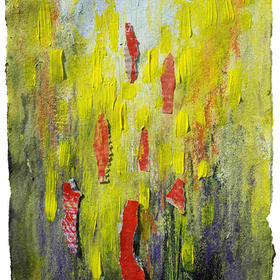
Psalm 28 by Dutch artist Wim van de Wege

I pray to you, O Lord, my rock.
    Do not turn a deaf ear to me.
For if you are silent,
    I might as well give up and die.
Listen to my prayer for mercy
    as I cry out to you for help,
    as I lift my hands toward your holy sanctuary.

Do not drag me away with the wicked—
    with those who do evil—
those who speak friendly words to their neighbors
    while planning evil in their hearts.
Give them the punishment they so richly deserve!
    Measure it out in proportion to their wickedness.
Pay them back for all their evil deeds!
    Give them a taste of what they have done to others.
They care nothing for what the Lord has done
    or for what his hands have made.
So he will tear them down,
    and they will never be rebuilt!

Praise the Lord!
    For he has heard my cry for mercy.
The Lord is my strength and shield.
    I trust him with all my heart.
He helps me, and my heart is filled with joy.
    I burst out in songs of thanksgiving.

The Lord gives his people strength.
    He is a safe fortress for his anointed king.
Save your people!
    Bless Israel, your special possession.
Lead them like a shepherd,
    and carry them in your arms forever. (New Living Translation)

The biblical character David, in frustration and agony, cried out for help, for God to hear his prayers. And, when his prayer was heard, David gave exuberant praise to the Lord for listening to him.

We are not told specifically of how that prayer was answered and what happened between the request and the response. It seems the juicy details are left out on purpose, so that maybe we would not get lost in the retribution but stick with the fact that there was a desperate need and the Lord stepped in and did something about it.

As I pondered this psalm and its lack of life-detail, I wondered about David’s situation:

Could it be that David gave God praise just for being heard by him? 

Was David cured in some way, or was he healed from the need to be healed? 

Was there even any actual deliverance that occurred? 

Did David come to praise God despite a lack of deliverance? 

Was David’s joy in his relationship with God conditional, or unconditional?

William Shakespeare’s Hamlet (c.1601 C.E.) put the question this way: “To be, or not to be, that is the question.” Hamlet’s soliloquy went on to say:

“Whether ’tis nobler in the mind to suffer
The slings and arrows of outrageous fortune,
Or to take arms against a sea of troubles,
And by opposing end them? To die: to sleep;
No more; and by a sleep to say we end
The heartache and the thousand natural shocks
That flesh is heir to, ’tis a consummation
Devoutly to be wish’d. To die, to sleep;
To sleep: perchance, to dream: ay, there’s the rub;
For in that sleep of death what dreams may come
When we have shuffled off this mortal coil,
Must give us pause: there’s the respect
That makes calamity of so long life;
For who would bear the whips and scorns of time,
The oppressor’s wrong, the proud man’s contumely,
The pangs of despised love, the law’s delay,
The insolence of office and the spurns
That patient merit of the unworthy takes,
When he himself might his quietus make
With a bare bodkin (knitting needle)?”

Hamlet, much like David of old, was miserable and burdened with a profound lack of power to change his circumstances. So, he reflects on life and death in a morbid and melancholy way. It’s not that Hamlet was contemplating suicide as much as he meditated on what life truly is and finding some meaning within it. Unlike David, Hamlet cannot find the courage to deal with his frustration and feels stymied with fear of the unknown.

If we are blatantly honest with ourselves, we must admit that far too often we have a particular outcome in mind that we want or expect God to do.  Our hopes become tethered to God doing something extremely specific so that, if it does not come to pass (or does not come quickly!) we become discouraged and disillusioned. Like Hamlet, we become lost in the shadows of our thinking and ponder some sort of escape.

So, here is another set of questions I am asking myself: 

If my adverse circumstances do not change, can I praise God anyway? 

Can I, like David, take joy in simply being heard? 

Can I find gratitude in all situations? 

Do I only express thanks and praise to God when things are going my way? 

Am I open to whatever God wants to do in my life, even if it is not what I would choose? 

Do I feel that I am above having to put up with the wickedness of this world? 

Am I expecting heaven on earth, or am I willing to suffer as Jesus did? 

I honestly believe the answers to those questions will determine the trajectory of our Christian experience. For the identity and meaning of all persons is found in the divine.

I praise you, O God, in the good and the bad, the easy and the difficult, the failures and the victories.  You are Lord over all things.  You are my strength and shield in every circumstance.  When I am weak, I am strong. I can do all things through Christ who strengthens me. Amen.