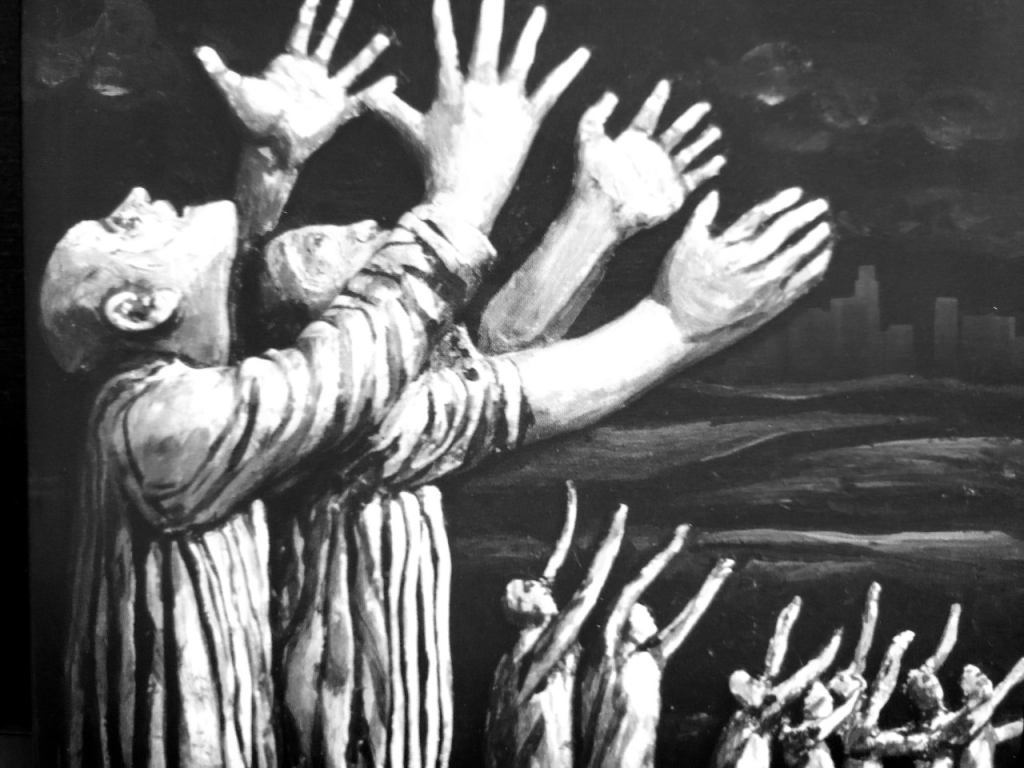
Psalm 6 – Our Tears Find a Better Way

Please, Lord,
    don’t punish me when you are angry;
    don’t discipline me when you are furious.
Have mercy on me, Lord,
    because I’m frail.
Heal me, Lord,
    because my bones are shaking in terror!
My whole body is completely terrified!
        But you, Lord! How long will this last?
Come back to me, Lord! Deliver me!
    Save me for the sake of your faithful love!
No one is going to praise you
    when they are dead.
Who gives you thanks
    from the grave?

I’m worn out from groaning.
    Every night, I drench my bed with tears;
    I soak my couch all the way through.
My vision fails because of my grief;
    it’s weak because of all my distress.
Get away from me, all you evildoers,
    because the Lord has heard me crying!
The Lord has listened to my request.
    The Lord accepts my prayer.
All my enemies will be ashamed
    and completely terrified;
    they will be defeated
    and ashamed instantly. (Common English Bible)

“Don’t ever discount the wonder of your tears. They can be healing waters and a stream of joy. Sometimes they are the best words the heart can speak.”

William Paul Young, The Shack

Sometimes, even oftentimes, our tears find a better way.

It seems as if many folks don’t know this. Whenever someone is distraught, discouraged, or in the throes of despair, the advice given to them is often unhelpful, and even hurtful.

“You just need to be strong,” “Keep your chin up, I’m sure you have a lot to be thankful for,” and “Don’t cry, everything will work out okay,” are statements which betray we are uncomfortable with tears and are unsure what to do with them in others.

It can also be worse than that, with exhortations which only harm and don’t assist. “Dry up those tears or I’ll give you something to really cry about,” “Being sad and depressed like that is a sin, you know,” and “God wants you to be happy, so just put a smile on your face and fake it until you make it,” are a misuse of words and an abuse of language’s power.

So, I say again: Our tears find a better way.

To hold back our tears, to stuff our sadness and grief, does not make it go away. It’s still in there. And, if left there for too long, will come out sideways in harming others or even ourselves.

Whenever we put away our tears, we’re setting aside God’s most powerful means of healing, health, and wholeness. Tears are the conduit of integrating body and soul, where what’s going on inside is expressed on the outside.

Often, you don’t even need words when you have tears. The presence of the tears themselves becomes a form of language. They’re just there, and they are beautiful. Tears are evidence of brokenness, and more importantly, of healing and of strength, not weakness.

Tears are the body’s release valve for stress, sadness, grief, anxiety, and frustration. Like the ocean, tears are saltwater. They protectively lubricate the eyes, remove irritants, and contain antibodies that fight pathogenic microbes.

Dr. William Frey is a biochemist and an expert on human tears at the University of Minnesota. He states that our bodies produce three kinds of tears: reflex, continuous, and emotional. Each kind has different healing roles. Reflex tears allow the eyes to flush noxious particles when they’re irritated by smoke or exhaust. Continuous tears are produced regularly to keep our eyes lubricated and protected from infection.

Emotional tears were the experience of the psalmist. Whereas reflex tears are 98% water, emotional tears contain stress hormones that get excreted from the body through crying. Emotional crying stimulates the production of endorphins – the hormone necessary for happiness and a decrease of pain.

As the only creatures carrying God’s image and likeness within us, humans alone shed emotional tears. And that’s because God cries.

Jesus wept. Real tears. Emotional tears. Tears of genuine feeling and solidarity with the community, lamenting at the death of a dear friend, Lazarus.

“The Teacher is here,” Martha said, “and is asking for you.” When Mary heard this, she got up quickly and went to him. Now Jesus had not yet entered the village but was still at the place where Martha had met him.When the Jews who had been with Mary in the house, comforting her, noticed how quickly she got up and went out, they followed her, supposing she was going to the tomb to mourn there.

When Mary reached the place where Jesus was and saw him, she fell at his feet and said, “Lord, if you had been here, my brother would not have died.”

When Jesus saw her weeping, and the Jews who had come along with her also weeping, he was deeply moved in spirit and troubled. “Where have you laid him?” he asked.

“Come and see, Lord,” they replied.

Jesus wept. (John 11:28-35, NIV)

The Lord Jesus came to the village three days after Lazarus died. He knew exactly what he was about to do: raise Lazarus from the dead in a miraculous resurrection. Yet, he did not come all smiles stating, “Hey, guys, don’t be sad! Watch what I’m going to do!”

No, instead, Christ participated fully in the sisters’ and the community’s grief. Only until he had done this did he proceed to performing the miracle.

The tears, just as much as the resurrection itself, were redemptive.

There was a time, long ago, when the word “loser” meant exactly what the word says – that someone had lost someone. It was a descriptive word recognizing the aching hole in the heart that one experiences from the death of a loved friend or family member.

Now, however, the word “loser” has taken an insidious twist over the years – meaning someone who hasn’t won, somebody who didn’t have what it took to be a winner. It is now a negative term that nobody wants to wear as a moniker, at all.

Perhaps that is one reason why so many people wear plastic smiles, pretend they are strong, and insist on keeping up appearances… And it is killing us with unprecedented numbers of depression, anxiety, and outright despair with nowhere to place it.

Our tears show us a better way. It was the way of the psalmist. It is the way of our Lord. It is the way of life.

You keep track of all my sorrows.
    You have collected all my tears in your bottle.
    You have recorded each one in your book.

Psalm 56:8, NLT

Beloved God, since all communion with You is prayer, my tears are psalms of petition and canticles of praise to You. The prayer You value greatly and always hear is the prayer of my tears; for You are a compassionate and kind God.

Surely, all truly great prayer rises from deep inside and springs spontaneously to the surface in the form of weeping. Perhaps, then, our tears are the purest and best worship of all.

May Your people not be ashamed of their tears; may they flow naturally and freely to You, my Blessed Redeemer. In times of joy or sorrow, blessed be the tears as the holy prayers of our hearts. Amen.

Psalm 77:1-2, 11-20 – I and Thou

I pray to you, Lord God,
    and I beg you to listen.
In days filled with trouble,
    I search for you.
And at night I tirelessly
lift my hands in prayer,
    refusing comfort…

Our Lord, I will remember
the things you have done,
    your miracles of long ago.
I will think about each one
    of your mighty deeds.
Everything you do is right,
and no other god
    compares with you.
You alone work miracles,
and you have let nations
    see your mighty power.
With your own arm you rescued
your people, the descendants
    of Jacob and Joseph.

The ocean looked at you, God,
and it trembled deep down
    with fear.
Water flowed from the clouds.
    Thunder was heard above
as your arrows of lightning
    flashed about.
Your thunder roared
    like chariot wheels.
The world was made bright
by lightning,
    and all the earth trembled.

You walked through the water
    of the mighty sea,
but your footprints
    were never seen.
You guided your people
    like a flock of sheep,
and you chose Moses and Aaron
    to be their leaders. (Contemporary English Version)

“A person becomes whole not in virtue of a relation to oneself only, but rather in virtue of an authentic relation to another.”

Martin Buber

We all have experienced what it means to be in distress. Whether it is physical pain, financial stress, mental agony, spiritual duress, or emotional overwhelm, the feeling of being distressed is inevitably a part of the human condition.

Questions abound whenever we are in throes of distress: What do I do? How do I cope? From where does my help come? Is there hope? Will this ever go away? Why is this happening?

We don’t know what the psalmist’s distress was, but he was in trouble up to his eyeballs and as anxious as can be. His feeling of being trapped and caught between a rock and hard place was palpable. So, he looked for deliverance.

In 1937, the Jewish philosopher, Martin Buber wrote an insightful book entitled “I and Thou.” Buber postulated how people exist in the world and how they actualize that existence. We engage the world through both monologue and dialogue. For Buber, “all real living is meeting.” In other words, to exist, to live, is to encounter another and relate to a “Thou.” We only have meaning in relationships. We only have our being in God.

The psalmist acknowledges there is a “Thou” besides his distressed “I” – that this Thou will hear, make a difference, and open a way of deliverance. There are four actions the psalmist decides to do in his distress, actions which put him in a vital dialogue with the divine “Thou.”

I pray

Prayer, at its heart, is a dialogue with God. From the place of our spiritual poverty and bankruptcy, we beg; and God gives us the kingdom. To be a spiritual beggar, pleading for our needs to be met, knowing we have no way to repay, is a posture which God delights in.

Great blessings belong to those who know they are spiritually in need. God’s kingdom belongs to them. (Matthew 5:3, ERV)

You’re blessed when you’re at the end of your rope. With less of you there is more of God and his rule. (Matthew 5:3, MSG)

I Search

In the I and Thou relationship, the search works both ways.

You have searched me, Lord,
    and you know me.
You know when I sit and when I rise;
    you perceive my thoughts from afar.
You discern my going out and my lying down;
    you are familiar with all my ways….

Search me, God, and know my heart;
    test me and know my anxious thoughts.
See if there is any offensive way in me,
    and lead me in the way everlasting. (Psalm 139:1-2, 23-24, NIV)

Ask, and it will be given to you; search, and you will find; knock, and the door will be opened for you. For everyone who asks receives, and everyone who searches finds, and for everyone who knocks, the door will be opened. (Matthew 7:7-8, NRSV)

I Remember

The psalmist intentionally sought to recall the mighty works of God, especially in delivering the people from slavery and bringing them to the Promised Land. In our forgetfulness, we get lost in our troubles and our perspective becomes skewed. We cannot see beyond the end of our nose. Remembering, however, grants us a fuller picture of what is happening in light of the past. It brings us out of the lonely “I” and into the relationship of “I and Thou.”

Remember those earlier days after you had received the light, when you endured in a great conflict full of suffering. 

Sometimes you were publicly exposed to insult and persecution; at other times you stood side by side with those who were so treated. You suffered along with those in prison and joyfully accepted the confiscation of your property, because you knew that you yourselves had better and lasting possessions. 

So do not throw away your confidence; it will be richly rewarded.

You need to persevere so that when you have done the will of God, you will receive what he has promised. (Hebrews 10:32-36, NIV)

I Meditate

Pondering and thinking upon God’s deeds enables praise to arise from us. It fosters the I and Thou relationship, bolstering and buoying our faith through life-events which produce our distress.

I lie awake thinking of you,
    meditating on you through the night.
Because you are my helper,
    I sing for joy in the shadow of your wings. (Psalm 63:6-7, NLT)

Thou Art Worthy

The psalm ends with no resolution to the personal distress of the psalmist.

Whether there is a happy ending, or not, isn’t the point. It’s the process, the journey of moving through our troubles and discovering lessons from both the presence and the absence of God, which makes all the difference. We learn to pray, search, remember, and meditate because of and despite our troubles. We learn to relate to God and proclaim that Thou art worthy.

Thou art worthy, O Lord, to receive glory and honor and power: for thou hast created all things, and for thy pleasure they are and were created. (Revelation 4:11, KJV)

Amen.

Matthew 9:27-34 – How To Use Your Faith

Jesus healing two blind men, 11th century mosaic, Sicily

As Jesus went on from there, two blind men followed him, calling out, “Have mercy on us, Son of David!”

When he had gone indoors, the blind men came to him, and he asked them, “Do you believe that I am able to do this?”

“Yes, Lord,” they replied.

Then he touched their eyes and said, “According to your faith let it be done to you”; and their sight was restored. Jesus warned them sternly, “See that no one knows about this.” But they went out and spread the news about him all over that region.

While they were going out, a man who was demon-possessed and could not talk was brought to Jesus. And when the demon was driven out, the man who had been mute spoke. The crowd was amazed and said, “Nothing like this has ever been seen in Israel.”

But the Pharisees said, “It is by the prince of demons that he drives out demons.” (New International Version)

Every day the news is a steady stream of disease, death, war, and outright human suffering. It’s as if the phrase, “slow news cycle,” is a thing of the past.

As we stare into the face of trouble, I find myself uttering the ancient prayer of the Church: “Lord have mercy.  Christ, have mercy.  Lord have mercy and grant us your peace.” 

We collectively feel the weight of the world’s suffering, experience the heaviness of concern for family and friends, and perhaps wonder how much more people can take.

It’s in the topsy-turvy times that I come back again and again to the deep spiritual convictions which inform what I do each day. One of those underlying creeds and affirmations is this:

Jesus is trustworthy, no matter whether my faith or the faith of others is small or great.

In our Gospel lesson for today, two blind men were healed according to their faith in Jesus. The diverse healing accounts of Jesus in the New Testament, whether the faith was large or small in those healed, leads me to the conclusion that:

It isn’t faith itself that heals, saves, or transforms – it is Jesus.

All the healing accounts in the New Testament Gospels have something in common: They all directly point to Jesus as the object of faith. 

It isn’t about the level or amount of faith, but about where the faith is placed. 

For the Christian, faith itself doesn’t mean much if it isn’t in Jesus.

If I place a large and sincere faith in an inanimate object such as money; in a position of power; or, even in my own independence, my faith isn’t worth much. 

If I have a huge faith in a doctor or a psychiatrist to heal my body or my mind, I will quickly discover there are limits to their abilities. 

If I have a confident faith that my family will meet all my needs, my faith will eventually run into failure when they let me down. That’s because the ultimate object of faith is Jesus. 

If all my faith eggs are in the church basket, my faith will eventually face a crisis because it is a misplaced faith.  Furthermore, the answer I provide for others is not simply getting them to attend church or to adopt my moral code.

There should be a consistency that runs through us all. For Jesus doesn’t change—yesterday, today, tomorrow, he’s always totally himself.

Hebrews 13:8, MSG

We know with certainty that circumstances change, as everyday seems to bring new levels and permutations of unprecedented alterations to our lives – and through it all, Jesus remains as the ever-present Savior, seated at the right hand of God ceaselessly interceding on behalf of those who offer even the slightest mustard seed of faith.

“For truly I tell you, if you have faith the size of a mustard seed, you will say to this mountain, ‘Move from here to there,’ and it will move, and nothing will be impossible for you.”

Jesus (Matthew 17:20-21, NRSV)

It says something about our modern Western society that whenever we hear the words of Jesus on faith that we interpret the mountain moving as an immediate event that happens almost instantaneous, like a snap of the finger. Yet, there is nothing in those words that says that. There is also nothing that says an individual necessarily does it.

The fact of the matter is this: Jesus heals, transforms, and delivers people from sickness, sin, trouble, and overwhelming circumstances in his own good time, not ours.

Just because we pray without ceasing for days, weeks, months, and even years for something doesn’t mean we lack faith if the prayer isn’t answered immediately. It could be that God wants others involved, maybe even across generations, for the impossible mountain to be moved.

It is misplaced faith which expects microwave results. Faith placed appropriately in Jesus as the object of belief discerns that faithful prayer is consistently prayed until there is an answer.

Healing and restoration will happen – just maybe not always how or when we think it will.

Almighty God, you know that we have no power in ourselves to help ourselves: Keep me both outwardly in my body and inwardly in my soul, that I may be defended from all adversities which may happen to the body, and from all evil thoughts which may assault and hurt the soul; through Jesus Christ our Lord, who lives and reigns with you and the Holy Spirit, one God, forever and ever. Amen.

Psalms 42 & 43 – Longing for Another World

As a deer gets thirsty
    for streams of water,
I truly am thirsty
    for you, my God.
In my heart, I am thirsty
for you, the living God.
    When will I see your face?
Day and night my tears
    are my only food,
as everyone keeps asking,
    “Where is your God?”

Sorrow floods my heart,
    when I remember
leading the worshipers
    to your house.
I can still hear them shout
    their joyful praises.
Why am I discouraged?
Why am I restless?
    I should trust you, Lord.
I will praise you again
because you help me,
    and you are my God.

I am deeply discouraged,
    and so I think about you
here where the Jordan begins
at Mount Hermon
    and at Mount Mizar.
Your vicious waves
    have swept over me
like an angry ocean
    or a roaring waterfall.

Every day, you are kind,
    and at night
you give me a song
as my prayer to you,
    the God of my life.

You are my mighty rock.
    Why have you forgotten me?
Why must enemies mistreat me
    and make me sad?
Even my bones are in pain,
    while all day long
my enemies sneer and ask,
    “Where is your God?”

Why am I discouraged?
Why am I restless?
    I trust you, Lord!
And I will praise you again
because you help me,
    and you are my God…

Show that I am right, God!
Defend me against everyone
    who doesn’t know you;
rescue me from each
    of those deceitful liars.
I run to you for protection.
Why do you turn me away?
Why must enemies mistreat me
    and make me sad?

Send your light and your truth
    to guide me.
Let them lead me to your house
    on your sacred mountain.
Then I will worship
at your altar because you
    make me joyful.
You are my God,
    and I will praise you.
Yes, I will praise you
    as I play my harp.

Why am I discouraged?
Why am I restless?
    I trust you, Lord!
And I will praise you again
because you help me,
    and you are my God. (Contemporary English Version)

Longing is a universal human experience. It is also an integral part of the human condition.

“If we find ourselves with a desire that nothing in this world can satisfy, the most probable explanation is that we were made for another world.”

C.S. Lewis

Before that statement, Lewis spoke of the nature of longing – how all that we experience in this life is not the ultimate object of our desire, of our longing. The beauty and satisfaction we seek:

“was not in them, it only came through them, and what came through them was longing. These things—the beauty, the memory of our own past—are good images of what we really desire; but if they are mistaken for the thing itself they turn into dumb idols, breaking the hearts of their worshipers. For they are not the thing itself; they are only the scent of a flower we have not found, the echo of a tune we have not heard, news from a country we have never yet visited.”

C.S. Lewis, The Weight of Glory

If we follow the path of any pain, any psychological or emotional wounding, it will lead us to this one primal pain: the pain of separation.

That’s because, having been born into this world, we are banished from Paradise and carry the scars of our Edenic estrangement – the separation from God.

Although it may sound counter-intuitive, if we will but embrace this suffering, if we allow it to lead us deep within ourselves, it will take us deeper than any healing this world can offer.

In other words, longing is itself the cure. It is when our hearts break that they become open for the love to come pouring out of it.

The grief we acknowledge and express draws us toward intimacy with the Divine and with others. It brings union, not separation. The problem itself becomes the cure.

“Do not seek for water. Be thirsty.”

Jalāl al-Dīn Muḥammad Rūmī (1207-1273)

The longing for love, belonging, and connection needs to be deeply felt, because it is really the only way of actually loving another. It is in hungering and thirsting – that is, in longing – which leads us to pray and seek to end our separation.

Prayer is the voice we give to our longings.

Naming our sadness for what it is, even our depression, is most necessary. Since we are emotional creatures, profound sadness even to the point of depression and/or despondency will happen.

Yet, despite the universal nature of discouragement, tears, and the longing for better and beauty, many Christians buck the feelings. Far too many believers focus so exclusively on victory in Jesus through his resurrection, ascension, and glorification that they use religion as their denial when unwanted emotions come banging at the doorstep of their soul.

Depression is not sin. To be discouraged is not the Enemy. And our longings are the evidence that this is so. We must sit with our emotions and feel the breadth and depth of them. Both our spiritual and emotional health come through an awareness and robust engagement with our feelings. Refusing to feel is, in reality, putting the stiff arm to God.

The psalmist does anything but deny his feelings. He brings them before the Lord and spreads them out before the Divine. Why am I discouraged? Why am I restless? Why the sadness? Could it be that God has forgotten me? Where is the Lord? Is God angry with me? Are my troubles the result of divine wrath?

To blandly say we have never uttered or thought such questions is a telltale sign of denying our deep longings. The bottom line for many folks is that they do not want to feel discouraged or cry any tears because it complicates their lives. Besides, it hurts!. “Why feel,” we reason, “when it only brings pain?”

Ah, yes, the avoidance of pain. And there is no pain quite like emotional and spiritual pain of separation and longing for things to be different.

Much like an open wound which needs a liberal application of painful peroxide, so our spiritual wounds must sting with the salve of emotional feeling. Healing is neither cheap, easy, nor painless. It typically hurts like hell.

The psalmist’s own pain revolved around feelings of alienation from God, being cut off from fellow worshipers, and harassed by others around him. Understandably, he experienced despondency and loneliness. The psalmist wondered if anyone, including God, even cared what he was going through. In other words, he is desperate for God to show up. So, he prayed as if his life depended on it.

The psalmist did not get answers to his questions. But that was never the point of the asking.

Hope arises from holding the big picture of the past, present, and future together at the same time. When present circumstances are difficult, and it appears we are about to swallowed up into the now, we must hold the past and future along with it, in careful tension.

While we desperately search for a cure, none will be found in this life – at least not in full. We are occasionally and surprisingly graced with glimpses of our deepest longings whenever we experience the kindness of a stranger, an answer to a prayer we uttered years ago, or the peace of an unexpected rest.

Then, our trust reawakens, and we are encouraged to take another step in the long walk of life – a walk in which God is beside us, even if we cannot discern it.

Gracious God, help us to know wonder in our waiting, patience in our wonderings, and a vision of how life is supposed to be lived. May our deepest longing find its satisfaction in you and in the many ways you mercifully hold the world together, through Jesus Christ our Lord. Amen.