Psalm 60 – A Prayer for Deliverance

You have rejected us, God, and defeated us;
    you have been angry with us—but now turn back to us.
You have made the land tremble, and you have cut it open;
    now heal its wounds, because it is falling apart.
You have made your people suffer greatly;
    we stagger around as though we were drunk.
You have warned those who have reverence for you,
    so that they might escape destruction.
Save us by your might; answer our prayer,
    so that the people you love may be rescued.

From his sanctuary God has said,
    “In triumph I will divide Shechem
    and distribute Sukkoth Valley to my people.
Gilead is mine, and Manasseh too;
    Ephraim is my helmet
    and Judah my royal scepter.
But I will use Moab as my washbowl,
    and I will throw my sandals on Edom,
    as a sign that I own it.
Did the Philistines think they would shout in triumph over me?”

Who, O God, will take me into the fortified city?
    Who will lead me to Edom?
Have you really rejected us?
    Aren’t you going to march out with our armies?
Help us against the enemy;
    human help is worthless.
With God on our side we will win;
    he will defeat our enemies. (Good News Translation)

When you are distressed, what do you do?

For the psalmist, David, a time of distress is always a time for prayer to God.

And whenever David prayed, it was real gut level prayer, sometimes raw, and always genuine.

Far too many religious folk seem to tip-toe around God, as if they fear raising the Lord’s ire about something. That’s not a healthy view of God, feeling like you’re walking on spiritual eggshells. In contrast, the God of the Psalms is a God big enough to take any sort of prayer – and David knew that.

The psalmist was not afraid to express his feelings of abandonment from God, as well as his heartfelt sense of trust in God. And in all things, David had a continual sense of utter dependence upon the Lord.

The perspective of the psalms is that any belief in an independent livelihood apart from God is flat-out delusional – not to mention the source of much human wickedness.

The God we have in today’s psalm, and throughout the psalter, is accessible to humans. God is even open to argumentation, accountability, and rebuke. This is astounding, considering that we are the puny creatures and God is the immensely huge Creator.

It’s high time we wisely discern that we can talk to God about anything; we can express any emotion to the Lord, without fear of retribution. Conversely, ignoring God altogether, and pursuing other gods, is the inaction likely to bring out divine disappointment and anger.

Despite the fact that God is the absolute Sovereign over all humanity, the Lord responds to our needs and shows solidarity with us. This, however, does not mean that God is always at our beck and call – which is why the psalmists sometimes complain and lament over divine silence in the face of trouble.

God is not a genie. Prayer is not rubbing a lamp and getting our wishes fulfilled. God is both absent and engaged according to divine purposes, not ours. Yet, the Lord is continually attentive, with full awareness of what’s going on.

If we need deliverance, we need deliverance. And just because God may not show up according to our timetable (now!) doesn’t mean the Lord is aloof or uncaring. It just means the deliverance is likely to come in a way we aren’t expecting. Whatever happens, we will make it to the strong walled City of God.

So, we must persevere in prayer. And the psalms help us voice those prayers for deliverance. Sometimes, when we are distressed and exhausted, the words of prayer simply don’t come. In those times, the psalms become our prayers, as well….

Look at my suffering and deliver me
    because I haven’t forgotten your Instruction.
Argue my case and redeem me.
    Make me live again by your word. (Psalm 119:153-154, CEB)

I am not afraid of ten thousands of people
    who have set themselves against me all around.

Rise up, O Lord!
    Deliver me, O my God!
For you strike all my enemies on the cheek;
    you break the teeth of the wicked.

Deliverance belongs to the Lord;
    may your blessing be on your people! (Psalm 3:6-8, NRSV)

I am in deep distress.
    How long will it be?

Turn and come to my rescue.
Show your wonderful love
    and save me, Lord.
If I die, I cannot praise you
    or even remember you. (Psalm 6:3-5, CEV)

But you, Lord, my Lord!—
    act on my behalf for the sake of your name;
    deliver me because your faithful love is so good;
    because I am poor and needy,
    and my heart is broken. (Psalm 109:21-22, CEB)

In you, Lord, I have taken refuge;
    let me never be put to shame;
    deliver me in your righteousness.
Turn your ear to me,
    come quickly to my rescue;
be my rock of refuge,
    a strong fortress to save me.
Since you are my rock and my fortress,
    for the sake of your name lead and guide me. (Psalm 31:1-3, NIV)

But as for me, my prayer is to you, O Lord.
    At an acceptable time, O God,
    in the abundance of your steadfast love, answer me.
With your faithful help rescue me
    from sinking in the mire;
let me be delivered from my enemies
    and from the deep waters.
Do not let the flood sweep over me
    or the deep swallow me up
    or the Pit close its mouth over me. (Psalm 69:13-15, NRSV)

Give justice to the poor and the orphan;
    uphold the rights of the oppressed and the destitute.
Rescue the poor and helpless;
    deliver them from the grasp of evil people. (Psalm 82:3-4, NLT)

I sought the Lord and he answered me.
    He delivered me from all my fears.
Those who look to God will shine;
    their faces are never ashamed.

This suffering person cried out:
    the Lord listened and saved him from every trouble.
On every side, the Lord’s messenger protects those who honor God; and he delivers them.
Taste and see how good the Lord is!
    The one who takes refuge in him is truly happy! (Psalm 34:4-8, CEB)

These prayers are for us to use, over and over again. Say them aloud, often, with flavor.

May the God of life strengthen you for this day, and protect you through the coming night, through Jesus Christ our Savior, in the power of the Holy Spirit. Amen.

Luke 11:1-13 – Ask. Seek. Knock.

One day Jesus was praying in a certain place. When he finished, one of his disciples said to him, “Lord, teach us to pray, just as John taught his disciples.”

He said to them, “When you pray, say:

“‘Father,
hallowed be your name,
your kingdom come.
Give us each day our daily bread.
Forgive us our sins,
    for we also forgive everyone who sins against us.
And lead us not into temptation.’”

Then Jesus said to them, “Suppose you have a friend, and you go to him at midnight and say, ‘Friend, lend me three loaves of bread; a friend of mine on a journey has come to me, and I have no food to offer him.’ And suppose the one inside answers, ‘Don’t bother me. The door is already locked, and my children and I are in bed. I can’t get up and give you anything.’I tell you, even though he will not get up and give you the bread because of friendship, yet because of your shameless audacity he will surely get up and give you as much as you need.

“So, I say to you: Ask and it will be given to you; seek and you will find; knock and the door will be opened to you. For everyone who asks receives; the one who seeks finds; and to the one who knocks, the door will be opened.

“Which of you fathers, if your son asks for a fish, will give him a snake instead? Or if he asks for an egg, will give him a scorpion? If you then, though you are evil, know how to give good gifts to your children, how much more will your Father in heaven give the Holy Spirit to those who ask him!” (New International Version)

Jesus, in his teaching ministry on earth, often used the “lesser-to-greater” argument in getting his point across. And that is precisely what he was doing with his disciples in today’s Gospel lesson, instructing them about the nature and motivation of prayer.

The lesser-to-greater argument implies a comparison of values. It’s grounded on a common sense and logical convention that if this lesser thing is true, then, of course, how much more is this greater thing!

If something less likely to happen is true, then something more likely to happen will probably be true as well. The technical phrase for this is the a fortiori argument. It’s a Latin term meaning, “for a still stronger reason.”

So, then, Jesus wanted his followers to understand that prayer has value because God is a loving Father, not a begrudging friend. Whereas the friend in the story was badgered just so the person could get some real necessities, God needs no badgering to generously give good gifts that may or may not be considered as necessities by us.

Prayer has veracity and potency because of whom those prayers are directed to.

In the ancient world, it was common understanding that you needed to get the local gods attention if you wanted something. Which is why, for example, in the prophet Elijah’s showdown with the prophets of Baal, that Baal’s worshipers were yelling, gesticulating, and even cutting themselves for hours. They fully expected to put a lot of work into getting Baal’s attention, to convince him of intervening in their ancient version of a wild West shootout. (1 Kings 18:16-29)

In contrast to the four-hundred prophets of Baal, a single prophet of the Lord utters one simple prayer, then fire comes rushing down from heaven. (1 Kings 18:30-39) Much like the person who badgered the friend for bread, the prophets pestered Baal for hours.

It all comes down to who really cares. The friend? Not enough to jump out of bed right away and meet a need. Baal? Not so much. God? Now we’re talking.

We typically don’t ask, seek, or knock, if we believe we won’t get a response – or if it will take a lot of energy, time, and effort we don’t have.

Yet, if we are confident of being with care, then we are likely to have a habit of asking, seeking, and knocking.

If a friend begrudgingly gives to you because of persistent knocking, how much more will God graciously, generously, and with gaiety give you goodness when you ask? Because God is good, God gives good gifts. The largess of the Lord is willing and ready to dispense grace from an infinite storehouse of mercy.

This is why Jesus encouraged people to not pray like those who don’t know God, babbling on because they think they’ll be heard because of the sheer volume of words. (Matthew 6:7-8)

There are two misconceptions of prayer which existed in Christ’s day, and today. They come from non-Christian sources:

  1. There must be a lot of prayer before prayer “works.” Although I believe repetition is important for forming good habits, praying the same prayers over and over again so as to be heard betrays an ignorance of God, not to mention an actual lack of faith. Many ancient religions were based in learning how to manipulate the spiritual forces out there to get what we need. It’s kind of like a divine version of hustling for love in all the wrong places. Christians need to know they don’t need to have thousands of people praying in order to get God’s attention to answer prayer.
  2. I must convince God of the need to answer my prayer. God is not a reluctant listener. The reason the Lord already knows what we need before we ask is because God has been paying close attention to us well before we got around to asking, seeking, and knocking on the divine door. God’s ear is already inclined to hear us – expectantly awaiting our petitions. This is a tremendously freeing idea, that I can come to God openly and honestly, without wondering if I am heard, or not.

We might too often neglect to ask, seek, and knock because we rely on our own determination, abilities, education, or observations. Life can be hard. So, we keep on asking, seeking, and knocking.

No one enters God’s realm because of sheer determination. God’s kingdom is only accessed through humble prayer. God is the One with the supernatural resources to help us live the Christian life.

And God is pleased to provide what we need to live that life. God delights in hearing our asking’s, responding to our seeking’s, and answering our knocking’s. With God, there is no daydreaming while we ask, no avoiding us when we seek, and no pulling the shades on the windows as the door is being knocked.

In love, God looks forward to our asking, seeking, and knocking.

Repetition is important – not vain repetition which believes that the more prayer is repeated, the greater possibility of the answer we want – but a routine lifestyle of persistently and consistently praying.

Ask

You want something you don’t have, and you will do anything to get it. You will even kill! But you still cannot get what you want, and you won’t get it by fighting and arguing. You should pray for it. Yet even when you do pray, your prayers are not answered, because you pray just for selfish reasons. (James 4:2-3, CEV)

The Apostle James, learning from his brother, Jesus, gets behind the asking to the heart of why we ask and why we do not ask. This, in no way, is to discourage us from asking or to be doubtful whether God cares about our asking, or not. James also said:

Anyone who needs wisdom should ask God, whose very nature is to give to everyone without a second thought, without keeping score. Wisdom will certainly be given to those who ask. Whoever asks shouldn’t hesitate. They should ask in faith, without doubting. (James 1:5-6, CEB)

Seek

If you seek the Lord your God, you will find him if you seek him with all your heart and with all your soul. (Deuteronomy 4:29, NIV)

Seek the Lord while he may be found, call upon him while he is near. (Isaiah 55:6, NRSV)

Prayer is much like a wrestling match. It requires a great deal of effort. In fact, every good thing in life demands blood, sweat, and tears. We are to keep on seeking, to continue searching and looking for God amid our life circumstances. The Lord will be found.

Knock

God has said:

“When you pray, I will answer you. When you call to me, I will respond.” (Isaiah 58:9, GNT)

Prayer isn’t all continual searching and diligently seeking. Sometimes, there is an immediate answer to our knocking on heaven’s door.

God has also said:

“I will answer their prayers before they finish praying.” (Isaiah 65:24, CEV)

It is to God’s glory whether our prayers are answered quickly, or not. It is to our glory that we exercise our ability to enter God’s throne room and ask, seek, and knock. We have the assurance that whatever the answer is from God, it will always be a merciful response.

For God mercifully gives us what we ask for, and also mercifully does not give us what we ask for.

We do not know what tomorrow may hold for us. All we know for certain is that we are known by a God who hears when we ask, is worth seeking, and answers when we knock.

May you be encouraged to pray, to truly connect with God, because the Lord is available without appointment, and is waiting for us to ask with bended ear.

Eternal God, by whose power we are created and by whose love we are redeemed: Guide and strengthen us by your Spirit so that we may give ourselves to your service and live today and every day in love to one another and to you, through Jesus Christ our Lord, in the strength of the Holy Spirit. Amen.

Psalm 119:17-32 – Examine the Wonders of God’s Instructions

Psalm 119:17-24, Common English Bible

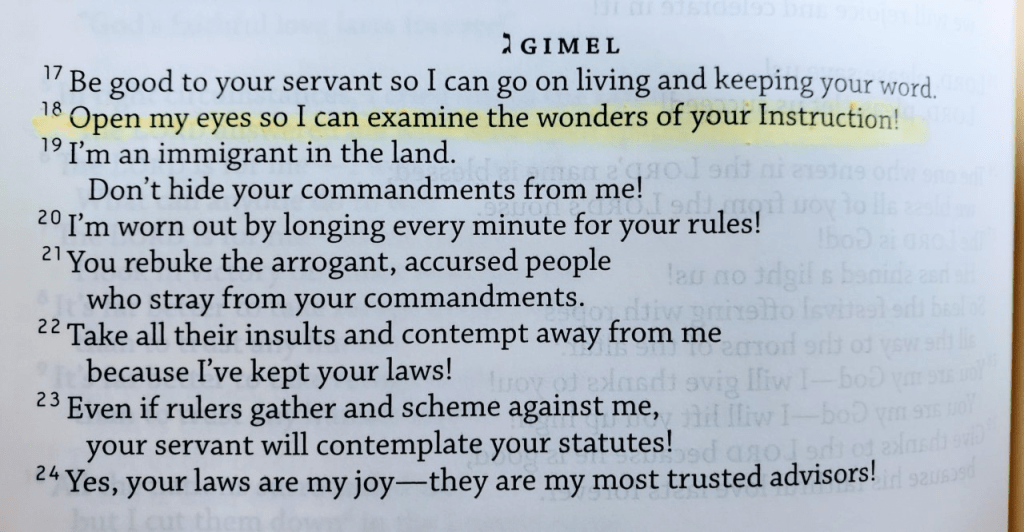
ג Gimel

Be good to your servant while I live,
    that I may obey your word.
Open my eyes that I may see
    wonderful things in your law.
I am a stranger on earth;
    do not hide your commands from me.
My soul is consumed with longing
    for your laws at all times.
You rebuke the arrogant, who are accursed,
    those who stray from your commands.
Remove from me their scorn and contempt,
    for I keep your statutes.
Though rulers sit together and slander me,
    your servant will meditate on your decrees.
Your statutes are my delight;
    they are my counselors.

ד Daleth

I am laid low in the dust;
    preserve my life according to your word.
I gave an account of my ways and you answered me;
    teach me your decrees.
Cause me to understand the way of your precepts,
    that I may meditate on your wonderful deeds.
My soul is weary with sorrow;
    strengthen me according to your word.
Keep me from deceitful ways;
    be gracious to me and teach me your law.
I have chosen the way of faithfulness;
    I have set my heart on your laws.
I hold fast to your statutes, Lord;
    do not let me be put to shame.
I run in the path of your commands,
    for you have broadened my understanding. (New International Version)

The biblical psalms are one of my favorite places in the whole of Holy Scripture. I especially like Psalm 119 because it reminds me that I am not only saved from something, but I am also saved to something.

Genuine and real deliverance comes so that we can be free to love and serve God with our whole being. And Psalm 119 is there to help us know how to do just that.

Psalm 119 stretches for 176 verses as an acrostic to the Hebrew alphabet. Each Hebrew letter has its own 8 verse stanza, with each of those verses beginning with that letter. Unfortunately, of course, we lose this insight through translation.

One of the reasons the psalm was organized this way is because it was meant to be learned and memorized. In fact, the entire psalter was meant for public consumption – to be engrafted into the soul and hidden in the heart.

The wonders of Psalm 119 are, overall, a paeon of reverence and praise of God’s law. That’s because the Lord’s commands and instructions are an extension of the divine character. Laws of mercy and holiness are given to the people because God is merciful and holy.

Grace and law are not antithetical. They go together like a hand in a glove and rely upon each other. The hand of grace is what fills the glove of the law, and together, they extend divine help and direction to people in this fallen world of ours.

The heartfelt prayer of the psalmist is that the Lord would open his eyes so that he could see the wonders contained within God’s divine instructions for humanity.

“Open my eyes so I can truly see
the marvelous things in your law.”

Psalm 119:18, NET

This is a prayer for us, as well. Those who desire to please the Lord and walk in the way of God are continually seeking awareness of the divine all around them, insight into others, and understanding of self.

It is one thing to read the Bible, but it’s another thing altogether to understand it. The psalmist is asking for God to intervene on his behalf and remove anything and everything that would inhibit his ability to understand and discern God’s words and actions.

Insight, understanding, and application to life comes from dwelling in the Word. It is a process. A daily crumb will neither do to satiate our physical hunger nor our spiritual appetite.

Going days, even weeks, without ingesting God’s instructions will only lead to spiritual emaciation. It harms us and helps no one. Instead, we need to feed on Holy Scripture and savor every bite. Like the cow, we need to slowly chew and ruminate on Scripture so that it can be fully digested and become part of us.

I have memorized large chunks of the Bible over the years. The main reason my memory can call up so much Scripture is that I have read it, and continue to read it, over and over again. Even though I’ve read the Old Testament about one-hundred times and the New Testament in the neighborhood of three-hundred times, I still gain insight and understanding, seeing new and wondrous things.

I truly believe the Bible is an inexhaustible source of sage instruction and a continual fountain of wisdom. I’ll spend an eternity in heaven examining God’s Word and will never reach the height, depth, length, and breadth of it’s incredible, massive, and glorious precepts.

I am a strong advocate of straightforward readings of Scripture, over and over again. Although I encourage looking at devotionals, commentaries, and reflections (like this blog!) to help and encourage us, nothing can replace our constant and continual reading of the Bible.

The biblical Book of Psalms is the Church’s prayerbook. All 150 of them are meant to be used for every sort of life circumstance. Whether discouraged or anxious, joyful or confident, the psalms encompass the full range of the human condition – and Psalm 119 lets us know how central God’s instructions are to the life of God’s people.

So, read today’s psalm… several times. Let Scripture do it’s marvelous and wondrous work within you.

Blessed Lord, you caused all Holy Scriptures to be written for our learning. Help us so to wisely hear, read, mark, learn, and inwardly digest them so that by our patient reading of your holy Word, we may embrace and ever hold fast the blessed hope of everlasting life, which you have given us in our Savior Jesus Christ.

Ephesians 3:14-21 – A Prayer for Every Believer

A mosaic of the Apostle Paul in St Isaac’s Cathedral, St. Petersburg, Russia

For this reason, I fall on my knees before the Father, from whom every family in heaven and on earth receives its true name. I ask God from the wealth of his glory to give you power through his Spirit to be strong in your inner selves, and I pray that Christ will make his home in your hearts through faith. I pray that you may have your roots and foundation in love, so that you, together with all God’s people, may have the power to understand how broad and long, how high and deep, is Christ’s love. Yes, may you come to know his love—although it can never be fully known—and so be completely filled with the very nature of God.

To him who by means of his power working in us is able to do so much more than we can ever ask for, or even think of: to God be the glory in the church and in Christ Jesus for all time, forever and ever! Amen. (Good News Translation)

In Jesus Christ, the believer has been given incredible blessings – adoption into God’s family and belonging with God, redemption through Christ’s cross and experiencing freedom from the power of sin, and intimacy and help by means of God’s own Spirit.

Today’s New Testament lesson is a prayer of the Apostle Paul for the Church. After three chapters of describing who we are and what we have in Christ as Christians, he goes to prayer, asking that the new life we have in Christ will be pressed firmly into our heads and our hearts so that this reality of spiritual blessings will be practically realized for the believer.

Here’s a quick remedial grammar lesson: a “verb” expresses an action between two things; a “participle” or “participial phrase” is a word or group of words which help describe the action of the verb.

There are two main verbs Paul uses: “I ask (pray)” for God “to give.” The participles all explain or modify the action of pray and give. In other words, the following actions are what Paul deeply desires that God will do for us as believers in Jesus….

To Become Mighty Through the Spirit

God grants us all the blessings of being in Christ. We are delivered from sin, death, and hell so that we will live into God’s purposes for this new life of freedom.

We live into the Christian life, on a practical level, as our faith is strengthened, and our inner person becomes powerful. This is the Spirit’s work in us – to strengthen our spiritual spine so that we can bear and carry our cross in this life, despite whatever the adversity or difficulty.

We are not alone. The Spirit is with us always. God is present. The believer is never promised that life will be a bowl of cherries and that being a Christian is all rainbows and unicorns. However, the believer is assured that God will be with us through the trouble – which is why we need a strong and robust faith.

You set a table for me
    right in front of my enemies. (Psalm 23:5, CEB)

To Dwell In Christ Through Faith

The “heart” in the New Testament is a reference not to the physical muscle in our chest but the seat or center of our inner person.

Paul’s prayer is that God gives or plants the seeds of the gospel in the hearts of people. Those good seeds then take root and become anchored firmly in the soul. They grow and mature, producing a harvest of love.

Not only do those roots grow down and deep, but they also grow out and connect with all other believers everywhere.

To Grasp God’s Love in Christ Through the Spirit

Enjoying this mystical union with Christ and connection with Christians, we come to experientially grasp together the vast dimensions of God’s love for us. God’s love is a multiverse of blessing. In fact, an eternity in heaven will never reach the bottom or top of the God who is Love itself.

When God our Savior made his kindness and love for humanity appear, he saved us, but not because of anything we had done to gain his approval. Instead, because of his mercy he saved us through the washing in which the Holy Spirit gives us new birth and renewal. God poured a generous amount of the Spirit on us through Jesus Christ our Savior. (Titus 3:4-6, GW)

To be filled with all the fullness of Love, is to be filled thoroughly with God – because God is Love.

My dear friends, we must love each other. Love comes from God, and when we love each other, it shows we have been given new life. We are now God’s children, and we know him. God is love, and anyone who doesn’t love others has never known him. (1 John 4:7-8, CEV)

Conclusion

Prayer is a gift. Like a little child bursting into her daddy’s office at work and crawling up on his lap, so we have the wondrous privilege of coming to God without hindrance and asking for whatever we need and want.

And what God wants and enjoys hearing, is us asking for spiritual strength, faith, and love. Because it is these things which create a thriving inner person who blesses others.

May it be so, to the glory of God, for the edification of the Church, and in the proclamation of the gospel. Amen.