To Be, or Not to Be (Psalm 28)

Only you, Lord,
    are a mighty rock!
Don’t refuse to help me
    when I pray.
If you don’t answer me,
    I will soon be dead.
Please listen to my prayer
    and my cry for help,
as I lift my hands
    toward your holy temple.

Don’t drag me away, Lord,
    with those cruel people,
who speak kind words,
    while planning trouble.
Treat them as they deserve!
    Punish them for their sins.
They don’t pay any attention
    to your wonderful deeds.
Now you will destroy them
    and leave them in ruin.

I praise you, Lord,
    for answering my prayers.
You are my strong shield,
    and I trust you completely.
You have helped me,
and I will celebrate
    and thank you in song.

You give strength
    to your people, Lord,
and you save and protect
    your chosen ones.
Come save us and bless us.
Be our shepherd and always
    carry us in your arms. (Contemporary English Version)

Today’s Psalm, in the Revised Common Lectionary, is alongside the Old Testament story of Joseph and his brothers in the book of Genesis. While out caring for the vast flocks of sheep and goats, Joseph’s brothers hatched a cabal against their younger sibling. They tossed him into an empty cistern (a deep water well) and intended to leave him for dead.

But when a caravan came along, heading to Egypt, the brothers decided on yet another diabolical plan. So, they brought Joseph out of the cistern and sold him into slavery. And, if that weren’t enough, the hateful brothers kept rolling out the devious scheming by making it look like a wild animal killed Joseph, so that they could hide their shameful guilt from Jacob, their father.

So, we are invited to view the psalm from Joseph’s perspective of frustration and agony, crying out to God. Then, praising the Lord for listening and saving his life – even if it meant becoming a servant in a foreign country.

Although becoming a slave was certainly not an ideal situation, Joseph faced a desperate need, even death, and the Lord saved him from it. And Joseph was encouraged and emboldened by the reality that God was with him, no matter where, nor what the situation.

Joseph, along with the original craftsman of the psalm, David, gave praise to God for hearing their prayers. Whereas we may get lost in anger and want retribution, perhaps our orientation is best directed toward offering praise to God for being with us and saving us from certain death.

This raises several questions, at least for me, about being in situations where I experience being heard by God, protected from ultimate harm, yet still left between a-rock-and-hard-place:

  • Can I praise God just for being heard and listened to? 
  • Do I really need to be healed or delivered? Or do I actually need to be delivered from the need for deliverance? 
  • What if I don’t get everything I pray for? Am I expecting to receive something God never promised? 
  • Will I offer praise and thanksgiving, even if God is silent? 
  • Is my joy in a relationship with God either conditional, or unconditional?

William Shakespeare’s Hamlet (c.1601 C.E.) put the question this way: “To be, or not to be, that is the question.” Hamlet’s soliloquy went on to say:

“Whether ’tis nobler in the mind to suffer
The slings and arrows of outrageous fortune,
Or to take arms against a sea of troubles,
And by opposing end them? To die: to sleep;
No more; and by a sleep to say we end
The heartache and the thousand natural shocks
That flesh is heir to, ’tis a consummation
Devoutly to be wish’d. To die, to sleep;
To sleep: perchance, to dream: ay, there’s the rub;
For in that sleep of death what dreams may come
When we have shuffled off this mortal coil,
Must give us pause: there’s the respect
That makes calamity of so long life;
For who would bear the whips and scorns of time,
The oppressor’s wrong, the proud man’s contumely,
The pangs of despised love, the law’s delay,
The insolence of office and the spurns
That patient merit of the unworthy takes,
When he himself might his quietus make
With a bare bodkin [knitting needle]?”

Like Joseph left for dead in an empty cistern, Hamlet was miserable and burdened with a profound lack of power to change his circumstances. So, he reflected on life and death in a morbid and melancholy way. It’s not that Hamlet had suicidal ideation, as much as he meditated on what life truly is, and tried to find some meaning within it.

Unlike Joseph, Hamlet cannot find the courage to deal with his frustration and feels stymied with fear of the unknown. He became lost in the injustice of it all.

If we are blatantly honest with ourselves, we much too often have a particular outcome in mind that we want or expect God to do. 

Our hopes become tethered to God doing something extremely specific so that, if it does not come to pass, or does not come quickly, or doesn’t happen as we want, then discouragement, disillusionment, and even depression may settle down in our souls like a lead weight. 

Like Hamlet, we become lost in the shadows of our thinking and ponder some sort of escape.

So, here is another set of questions I am asking myself: 

  • If my adverse circumstances do not change, can I praise God anyway? 
  • Can I, like David, take joy in simply being heard? 
  • Can I find gratitude in all situations? 
  • Do I only express thanks and praise to God when things are going my way? 
  • Am I open to whatever God wants to do in my life, even if it is not what I would choose? 
  • Do I feel that I am above having to put up with the wickedness of this world? 
  • Am I expecting heaven on earth, or am I willing to suffer as Jesus did? 

I honestly believe the answers to those questions will largely determine the trajectory of our spiritual development, our emotional maturity, our mental thoughts, and our overall religious experience.

I praise you, O God, in the good and the bad, the easy and the difficult, the failures and the victories. You are Lord over all things. You are my strength and shield in every circumstance. When I am weak, then I am strong. I can do all things through Christ who strengthens me. Amen.

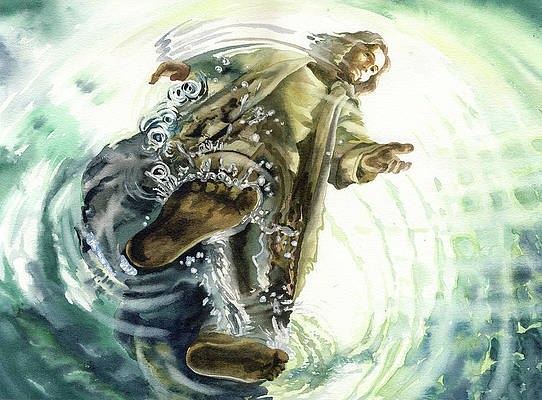
Walk on Water? Why? (Matthew 14:22-33)

Jesus Walks on Water, by Konstantin Alexejewitsch Korowin, 1890 

Immediately Jesus made the disciples get into the boat and go on ahead of him to the other side, while he dismissed the crowd. After he had dismissed them, he went up on a mountainside by himself to pray. Later that night, he was there alone,and the boat was already a considerable distance from land, buffeted by the waves because the wind was against it.

Shortly before dawn Jesus went out to them, walking on the lake. When the disciples saw him walking on the lake, they were terrified. “It’s a ghost,” they said, and cried out in fear.

But Jesus immediately said to them: “Take courage! It is I. Don’t be afraid.”

“Lord, if it’s you,” Peter replied, “tell me to come to you on the water.”

“Come,” he said.

Then Peter got down out of the boat, walked on the water and came toward Jesus. But when he saw the wind, he was afraid and, beginning to sink, cried out, “Lord, save me!”

Immediately Jesus reached out his hand and caught him. “You of little faith,” he said, “why did you doubt?”

And when they climbed into the boat, the wind died down. Then those who were in the boat worshiped him, saying, “Truly you are the Son of God.” (New International Version)

In the New Testament Gospels, we see Jesus for who he is – Son of God and true Sovereign of the universe – seeking to reconcile people to God through his life, miracles, and teaching. In the Gospels we also see Christ’s disciples for who they are – a rag-tag bunch who express both belief and doubt, and experience both faith and failure.

The reality of the Christian life is that it is a sort of three-steps-forward and two-steps-backward kind of experience. The expectation that we will “succeed” and have everything go hunky-dory each time we step out in faith, is far from how things actually work in both the world and in God’s kingdom. Doubt and failure are important experiences for the believer in Jesus.

Without failure, there is no Christian life. Why? Because it means we are still in the boat.

It’s evidence that we never left the safety of established routines and responded to God’s command to step out of our comfort zone, and boldly go where we’ve never gone before.

Our failures may, like Peter, be colossal bellyflops. Yet, Jesus is there – extending grace to Peter and helping him, even in his failure of faith. Failure does not define us; it isn’t our identity. Jesus is Lord over everything, including storms, hardship, and trouble. 

Yes, there are a lot of scary things in life. Learning to ride a bike was scary. Driving for the first time on an icy road was scary. Getting married and having kids was scary. Admitting a fault, mistake, or weakness is scary. Being vulnerable with another person is scary.

It can even be scary to be at church. Why? Because we might fail, and it may crush us.

The fear of failure, however, need not control our lives. Why? Because grace overcomes everything.

We all find ourselves, at times, caught midway between faith and doubt. But to know this situation is to experience grace. If the worst scenario you worry about in your head would actually come to pass, it will still never change the reality that God loves you! And it will not stop Jesus from extending his hand to you in a life-saving grip of grace. 

Fear melts away when we keep our eyes on Jesus. So, we must focus on Christ, instead of fixating on the waves around us. The truth sets us free. Therefore, let’s notice five truths about Jesus that help us overcome the fear of failure and embrace a life of faith.

1. Jesus is a person of prayer

Jesus was deeply dependent on his heavenly Father. His life exhibited the necessities of simple prayer and obedience. If Jesus found the need for solitude and prayer for his life and ministry, how much more to we need it!? 

The Lord had his disciples get into the boat and go out on the lake. Jesus knew they were about to face a storm. The boat ended up getting thrown around by the waves. Even though the disciples were doing God’s will by going out on the lake, they were not spared from adversity.  

Jesus wanted his disciples to experience the storm. Why? Because it is through the storm that we learn faith.  

Faith is developed through experience and adversity. Faith that never endures distress, never grows and matures. Faith must be exercised – and if it isn’t, it atrophies and becomes useless. 

Show me a person with great faith, and I’ll show you a person that has gone through a boatload of adversity and hurt, having allowed Jesus to grace them with healing.

2. Jesus is present with us, and this presence brings an end to fear

Being in the middle of a lake during a storm did not prevent Jesus from being present with the disciples – he just walked on the water to be with them. Even though the disciples had just participated in the miracle of Jesus feeding the five thousand, another miracle was not on their radar – which is why they did not recognize Jesus and were afraid when they saw him.

While afraid, we don’t see Jesus, even when he’s right in front of our faces. Why? Because we don’t expect him to be there and mistake him for a ghost.  

When the disciples cried out in fear, Jesus responded. I used to have a factory job, training workers. When the training was completed, I had the trainees evaluate our time together. The top response I received is that my presence helped them to learn their job – the freedom to fail time and time again without judgment. Having me there to rescue them, when things got too much, built confidence that they could do it on their own.

3. Jesus desires those who follow him to imitate him

Jesus walked on water. Jesus invited Peter to walk on water. Peter was not chided by Jesus for getting out of the boat, but for doubting that he could continue in the miracle that was happening. 

Jesus isn’t merely interested in disciples being able to regurgitate his teaching. Why? Because he wants us to exercise our learning through actual deeds of faith.  

Once the command of Jesus was given to Peter, “Come”, then walking on water became only a matter of trust.

“Christianity has not been tried and found wanting. It has been found difficult and left untried.”

G.K. Chesterton

We understandably get nervous when a crazy Jesus and an unpredictable Holy Spirit call us to change by getting out of the friendly confines of the boat. Why? After all, we might fail. 

However, it is at those times that we bank on God’s Word and promises. The Apostle James said that if we find ourselves lacking wisdom to deal with the unpredictable and unknowable, we are to ask God who gives generously to all without finding fault and will be given to us. (James 1:5)

Christ Walking on the Sea, by Natali Fedorova

Peter responded to his predicament by crying out to Jesus, “Lord, save me!” Jesus immediately reached out and saved Peter from his own doubt and lack of faith. Jesus called Peter a “little-faith.”

Many people have lived too long with the notion that God is some stern angry deity who is constantly displeased with sinful people, and that only through perfection will God ever be happy with us. The truth is that Jesus wants us to imitate him; and, when we fail, he is there to pick us up. 

4. Jesus has the authority to settle the storm when he is ready to do it

Jesus is King. Christ is Sovereign of the world. He will bring the crisis to an end according to his own good pleasure and good timing. Rather than spending all our emotional capital by worrying or conniving to get out of a situation, we can trust God and keep our eyes on Jesus.  Our job is to believe; God’s job is everything else.

5. Jesus’ power led the disciples to acknowledge who he is

Worship happens when we see Jesus as he really is, the Son of God. Flat, dull, boring worship comes from flat, dull, boring Christians who are unable to see the power of Jesus in their lives. We discover the power of God when we are in a situation which requires God’s strength to deliver us. Grasping Jesus as the Son of God is more than a verbal confession of faith; it is being able to trust him, like getting out of a boat in the middle of a lake.

We are to live by faith in the Son of God who loved us and gave himself for us (Galatians 2:20). It doesn’t require much faith to pray that Aunt Mable’s bunions will feel better. It only requires a little faith to give a dollar when you have ten dollars. It takes no faith to discuss the weather and steer clear of hard conversations.

But it does require faith:

  • to pray for a miraculous healing every day without giving up for a little boy who is racked by epilepsy, and trust God to spare his life
  • to write a check for $100 to someone in need when you have exactly $100 in your checking account, and trust God to provide for you own necessities. 
  • to go off the grid of the routine schedule to have a difficult discussion about social justice, and trust God to act on Christ’s teachings. 
  • to live as though the mission of God in this world is the most important thing we could ever do, and trust God to step out and do it.

It would be great if we could pray and act without ever doubting or failing, yet the only way to do that is to never step out of the boat. Instead, live life. Trust God. And see what happens.

Holy God, help us, your people, to embrace the life that is truly life by stepping out of the boat.  May Jesus define our lives instead of letting failure define us. May we accept the grace that is ours in Jesus Christ our Lord, in whose name we are bold to pray. Amen.

Dealing with Hate (Genesis 37:5-11)

One night Joseph had a dream, and when he told his brothers about it, they hated him more than ever. “Listen to this dream,” he said. “We were out in the field, tying up bundles of grain. Suddenly my bundle stood up, and your bundles all gathered around and bowed low before mine!”

His brothers responded, “So you think you will be our king, do you? Do you actually think you will reign over us?” And they hated him all the more because of his dreams and the way he talked about them.

Soon Joseph had another dream, and again he told his brothers about it. “Listen, I have had another dream,” he said. “The sun, moon, and eleven stars bowed low before me!”

This time he told the dream to his father as well as to his brothers, but his father scolded him. “What kind of dream is that?” he asked. “Will your mother and I and your brothers actually come and bow to the ground before you?” But while his brothers were jealous of Joseph, his father wondered what the dreams meant. (New Living Translation)

We need to talk about hate, and it’s wicked stepsisters jealousy and disrespect.

In the ancient world, the oldest son was usually the one favored by parents. The eldest child would typically grow up to lead the family and inherit the largest share of the family resources. Joseph and Benjamin were two sons born to Jacob and Jacob’s favored wife, Rachel (Genesis 30:22-24). They were the youngest of Jacob’s twelve sons.

Jacob loved Joseph more than any other of his children (Genesis 37:3). To make things even more complicated, Jacob made his affection for the seventeen-year-old Joseph very public by giving Joseph a special long multi-colored robe. Not surprisingly, the other brothers hated him. 

“Joseph’s Dreams” by Susan Govatos

From the brothers’ perspective, Joseph added insult to injury by sharing a dream of his, implying that all of them would one day bow down to him. Dreams were significant in the ancient world; they were understood to be one way the divine realm could communicate with humans. But all this only made Joseph’s brothers hate him more than they already did.

Unfortunately, as the story unfolds further into Genesis, Joseph’s brothers take their sibling rivalry to a diabolical level. And it’s all fueled by their hatred and jealousy.

We all can relate to feelings of hatred and jealousy toward another. They can overwhelm us. So, what do we do when these big emotions come upon us?

  1. Consider your thoughts. If you find that you’ve been engaging in an all-or-nothing thought or a generalization, consider what a more balanced thought might be. Instead of saying, “He’s a total jerk,” consider instead, “I don’t like what he did to me” as an alternative. This approach typically makes the difference between health and sickness. A peaceful heart leads to a healthy body; jealousy is like cancer in the bones. (Proverbs 14:30, NLT)
  2. Pause for a moment and be curious about whether what you’re telling yourself about the other person or group is accurate. Crowds came from the villages around Jerusalem, bringing their sick and those possessed by evil spirits, and they were all healed. The high priest and his officials, who were Sadducees, were filled with jealousy. They arrested the apostles and put them in the public jail. (Acts 5:15-18, NLT)
  3. Lead with empathy and compassion if you feel hatred toward a person or group. Empathy is the ability to understand and share the feelings of another. Compassion is engaging in an act of kindness. If you come upon your enemy’s ox or donkey that has strayed away, take it back to its owner. If you see that the donkey of someone who hates you has collapsed under its load, do not walk by. Instead, stop and help. (Exodus 23:4-5, NLT) “But to you who are willing to listen, I say, love your enemies! Do good to those who hate you. Bless those who curse you. Pray for those who hurt you.” (Luke 6:27-28, NLT)
  4. Talk to God instead of bottling up your feelings. Many people believe that ignoring their emotions will make them disappear, but in reality, it’s quite the opposite. Rather than going away, unaddressed emotions build up and intensify over time. Praying to the Lord and crying out to God are therapeutic. Rescue me from the mud; don’t let me sink any deeper! Save me from those who hate me, and pull me from these deep waters. (Psalm 69:14, NLT)
  5. Receive God’s love and kindness. We cannot give that which we have not first received. Once we, too, were foolish and disobedient. We were misled and became slaves to many lusts and pleasures. Our lives were full of evil and envy, and we hated each other. But when God our Savior revealed his kindness and love, he saved us, not because of the righteous things we had done, but because of his mercy. He washed away our sins, giving us a new birth and new life through the Holy Spirit. (Titus 3:3-5, NLT)

If we spend a disproportionate amount of time hating someone in our heart, have difficulty focusing on other things because of jealousy, or consider disrespecting another to the point of violence, then we need help; we cannot handle this alone.

Seeking help to resolve hatred doesn’t mean that there’s mental illness going on. Everyone experiences hatred at some point in their lives. Allowing God and others to help is a rational, responsible, and courageous act.

Almighty God, from whom all thoughts of truth and peace proceed: kindle, we pray, in the hearts of all, the true love of peace and guide us with your pure and peaceable wisdom, so that your kingdom may go forward on this earth, filled with the knowledge of your love; through Jesus Christ your Son our Lord, who is alive and reigns with you, in the unity of the Holy Spirit, one God, now and forever. Amen.

Anxious (Genesis 32:3-21)

Jacob praying for deliverance from his brother Esau, by Gustave Doré (1832-1883)

Jacob sent messengers on ahead to Esau, who lived in the land of Seir, also known as Edom. Jacob told them to say to Esau, “Master, I am your servant! I have lived with Laban all this time, and now I own cattle, donkeys, and sheep, as well as many slaves. Master, I am sending these messengers in the hope that you will be kind to me.”

When the messengers returned, they told Jacob, “We went to your brother Esau, and now he is heading this way with 400 men.”

Jacob was so frightened that he divided his people, sheep, cattle, and camels into two groups. He thought, “If Esau attacks one group, perhaps the other can escape.”

Then Jacob prayed:

You, Lord, are the God who was worshiped by my grandfather Abraham and by my father Isaac. You told me to return home to my family, and you promised to be with me and make me successful. I don’t deserve all the good things you have done for me, your servant. When I first crossed the Jordan, I had only my walking stick, but now I have two large groups of people and animals. Please rescue me from my brother. I am afraid he will come and attack not only me, but my wives and children as well. But you have promised that I would be a success and that someday it will be as hard to count my descendants as it is to count the grains of sand along the seashore.

After Jacob had spent the night there, he chose some animals as gifts for Esau: 200 female goats and 20 males, 200 female sheep and 20 males, 30 female camels with their young, 40 cows and 10 bulls, and 20 female donkeys and 10 males.

Jacob put servants in charge of each herd and told them, “Go ahead of me and keep a space between each herd.” Then he said to the servant in charge of the first herd, “When Esau meets you, he will ask whose servant you are. He will want to know where you are going and who owns those animals in front of you. So tell him, ‘They belong to your servant Jacob, who is coming this way. He is sending them as a gift to his master Esau.’ ”

Jacob also told the men in charge of the second and third herds and those who followed to say the same thing when they met Esau. And Jacob told them to be sure to say that he was right behind them. Jacob hoped the gifts would make Esau friendly, so Esau would be glad to see him when they met. Jacob’s men took the gifts on ahead of him, but he spent the night in camp. (Contemporary English Version)

Anxiety’s a booger. It arises as an unwanted guest within our psyche, putting pressure on our chest, and becoming a squatter in the pit of our gut. To be anxious is to have a vague sense of dread, anticipating some upcoming threat.

Jacob knew the feeling well. His mind raced with thoughts of what might happen and how to placate Esau when he encountered his brother. Jacob left home two decades earlier to escape Esau’s vengeance. Now their meeting up was imminent. Jacob was scared spitless.

What do you do when distress and dread wrap you in a straitjacket of anxiety?

Avoid avoidance

The only way to deal with fear is to face it. Avoiding it prevents us from moving forward. It makes us anxious.  One way of facing your fear and/or anxiety is to name it. When fear, anxiety, terror, apprehension, or distress arises, then name it. In naming our fears and anxieties, they become real and, thus, manageable. 

“Every time your fear is invited up, every time you recognize it and smile at it, your fear will lose some of its strength.”

Thict Nhat Hanh (1926-2022)

Another way to face fear is to “sit with it” for a short while. Give yourself permission to feel the anxiety for a set amount of time without judgment or trying to get over it. Pay attention to where you are carrying your anxiety in your body.

Focus on what’s within your control

We cannot control other people. There’s no way Jacob was going to control or manipulate his brother Esau. Many circumstances are outside our control. And yet, we always have the choice of self-control. Giving into addictions, or not facing problems are ways of giving up control of ourselves. Taking good care of ourselves, and focusing on good attitudes are ways of strengthening personal control.

The Serenity Prayer is a good reminder in those times when we feel out of control:

God, grant me the serenity to accept the things I cannot change,

The courage to change the things I can,

And the wisdom to know the difference.

Promote a positive mindset

Positive attitudes help us widen our perspective on things – and with a broader view of things comes more awareness of choices. Making wise choices for ourselves now, builds resilience and fortifies us for difficult situations down the road – without succumbing to old unhealthy coping mechanisms.

Find purpose and meaning in life

Experiencing traumatic events might cause us to question whether our lives have meaning, or not. We may feel unnecessary or expendable, and see no meaning for the future. 

So, it’s important to discover or reconnect with the spirituality within you. Take the time and energy to read Scripture, walk through nature, or discuss matters of the spirit with others. Just as our physical spine helps to support us and is not optional, so we also have a spiritual spine that needs attention for which we cannot live without.

Get support

Other people, like trusted friends and family, can help us make a realistic assessment of the fear and anxiety we are experiencing. With the support of others, we become more confident that we can deal with issues. Finding a church or some other religious gathering can be a fresh means of emotional support.

You are not alone. We are all in this life together. So, let’s rely upon one another and not believe that we just need to pull up ourselves out of impending trouble. There is a God (and God’s people) who are ready to help, if but we just ask.

O God, preserve us from faithless fears and worldly anxieties, and grant that no clouds of this mortal life may hide from us the light of that love which is immortal, and which you have manifested to us in your Son, Jesus Christ our Lord. Amen.