Our Place in the World (Psalm 8)

Lord, our Lord,
    how majestic is your name in all the earth!

You have set your glory
    in the heavens.
Through the praise of children and infants
    you have established a stronghold against your enemies,
    to silence the foe and the avenger.
When I consider your heavens,
    the work of your fingers,
the moon and the stars,
    which you have set in place,
what is mankind that you are mindful of them,
    human beings that you care for them?

You have made them a little lower than the angels
    and crowned them with glory and honor.
You made them rulers over the works of your hands;
    you put everything under their feet:
all flocks and herds,
    and the animals of the wild,
the birds in the sky,
    and the fish in the sea,
    all that swim the paths of the seas.

Lord, our Lord,
    how majestic is your name in all the earth! (New International Version)

I adore the psalms. Many years ago, it was the biblical psalter which helped me come to faith. This little psalm for today is illustrative of why I was moved toward embracing a life with God. Psalm 8 grounds us by dealing with the ultimate questions of human existence:

  • Who am I?
  • Why do I exist?
  • What is the purpose of life?

The answers to those questions are supremely important because people throughout history, and now across the world, are asking what meaning their lives really have.

For example, depression is pervasive throughout the world, as well as the church. It’s a huge issue. Peeling back the layers of a person’s life, many have a deep sense of not truly belonging, and of being profoundly misunderstood by others. Many depressed persons are very aware of their own mortality and have a disconnected sense of their personal role in the world.

Put another way, some folks have lost their original purpose of being a person, that they belong to the human family in a way that makes a significant contribution to the world.

Living on such a big planet causes some people to feel small and wonder how they fit in. With such a large universe, which may at times seem cold and capricious, we may ask, along with psalmist, “What is humanity that you are mindful of them?”

That question forms the center of the psalm. Hebrew poetry is typically set up to have the front and the end of the poem point to the middle where the chief focus is found. So then, the psalmist purposely wrote this psalm so we would consider this great question of what God thinks of humanity within the scope of this immense universe.

And it is a staggeringly huge universe! To put it in perspective, if our galaxy, the Milky Way, were the size of the entire continent of North America, our solar system would fit in a coffee cup.

Even now, two Voyager spacecraft are hurtling toward the edge of the solar system at a rate of 100,000 miles per hour. For decades they have been speeding away from Earth, having now traveled billions of miles. When engineers beam a command to the spacecraft at the speed of light, it takes over half a day to arrive.

Yet this vast neighborhood of our sun—in truth, the size of a coffee cup—fits along with several hundred billion other stars and their planets in the Milky Way, one of perhaps 100 billion such galaxies in the universe. To send a light-speed message to the edge of that universe would take 15 billion years.

Out of the billions of galaxies in the universe, what is the planet Earth that God should care about it? 

Even on our planet there are billions of creatures. Yet, of all those bugs, animals, fish, and birds, God has a special relationship with us, humanity, and cares for us deeply. We know that God cares for us, according to this psalm, because he has entrusted us with the responsibility to care for creation.

We are the only creatures who have the charge to steward all that God has created. As people created in the image of God, we have a job that is befitting of a king. We are God’s vice-regents, in charge of tending and caring for all creation. This incredible job is both a duty and a delight.

God has us playing a crucial role in governing and caring for the world he created. Like a parent or grandparent patiently working with a child to teach them responsibility for all that is around them, God teaches us, and has entrusted to us, this large expansive world we live in. Literally everything in all creation is under our stewardship.

People alone have the self-awareness and perspective of the world that is needed to govern the world. Therefore, we can only find our true purpose and belonging in the stewardship of creation. Caregiving is at the heart of being a person.

The only glitch to all this, and why so many lose their way, is that the world is still living under a curse due to the original fall of humanity.

When we allow other dominions to supersede God’s dominion, then we have issues. Whenever the power of money or the significance of a position, job title, or the ability to do certain tasks is our basic identity and place of belonging, then we will likely succumb to anxiety. That’s because other dominions cannot help us find our true God-given majesty as people created in God’s image.

Living a way other than being a proper steward of the world is beneath us because we have inherent dignity as God’s vice-regents over creation.

Mother Teresa once said that there is no such thing as a small thing – only small things which are done with big love. Her sentiment perfectly captures the vision of the psalmist – that all people are crowned with glory and honor and rule with God to do all the small things of life with a love that comes from our Creator.

We continually have possibilities of engaging in good stewardship of all that God has given us. We have the chance to be attentive to all the little things of life, whether gardening, building a bird house, working with diligence and care at our jobs, or keeping our community clean and its citizens healthy and happy – it’s all important. It brings meaning to our existence as human beings.

People, like all creation, are meant for growth. Putting effort into developing our skills and honing our craft, whatever that may be, is what helps us tap into our God-given purpose for being in this big world.

So, may we continually improve what we do, no matter what it is, so that it befits us as God’s people crowned with honor. May we realize joy and contentment – knowing the majesty we share with God in his wondrous world. 

Almighty God, Creator of the heavens and the earth, words are not enough to express your awesome majesty. Our highest expressions of theology are but baby talk next to you.

Grant us awareness through your Spirit that you are here with us. May this awareness lead us to approach life carefully. The words we speak, the songs we sing, the thoughts we think, the joy and sadness we feel – may it all be pleasing to you, O Lord.

For, despite the inadequacy of our words and actions, our life and worship are addressed to you alone. May you make that life complete, whole, and full to overflowing through Jesus Christ, your Son, our Lord, who with you and the Holy Spirit lives and reigns forever.  Amen.

Give Thanks and Praise (Luke 17:11-19)

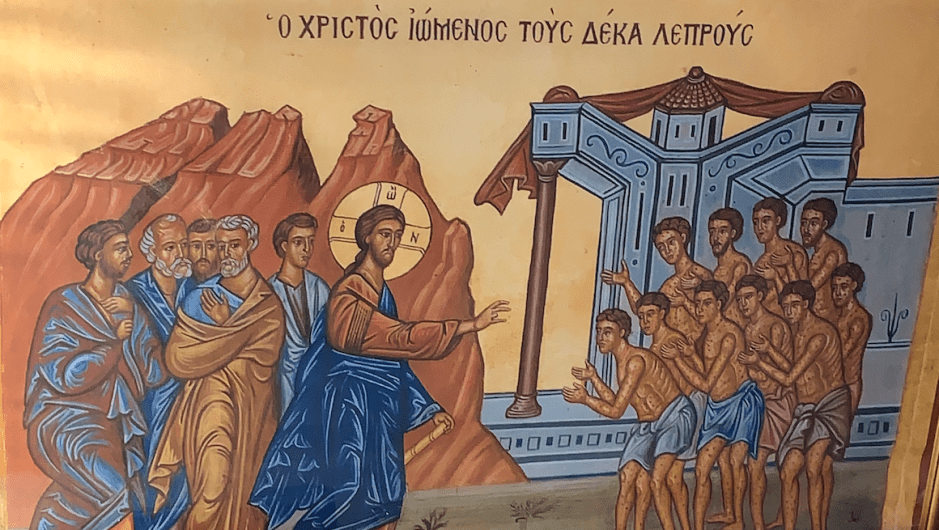
Eastern Orthodox depiction of Jesus Christ healing the ten lepers

Now on his way to Jerusalem, Jesus traveled along the border between Samaria and Galilee. As he was going into a village, ten men who had leprosy met him. They stood at a distance and called out in a loud voice, “Jesus, Master, have pity on us!”

When he saw them, he said, “Go, show yourselves to the priests.” And as they went, they were cleansed.

One of them, when he saw he was healed, came back, praising God in a loud voice. He threw himself at Jesus’ feet and thanked him—and he was a Samaritan.

 Jesus asked, “Were not all ten cleansed? Where are the other nine? Has no one returned to give praise to God except this foreigner?” Then he said to him, “Rise and go; your faith has made you well.” (New International Version)

Today’s Gospel story is both joyous and sad. The healing of ten lepers is astonishing and elicits praise and thanks… from only one. Maybe it’s because they stood at a distance. After all, it’s a close connection to God which causes praise and gratitude to arise within us – and not some appreciation from afar. Therefore, methinks we ought to consider what the nature of our own connection is. 

“Thanksgiving” to most Americans is Thanksgiving Day – a holiday filled with food, football, and family, the trifecta of American celebration. I myself admit to liberally indulging in all three. Although Thanksgiving has become a form of secular liturgical worship, I believe that underneath all the gravy, naps at halftime, and the occasional obnoxious relative, we know why we celebrate: To praise God and give thanks for our abundant blessings. 

It seems that even those who do not readily acknowledge the Divine intuitively know there is a power and source of blessing well beyond themselves which makes all good things occur.

Celebrations are a spiritual activity. God invented parties. When Israel was preparing for a new national life in the Promised Land, God told them to celebrate the Feast of Harvest with the first fruits of the crops (Exodus 23:16). The Levitical law prescribed how to go about giving thanksgiving offerings and offering praise (Leviticus 7:11-34).

Gratitude and praise was commanded, expected, and an important dimension of Old Testament worship. King David established a group of 288 full-time musicians to do nothing but praise and give thanks before God day and night (1 Chronicles 25).

Let us come into his presence with thanksgiving; let us make a joyful noise to him with songs of praise!

Psalm 95:2, NRSV

Enter his gates with thanksgiving
    and his courts with praise.
    Give thanks to him; bless his name.

For the Lord is good;
    his steadfast love endures forever
    and his faithfulness to all generations. (Psalm 100:4-5, NRSV)

It ought to have been reflexive for all ten lepers healed by Jesus to offer their worship to Jesus. A Samaritan, considered by many of the time as the lowliest of the low, a “half-breed,” was the lone person who came and fell at Christ’s feet with effusive praise and heartfelt gratitude. While the other nine went about their lives, free from disease and glad for it, only one guy took the time to thank Jesus and give glory to God. 

The Samaritan leper alone gives thanks to Christ, by Unknown artist

Sometimes we need to be reminded that celebration is a spiritual practice. It’s important to celebrate Jesus and for the ways God has provided and blessed us. In Holy Scripture, it is often the homeless, the sick, the lowly, and the outsiders who lead the way and demonstrate what genuine praise and honest thanksgiving looks like.

We, the Church, who belong to God and possess the Spirit, are to always remember and be mindful of what we truly have in Jesus Christ:

So then, just as you received Christ Jesus as Lord, continue to live your lives in him, rooted and built up in him, strengthened in the faith as you were taught, and overflowing with thankfulness. (Colossians 2:6-7, NIV)

We, like King David of old, are to establish continual worship of God:

Rejoice always, pray continually, give thanks in all circumstances; for this is God’s will for you in Christ Jesus.

1 Thessalonians 5:16-18, NIV

Our sacrifice as Christians is not with the blood of animals but with our lips and our lives:

Through Jesus, therefore, let us continually offer to God a sacrifice of praise—the fruit of lips that openly profess his name. (Hebrews 13:15, NIV)

And the worship service is eternal; it will never end:

And the twenty-four elders, who were seated on their thrones before God, fell on their faces and worshiped God, saying:

“We give thanks to you, Lord God Almighty,
    the One who is and who was,
because you have taken your great power
    and have begun to reign.” (Revelation 11:16-17, NIV)

Praising God and giving thanks to the Lord go together like mashed potatoes and gravy. Since God created everything, and since Jesus has brought healing to us through the cross, every juicy morsel of goodness we have is to be received with the full cognizance that God is behind it all.

Our lives need to be punctuated with times of celebration, praise, gratitude, and even blowout parties. Otherwise, we become dull, boring, lifeless, and bereft of Christ’s lifeblood coursing through our spiritual veins. A joyous and raucous group of healed believers jabbering incessantly with thanksgiving of God’s goodness are winsome and peculiar (in a good way and not in the strange way of your weird uncle who wants the turkey neck to gnaw on at the Thanksgiving meal).

Seems to me that Christians really ought to be at the forefront of having maximum fun because we are forgiven people; we know and experience the presence of God; our lives are hidden with God in Christ; we are confident and can approach the throne of God with boldness; and we possess the power of the Spirit and the shepherding ministry of Jesus.

Remember to give thanks. Plan to praise – out loud and with others – for the God who stands behind every good gift of creation. Let thanksgiving (not complaint) shape your life. Be the person who comes back to Jesus and offers praise and gratitude – and see how such gratefulness and glory can change the world.

Gracious God, Father of all mercies, we your unworthy servants give you humble thanks for all your goodness and steadfast love to us and to all whom you have made. We bless you for our creation, preservation, and all the blessings of this life; but above all praise you for your immeasurable love in the redemption of the world by our Lord Jesus Christ; for the means of grace, and for the hope of glory.

Give us such an awareness of your mercies, that with truly thankful hearts we may show forth your praise, not only with our lips, but in our lives, by giving up ourselves to your service, and by walking before you in holiness and righteousness all the days of our lives, through Jesus Christ our Lord, who with you and the Holy Spirit, be honor and glory throughout all ages and forevermore. Hallelujah! Amen!

Revelation 19:1-8 – The Time Is Coming

Photo by Andrea Piacquadio on Pexels.com

After this I heard what sounded like the roar of a large crowd of people in heaven, saying, “Praise God! Salvation, glory, and power belong to our God! True and just are his judgments! He has condemned the prostitute who was corrupting the earth with her immorality. God has punished her because she killed his servants.” Again, they shouted, “Praise God! The smoke from the flames that consume the great city goes up forever and ever!” The twenty-four elders and the four living creatures fell down and worshiped God, who was seated on the throne. They said, “Amen! Praise God!”

Then there came from the throne the sound of a voice, saying, “Praise our God, all his servants and all people, both great and small, who have reverence for him!” Then I heard what sounded like a crowd, like the sound of a roaring waterfall, like loud peals of thunder. I heard them say, “Praise God! For the Lord, our Almighty God, is King! Let us rejoice and be glad; let us praise his greatness! For the time has come for the wedding of the Lamb, and his bride has prepared herself for it. She has been given clean shining linen to wear.” (The linen is the good deeds of God’s people.) (Good News Translation)

The past few years, it seems as if the world is upside-down. For many people, living on this earth has become something of a surreal experience of folks dying apart from loved ones, racism rearing its ugly head through microaggressions, as well as overt words and actions, and neighbors killed due to gun violence. The suffering is palpable.

However, things will not always be this way. There is coming a time when disease, death, and poverty will end. In the age to come there will be no more numbing grief, seemingly endless tears, constant oppression, grinding hardship, and silent suffering.

The day will arrive when, together with all saints past and present, and along with the angelic host, we will collectively shout, “Hallelujah!” The end of this present age will eventually come.

Time is nothing more than the relationship between events. When all events are ended, there will be no more time – only unending eternity in the presence of God. For the Christian, this is our hope and ultimate salvation. Our deliverance from sin, death, and hell will be complete.

So, we wait and watch, preparing ourselves for the consummation of God’s kingdom. Meanwhile, we are truly in an awkward time between the two advents of Christ. It is the already/not yet time. We are already saved, yet not fully; we are holy, yet not completely; we have our adoption papers as children of God, yet still wait for our celebration feast with Christ.

There are few times more impatient, agonizing, joyful, and hopeful than a marriage engagement. It’s as if two people are inextricably connected but not yet completely together.

I still remember the weird feeling of the six months between my engagement to my heart’s love and standing at the altar marrying my bride. Those months included every emotion imaginable, from exuberant happiness to agonizing waiting, along with hopeful anticipation and sheer nervousness.

It was a time, for me, of unique joy and unwanted suffering. Since I was separated by two-thousand miles from my beloved for most of our engagement, it was an unparalleled longing for the marriage to occur.

That is likely how believers have felt throughout the ages as they look forward to the second coming of Christ. In a period of hardship and even persecution, Christians long for their Savior – to be with Jesus forever and be shed of the world’s crud, the sinful nature, and the machinations of the devil.

In this present age, we have received the Holy Spirit as a sort of engagement ring, a constant sign and presence to help us until the marriage happens with Christ as groom and the Church as bride. Since we have not yet experienced this, it is difficult for us to anticipate just how incredible and inconceivable the coming age will be.

Yet, the Christian intuitively knows, by means of the Spirit, that the upcoming marriage supper will be a heavenly paradise – and so we long for it, especially in these days of uncertainty and difficulty.

Presently, the great harlot attempts to seduce the believers, if that were possible, away from Christ. However, along with all God’s holy angels, we will join in the heavenly chorus which continually sings, “Praise God!” to Father, Son, and Spirit.

The book of Revelation describes the end of history for the purpose of encouraging the saints of God in the present moment of hardship. God will, once and for all, destroy evil, and faithful believers will be united with Christ forever in glory.

So, as we plod through the Christian season of Lent, we do so with the anticipation and hope of Easter and new life. Because Jesus is risen from death, we gaze into the future longing for our own resurrection. Presently, we hold both suffering and glory together, the past and the future.

For it is the past redemptive deeds of Christ which guide us in the present and gives shape to our future. Christ shall return – and it will be soon.

Even so, come, Lord Jesus. Amen.

2 Chronicles 20:1-22 – Praying in Desperate Times

Photo by cottonbro on Pexels.com

The armies of Moab and Ammon, together with the Meunites, went to war against Jehoshaphat. Messengers told Jehoshaphat, “A large army from Edom east of the Dead Sea has invaded our country. They have already reached En-Gedi.”

Jehoshaphat was afraid, so he asked the Lord what to do. He then told the people of Judah to go without eating to show their sorrow. They immediately left for Jerusalem to ask for the Lord’s help.

After everyone from Judah and Jerusalem had come together at the Lord’s temple, Jehoshaphat stood in front of the new courtyard and prayed:

You, Lord, are the God our ancestors worshiped, and from heaven you rule every nation in the world. You are so powerful that no one can defeat you. Our God, you forced out the nations who lived in this land before your people Israel came here, and you gave it to the descendants of your friend Abraham forever. Our ancestors lived in this land and built a temple to honor you. They believed that whenever this land is struck by war or disease or famine, your people can pray to you at the temple, and you will hear their prayer and save them.

You can see that the armies of Ammon, Moab, and Edom are attacking us! Those are the nations you would not let our ancestors invade on their way from Egypt, so these nations were not destroyed. Now they are coming to take back the land you gave us. Aren’t you going to punish them? We won’t stand a chance when this army attacks. We don’t know what to do—we are begging for your help.

While every man, woman, and child of Judah was standing there at the temple, the Lord’s Spirit suddenly spoke to Jahaziel, a Levite from the Asaph clan. Then Jahaziel said:

Your Majesty and everyone from Judah and Jerusalem, the Lord says that you don’t need to be afraid or let this powerful army discourage you. God will fight on your side! So, here’s what you must do. Tomorrow the enemy armies will march through the desert around the town of Jeruel. March down and meet them at the town of Ziz as they come up the valley. You won’t even have to fight. Just take your positions and watch the Lord rescue you from your enemy. Don’t be afraid. Just do as you’re told. And as you march out tomorrow, the Lord will be there with you.

Jehoshaphat bowed low to the ground, and everyone worshiped the Lord. Then some Levites from the Kohath and Korah clans stood up and shouted praises to the Lord God of Israel.

Early the next morning, as everyone got ready to leave for the desert near Tekoa, Jehoshaphat stood up and said, “Listen my friends, if we trust the Lord God and believe what these prophets have told us, the Lord will help us, and we will be successful.” Then he explained his plan and appointed men to march in front of the army and praise the Lord for his holy power by singing:

“Praise the Lord!
    His love never ends.”

As soon as they began singing, the Lord confused the enemy camp. (Contemporary English Version)

King Jehoshaphat and Judah were about to be attacked. War was imminent. Anxiety was high. The people were on edge. What were they going to do in the face of a combined army that seemed as if they’d steamroll over the nation of Judah? 

Here’s what Jehoshaphat did: He admitted his fear, sought the Lord for help, and proclaimed a national fast for everyone in Judah. Then, the king prayed, and God responded.

A most unconventional method of defeating the enemy was put into motion. The king and the people of Judah put together a praise team and a worship gathering to go before the army; they believed God was good for divine promises and would deliver them.

The king’s prayer was a deeply felt and sincere belief that God could and would answer, according to ancient promises to the people. The meat of the prayer affirmed both the powerlessness of their situation and the power of God to transcend even the most difficult of circumstances. They didn’t know how deliverance was going to come; they simply believed it was going to happen. 

This is, indeed, the kind of prayer God delights to answer! It was a prayer born of great need and desperation – a prayer upholding the name of God and discerning that unless the Lord showed up, all would be lost.

The foundational basis of all prayer to God is the recognition that we do not know what to do, other than look to the Lord. 

We pray because we desperately need God to show up and do for us what we cannot do for ourselves. 

We cry out to God in our affliction and believe that the gracious ears of the Lord will hear and save us from our terrible plight. 

And once we pray, we are to stand firm, hold our position, and see the salvation from God on our behalf. 

If we need some inspiration for prayer and find ourselves in need of faith to believe what God can do, then take the time to read carefully and prayerfully over today’s Old Testament lesson several times. 

Then, let the prayers arise to the God of deliverance so that our stressful and worrisome pressure is transformed into praise for the Lord’s steadfast love.

Almighty God, you rule over all the nations of the earth. In your hand are power and might, so that none are able to withstand you. My eyes are fixed on looking for you to act on my behalf so that I might declare that your steadfast love endures forever, through Jesus Christ, my Savior. Amen.