


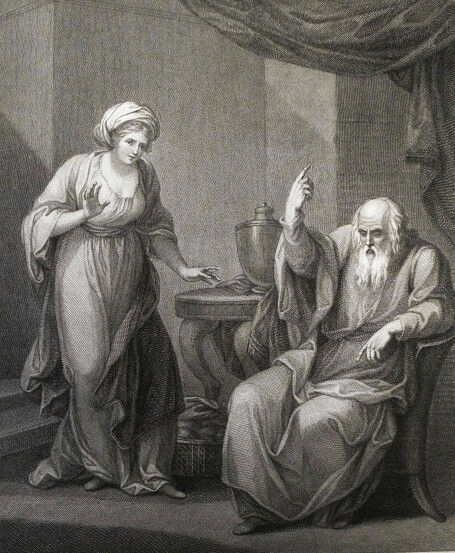
At that time Abijah son of Jeroboam became ill, and Jeroboam said to his wife, “Go, disguise yourself, so you won’t be recognized as the wife of Jeroboam. Then go to Shiloh. Ahijah the prophet is there—the one who told me I would be king over this people. Take ten loaves of bread with you, some cakes and a jar of honey, and go to him. He will tell you what will happen to the boy.” So Jeroboam’s wife did what he said and went to Ahijah’s house in Shiloh.
Now Ahijah could not see; his sight was gone because of his age. But the Lord had told Ahijah, “Jeroboam’s wife is coming to ask you about her son, for he is ill, and you are to give her such and such an answer. When she arrives, she will pretend to be someone else.”
So when Ahijah heard the sound of her footsteps at the door, he said, “Come in, wife of Jeroboam. Why this pretense? I have been sent to you with bad news. Go, tell Jeroboam that this is what the Lord, the God of Israel, says: ‘I raised you up from among the people and appointed you ruler over my people Israel. I tore the kingdom away from the house of David and gave it to you, but you have not been like my servant David, who kept my commands and followed me with all his heart, doing only what was right in my eyes. You have done more evil than all who lived before you. You have made for yourself other gods, idols made of metal; you have aroused my anger and turned your back on me.
“‘Because of this, I am going to bring disaster on the house of Jeroboam. I will cut off from Jeroboam every last male in Israel—slave or free. I will burn up the house of Jeroboam as one burns dung, until it is all gone. Dogs will eat those belonging to Jeroboam who die in the city, and the birds will feed on those who die in the country. The Lord has spoken!’
“As for you, go back home. When you set foot in your city, the boy will die. All Israel will mourn for him and bury him. He is the only one belonging to Jeroboam who will be buried, because he is the only one in the house of Jeroboam in whom the Lord, the God of Israel, has found anything good.
“The Lord will raise up for himself a king over Israel who will cut off the family of Jeroboam. Even now this is beginning to happen. And the Lord will strike Israel, so that it will be like a reed swaying in the water. He will uproot Israel from this good land that he gave to their ancestors and scatter them beyond the Euphrates River, because they aroused the Lord’s anger by making Asherah poles. And he will give Israel up because of the sins Jeroboam has committed and has caused Israel to commit.”
Then Jeroboam’s wife got up and left and went to Tirzah. As soon as she stepped over the threshold of the house, the boy died. They buried him, and all Israel mourned for him, as the Lord had said through his servant the prophet Ahijah. (New International Version)
It’s a sad reality that whenever we make choices to live against the grain of who are meant to be as humans, we not only harm ourselves, but other people also end up as collateral damage. Our own individual decisions may be independent, but the ramifications of those choices are always interdependent in scope and complexity.
The very same prophet who prophesied the rise of Jeroboam and his reign also prophesied his calamitous ending. Along with the establishment of a monarchy in Israel, there was also an ascension of divine prophets to the royal kings whenever things were going awry.
The prophet Ahijah had let King Jeroboam know, at the outset of his reign, that his longevity would depend upon his own faithfulness and attentiveness to God’s law (1 Kings 11:38). But Jeroboam failed to do this, and it doomed him and his family. The immediate death of Jeroboam’s young son was the confirmation of the divine judgment that would eventually come.
It behooves us all to consider the Apostle Paul’s words concerning fidelity toward God and our decisions as persons:
Make no mistake, God is not mocked. A person will harvest what they plant. Those who plant only for their own benefit will harvest devastation from their selfishness, but those who plant for the benefit of the Spirit will harvest eternal life from the Spirit. Let’s not get tired of doing good, because in time we’ll have a harvest if we don’t give up. So then, let’s work for the good of all whenever we have an opportunity, and especially for those in the household of faith. (Galatians 6:7-10, CEB)
Jeroboam turned his back on God, in favor of going with his own ingenuity and pragmatic actions to secure his rule and reign in Israel. No matter who we are – whether king or commoner, rich or poor – it is our personal and collective responsibility to ensure that sound, wise, and good decisions are being made with an eye toward the benefit of all persons.
This then, begs the question: What are our priorities and practices?
Prophetic utterances in Holy Scripture typically center in human arrogance and mistreatment of other people. And this is why following the commands of God are to be supremely important to the believer – because the instructions given to humanity from the Lord are meant for humility and justice toward others.
I believe that if we seek to live into the spirit of God’s law, we will continually labor to make good choices for the common good of everyone. Important social, economic, and political policies and practices won’t just spring up from nowhere to benefit humanity; they must be intentionally cultivated by people who make it a priority to pay attention to such matters and follow through with the right, the just, and the good.
Let’s persevere in doing good; and not succumb to the pragmatic, just to get something done that we want.
Almighty God our heavenly Father, you declare your glory and show forth your handiwork in the heavens and in the earth: Deliver us in our various occupations from the service of self alone, that we may do the work you give us to do in truth and beauty and for the common good; for the sake of him who came among us as one who serves, your Son Jesus Christ our Lord, who lives and reigns with you and the Holy Spirit, one God, for ever and ever. Amen.




 Rev. Tim Ehrhardt