Imitate the Right Use of Power (1 Corinthians 4:14-20)

I am writing this not to shame you but to warn you as my dear children. Even if you had ten thousand guardians in Christ, you do not have many fathers, for in Christ Jesus I became your father through the gospel. Therefore I urge you to imitate me. For this reason I have sent to you Timothy, my son whom I love, who is faithful in the Lord. He will remind you of my way of life in Christ Jesus, which agrees with what I teach everywhere in every church.

Some of you have become arrogant, as if I were not coming to you. But I will come to you very soon, if the Lord is willing, and then I will find out not only how these arrogant people are talking, but what power they have. For the kingdom of God is not a matter of talk but of power. (New International Version)

We need to talk about power.

And we need solid sacred examples of how to wield power rightly and justly.

Power is a lot like sex. Everyone wants it, but not everyone respects it and uses it well.

Humanity was created by God to exercise power. True human power has always been intended by our Creator as a means of giving love to others. Wherever you find love being extended by people in power to the powerless, there you will see that it works.

Yet, here’s the rub for many of us: This godly use of power may not (and likely will not) achieve instant results. That’s probably why we so often associate humanity’s possession of power with threats, bullying, and violence – because they usually work to get the immediate results of obtaining power and keeping others in subservience to that power.

The right use of power rarely gets rolled out smoothy without any wrinkles to it. Instead, wielding power through love makes its way by means of suffering. It comes from the humble servants like Mother Teresa, and from those who could throw their weight around, but instead choose to use their influence for self-giving love.

This sort of just and right authority is realized when we are aware of our own weaknesses and failures. Believing that “might=right” is merely a prescription for working out our own complexes on other people; it will only result in extending hate, not love, when others resist our authority.

The ones who hold true power are those who know they are unworthy of it, and incapable of using it without humility and divine help. Real power is like a shepherd looking after a flock of sheep – and not like pulling out a sword to kill the bad guys when they come to challenge authority.

Believers everywhere need awareness that the Christian message offers a profound reversal of what we think we know about power. All signs of real power lead us to the foot of the cross. National governments seems to think that power must be both achieved and sustained by the threat of violence. But the power of God’s kingdom is exercised through giving, serving, and loving.

And it is that sort of power which transforms the world in ways that probably won’t make headlines on the nightly news. The power of Christ is passed on throughout the generations of believers – learned by imitating people, like the Apostle Paul, who demonstrated humble service, instead of arrogant authority.

Faith is passed from person to person; and not just handed down from individuals reading their bibles in seclusion. Power and authority are given to those who are capable of handling it with justice and righteousness.

“You have heard me teach things that have been confirmed by many reliable witnesses. Now teach these truths to other trustworthy people who will be able to pass them on to others.”

The Apostle Paul to his protégé Timothy (2 Timothy 2:2, NLT)

Christians learn from leaders how the faith is lived out, and how power is used, by imitating what they see and hear. Therefore, an important question is this: Who do I imitate?

“Dear brothers and sisters, pattern your lives after mine, and learn from those who follow our example.”

The Apostle Paul to the Philippian Church (Philippians 3:17, NLT)

Our great desire is that you will keep on loving others as long as life lasts, in order to make certain that what you hope for will come true. Then you will not become spiritually dull and indifferent. Instead, you will follow the example of those who are going to inherit God’s promises because of their faith and endurance. (Hebrews 6:11-12, NLT)

Remember your leaders who taught you the word of God. Think of all the good that has come from their lives, and follow the example of their faith. (Hebrews 13:7, NLT)

Those who hold authority and power in the Christian Church must exemplify a proven character of persevering love in the face of pain and suffering. Such persons, having shown humility through it all, are worthy to imitate.

This does not necessarily mean that we emulate those who eruditely speak the Word of God, have superior gifts and abilities, and enjoy success in ministry. It does mean that we ought to imitate, and have as mentors, those persons who imitate Christ and are not self-promoting peacocks who go after being admired and praised.

A cocky Christian leader who has not focused on suffering love, and who has not experienced the purgative fiery trials of this life, may easily become seduced by their own importance. However, leaders who have seen their share of hard circumstances, pain, and suffering, and have come through it loving God and serving others out of grace and humility, are leaders worth imitating. 

Character shapes power, and never the other way around.

God of unchangeable and unending power: Look with mercy on your Church everywhere, and carry out your good and loving purposes through us your people. We trust that your power and love will have it’s way in this old fallen world – and that your plan of salvation shall be carried out, through Jesus Christ our Lord, in the strength of the Holy Spirit. Amen.

Speaking Truth to Power (Jeremiah 26:1-15)

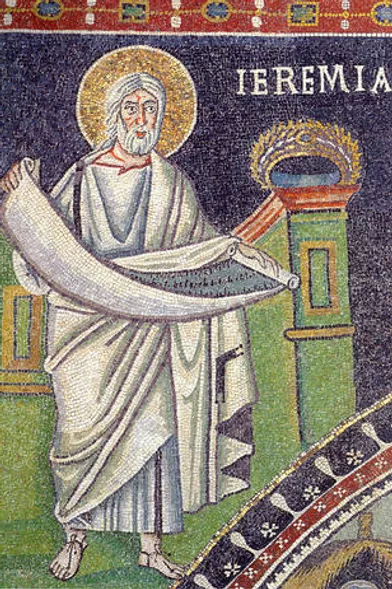
The prophet Jeremiah, 6th century mosaic, Ravenna, Italy

Early in the rule of Judah’s King Jehoiakim, Josiah’s son, this word came from the Lord: The Lord proclaims: Stand in the temple courtyard and speak to all the people of the towns of Judah who have come to the temple to worship. Tell them everything I command you; leave nothing out. Perhaps they will listen, and each will turn from their evil ways. If they do, I will relent and not carry out the harm I have in mind for them because of the wrong they have done. 

So tell them, The Lord proclaims: If you don’t listen to me or follow the Instruction I have set before you—if you don’t listen to the words of the prophets that I have sent to you time and again, though you haven’t listened, then I will make this temple a ruin like Shiloh, and this city I will make a curse before all nations on earth.

The priests, the prophets, and all the people heard Jeremiah declare these words in the Lord’s temple. And when Jeremiah finished saying everything the Lord told him to say, the priests and the prophets and all the people seized him and said, “You must die! Why do you prophesy in the Lord’s name that ‘this temple will become a ruin like Shiloh, and this city will be destroyed and left without inhabitant’?” Then all the people joined ranks against Jeremiah in the Lord’s temple.

When the officials of Judah heard these things, they went up from the royal palace to the Lord’s temple and took their places at the entrance of the New Gate of the Lord’s temple. The priests and the prophets said to the officials and all the people: “This man deserves to die for prophesying against this city as you have all heard firsthand.”

Jeremiah said to all the officials and to all the people, “The Lord sent me to prophesy to this temple and this city everything you have heard. So now transform your ways and actions. Obey the Lord your God, and the Lord may relent and not carry out the harm that he’s pronounced against you. 

But me? I’m in your hands. Do whatever you would like to me. Only know for certain that if you sentence me to death, you and the people of this city will be guilty of killing an innocent man. The Lord has in fact sent me to speak everything I have said to you.” (Common English Bible)

When it comes to the spiritual and religious life, on the one hand, we hold the joy and contentment of divine connection and peace; and, on the other hand, we hold the sadness that many turn their backs on divine realities. In Christian terms, Jesus is both the cornerstone of faith and the stone which causes people to stumble and fall. (1 Peter 2:8)

Frankly, the Lord is not okay with cruel injustice, hollow worship, and inattention to both the divine and human. There is a way to make things right. But not everyone wants that. Systemic evil persists because there are always those who benefit from the current structures of power – and they care little about how it impacts those on the underbelly of their control.

Things may be going well for a large chunk of people. And, conversely, things may not be going well at all, for an even larger group of folks. Therefore, it is necessary to acknowledge that the world is not only good, but also quite broken. We must speak truth to power. I understand that this is no easy task, because rarely are things simply black and white, all good or all bad.

Jeremiah preaches in the temple gate, a woodcut by Unknown artist, 1886

In the prophet Jeremiah’s day, it was not that his opponents were pure evil with no acknowledgment of God. Rather, the problem was that the power brokers in Judah tried to keep a strict separation of religion from everything else; they were perfectly fine with God, that is, if the Lord would stay in the temple where he belonged.

But Jeremiah would have none of this sort of mentality and behavior. Keeping Yahweh out of matters of social justice, geopolitics, and institutional governance led to severe humanitarian problems. Jeremiah became God’s voice to a generation of people who ignored the divine in everything but religious ritual.

Bifurcating worship and work disconnects daily life from divine resources. Without God infused in all of life, a lack of grace fills the empty places. What’s more, the sovereign Lord can neither be silenced nor dismissed; God will find a way to accomplish peace and justice for the common good of everyone, and not just the few.

The heart of Jeremiah’s message was for king and people to be obedient in all of life, to recenter themselves around God’s law – not just the religious bits but the social ones, as well. Jeremiah did not proclaim something new. He was calling those in places of power and authority to a proper Torah observance.

The true needs and interests of our communities can never be addressed and lifted-up in the narrow self-serving interests of persons in power who turn a blind eye to anyone unlike them.

The needs and interests of our world lie in becoming who we were designed to be from the beginning: A people belonging to God, tapping into the deep reservoir of light and spirituality within us. It is to acknowledge the image of God inside us all.

We are to follow in the way of grace and truth. There is to be no division between the sacred and the secular because, for the Christian, Jesus is Lord of all.

We are to continually use our voice for both praise and prophecy, for shouting celebration to God and for speaking truth to power.

Holy God, the gracious Sovereign of all, we give you praise for your steadfast love toward us, your people. Keep us grounded in humility, sensitive to sin, attentive to that which is just and right, merciful in all things, pure in worship, and peace-loving through Christ our Lord in the strength of the Spirit. Amen.

Less Is More (Luke 17:5-10)

The apostles said to the Lord, “Increase our faith!”

He replied, “If you have faith as small as a mustard seed, you can say to this mulberry tree, ‘Be uprooted and planted in the sea,’ and it will obey you.

“Suppose one of you has a servant plowing or looking after the sheep. Will he say to the servant when he comes in from the field, ‘Come along now and sit down to eat’? Won’t he rather say, ‘Prepare my supper, get yourself ready and wait on me while I eat and drink; after that you may eat and drink’? Will he thank the servant because he did what he was told to do? So, you also, when you have done everything you were told to do, should say, ‘We are unworthy servants; we have only done our duty.’” (New International Version)

You and I do not need control. Authority and power belong to God. And we are not God.

You and I need faith. And, since we belong to God, who is the ultimate authority and controls all things, we already have it.

You already have what you need: Jesus. There is no need to hustle and cajole for something you do not need.

Jesus tells his disciples two parables designed to reorient their thinking and their lives around God, and not around the typical worldly tools of power and authority.

We find self-control something very hard. We’d rather have plain old control.

In the 1990s, The Department of Transportation set aside $200 million dollars for research and testing of an automated Highway System. The plan was that this system would relieve traffic problems by placing all cars that entered the highway on “super cruise control,” allowing them to move in unison as they traveled in heavily congested cities.  

Such travel would be made possible by using special magnets embedded in the asphalt every four feet, which would transfer signals between the vehicles and a main computer system.  

Steering, acceleration and braking would be controlled by sensors, computer navigation systems and cameras along the side of the road. Control would be returned to drivers as they exited the highway.  According to the technology manager of the project, “The only thing we can’t do yet is get people to comfortably trust the system. It’s not a technology issue.”

The grace of God in Jesus Christ is our fail-safe system designed to put us in “super cruise control” when dealing with circumstances and relating to people. There is just one difficulty with the system: Getting people to comfortably trust it.

The real problem is that we prefer to retain control of life’s steering wheel, even though it is this tendency that drives us to discontentment and endless relational conflict. Rather than insisting on doing life our way, we need Jesus to take the wheel.

And the irony to all this is that we already have what we so desperately seek.

Just a little bit of Jesus makes a large impact on the world.

            Our Lord’s entire kingdom movement looked as insignificant as a mustard seed. Christ’s little band of disciples were, at best, a motley crew of very human characters who vacillated between faith and doubt; they spent as much time arguing amongst themselves as they did engaging in ministry. Yet, it was these same people who ended up turning the world upside-down.

            The insignificant and small looking mustard seed eventually becomes a world-sheltering tree. In the same way, a barbaric, bloody, seemingly insignificant cross became the means of changing the world.

            We, even though imperfect and small, can become, with Jesus in us, a healing force for the world. Little is much when God is in it. Although Gideon believed he needed to be in charge of a large army to defeat Israel’s enemies, God whittled his soldiers down to just 300, against a force described as an army with men as many as the sand on the seashore. Victory was no problem. Gideon already had what he needed: God. (Judges 7:1-25)

Never underestimate the potency of our little bit of ministry with Jesus animating it. Our…

Kind words spoken in the name of Jesus…

Hidden prayers uttered silently behind closed doors…

Secret giving in which the right hand doesn’t know what the left is doing…

Gentleness in the face of violence…

Humility in the midst of pride…

Mercy given instead of judgment…

Peacemaking wherever frustration exists…

These and so much more, when energized by Jesus, becomes a mighty force for good and change in this old fallen world.

Yet so many Christians think they need all kinds of power, authority, and control – then mountains can be moved, trees uprooted, and things can happen.

With this misguided notion, we too easily succumb to the temptations of winning success, spinning a superior self-image, and pinning down power to get what we want and need.

However, we already have what we need, Jesus, and we do not need what he has – power and authority; we just need him.

The Lord Jesus has shown us the way in this. In Christ’s incarnation, he emptied himself and became like one of us – eschewing the typical power dynamics of the world. At the beginning of his ministry, Jesus spends 40 days in the desert fasting – making himself empty.

And at the end of that time, the devil came to Christ and tempted him in the very same ways we are tempted (Matthew 4:1-11):

Satan: “You need to be successful.”

Jesus: “Nope, don’t need that.”

Satan: “Well, you definitely need to be on the right religious track.”

Jesus: “Get out of my face. I don’t need to play that game.”

Satan: “It’s simple. You can do your Father’s will with the tools of power I have.”

Jesus: “I’m not going there. I don’t need your sort of help.”

In submitting to his Father’s plan and will, Jesus showed us the way to live as his followers.

We, too, have to stare the same three temptations in the eye: the belief that I need to be successful, to be right, and to have everything under control.

The truth, however, is just the opposite. In actuality, we need to be poor in spirit, powerless,  and humble – not full of strength and control.

Jesus said, “My grace is sufficient for you, for my power is made perfect in weakness.” And Paul responded, “Therefore, I will boast all the more gladly about my weaknesses, so that Christ’s power may rest on me. That is why, for Christ’s sake, I delight in weaknesses, in insults, in hardships, in persecutions, in difficulties. For when I am weak, then I am strong.” (2 Corinthians 12:9-10, NIV)

In reality, we need to be open and vulnerable – not spinning a self-image which projects strength, authority, and power.

 In your relationships with one another, have the same mindset as Christ Jesus:

Who, being in very nature God,
    did not consider equality with God something to be used to his own advantage;
rather, he made himself nothing
    by taking the very nature of a servant,
    being made in human likeness.
And being found in appearance as a man,
    he humbled himself
    by becoming obedient to death—
        even death on a cross! (Philippians 2:5-8, NIV)

We need to be meek and gentle – just like our Lord – not puffing our chests out with a show of strength and authority.

Jesus said, “Come to me, all you who are weary and burdened, and I will give you rest.Take my yoke upon you and learn from me, for I am gentle and humble in heart, and you will find rest for your souls. For my yoke is easy and my burden is light.” (Matthew 11:28-30, NIV)

Less is truly more. Only those who have nothing to prove and nothing to protect can receive Christ. And Jesus himself will lead us on this path of self-emptying.

We already have Jesus. Therefore, we already have everything we need. Even a smidgeon of Christ is more than enough for us. What we may think we need – to win at success, to spin a narrative of rightness, and to pin down control through power and authority – amounts to nothing in the kingdom of God.

Instead, what we really need is to walk in the way of Jesus – to be weak through self-emptying, to leak out our pride and embrace humility and vulnerability, and to be meek by having a gentle spirit.

Being a servant is a good thing. And being a servant of the Lord Jesus Christ – the author and perfecter of our faith – is the only vocation we need. With Jesus, less is more.

Almighty and everlasting God, we are far too often influenced by what others think of us. We pretend to be in control, with it, in charge, and strong. Prevent us from trying to attract attention. Don’t let us gloat over praise on one hand or be discouraged by criticism on the other. Nor let us waste time weaving imaginary situations in which the most heroic, put together, and powerful person present is me. Rather, show us how to be humble of heart, just like your Son, our Lord, Jesus Christ, who with you and the Holy Spirit are one God, now and forever. Amen.

Amos 8:1-12 – A Prophet’s Perspective on Power and Poverty

Miners’ wives carrying sacks of coal by Vincent Van Gogh, 1881

This is what the Sovereign Lord showed me: a basket of ripe fruit. “What do you see, Amos?” he asked.

“A basket of ripe fruit,” I answered.

Then the Lord said to me, “The time is ripe for my people Israel; I will spare them no longer.

“In that day,” declares the Sovereign Lord, “the songs in the temple will turn to wailing. Many, many bodies—flung everywhere! Silence!”

Hear this, you who trample the needy
    and do away with the poor of the land,

saying,

“When will the New Moon be over
    that we may sell grain,
and the Sabbath be ended
    that we may market wheat?”—
skimping on the measure,
    boosting the price
    and cheating with dishonest scales,
buying the poor with silver
    and the needy for a pair of sandals,
    selling even the sweepings with the wheat.

The Lord has sworn by himself, the Pride of Jacob: “I will never forget anything they have done.

“Will not the land tremble for this,
    and all who live in it mourn?
The whole land will rise like the Nile;
    it will be stirred up and then sink
    like the river of Egypt.

“In that day,” declares the Sovereign Lord,

“I will make the sun go down at noon
    and darken the earth in broad daylight.
I will turn your religious festivals into mourning
    and all your singing into weeping.
I will make all of you wear sackcloth
    and shave your heads.
I will make that time like mourning for an only son
    and the end of it like a bitter day.

“The days are coming,” declares the Sovereign Lord,
    “when I will send a famine through the land—
not a famine of food or a thirst for water,
    but a famine of hearing the words of the Lord.
People will stagger from sea to sea
    and wander from north to east,
searching for the word of the Lord,
    but they will not find it. (New International Version)

I’ve been in the church most of my life. I have listened to thousands of sermons, as well as preaching thousands of them myself. I can count on both hands how many times I’ve heard a sermon from one of the twelve minor prophets in the Bible. Although I personally have preached on them more times than that, it still pales in comparison with how many sermons I’ve preached from the New Testament gospels or epistles.

This, I believe, is an indictment on us, especially those with privilege and power. If you add the major prophets, we have sixteen books contained in Holy Scripture calling out powerful and influential people’s oppression of others. To overlook such a girth of text is to stick our fingers in our ears and refuse to listen to God.

Those with power, position, and privilege must continually be vigilant to use such influence for the benefit of all persons – not just themselves or people just like them.

The books of the prophets make it very clear that God cares about justice. God will uphold the needy. The Lord will stand with the oppressed. If we fail to share a divine sense of justice and injustice, there will be hell to pay.

God is longsuffering. The Lord patiently awaits us to pay attention. Yet, eventually, that patience will run its course. A prophet will be sent to voice God’s concerns. Like a basket of ripe fruit now finally ready to be eaten, so God’s justice is ripe and ready for action.

The prophet Amos delivered a scathing message to the ancient Israelites about their total disregard for the poor and needy in the land. The people in positions of authority and power only looked on the less fortunate as commodities – as pawns to be taken advantage of for the rich merchants. 

Because the wealthy never took the time to listen to the poor, God would not listen to them. Judgment was coming, and it would not go so well for the power brokers of society who only thought of their business and squeezing others for more money.      

Peasants planting potatoes by Vincent Van Gogh, 1885

Few people rush to have poor folk as their friends. Those in poverty are often overlooked and disregarded. Either they are ignored altogether or are given hand-outs and services without ever having any significant human contact. Even when there is help, it comes from a distance.

In other words, those in authority rarely take the time to listen and get to know the real face of poverty. If there isn’t a photo opportunity, then encounters with the poor are not likely to happen with politicians, or anyone else. After all, so many are busy making money, checking stock portfolios, and considering how to get bigger market shares…. 

Perhaps we have an answer as to why there is no revival in the land. God shows such solidarity with the poor that to ignore them is to ignore him.  No matter our financial picture and outlook, every one of us can grace the poor with the gift of time and listening.  For in doing so we might just be listening to the voice of God.

Justice is the responsibility of everyone, not just a few.

God identifies closely with the poor, the distressed, the underprivileged, and the needy. The Lord listens to the lowly. So, we as God’s people, are to share this same concern. It is a theme throughout the entirety of Holy Scripture.

From the Old Testament:

God will rescue the needy person who cries for help
and the oppressed person who has no one’s help.
He will have pity on the poor and needy
and will save the lives of the needy. (Psalm 73:12-13, GW)

Those who mock the poor insult their Maker; those who rejoice at the misfortune of others will be punished. (Proverbs 17:5, NLT)

Those who are gracious to the poor lend to the Lord, and the Lord will fully repay them. (Proverbs 19:17, CEB)

If you close your ear to the cry of the poor, you will cry out and not be heard.

Proverbs 21:13, NRSV

Those who give to the poor will lack nothing, but those who turn a blind eye will be greatly cursed. (Proverbs 28:27, CEB)

Give your food to the hungry
    and care for the homeless.
Then your light will shine
    in the dark;
your darkest hour will be
    like the noonday sun. (Isaiah 58:10, CEV)

The Spirit of the Sovereign Lord is on me,
    because the Lord has anointed me
    to proclaim good news to the poor. (Isaiah 61:1, NIV)

From the New Testament:

“If you want to be complete, go, sell what you own, and give the money to the poor. Then you will have treasure in heaven.”

Jesus (Matthew 19:21, CEB)

Command those who are rich in this present world not to be arrogant nor to put their hope in wealth, which is so uncertain, but to put their hope in God, who richly provides us with everything for our enjoyment. Command them to do good, to be rich in good deeds, and to be generous and willing to share. (1 Timothy 6:17-18, NIV)

 If we are rich and see others in need, yet close our hearts against them, how can we claim that we love God? My children, our love should not be just words and talk; it must be true love, which shows itself in action. (1 John 3:17-18, GNT)

Poverty is not only an issue in some far away place; the poor are found everywhere, and they are always among us.

I believe an honest hearing of the prophet Amos would change the world. I’m not talking about angry ranting which works people into a frenzy of fear and suspicion. I am referring to giving Amos a serious hearing, just like we give the Apostle Paul our focused attention.

Just because poverty has always been with us, doesn’t mean we ought to only shrug our shoulders and say, “Meh, what’s a guy to do?” Instead, we can determine to address the issues which create a large class of poor people to begin with – including malevolence and materialism.

The moral compass of many of the earth’s nations is askew, even broken. It needs to be recalibrated to the true north of biblical justice. Back in the prophet’s day, bullying, bribery, and backstabbing were tools used for malevolent purposes. Those same implements are still being used by some today.

You must not pervert justice or show favor. Do not take a bribe, for bribes blind the eyes of the wise and distort the words of the righteous. (Deuteronomy 16:19, NET)

Those who plant injustice will harvest disaster,
    and their reign of terror will come to an end. (Proverbs 22:8, NLT)

But why would people be so unjust to other people? What would motivate someone to purposefully harm another in this way?… Materialism would.

Whenever people have an exorbitant amount of stuff, generosity is typically not their first impulse (Ecclesiastes 5:10). Rather, the extremely rich among us have an equally extreme temptation to hold on tight to their wealth – so much so that money and acquiring more stuff becomes their religion. That’s why Scripture is replete with warnings about money.

In short, poverty must be tackled, from a biblical perspective, on both the personal and systemic level. Individuals, families, churches, faith communities, organizations, corporations, and governments must all remove the obstacles which keep people in poverty. This is an appropriate use of power and authority.

What will you and I do?…

Gracious God, you are found everywhere – both the halls of power, and the back alleys of slums. As we seek you more and more, help us to see the face of Jesus in everyone we encounter, whether rich or poor, so that we might share the gift of life with them, through Jesus Christ our Lord, in the power of your Holy Spirit. Amen.