
Hold It Loosely (Exodus 1:1-7)

When Jacob went to Egypt, his son Joseph was already there. So Jacob took his eleven other sons and their families. They were: Reuben, Simeon, Levi, Judah, Issachar, Zebulun, Benjamin, Dan, Naphtali, Gad, and Asher. Altogether, Jacob had 70 children, grandchildren, and great-grandchildren who went with him.

After Joseph, his brothers, and everyone else in that generation had died, the people of Israel became so numerous that the whole region of Goshen was full of them. (Contemporary English Version)

Exodus is the second book of the Bible, and the second of five books known as the “Pentateuch” by Christians, and the “Torah” by Jews. The first book, Genesis, ended with the story of Joseph – who was one of the 12 patriarchs. God established a covenant with Abraham, the father of Judaism, and promised him land and descendants – even though he did not have a son. God miraculously gave Abraham and Sarah a biological son, Isaac, who grew up to be the father of Jacob, or Israel, Joseph’s father.

The stories in Genesis surrounding Abraham, Isaac, Jacob, and Joseph were filled with wonderings of whether God’s promise would ever survive, or not. Yet, it did. Joseph, in the ultimate reversal of fortunes, went from the lowest person in Egypt to it’s highest official. Through Joseph, the brothers and their families ended up relocating to Egypt because of a severe famine.

Present-day land of Goshen, Egypt

As time moved on, Joseph, his brothers, and all that generation died. In contrast to the extended family of Jacob, 70 of them, who initially went to Egypt, the opening of of Exodus relays an exponential growth in numbers of Israelites.

God was faithfully and tirelessly preserving the covenant and the promise for Israel. When the people went to Egypt, God assured them they need not be afraid. The Lord will make them a great nation, will be with them, and shall lead them back out again. (Genesis 46:1-4)

The opening of Exodus not only connects us with events in the latter part of Genesis, but also hearkens back to it’s very beginning, when God spoke to the first human couple. The Lord gave them a five-fold blessing, consisting of commands to 1) be fruitful 2) multiply 3) fill the earth 4) subdue it, and 5) have dominion over it. (Genesis 1:28)

Following the Flood, God blessed Noah, repeating the commands to be fruitful, multiply, and fill the earth (Genesis 9:1). Later, God spoke to Abraham, promisingto make him fruitful (Genesis 17:5-9). Moving into Exodus, we see a fulfillment of the commands and the promise taking shape, stating that the descendants of Israel were fruitful and multiplying, so that the land was filled with them.

It was this very blessing of progeny, and the fertile increase of descendants, which sets up the entire book of Exodus. The great and growing numbers of Israelites became a source of concern and fear amongst the Egyptians. It wasn’t long before the Jews were seen as another source of slave labor.

Sometimes, we must bear in mind and remember that great blessing also has an underbelly of great blight. Only God and relationships last forever; everything else is temporary, including our earthly blessings.

Therefore, it is wise to hold all things loosely, with open hands, and not with clenched fists that believes possessing things in this moment will be permanent. The following are some things to remember:

Remember who is in control

When things are going well, it may create the illusion that I am in charge of the blessing. But, in reality, it was given to you, and it can be taken away, as well.

The only thing you can control are your thoughts, feelings, emotions, choices, actions and the story you are telling yourself about what happened in the past, is happening now, and will happen tomorrow.

We all have our personal invisible backpacks to carry. That backpack is ours, and nobody else’s. Others have their own burdens to carry, which are individual to them. They aren’t yours to carry. Their stories aren’t yours to tell.

God is the Sovereign of the universe, and controls all things. That is God’s burden to carry. Not yours. Carrying the world on your shoulders isn’t your job. So, hold loosely whatever happens on this earth, whether for good or ill. 

Remember that life is both planning and improvisation

We have an agenda, make our plans, and put things in place. Yet, in the execution of doing it, we have to move with whatever circumstances and conditions arise – with whatever life throws our way – and then adjust our expectations.

Remember it’s both in planning and in improvising. The Israelites laid plans to go to Egypt, went there, and then had to deal with changing conditions once they were there. All planning and no improvising is unrealistic; and all improvisation with no plan is flying by the seat of your pants and living in a dream world which doesn’t exist.

What’s more, it might be your plan, or your group’s plan, but it’s not everybody’s plan. They have the freedom to say, “No thank you.” So, be careful to not marry yourself to a particular outcome. Release the urge to cling or obsess about certain expectations. Hold your plans loosely, and plan to improvise.

Remember to cooperate with God

In reality, there is a divine/human cooperative which exists on the earth. Ideally, we are to work together, me doing my part, and God handling the rest. And the both of us constantly must be in dialogue with each other.

When we align with this truth, and participate with God and integrate this cooperative into daily life, then we begin to relax, breathe, move with confidence, and speak with purpose. Head, heart, and gut are no longer disparate parts within me, but work together in a harmonious sync with the Lord.

If this is a challenge for you, set aside some time and be in nature. Look around you and observe all the life thriving right in front of you. Connecting with what is alive connects us to the universal Love which exists everywhere. And that Love can help us and heal us – if we will but let it.

I can hold things loosely because I know the internal pressure of “getting it right” isn’t mine to carry. I can cooperate with God, relax, do my best, and trust.

Blessings are wonderful and abound everywhere. Yet, adversity, acrimony, and even abuse still lurk about in this old fallen world. So, may you learn to hold all things loosely, and live as you know you can, and ought. Amen.

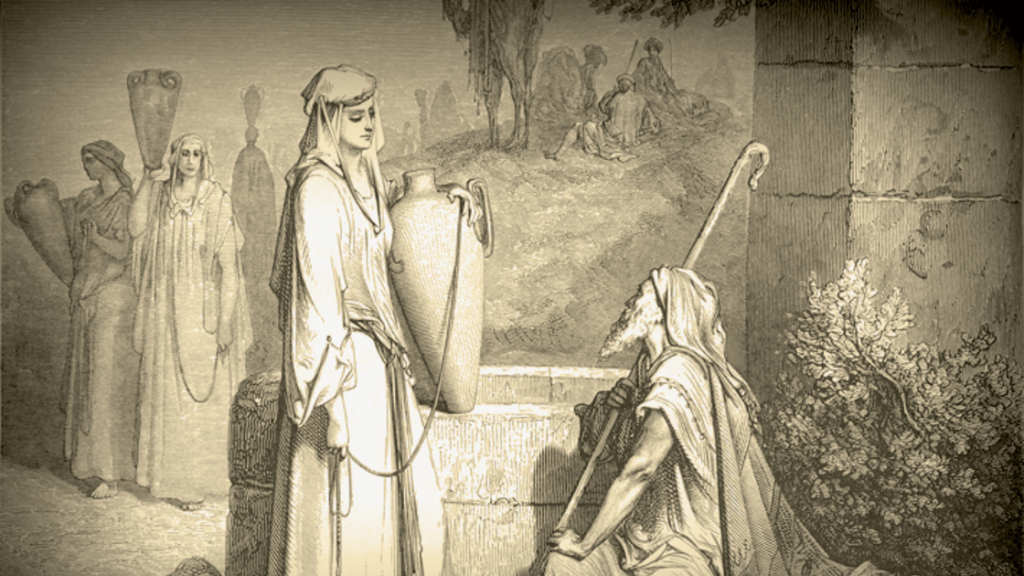
The Plan Comes Together (Genesis 24:10-52)

Rebekah and Abraham’s servant, an engraving by Gustave Dore (1832-1883)

Reading Holy Scripture is important. And the way we read it is significant. For the past several years, I have personally made it a practice to always read from the Bible out loud. There is something deeply powerful and impactful about the experience of reading aloud God’s Word.

I also try and read Scripture carefully and slowly. I deliberately make choices about my tone and inflexion, paying attention to which words are emphasized. I try to communicate as best I can the spirit and intent of the words.

I encourage you today to read aloud (and listen to) today’s Old Testament lesson. Take your time. Read it at your own pace. Notice which words you tend to accent, and what the Spirit may be saying to you in the reading…

Soon after that, the servant loaded ten of Abraham’s camels with valuable gifts. Then he set out for the city in northern Syria, where Abraham’s brother Nahor lived.

When he got there, he let the camels rest near the well outside the city. It was late afternoon, the time when the women came out for water. The servant prayed:

You, Lord, are the God my master Abraham worships. Please keep your promise to him and let me find a wife for Isaac today. The young women of the city will soon come to this well for water, and I’ll ask one of them for a drink. If she gives me a drink and then offers to get some water for my camels, I’ll know she is the one you have chosen and that you have kept your promise to my master.

While he was still praying, a beautiful unmarried young woman came by with a water jar on her shoulder. She was Rebekah, the daughter of Bethuel, the son of Abraham’s brother Nahor and his wife Milcah. Rebekah walked past Abraham’s servant, then went over to the well, and filled her water jar. When she started back, Abraham’s servant ran to her and said, “Please let me have a drink of water.”

“I’ll be glad to,” she answered. Then she quickly took the jar from her shoulder and held it while he drank. After he had finished, she said, “Now I’ll give your camels all the water they want.” She quickly poured out water for them, and she kept going back for more, until his camels had drunk all they wanted. Abraham’s servant did not say a word, but he watched everything Rebekah did, because he wanted to know for certain if this was the woman the Lord had chosen.

The servant had brought along an expensive gold ring and two large gold bracelets. When Rebekah had finished bringing the water, he gave her the ring for her nose and the bracelets for her arms. Then he said, “Please tell me who your father is. Does he have room in his house for me and my men to spend the night?”

She answered, “My father is Bethuel, the son of Nahor and Milcah. We have a place where you and your men can stay, and we also have enough straw and feed for your camels.”

Then the servant bowed his head and prayed, “I thank you, Lord God of my master Abraham! You have led me to his relatives and kept your promise to him.”

Rebekah ran straight home and told her family everything. Her brother Laban heard her tell what the servant had said, and he saw the ring and the bracelets she was wearing. So Laban ran out to Abraham’s servant, who was standing by his camels at the well. Then Laban said, “The Lord has brought you safely here. Come home with me. There’s no need for you to keep on standing outside. I have a room ready for you in our house, and there’s also a place for your camels.”

Abraham’s servant went home with Laban, where Laban’s servants unloaded his camels and gave them straw and feed. Then they brought water into the house, so Abraham’s servant and his men could wash their feet. After that, they brought in food. But the servant said, “Before I eat, I must tell you why I have come.”

“Go ahead and tell us,” Laban answered.

The servant explained:

I am Abraham’s servant. The Lord has been good to my master and has made him very rich. He has given him many sheep, goats, cattle, camels, and donkeys, as well as a lot of silver and gold, and many slaves. Sarah, my master’s wife, didn’t have any children until she was very old. Then she had a son, and my master has given him everything. I solemnly promised my master that I would do what he said. And he told me, “Don’t choose a wife for my son from the women in this land of Canaan. Instead, go back to the land where I was born and find a wife for my son from among my relatives.”

I asked my master, “What if the young woman refuses to come with me?”

My master answered, “I have always obeyed the Lord, and he will send his angel to help you find my son a wife from among my own relatives. But if they refuse to let her come back with you, then you are freed from your promise.”

When I came to the well today, I silently prayed, “You, Lord, are the God my master Abraham worships, so please lead me to a wife for his son while I am here at the well. When a young woman comes out to get water, I’ll ask her to give me a drink. If she gives me a drink and offers to get some water for my camels, I’ll know she is the one you have chosen.”

Even before I had finished praying, Rebekah came by with a water jar on her shoulder. When she had filled the jar, I asked her for a drink. She quickly lowered the jar from her shoulder and said, “Have a drink. Then I’ll get water for your camels.” So I drank, and after that she got some water for my camels. I asked her who her father was, and she answered, “My father is Bethuel the son of Nahor and Milcah.” At once I put the ring in her nose and the bracelets on her arms. Then I bowed my head and gave thanks to the God my master Abraham worships. The Lord had led me straight to my master’s relatives, and I had found a wife for his son.

Now please tell me if you are willing to do the right thing for my master. Will you treat him fairly, or do I have to look for another young woman?

Laban and Bethuel answered, “The Lord has done this. We have no choice in the matter. Take Rebekah with you; she can marry your master’s son, just as the Lord has said.” Abraham’s servant bowed down and thanked the Lord. (Contemporary English Version)

How was your experience in reading this story out loud? What did the Spirit bring to you through it? Will you share your experience with us?…

What Does God Want? (John 11:1-45)

The Raising of Lazarus, by Rembrandt, c.1632

Now a man named Lazarus was sick. He was from Bethany, the village of Mary and her sister Martha. (This Mary, whose brother Lazarus now lay sick, was the same one who poured perfume on the Lord and wiped his feet with her hair.) So the sisters sent word to Jesus, “Lord, the one you love is sick.”

When he heard this, Jesus said, “This sickness will not end in death. No, it is for God’s glory so that God’s Son may be glorified through it.” Now Jesus loved Martha and her sister and Lazarus. So when he heard that Lazarus was sick, he stayed where he was two more days, and then he said to his disciples, “Let us go back to Judea.”

“But Rabbi,” they said, “a short while ago the Jews there tried to stone you, and yet you are going back?”

Jesus answered, “Are there not twelve hours of daylight? Anyone who walks in the daytime will not stumble, for they see by this world’s light. It is when a person walks at night that they stumble, for they have no light.”

After he had said this, he went on to tell them, “Our friend Lazarus has fallen asleep; but I am going there to wake him up.”

His disciples replied, “Lord, if he sleeps, he will get better.” Jesus had been speaking of his death, but his disciples thought he meant natural sleep.

So then he told them plainly, “Lazarus is dead, and for your sake I am glad I was not there, so that you may believe. But let us go to him.”

Then Thomas (also known as Didymus) said to the rest of the disciples, “Let us also go, that we may die with him.”

On his arrival, Jesus found that Lazarus had already been in the tomb for four days. Now Bethany was less than two miles from Jerusalem, and many Jews had come to Martha and Mary to comfort them in the loss of their brother. When Martha heard that Jesus was coming, she went out to meet him, but Mary stayed at home.

“Lord,” Martha said to Jesus, “if you had been here, my brother would not have died. But I know that even now God will give you whatever you ask.”

Jesus said to her, “Your brother will rise again.”

Martha answered, “I know he will rise again in the resurrection at the last day.”

Jesus said to her, “I am the resurrection and the life. The one who believes in me will live, even though they die; and whoever lives by believing in me will never die. Do you believe this?”

“Yes, Lord,” she replied, “I believe that you are the Messiah, the Son of God, who is to come into the world.”

After she had said this, she went back and called her sister Mary aside. “The Teacher is here,” she said, “and is asking for you.” When Mary heard this, she got up quickly and went to him. Now Jesus had not yet entered the village, but was still at the place where Martha had met him. When the Jews who had been with Mary in the house, comforting her, noticed how quickly she got up and went out, they followed her, supposing she was going to the tomb to mourn there.

When Mary reached the place where Jesus was and saw him, she fell at his feet and said, “Lord, if you had been here, my brother would not have died.”

When Jesus saw her weeping, and the Jews who had come along with her also weeping, he was deeply moved in spirit and troubled. “Where have you laid him?” he asked.

“Come and see, Lord,” they replied.

Jesus wept.

Then the Jews said, “See how he loved him!”

But some of them said, “Could not he who opened the eyes of the blind man have kept this man from dying?”

Jesus, once more deeply moved, came to the tomb. It was a cave with a stone laid across the entrance. “Take away the stone,” he said.

“But, Lord,” said Martha, the sister of the dead man, “by this time there is a bad odor, for he has been there four days.”

Then Jesus said, “Did I not tell you that if you believe, you will see the glory of God?”

So they took away the stone. Then Jesus looked up and said, “Father, I thank you that you have heard me. I knew that you always hear me, but I said this for the benefit of the people standing here, that they may believe that you sent me.”

When he had said this, Jesus called in a loud voice, “Lazarus, come out!” The dead man came out, his hands and feet wrapped with strips of linen, and a cloth around his face.

Jesus said to them, “Take off the grave clothes and let him go.”

Therefore many of the Jews who had come to visit Mary, and had seen what Jesus did, believed in him. (New International Version)

The Raising of Lazarus, by Vincent Van Gogh, 1890

Here’s a Captain Obvious observation:

what God wants, and what we want, is not always the same thing. 

Today’s Gospel story centers around a man named Lazarus, the brother of Mary and Martha. The disciples were familiar with them since they were committed followers of Jesus. 

Their friend Lazarus became deathly ill. Christ and the disciples caught wind of it. Everyone believed Jesus could do something about this. But Jesus stayed put. He didn’t make a move to go to his sick friend. 

After a few days, Lazarus died. It was only then, that Jesus made his move.

The religious authorities in Jerusalem had it out for Jesus. But Jesus decided to go to Bethany and Jerusalem anyway. This made no sense to the disciples. Lazarus was lying dead in Bethany. Going there would put everyone at risk – which is why Thomas uttered the defeatist and dramatic statement, “Let us also go, that we may die with him.”

Yet, they all went. And once they arrived, Christ and his disciples found the grieving sisters. Mary and Martha believed that Jesus was the promised Messiah who would come and save the people. They didn’t understand why Jesus stayed away and didn’t come sooner. 

If Jesus had been there, he could have healed Lazarus. He healed other people, so why not a friend and a brother?

The death of Lazarus seemed to be the end. No one was happy with how things shook-out. Lazarus died. The disciples’ plans were dead. Mary and Martha’s expectations died…

but death is exactly what it takes in to have resurrection.

There’s no such thing as a painless miracle. Death isn’t a pleasant affair. I have been with countless people at the end of life, and I will tell you that, although it’s possible for a death to be peaceful, it’s still ugly business. 

It’s also painful to watch carefully laid and prayed over plans die. It hurts to see a long sought after dream just go up in smoke and die. To see anything or anyone we deeply care about die is gut-wrenching. Yet, in order for a resurrection to occur, there must first be a death.

There cannot be a new life unless there’s an old one. 

Jesus did the impossible by raising Lazarus from death and giving him new life. And the resurrection of Lazarus pointed to an even greater truth: Christ’s own death and resurrection was coming, and it will change everything.

Whenever what we want dies, then we are in a position to ask: So, what does God want? 

God wanted something better than what everybody else wanted. By allowing ourselves to be consumed with what God wants, it turns out to be the very best thing for us, even if it does not quite jive with what I want.

Everyone’s expectations needed to die, along with Lazarus, for the resurrection to become reality. Only then did Jesus act by rising Lazarus from death.

Jesus pointed to himself as the one able to bring life to all that is dead among us. Sometimes:

  • dreams must die so that Jesus can resurrect them to new life, with outcomes far more glorious than you and I could ever imagine
  • plans have to be dead and buried before Jesus will breathe new life into them, making those plans so much more than they could ever have been in our hands.
  • ministries, even churches, need to be dead as a doorknob so that Jesus can resurrect them and give them new life, invigorated with spiritual resurrection power.

If we desire to see the miracle of resurrection, we must die to ourselves – take up our crosses and follow Jesus into the grave so that he can transform our lowly expectations into a glorious new existence. Death does not have the last word because Christ’s resurrection makes it possible for us to have new life. Again, I ask:

What does God want? God wants to raise the dead to life.

Do you believe this? Yes, I believe. Help me in my unbelief.

Follow the path of what God wants and watch what the Lord will do for you.

Luke 7:18-30 – Use the Right Color

John’s disciples told him about all these things. Calling two of them, he sent them to the Lord to ask, “Are you the one who is to come, or should we expect someone else?”

When the men came to Jesus, they said, “John the Baptist sent us to you to ask, ‘Are you the one who is to come, or should we expect someone else?’”

At that very time Jesus cured many who had diseases, sicknesses and evil spirits, and gave sight to many who were blind. So, he replied to the messengers, “Go back and report to John what you have seen and heard: The blind receive sight, the lame walk, those who have leprosy are cleansed, the deaf hear, the dead are raised, and the good news is proclaimed to the poor. Blessed is anyone who does not stumble on account of me.”

After John’s messengers left, Jesus began to speak to the crowd about John: “What did you go out into the wilderness to see? A reed swayed by the wind? If not, what did you go out to see? A man dressed in fine clothes? No, those who wear expensive clothes and indulge in luxury are in palaces. But what did you go out to see? A prophet? Yes, I tell you, and more than a prophet. This is the one about whom it is written:

“‘I will send my messenger ahead of you,
    who will prepare your way before you.’

I tell you, among those born of women there is no one greater than John; yet the one who is least in the kingdom of God is greater than he.”

(All the people, even the tax collectors, when they heard Jesus’ words, acknowledged that God’s way was right, because they had been baptized by John. But the Pharisees and the experts in the law rejected God’s purpose for themselves, because they had not been baptized by John.) (New International Version)

For a short time in my life, I had a side business doing some painting. I once painted an interior apartment in a large beautiful Victorian house. When I was done, it looked great. However, there was a bit of a problem. The owner came to check on my progress only to find that I had painted with the wrong color! I was certain I had it right, but, alas, the job ended up taking twice as long as anticipated.

Sometimes, we can be so sure about our plans, only to discover our expectations were off. John the Baptist was sitting in jail, not for any crime other than offending the king. As he sat there, John began to doubt. He started wondering about Jesus. Maybe he had been wrong about him. Perhaps he was not the Messiah, after all. 

John had been doing ministry with the expectation that Jesus would beat up the Romans, usher in a renewed political Israel, and put down all threats to his Lordship. But that was not happening. John was now uncertain. So, he sent some of his disciples to Jesus to ask, “Are you the one who is to come, or shall we look for another?”

John reasoned that if Jesus were really a sovereign king, he would not be languishing in a prison and facing imminent death. Jesus responded to John’s uncertainty by quoting the prophet Isaiah and letting him know that the kingdom takeover was going exactly as planned. 

“Huh!?” John must have wondered. Maybe something was lost in translation. But no. The problem was that John had been using the wrong paint. John’s plans and expectations did not fully sync with Jesus.

It’s easy to doubt when unexpected and unwanted adversity strikes. When things don’t go according to our expected plans, then what? 

This is why it is so vitally important to continually seek the Scriptures and seek the Lord Jesus so that we might not only paint the right building but also use the paint Jesus expects us to use. 

The thing John got right was pursuing Jesus. When in doubt, he sought the Lord – and that is something we all can emulate.

As we paint the portrait of our lives, let’s be sure to use the colors Jesus gives us.

Lord Christ, you came into the world as one of us, and suffered as we do. As I go through the trials of life, help me to realize that you are with me at all times and in all things; that I have no secrets from you; and that your loving grace enfolds me for eternity. In the security of your embrace, I pray. Amen.