The Coming Judgment (Revelation 11:1-14)

Then I was given a measuring stick, and I was told, “Go and measure the Temple of God and the altar, and count the number of worshipers. But do not measure the outer courtyard, for it has been turned over to the nations. They will trample the holy city for 42 months. And I will give power to my two witnesses, and they will be clothed in burlap and will prophesy during those 1,260 days.”

These two prophets are the two olive trees and the two lampstands that stand before the Lord of all the earth. If anyone tries to harm them, fire flashes from their mouths and consumes their enemies. This is how anyone who tries to harm them must die. They have power to shut the sky so that no rain will fall for as long as they prophesy. And they have the power to turn the rivers and oceans into blood, and to strike the earth with every kind of plague as often as they wish.

When they complete their testimony, the beast that comes up out of the bottomless pit will declare war against them, and he will conquer them and kill them. And their bodies will lie in the main street of Jerusalem, the city that is figuratively called “Sodom” and “Egypt,” the city where their Lord was crucified. And for three and a half days, all peoples, tribes, languages, and nations will stare at their bodies. No one will be allowed to bury them. All the people who belong to this world will gloat over them and give presents to each other to celebrate the death of the two prophets who had tormented them.

But after three and a half days, God breathed life into them, and they stood up! Terror struck all who were staring at them. Then a loud voice from heaven called to the two prophets, “Come up here!” And they rose to heaven in a cloud as their enemies watched.

At the same time there was a terrible earthquake that destroyed a tenth of the city. Seven thousand people died in that earthquake, and everyone else was terrified and gave glory to the God of heaven.

The second terror is past, but look, the third terror is coming quickly. (New Living Translation)

There are many people who look upon Christians as oppressors and persecutors in history. And they aren’t wrong. From calls to war for the Crusades, to the Spanish Inquisition, and much more, a great deal of blood has been spilled in the name of Christianity.

The Book of Revelation, however, knows nothing of that history, simply because it pre-dates all of it. Many people forget, in it’s first few hundred years, that Christianity was a persecuted religion by all sorts of people.

Christians were often the scapegoats to many a leader’s problems. From throwing Christians to the lions in the Roman Coliseum, to burning them at the stake because of their faith, many a martyr has faced a bloody death.

The Apostle John’s Apocalypse, which is known to us as the Book of Revelation, was a vision given to John in order to encourage the persecuted Christian Church that God knows their suffering; and that Jesus will return to judge the living and the dead.

John’s vision had a message of judgment on those who were persecuting Christians for their faithful witness of Jesus. The believers in Jesus who were suffering at the hands of oppressors, cried out for vindication and retribution against their persecutors.

Today’s portion of Revelation is situated between the sixth and seventh trumpets of God’s judgment (which are the second and third woes upon the earth). This interlude has to do with two godly witnesses. And the whole world is able to see them.

The space which the two witnesses occupy is in the outer courtyard of the Temple. The two of them symbolize all the faithful people of God in the world. They are attacked and killed, having carried out their witness for 1,260 days (42 months).

This is a time, related to the Old Testament prophecy of Daniel, appointed for the godless to overcome the city. But this time of suffering and woe will not last.

The two witnesses are not named or identified. The point is that whomever they are, these two maintain their prophetic witness to the Lord consistently to their martyrdom.

Like their Lord before them, the two witnesses lay dead for three days. Their bodies visible for all to see. The godless inhabitants of earth gloat over them, and celebrate their demise.

But again, like Jesus, the two are raised from death and ascend to heaven. This evokes a mass of fear throughout the world. The fact that the event causes fear and terror, instead of repentance  and penitence, speaks to how warped the people of earth have become.

Indeed, the Book of Revelation is highly symbolized reading, and John’s vision is not easy to understand. Yet, there are a few things we can reflect upon in light of this passage; and some questions we can ask of ourselves:

  1. It is important to be faithful and persevere to the very end of our lives. How will we respond to this present darkness in the world?
  2. The way in which we live our lives is the legacy we leave for others when we are gone. What will we be remembered for?
  3. Our lives speak to others about who the God of heaven is. Therefore, it is profoundly important how we go about living our current mundane daily existence. How, then, shall you and I live?
  4. Our short lives have eternal ramifications, not only for ourselves, but for future generations. In what ways will you build into the next generation and help them persevere in faith?
  5. Everything you and I see today will change. There is a Judgment Day coming, just as sure as summer will transition to autumn and then into winter. What will you do today that prepares for the final season of the earth as we know it?

Although much of John’s apocalyptic vision deals with wickedness reaching a ripeness which releases the wrath of God’s judgment; it is also simultaneously the church’s entrance into her eternal inheritance. Systemic sin, structural evil, and devilish deeds shall be no more.

Even so, come Lord Jesus. May peace soon come to this world, and within our hearts. Amen.

Visible Signs of Invisible Realities (Hebrews 9:15-24)

For this reason Christ is the mediator of a new covenant, that those who are called may receive the promised eternal inheritance—now that he has died as a ransom to set them free from the sins committed under the first covenant.

In the case of a will, it is necessary to prove the death of the one who made it, because a will is in force only when somebody has died; it never takes effect while the one who made it is living. This is why even the first covenant was not put into effect without blood. When Moses had proclaimed every command of the law to all the people, he took the blood of calves, together with water, scarlet wool and branches of hyssop, and sprinkled the scroll and all the people. He said, “This is the blood of the covenant, which God has commanded you to keep.” In the same way, he sprinkled with the blood both the tabernacle and everything used in its ceremonies. In fact, the law requires that nearly everything be cleansed with blood, and without the shedding of blood there is no forgiveness.

It was necessary, then, for the copies of the heavenly things to be purified with these sacrifices, but the heavenly things themselves with better sacrifices than these. For Christ did not enter a sanctuary made with human hands that was only a copy of the true one; he entered heaven itself, now to appear for us in God’s presence. (Hebrews 9:15-24)

The Hebrew Christians were tired. They had faced adverse circumstances, unjust imprisonments, persecution, prejudice, confiscation of their property, and public ridicule.

Most of all, they encountered rejection from their Jewish families of origin. There was precious little support for them, outside of their group.

The suffering went on long enough that the Christians began to experience a weakening of faith. In their distress, they started considering whether to return to Judaism, and renege on their commitment to Christ.

The author of Hebrews saw the struggle and spoke up, encouraging and exhorting the believers to keep going, to exercise faith and perseverance in the face of their ongoing troubles.

The author’s overall message to the discouraged believers was that Jesus Christ is superior over everything and everyone. Christ is better than the angels, Moses, and Aaron. Jesus is the ultimate high priest who offered himself as a sacrifice, once for all.

By means of the cross, Jesus became the mediator of a new and better covenant. There is, therefore, no more need of another high priest. Christ now occupies that office permanently.

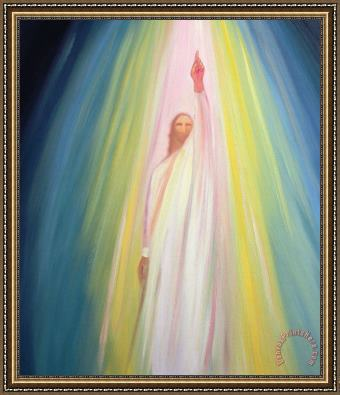
Jesus Christ Points us to God, by Elizabeth Wang

Christ’s death was efficacious for all. The sacrificial system with all of the officiating Levitical priests was the old order of things, meant to point us to Christ.

Offering sacrifices day after day, and engaging in prescribed liturgical rituals in order to access God, are no longer necessary. Perpetual anxiety exists wherever people keep wondering if they have done enough to satisfy their guilt and/or responsibility.

The answer of Christianity is yes, the work is finished; Jesus completed it, once and for all.

There is no longer anything that can distress us. Sin, death, and hell have been conquered through the death of Christ. His singular sacrifice has achieved victory over the sinful powers, and reconciliation and peace with God.

Blessed is the one
    whose sin the Lord does not count against them
    and in whose spirit is no deceit. (Psalm 32:2, NIV)

The covenant code’s sacrificial system was never designed to be a permanent way of doing things. All of the implements used in that system were symbols pointing to the real deal. They were a temporary means of leading people to Christ, who is the once for all sacrifice to end all sacrifices, the one who truly takes away our guilt and shame forever.

The picture is of Christ, as our high priest, who sprinkled us with his own blood and made us clean – not only today or for some temporary period of time – but for all time. We are not only made clean; we are made clean forever by the blood of Christ.

Cleanse me with hyssop, and I will be clean;
    wash me, and I will be whiter than snow. (Psalm 51:7, NIV)

The historical person of Jesus – his life, ministry, crucifixion, death, resurrection, ascension and glorification – was a visible image showing us the great importance of invisible realities.

The Ark of the Covenant was a visible sign of God’s invisible presence, and the need for a restoration of the divine/human connection.

The temple, the worship implements, and the whole sacrificial system was a visible sign of God’s invisible holiness, and the need for purity of heart amongst the people.

Jesus was a real person with a real body and real human needs, a visible reality which showed us the invisible God, and what God truly deems as right and good.

It is Jesus Christ, the Son of God and Son of Humanity, in whom we have redemption the forgiveness of sins. He is the image of the invisible God. (Colossians 1:14-15)

Christ is our Mediator, bridging the gap between heaven and earth.

Christ is our Savior, delivering us from our guilt and shame, our worry and anxiety, and our old enemy, death itself.

Christ is our Advocate, stepping in and acting on our behalf, and sending the Holy Spirit to be his continuing presence on this earth.

Christ is our champion, the pioneer of our salvation, securing redemption for us through his singular death.

Christ is our Intercessor, who even now lives to intercede for us, as we strive and struggle to live in humility, justice, and righteousness, as peacemakers in this world.

What this all means, from the vantage of Christianity, is that we need Jesus.

Without Christ, there is no hope. With Christ, all things are possible.

Jesus is the answer to every question, because Jesus is the center of all things. He is the fertile soil from which all of life sprouts; the first-fruit which provides life; and the continuing sustenance which saves us from a disconnected, fragmented, discouraging existence.

Along with the ancient Hebrew Christians, let us be encouraged with Christ, who is truly our everything.

Accept, O Lord, our thanks and praise for all that you have done for us. We thank you for the disappointments and failures that lead us to acknowledge our dependence on you alone.

Above all, we thank you for your Son Jesus Christ; for the truth of his Word, and the example of his life; for his steadfast obedience, by which he overcame temptation; for his dying, through which he overcame death; and for his rising to life again, in which we are raised to the life of your kingdom.

Grant us the gift of your Spirit; that we may know you and make you known; and through your Spirit, at all times and in all places, may give thanks to you in all things. Amen.

All Saints Day (John 11:32-44)

The Forerunners of Christ with Saints and Martyrs, by Fra Angelico, 15th century

When Mary came where Jesus was and saw him, she knelt at his feet and said to him, “Lord, if you had been here, my brother would not have died.” When Jesus saw her weeping and the Jews who came with her also weeping, he was greatly disturbed in spirit and deeply moved. He said, “Where have you laid him?” They said to him, “Lord, come and see.” Jesus began to weep. So the Jews said, “See how he loved him!” But some of them said, “Could not he who opened the eyes of the blind man have kept this man from dying?”

Then Jesus, again greatly disturbed, came to the tomb. It was a cave, and a stone was lying against it. Jesus said, “Take away the stone.” Martha, the sister of the dead man, said to him, “Lord, already there is a stench because he has been dead four days.” Jesus said to her, “Did I not tell you that if you believed you would see the glory of God?” So they took away the stone.

And Jesus looked upward and said, “Father, I thank you for having heard me. I knew that you always hear me, but I have said this for the sake of the crowd standing here, so that they may believe that you sent me.” When he had said this, he cried with a loud voice, “Lazarus, come out!” The dead man came out, his hands and feet bound with strips of cloth and his face wrapped in a cloth. Jesus said to them, “Unbind him, and let him go.” (New Revised Standard Version)

Every year on the Christian Calendar, the Church commemorates the saints who have gone before us. This day provides an opportunity to acknowledge the spiritual reality that contemporary believers stand on the shoulders of those who lived and died before us. Those saints of yester year deserve our recognition.

Since many believers know little about Christian history, it is good to take the time and reflect on the contributions of our spiritual ancestors. Our own personal spiritual growth isn’t just something we did on our own; we owe a lot to the saints who preceded us, and made it possible for us to know Christ.

In our Gospel lesson for today, Mary’s brother Lazarus had died. She was distraught and mourned her loss. Jesus reminded Mary that physical death is not the end; it is a temporary move to a higher plan of existence, until we all share in the final resurrection of the dead together as believers.

Although dead, the saints we recognize and remember can still speak to us, making significant contributions to our lives. All sorts of books, including Holy Scripture, have timeless reminders of how to live in this world. And, for some Christian traditions, the saints of long ago still maintain a real interaction with us in the present.

Times may change, yet the basic nature of people does not. The saints of the past have incredible wisdom for us, if we will but listen.

The Raising of Lazarus, by John Reilly (1928-2010)

In this way, Lazarus serves as an example of one who has a unique, powerful, and compelling testimony. He speaks, not only actually in his post-resurrection awakening by Jesus, but also virtually in speaking to us through the text and from his historical and heavenly place.

The presence and testimony of Lazarus was incredibly real enough for the religious leaders to begin plotting Christ’s demise; and even planning to kill Lazarus, because of his powerful testimony.

There is a place for grief and tears, and a place for joy and celebration. It seems that too much of our present time is given to the lament which comes from loss. The death and then resurrection of Lazarus by Jesus is a foretaste of Christ’s return.

We, along with all of the saints of bygone eras, will share together in a great resurrection at the end of time.

The author of Hebrews understood this, and spoke about the saints’ anticipation. Even though their lives were often characterized by adversity and suffering, they were able to exercise patience and perseverance, knowing there is something better ahead, along with us:

Some faced jeers and flogging, and even chains and imprisonment. They were put to death by stoning; they were sawed in two; they were killed by the sword. They went about in sheepskins and goatskins, destitute, persecuted and mistreated—the world was not worthy of them. They wandered in deserts and mountains, living in caves and in holes in the ground.

These were all commended for their faith, yet none of them received what had been promised, since God had planned something better for us so that only together with us would they be made perfect. (Hebrews 11:36-40, NIV)

Death is our enemy. Each one of us will succumb to it. Even Lazarus, although dead and then raised to life, ended up dying again. Yet he, along with us, shall be raised immortal.

Until that glorious time, we need to keep going and enduring in this life. We are mortals, subject to all that mortality means for us. Death is that ever-present specter that continually lingers in the background of everyone’s life. The reality of death can upend us, either through the bereavement of loved ones, or through anxious thoughts of our own impending death.

Although Christ has won the war against our old enemy, the fight, however, is not yet over. We need to keep up a future orientation, as Jesus did, and as the faithful saints of the past did.

The risen Lord shall not only cry with us, but shall wipe away every tear, and make it so that we will never be put to shame.

This makes the Christian recognition of All Saints Day not only a remembrance of the past, but also a way of viewing the future. Let us, then, join with all the saints in looking forward to the day of Christ, and letting that perspective shape how we live today.

Beloved God, you deal with us kindly and in steadfast love. You lift up those bent over with heavy burdens, and sustain the weak and oppressed. Release us from our present anxious fears, so that we who hold fast to your commandments, may honor you with faith and patience for all that you have done for us, and will do for us; through Jesus Christ our Lord, in the power of the Holy Spirit. Amen.

Jesus Is Better (Hebrews 7:1-10)

Abraham meets Melchizedek, 13th century mosaic, Basilica di San Marco, Venice, Italy

This Melchizedek was king of Salem and priest of God Most High. He met Abraham returning from the defeat of the kings and blessed him, and Abraham gave him a tenth of everything. First, the name Melchizedek means “king of righteousness;” then also, “king of Salem” means “king of peace.” Without father or mother, without genealogy, without beginning of days or end of life, resembling the Son of God, he remains a priest forever.

Just think how great he was: Even the patriarch Abraham gave him a tenth of the plunder! Now the law requires the descendants of Levi who become priests to collect a tenth from the people—that is, from their fellow Israelites—even though they also are descended from Abraham. This man, however, did not trace his descent from Levi, yet he collected a tenth from Abraham and blessed him who had the promises. And without doubt the lesser is blessed by the greater. In the one case, the tenth is collected by people who die; but in the other case, by him who is declared to be living. One might even say that Levi, who collects the tenth, paid the tenth through Abraham, because when Melchizedek met Abraham, Levi was still in the body of his ancestor. (New International Version)

We all become discouraged at various times in our lives; it’s part of being human. Chronic discouragement, however, can turn into a resignation to one’s apparent fate. It can cause us to give up.

That is where the Jewish Christians were, both spiritually and emotionally, in the New Testament Book of Hebrews. As Jews, they were living in a pagan Gentile world which did not appreciate their religious and cultural differences. As Christians, they lived with isolation from their Jewish families who did not understand their faith commitment to Christ and the Church.

It’s one thing to become discouraged. It’s another thing altogether to never have your situation change. Day after day, the Jewish Christians faced hardship, even persecution. So, over time, their faith and resolve to serve Jesus began weakening. They were in danger of reneging on their cherished beliefs and way of life.

This is why the author of Hebrews stepped in to address the situation. He wanted to encourage the struggling believers to not give up, to persevere in their faith. In order to do that, the Christians would need to fix their eyes on Jesus.

Instead of returning to Judaism, the Jewish Christians were encouraged to see how Jesus is superior to every important person in history, and better than the legal and sacrificial systems that they came from.

In chapter 7 of Hebrews, the author is continuing an argument that Jesus is better than the high priest Aaron (Hebrews 4:14-10:18). Part of that argument was to highlight the significance of an ancient king, Melchizedek, who was both a king and a priest of the Most High God.

The line of reasoning goes like this:

  • Melchizedek was a king and a priest in the time of Abraham.
  • Abraham acknowledged Melchizedek as such, and recognized his greatness and authority.
  • Therefore, Melchizedek is superior to the founder and patriarch of Jewish faith, Abraham.
  • Jesus is both a king and a priest, like Melchizedek.
  • Aaron is a priest, not a king.
  • Jesus is superior to Aaron; Aaron’s ministry was temporary, and Christ’s reign is permanent.

Specifically, regarding the lesson today, the argument is this:

  • Descendants of Levi were priests in Israel.
  • Levi was the ancestor of Aaron, the original Levitical high priest.
  • Abraham was the great grandfather of Levi.
  • Abraham was patriarch, and therefore, greater than Levi.
  • Melchizedek is greater than Abraham.

And so, the author of Hebrews was making this argument:

Jesus is a priest and king, like Melchizedek. Therefore, Jesus is superior to Abraham, Levi, Aaron, and all of the Levitical priests.

The Book of Hebrews insists that Jesus is greater than all other Jewish persons in history; and is superior to the old Levitical sacrificial system. Every Levitical priest lived and died. Jesus lived and died and rose from death. Therefore, Christ’s priesthood is still in existence. It is permanent.

From the New Testament perspective, Christ’s death and resurrection has replaced the Levitical priesthood as a new and better system of order. It’s new and better because, whereas the Levitical priests offered sacrifices day after day, Christ offered himself, once for all. The Cross of Christ was the sacrifice to end all sacrifices.

This spiritual reality, presented to the Jewish Christians in the ancient world, was meant to encourage them to hold fast in their commitment to Jesus.

We now have the privilege of coming to God without any spiritual hurdles to jump or obstacles to overcome, because Jesus made it possible.

God is available to us at all times, without having to offer a sacrifice in order to enter God’s presence, because the curtain of the temple has been torn in two.

Christ Jesus has finished the sacrificial work, and made it possible for every believer to come to God by faith alone.

So, don’t give up. Be encouraged with Jesus, the Savior and Sovereign of the universe, the Sustainer and Helper in a time of need, and the great King and High Priest who lives even now to intercede for us.

Hebrews is a somewhat long book in the New Testament of the Bible, encompassing thirteen chapters in all. It’s contents may sometimes seem dense and/or confusing. Yet, if you read through it, in one sitting, I believe you will come away encouraged and motivated to persevere and keep going.

Be patient, my friend. The situations which are now discouraging you will not last. And there is a King and High Priest who will last forever, and who has your back through all of the icky sticky circumstances of your life.

Fix your eyes on Jesus, the author and perfector of our faith.

Accept, O Lord, our thanks and praise for all that you have done for us. We thank you for the splendor of the whole creation, for the beauty of this world, for the wonder of life, and for the mystery of love.

Above all, we thank you for your Son Jesus Christ; for the truth of his Word and the example of his life; for his steadfast obedience, by which he overcame temptation; for his dying, through which he overcame death; and for his rising to life again, in which we are raised to the life of your kingdom.

Grant us the gift of your Spirit; that we may know you and make you known; and through your Spirit, at all times and in all places, may give thanks to you in all things. Amen.