Be Patient – Third Sunday of Advent (James 5:7-10)

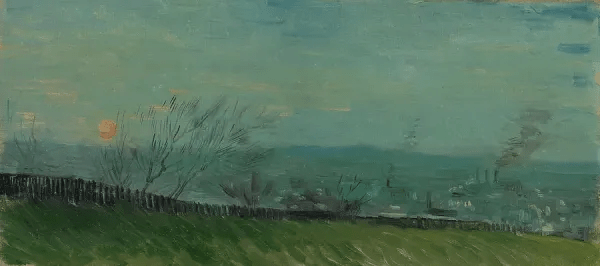
Sunset in Montmartre, by Vincent Van Gogh, 1887

Be patient, therefore, brothers and sisters, until the coming of the Lord.

The farmer waits for the precious crop from the earth, being patient with it until it receives the early and the late rains. You also must be patient.

Strengthen your hearts, for the coming of the Lord is near.

Brothers and sisters, do not grumble against one another, so that you may not be judged. See, the Judge is standing at the doors! 

As an example of suffering and patience, brothers and sisters, take the prophets who spoke in the name of the Lord. (New Revised Standard Version)

Patience is a wonderful virtue… unless you’re smack in the middle of circumstances you neither want nor asked for. Then, patience feels a whole lot more like a vice.

It’s easy to be impatient; it takes little to no effort at all. And praying for patience doesn’t help, because you’re prayer actually gets answered; God puts you in one of those unwanted situations.

The Jewish Christians for whom the Epistle of James was addressed were in that weird life-place of enduring hard circumstances. They were struggling with impatience, so much that the believers began cozying up to the rich and powerful to meet their ever-increasing needs. In their misery, they were looking to the very people who were using them and withholding wages from them. (James 2:1-7; 5:1-6)

It seemed as if God was shuffling his divine feet and not getting around to helping the Christians in their difficulty. They gave everything to Jesus and following him, to the point of being willing to suffer for the Name.

Their suffering led to outright persecution. The believers had to flee Judea for Gentile lands to the West (Acts 8:1-3). In their new homes they got double-trouble. Because they were Jews, they were looked at with suspicion. And because they were Christians, the Jewish community didn’t accept them. The believers were truly alone. All they had was Jesus.

It was enough, at least for a while. But it’s one thing to face difficulty, and quite another thing for the trouble to bleed into next week, next month, next year… When is this ever going to end?

Impatience doesn’t help. In fact, it only exacerbates an already agonizing situation. Grumbling and arguing and verbal fights begin to occur. The community starts to fracture. Blaming and shaming slowly replace the love and encouragement they once had together.

Every good thing in life takes time – lots of time! And the best things in life require a lifetime of endurance, perseverance, and patience. In order to keep going and hold onto our spiritual commitment, we need solid examples of patience, and reasonable ways to think about our situations.

I admit that it has been hard for me to be patient, as of late. I’m weary of American politics and the current administration. I’m tired of seeing my family members struggle with health issues day after day – many of them having to endure debilitating and heart-wrenching trials.

And there are some days when I’ve just had it with my own limitations. I can’t do many of the things I used to do, and it’s frustrating to tears to try and do some things that others do effortlessly.

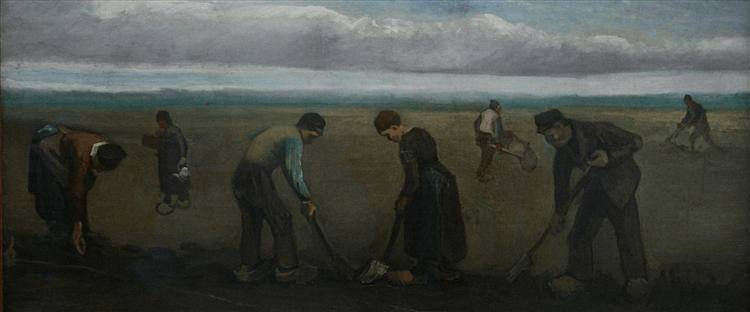
Yet the Scripture reminds me of my days growing up on the farm. Planting and harvesting never happened in a week; it takes months to realize a return on all the hard work done through the Spring and Summer to get to Fall’s mature crop.

Peasants Planting Potatoes, by Vincent Van Gogh, 1884

I’m also reminded of the biblical prophets who suffered much for their message to the people. Lately, I’ve been reading the prophecy of Ezekiel in the Old Testament. If you have never read Ezekiel, or only read bits of it, you may not realize how incredibly difficult Ezekiel’s life was in serving Yahweh.

The prophet kept up a steady stream of very challenging situations to illustrate the message of judgment he was continually giving. Needless to say, Ezekiel was not always a popular guy. Proclaiming gloom, doom, and death all day every day tends to do that. In one encounter, for month after month, the prophet laid on his side and had to use excrement to light a fire and cook his food every day. God told him to, so that the people would see what was about to happen to them. (Ezekiel 4:1-17)

We have no record of Ezekiel grumbling or talking back to God. He faithfully did all that the Lord commanded him to say and do. He endured all the grumblers around him, and all the grieving people who had been displaced from their homes in Jerusalem.

In every generation, there are people in this world that undergo difficulties and troubles which others could never even imagine. And it’s been going on for millennia. Furthermore, terrible adversity will keep happening… until Christ returns.

Yes, there will be an end to all the suffering. But we may have to persevere to the end of our lives, remaining faithful to our spiritual commitment, and keeping up our love for one another. It won’t be easy to do.

I would be nothing but a hack preacher if I told you that everything will be bunnies and butterflies if you only look to Jesus and have faith. Although there can be joy, even in our mourning, there will always be the need for an agonizing form of patience that continually watches for help, healing, and hope in the return of Christ.

This is why it is so important not to let your own family, church, and faith community break down into fissures of impatience and grumbling.

We must keep our hearts strong. Ironically and paradoxically, that happens through our weakness.

In some ways, I’m weaker than I’ve ever been in my life. Yet, in other ways, I’ve never been stronger. The Trump administration can break me down and mess with my healthcare and my finances… my illness can keep me from ministry that I long to do… and the daily crud of life may redirect me in ways I don’t like… but I can truly say that God is good; God is the strength of my life.

I know that Christmas is coming. I’m looking for the birth of the Savior. I expect to see the angels rejoicing in the sky. I fully look forward to stepping in a few cow pies and horse apples in order to get a glimpse at the baby who changes the world.

Every good thing in life comes with a bit of manure on the shoes. And the best things in life are worth all the hardship one goes through in order to see the glory and majesty of the Divine.

I may not know you, my friend, but please know that I am praying for you. No matter what happens, I can always pray, always watch, always hope, always believe, and always love my neighbor, despite all the hate in this old fallen world.

Be safe. Be strong. Be spiritual. We are all in this life together.

God of joy and exultation, you strengthen what is weak; you enrich the poor and give hope to those who live in fear. Look upon our needs this day. Make us grateful for the good news of salvation and keep us faithful in your service until the coming of our Lord Jesus Christ, who lives forever and ever. Amen.

It’s Time To Wake Up – First Sunday of Advent (Romans 13:11-14)

Besides this, you know what time it is, how it is already the moment for you to wake from sleep. For salvation is nearer to us now than when we became believers; the night is far gone; the day is near. Let us then throw off the works of darkness and put on the armor of light; let us walk decently as in the day, not in reveling and drunkenness, not in illicit sex and licentiousness, not in quarreling and jealousy. Instead, put on the Lord Jesus Christ, and make no provision for the flesh, to gratify its desires. (New Revised Standard Version)

But make sure that you don’t get so absorbed and exhausted in taking care of all your day-by-day obligations that you lose track of the time and doze off, oblivious to God. The night is about over; dawn is about to break. Be up and awake to what God is doing! God is putting the finishing touches on the salvation work he began when we first believed. We can’t afford to waste a minute, must not squander these precious daylight hours in frivolity and indulgence, in sleeping around and dissipation, in bickering and grabbing everything in sight. Get out of bed and get dressed! Don’t loiter and linger, waiting until the very last minute. Dress yourselves in Christ, and be up and about! (The Message)

I like metaphors, that is, word-pictures that help illustrate and visualize a concept or idea. That’s probably why I like the Apostle Paul, because I find in him a guy who appears to have the same affinity for metaphors that I do.

In the New Testament reading on this First Sunday of Advent, Paul gives four metaphors to help us grab ahold of what he wants to get across to us:

We are not in some holding pattern, passively awaiting heaven. This is because our salvation is not yet complete. Completeness won’t happen until Jesus returns, until the second advent of Christ. Therefore, we are to be active now, working on our faith commitment to Jesus and to his church.

In this advent season, as we remember Christ’s first “advent” (or “coming”) to this earth, we are equally anticipating the second coming of Christ – not knowing quite when that will occur. Only until this event happens will our salvation come in all of its fullness.

The church is a unique community of persons who continually have an eye toward the future return of Jesus. And this future orientation is supposed to give shape to how we live in the present time.

The world-wide Christian community presently follows the way of deliverance. This current time and place is not the arrival point. Today doesn’t mark the time in which our salvation is fully realized or acquired.

In other words, we are to avoid acting as if this is our permanent home. Rather, we are pilgrims on this earth, sojourning through it as if we were but camping out. Our true home is someplace else. And we will get there when Christ comes again.

There is a stark contrast between those who put all their eggs into the present earthly basket, and those who maintain a future orientation of working now with an eye out for Jesus to return. This contrast is illustrated by Paul with images of what it’s like to live for and in the Roman society; and what it’s like to live with Jesus as Lord, instead of Ceasar.

Are you asleep or awake, living for the night or in the day?

Therefore, keep awake, for you do not know when the master of the house will come, in the evening or at midnight or at cockcrow or at dawn, or else he may find you asleep when he comes suddenly. (Mark 13:35-36)

Paul, taking his cues from Jesus, exhorted the believers to stay alert and be prepared for the end when it comes. Living for the nighttime is a metaphor for giving-in to one’s personal sinful desires; whereas living in the daylight hours is a picture of following the words and ways of Jesus.

What are you wearing? What are you taking off, and what are you putting on?

Using the metaphor of clothes – undressing and dressing oneself – Paul is talking about exchanging one set of clothing for another. This isn’t merely putting on a different pair of jeans than what you already have on. It’s much more radical than that. It’s doffing the tuxedo and donning the overalls. The picture is one of doing something completely different than what you’ve been doing before.

Paul wanted a complete makeover, a total change of moral and ethical behavior that is consistent with the gospel of Christ, and not with typical Roman society. It involves taking up one’s cross and following Jesus. It’s gritty and dirty and gets down to it; instead of avoiding hard work and seeking to have someone else do what is unpleasant to me.

Our allegiance and commitment to Christ is on full public display – not in placards with Bible verses on them, but with the sweet aroma of living a humble and just life in all of its simplicity and holiness.

Will you do the works of darkness, or take up the armor of light?

The darkness represents the unjust life of lies, selfishness, conflicts of interest, relational discord, and immoral actions. The light is meant to convey a beautiful life of integrity, wholeness, righteousness, and peace through loving actions.

Christians are to progressively take on the character of Christ, and not of whatever political character happens to be in power.

Using the metaphor of armor points us not only toward the struggle we confront in living a moral and righteous life, but also toward Christ who is our Divine Warrior. Jesus is the One who fights the battle and wins the victory.

Our struggle is not against flesh and blood, but “against the rulers, against the authorities, against the cosmic powers of this present darkness, against the spiritual forces of evil in the heavenly places.” (Ephesians 6:12)

Do you know what time it is? Is there any hopeful expectation?

The Christian is one who knows the time is nearer now than when they first believed. We may not know the precise date on the calendar when Jesus will come again, yet we are convinced that he is returning soon.

Therefore, the believer has no business spending time in trying to predict the day of the end. Instead, the believer must remain faithful and persevere to the end with a firm commitment to Christ, and a dedication to doing what is good, right, and just.

So, herein lies the challenge for every believer: Those of us who name Jesus as Lord will continue to live in a world of injustice and unrighteousness. Christians are continually being pulled in differing directions all at once, all the time.

It’s a hard slog. Yet the Christian finds joy and satisfaction in knowing who they are, who they believe in, and who is coming back to make all things new.

Christianity involves a whole lot more than praying a salvation prayer once, then going on one’s merry way, doing whatever the heck one wants to do.

Rather, Christianity is a radical existence of waking from sleep and changing allegiances from immoral leaders to the true sovereign of the universe.

It’s like moving from seeing shadowy forms just before the dawn to seeing clearly in the sun’s full light of day.

It’s as if I’ve been given a completely new set of clothes to put on, giving up the rags of this world for the raiment of being adopted into royalty.

We remain continually vigilant, always watching, always praying, always believing, always loving – knowing that our salvation is at hand, nearly here, and could happen at any moment.

God of justice and peace, from the heavens you rain down mercy and kindness, so that all on earth may stand in awe and wonder before your marvelous deeds. Raise our heads in expectation, that we may yearn for the coming day of the Lord and stand without blame before your Son, Jesus Christ, who lives and reigns forever and ever. Amen.

The Time Is Near (Luke 21:5-19)

The Siege and Destruction of Jerusalem, by David Roberts, 1850

When some were speaking about the temple, how it was adorned with beautiful stones and gifts dedicated to God, he said, “As for these things that you see, the days will come when not one stone will be left upon another; all will be thrown down.”

They asked him, “Teacher, when will this be, and what will be the sign that this is about to take place?” And he said, “Beware that you are not led astray, for many will come in my name and say, ‘I am he!’ and, ‘The time is near!’ Do not go after them.

“When you hear of wars and insurrections, do not be terrified, for these things must take place first, but the end will not follow immediately.” Then he said to them, “Nation will rise against nation and kingdom against kingdom; there will be great earthquakes and in various places famines and plagues, and there will be dreadful portents and great signs from heaven.

“But before all this occurs, they will arrest you and persecute you; they will hand you over to synagogues and prisons, and you will be brought before kings and governors because of my name. This will give you an opportunity to testify. So make up your minds not to prepare your defense in advance, for I will give you words and a wisdom that none of your opponents will be able to withstand or contradict. You will be betrayed even by parents and siblings, by relatives and friends, and they will put some of you to death. You will be hated by all because of my name. But not a hair of your head will perish. By your endurance you will gain your souls. (New Revised Standard Version)

The Arch of Titus in Rome, depicting the Roman triumphal march after victory against the Jewish revolt

The temple, central in today’s Gospel lesson, had undergone an impressive and beautiful refurbishment by Herod the Great (appointed as King of Judea by the Roman Emperor).

It took eighty years for the rebuilding project to be completed. It was significantly enlarged; and generous amounts of gold and silver were used to refurbish it, along with ample use of white marble.

So, it was no wonder that people coming to Jerusalem and approaching the temple admired the massive and impressive edifice. In their awe, they commented so to Jesus.

But Jesus was less impressed with all the architectural rebuilding and expansion of grounds, and more concerned about what would be coming soon concerning the temple and the inhabitants of Jerusalem.

Jesus became the wet washrag to the awe of viewing the Jerusalem temple. He stated that the temple would be destroyed; and it would happen soon.

Imagine if you were one of the persons in the crowd listening to Jesus. “What are you talking about? Why in the world would you even bring that up? It’s obvious that God won’t let this temple be destroyed. It’s his house!”

To their credit, Christ’s disciples did not question the words of Jesus. They only asked a follow up question of when this imminent destruction was going to take place. Unlike the crowd, their query was: “When can we expect this to happen?”

Christ responded by warning his disciples not to believe every apocalyptic preacher who comes along trying to tell everyone when the event will happen. Because some of those preachers will be false prophets who only lead people astray.

False prophets tend to prophesy peace and abundance when God has already proclaimed doom. I find it curious and interesting that the current U.S. President keeps up a steady stream of telling the American people that the economy is booming and that everyone can trust him to keep them safe and secure – even though there is zero evidence for such bluster.

(In in fact, there is contrary evidence to his words; which begs the question why anyone would listen to him…). Prophets who ignore truth and proclaim error tend to downplay any sort of doom on the horizon, especially when they are in power.

Yet, with all the doom and gloom proclaimed by Christ, let’s keep in mind that although the temple was indeed destroyed as Jesus said it would in the year 70 C.E., neither Christianity nor Judaism was destroyed along with it.

God transcends any physical sacred religious space in the form of temples and church buildings.

After the temple’s destruction, both religions kept on, with Christianity growing and becoming the world’s most populous religion. Today, Judaism and Christianity have adherents across the entire earth in every nation, and among all sorts of races and ethnicities.

Sometimes the modern church forgets these things. There are many congregations today who identify themselves chiefly by their church building. For them, everything revolves around maintaining the physical plant, keeping the lights on, and having enough people in the pew to pay for it all.

All of this focus on the building means that congregants too often get excited about new people because they see them as potential givers who can help shoulder the load of paying bills and keeping up the building’s maintenance.

It’s no wonder that these same churches are continuing to decline. They are closing their doors at the rate of about 10 churches every day in the United States (nearly 4,000 churches per year).

When a church is struggling, it’s easy to believe that some gifted pastor will come along to renew and refurbish them; or that God will magically intervene and bring dozens if not hundreds of people to fill their empty pews.

They don’t want to hear any message that their building will be demolished by a wrecking crane. Yet, in many circumstances, Jesus has communicated to them what will happen. But the people continue believing the false prophesies of renewed glory days and the building busting at the seams with fresh converts.

If I’m coming across as a wet washrag, I’ll gently point us back to the Gospel story of Jesus for today.

Sometimes grief and lament are more biblical than overt positive thinking which is guised in the language of faith.

However, no matter what, the worldwide church will continue to go on, and the gates of hell shall not prevail upon it. The church will keep going, albeit in new places and in all sorts of new forms. Our task is to be sensitive to the Spirit’s leading, and have discerning men and women of faith who are true prophets with helpful information.

Back to the story, Jesus was even more gloomy about what would happen after the temple was destroyed. Believers would be arrested and persecuted. Circumstances would be dire. Christians would continually be at risk. And yet, a look back at history tells us that the church did not die; rather, it grew and flourished.

I am reminded today that hard circumstances and difficult situations – even including death and destruction – are not the end. In God’s kingdom, up is down and down is up; first is last and last is first. All is not lost, even though it may look that way today.

I am reminded of the words of the medieval priest, Thomas à Kempis, who wisely had his mind and heart in the right place when it came to hardship and persecution:

“Sometimes it is to our advantage to endure misfortunes and adversities, for they make us enter into our inner selves and acknowledge that we are in a place of exile and that we ought not to rely on anything in this world.

“And sometimes it is good for us to suffer contradictions and know that there are those who think ill and badly of us, even though we do our best and act with every good intention. Such occasions are aids in keeping us humble and shield us from pride.

“When men ridicule and belittle us, we should turn to God, who sees our innermost thoughts, and seek His judgment…

“It is when a man of good will is distressed, or tempted, or afflicted with evil thoughts, that he best understands the overwhelming need he has for God, without whom he can do nothing.

“While enduring these afflictions he takes himself to prayer with sighs and groans; he grows tired of this life and wishes to die so that he could be undone in order to live with Christ. It is in such times of trial that he realizes that perfect security and full peace are not to be found in this world.”

May we put our eggs not in the earthly basket of architectures, buildings, and physical plants, but in the heavenly basket of compassionate ministry, uplift for the poor and needy, and proclamation of the gospel of grace to all.

O God, in Christ you give us hope for a new heaven and a new earth. Grant us wisdom to interpret the signs of our times; encourage us to stand in the time of trial; and have faith to witness to your truth and love. Amen.

The Righteous and the Wicked (Malachi 3:13-18)

“You have spoken arrogantly against me,” says the Lord.

“Yet you ask, ‘What have we said against you?’

“You have said, ‘It is futile to serve God. What do we gain by carrying out his requirements and going about like mourners before the Lord Almighty? But now we call the arrogant blessed. Certainly evildoers prosper, and even when they put God to the test, they get away with it.’”

Then those who feared the Lord talked with each other, and the Lord listened and heard. A scroll of remembrance was written in his presence concerning those who feared the Lord and honored his name.

“On the day when I act,” says the Lord Almighty, “they will be my treasured possession. I will spare them, just as a father has compassion and spares his son who serves him. And you will again see the distinction between the righteous and the wicked, between those who serve God and those who do not. (New International Version)

The righteous and the wicked. Depending upon what sort of faith tradition you grew up in as a child; or by what belief system you currently adhere to, this may likely determine your understanding of those two words.

The terms “righteous” and “wicked” vary amongst differing groups of people. But however you understand those words, I want us to notice how the prophet Malachi understands them.

To be “righteous” means to have a right relationship with both God and others. It is to be close enough to knowing God to carry out what is important to God.

Righteous folk actually listen and talk to one another. They consult and collaborate with each other. They enjoy good relations because the righteous understand that relationships are a high value. They discern that people are important.

And so, God’s justice is very important to the righteous, because God wants everyone’s basic needs met. The Lord desires people to be treated well, with respect and dignity, in order to make a living and enjoy life.

To be “wicked” means to be arrogant, proud, and boastful. It is to have a string of messed up relationships with both God and others because they insist on their own way.

The wicked are far from God, and do whatever they want to do, regardless of how it may affect others. They view justice and righteousness as dispensable, and unnecessary, unless it can be used as leverage for selfish desires. Even though the wicked might be rich and powerful in this life, they will not be spared from God’s judgment.

Wicked persons – those who carry out injustice and seek to care only for themselves – are called to repent, to change, to amend their evil ways. Their negative statements about God, and their mistreatment of others, has not gone unnoticed.

A typical tactic of wicked persons is to blame others. In Malachi’s day, they were blaming God, and ironically, accusing the Lord of injustice. That’s because the wicked person’s understanding of God is that the Lord exists for their personal benefit.

So, if the wicked person is not receiving some benefit from God, then God isn’t being God, and then is accused and blamed as being the problem to any sort of adverse situation.

But in reality, the righteous are God’s treasured possession, because they consistently serve the Lord, no matter the circumstances. The righteous are faithful, and so, they will be spared on the day of God’s judgment.

So far, I have made this all seem quite black and white. But that was only to make clear the contrast between righteousness and wickedness. The truth is that all of us are a bit of both. We are not always completely right, nor are we always wrong.

We are in the middle of things. Most folks have not rejected God through a lack of belief. Yet, they also have not fully accepted God’s intentions for this world and are not fully living into them.

The prophet Malachi calls such persons (which is perhaps all of us?) to a day when trying circumstances will make the distinction between the wicked and the righteous much more clear.

Then, we will be able to change, fully convinced and knowing the difference between right and wrong, truth and error, faith and fear.

Charlatans will eventually be found out and known. And the consistently faithful people will eventually be noticed and held up by God for others to see and know.

If everything presently appears murky, shadowy, and unclear, please know that it will not always be this way for you.

I am assuming that there very few “wicked” persons actually reading or listening to this. Simply because they see no value in doing so. It doesn’t get them anywhere they want to go.

The wicked may seem to know what they’re doing, but they don’t. Life for them is very nebulous and unclear. They’re only spit-balling through life, trying to look out for number one, that is, themselves.

But you who are reading or listening to this likely want nothing to do with wickedness. You want to stay away from evil.

You are looking to make a difference on this earth, and to improve your little corner of the world. You desire good things for yourself and others. You seek to live as justly and rightly as you can.

Good for you! The Lord is noticing your faith and patience.

So do not throw away your confidence; it will be richly rewarded.

You need to persevere so that when you have done the will of God, you will receive what he has promised. For,

“In just a little while,
    he who is coming will come
    and will not delay.”

And,

“But my righteous one will live by faith.
    And I take no pleasure
    in the one who shrinks back.”

But we do not belong to those who shrink back and are destroyed, but to those who have faith and are saved. (Hebrews 10:35-39, NIV)

Eternal God, in whose perfect kingdom no sword is drawn but the sword of righteousness, no strength known but the strength of love: So mightily spread abroad your Spirit, that all peoples may be gathered under the banner of the Prince of Peace, as children of one Father; to whom be dominion and glory, now and forever. Amen.