Put To Death (Acts 7:55-60)

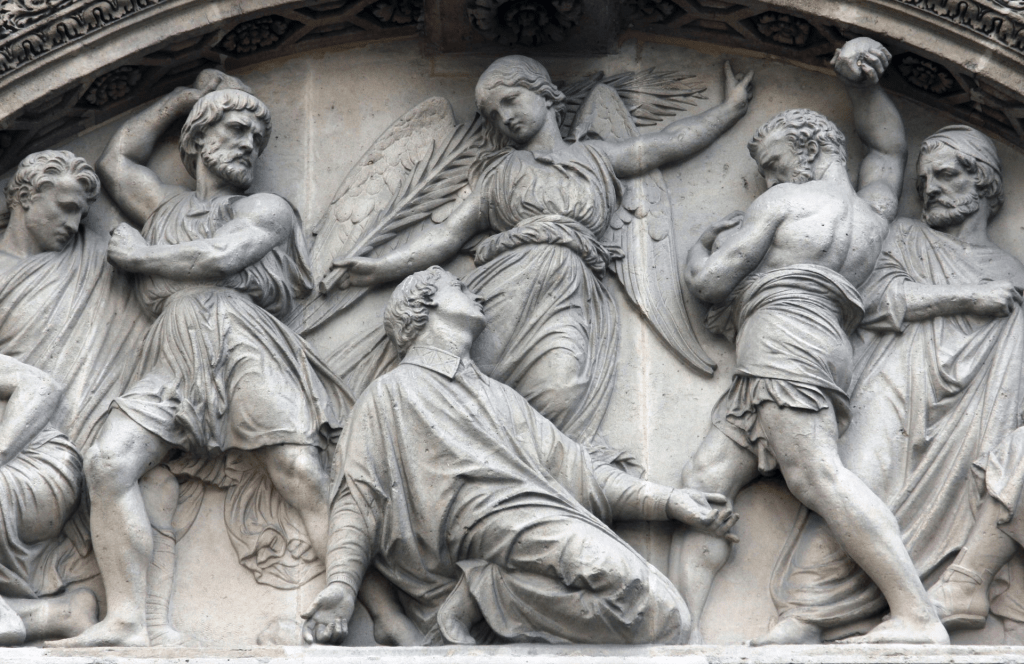
The Martyrdom of Stephen, by sculptor Gabriel-Jules Thomas (1824-1905)

But Stephen, full of the Holy Spirit, looked up to heaven and saw the glory of God, and Jesus standing at the right hand of God. “Look,” he said, “I see heaven open and the Son of Man standing at the right hand of God.”

At this they covered their ears and, yelling at the top of their voices, they all rushed at him, dragged him out of the city and began to stone him. Meanwhile, the witnesses laid their coats at the feet of a young man named Saul.

While they were stoning him, Stephen prayed, “Lord Jesus, receive my spirit.” Then he fell on his knees and cried out, “Lord, do not hold this sin against them.” When he had said this, he fell asleep. (New International Version)

Although I am a trained in biblical exegesis and hermeneutics (interpreting Scripture) I believe that most insights come from making simple observations about the text. So, I want to point out: Stephen was not martyred by the Romans, a religiously pagan group, nor Gentile people; he was martyred by those of his own ethnicity, by “God’s people.”

The religious authorities were more than just unhappy with Stephen. The Sanhedrin (the Jewish ruling council) were incensed with him, so mad that they were grinding their teeth at him. The council sincerely believed Stephen was a blasphemer of God, that what he was saying was so subversive and religiously radical, they could stone him to death with a clear conscience, as if this act were upholding God’s honor and God’s Law.

The result was not only the death of a humble man; it also sparked an intense persecution against the church which caused a new Christian diaspora (Acts 8:1-3). Many believers in Jesus found themselves as Christian refugees trying to eke out a living and worshiping Christ in foreign places.

I wish I could say the greatest opposition I’ve ever experienced as a Christian came from non-Christians who simply misunderstood and misinterpreted me. However, my most hurtful wounds have come from the hands of church folk, believing they were acting on God’s behalf by exacting an emotional martyrdom upon me with the stones of gossip, slander, backbiting, blame-shifting, and outright lying (and a few threats of violence).

Whenever I encounter persons who no longer attend church and have no intention of ever returning to any local congregation, I get it. I understand. Yet, although the church is sometimes like a woman of disrepute, I still love her, and will do whatever I can to edify her and not repay evil with evil.

Stoning a believer, either actually with physical rocks or virtually with verbal stones, is akin to persecuting Jesus himself. That’s because Christ so closely identifies with his people that it is as if he is a head, and his followers are a body – joined together in a vital union.

So, when Christ’s Body is subjected to what I call, “hermeneutical hubris,” in which one group of people insists there is only one way to interpret Scripture, and then uses their authority and structures of power to force compliance on another group, the result is persecution.

And that is precisely why Christians can abuse other Christians.

Rather than discerning that all Christians belong to God, one narrow-minded and small-hearted group excludes all other groups who disagree with them as blaspheming the name of Christ.

For example, insisting that a literal interpretation in the only means of understanding the Bible’s authority is to ignore and abuse the actual and real authority which exists with the Bible. I am in no way encouraging an “anything goes” type of approach to Holy Scripture that lets it say whatever you want it to say. 

What I am saying is that the biblical writers themselves employed different methods of interpretation, as well as the early church fathers (which is one reason I hold to the interpretive guides of the ancient Christian creeds, i.e. The Apostles’ Creed and Nicene Creed).

Far too often, churches stick to a particular interpretation because they believe they are keeping biblical fidelity. This is many times born of a fear that Christendom will be lost, and society will sink into an abyss of egregious sin. The irony is that many churches are sinking into forms of abusive and ungracious behavior by fighting battles that Scripture does not call them to fight.

The binary thinking of “I’m right and you’re wrong” is not an approach you’ll find in God’s Holy Word.

Even if the Sanhedrin in Stephen’s day intended on upholding the holiness of their God and the rightness of their cause, the impact it had on the church was martyrdom, death, and diaspora.

Unfortunately, throughout Christian history, the tables have too often turned with Christians persecuting Jews. I myself would like to avoid being the persecutor. If I kill anything, may it be putting to death my own sin – because that is what the Bible calls me to do.

Dear brothers and sisters, you have no obligation to do what your sinful nature urges you to do. For if you live by its dictates, you will die. But if through the power of the Spirit you put to death the deeds of your sinful nature, you will live.

The Apostle Paul (Romans 8:12-13, NLT)

Since, then, you have been raised with Christ, set your hearts on things above, where Christ is, seated at the right hand of God. Set your minds on things above, not on earthly things. For you died, and your life is now hidden with Christ in God. When Christ, who is your life, appears, then you also will appear with him in glory.

Put to death, therefore, whatever belongs to your earthly nature: sexual immorality, impurity, lust, evil desires and greed, which is idolatry. Because of these, the wrath of God is coming.You used to walk in these ways, in the life you once lived. But now you must also rid yourselves of all such things as these: anger, rage, malice, slander, and filthy language from your lips. 

Do not lie to each other, since you have taken off your old self with its practices and have put on the new self, which is being renewed in knowledge in the image of its Creator. Here there is no Gentile or Jew, circumcised or uncircumcised, barbarian, Scythian, slave or free, but Christ is all, and is in all.

Therefore, as God’s chosen people, holy and dearly loved, clothe yourselves with compassion, kindness, humility, gentleness and patience. Bear with each other and forgive one another if any of you has a grievance against someone. Forgive as the Lord forgave you. And over all these virtues put on love, which binds them all together in perfect unity.

Let the peace of Christ rule in your hearts, since as members of one body you were called to peace. And be thankful. Let the message of Christ dwell among you richly as you teach and admonish one another with all wisdom through psalms, hymns, and songs from the Spirit, singing to God with gratitude in your hearts. And whatever you do, whether in word or deed, do it all in the name of the Lord Jesus, giving thanks to God the Father through him. (Colossians 3:1-17, NIV)

Gracious God, as your Son humbled himself on this earth, so may your church walk continually in such humility that believers everywhere work together in unity for the sake of gospel of grace as a blessing to the world in the power of your Holy Spirit. Amen.

Persevere Through Adversity (Psalm 129)

Painting of Jerusalem by Alex Levin

From my earliest youth my enemies have persecuted me.
    Let all Israel repeat this:
From my earliest youth my enemies have persecuted me,
    but they have never defeated me.
My back is covered with cuts,
    as if a farmer had plowed long furrows.
But the Lord is good;
    he has cut me free from the ropes of the ungodly.

May all who hate Jerusalem
    be turned back in shameful defeat.
May they be as useless as grass on a rooftop,
    turning yellow when only half grown,
ignored by the harvester,
    despised by the binder.
And may those who pass by
    refuse to give them this blessing:
“The Lord bless you;
    we bless you in the Lord’s name.” (New Living Translation)

The Jewish people know a thing or two about perseverance through suffering; they’ve been enduring it for millennia. If we let them, they can show us a better way of facing adversity.

It seems to me that we modern Gentiles could learn from our Jewish brothers and sisters. We Westerners tend toward burying the past, putting things behind us, and forgetting all the bad things which occurred back there. But the Psalms, a wonderful depository of Jewish thought and practice, will have none of that approach.

Today’s Psalm comes from a group known as the “Psalms of Ascent.” (Psalms 120-134) These were sung by ancient Jewish worshipers as they made the journey up to Jerusalem for the Feast of Tabernacles.

As the pilgrims walked together on their ascent to the great city, the experience of collectively singing and worshiping made the people feel united in joy, purpose, and sorrow. Remembering was central to that sense of solidarity.

The Jewish people have been attacked by countless enemies, not only throughout the Old Testament, but also throughout their long history. Empires tend to not like Jews because Jews hold to their own set of laws and worship practices – which seem to always come into conflict with what some Emperor, Dictator, or Tyrant wants. So, they try to be rid of Jews, like plowing a field to break up the stubborn hard ground of Yahweh worship. The Jewish people end up being treated, literally, like dirt.

“The attempt to eliminate the people of God was an attempt to eradicate the presence of God from the human situation. The fact that after Auschwitz the Jewish people still lives and can still affirm its faith is the most powerful testimony that God still lives.”

Rabbi Jonathan Sacks, Crisis and Covenant

God will deliver… eventually. Whether Jew or Christian, there will always be enemies to the faith. And sadly, the history of Christianity includes their own brand of persecuting Jews. *Sigh*

Haters, the Psalm hopes, will be like grass in shallow soil: They may sprout quickly, but will also wither quickly and blow away to be gone forever.

The evil of this fallen world is terrible and ugly; but it isn’t permanent. Therefore, we need patience and perseverance through the suffering and adversity to realize the deliverance.

And as much as aggressive bullies try to wipe out those not conforming to their ways, the Lord simply brings in a harvest of righteousness, despite it all.

Even though the Psalms of Ascent were written long ago by people living in a time and place very different from ours, yet they express the emotions we all feel, which makes them helpful for our journey through life, as well.

Although none of us delights in persecution, pain, and struggle, we can take the stance of embracing our hard circumstances because suffering produces perseverance; perseverance, character; and character, hope. And hope does not put us to shame, since love is the force that binds the world together. (Romans 5:3-8)

“When two friends climb a hill, the hill seems less steep than if they climbed it alone.”

Sherri Mandell

Oftentimes, it is inside the pain that we begin to become one with our own vulnerable humanity. And that humble humanity is where great courage, great creativity, and great work germinates within our spirits and cultivates the ground of this world, growing to produce faith, hope, and love.

Everyone facing adversity knows how hard it is to keep going without seeing the goal. Like the farmer, we must expectantly wait till the harvest. There is nothing we can do to speed up the process and go straight from planting to harvest. It takes time and plenty of patience. Grumbling and complaining about how long it is taking will not make it go any faster.

Perseverance in the face of hardship is a major pathway to realizing a holy life. Consider the ancient prophets:

  • Jeremiah was faithful to proclaim God’s message yet was thrown into a cistern and left for dead. Yet, he was delivered from it. (Jeremiah 38:1-28)
  • Micaiah was faithful to declare truth to King Zedekiah, who then promptly imprisoned him, even though the king asked for God’s message. (1 Kings 22:24-27)
  • Daniel was faithful to pray consistently to the one true God and was thrown into the lion’s den to be killed. But the Lord saved him. (Daniel 6:1-28)

The prophets all suffered for doing the right thing and did not waver in their commitment to the Lord. Through their troubles they learned to trust God and draw near to the Lord. The adversity strengthened, not weakened, their faith.

What’s more, consider the Old Testament character of Job, who is Exhibit A of perseverance through grinding hardship. Job had it all; and he lost it all… except his faith. Job tenaciously held onto righteousness, despite his awful physical, mental, emotional, and spiritual pain. And he eventually came through it, restored and whole.

We are to keep going in our faith and not give up – and the Psalms of Ascent can help us in our endurance.

The soul would have no rainbow if the eyes had no tears. We live in a time when we will either sink or swim – there is no in-between. God’s celestial shore is within sight; don’t miss it by getting discouraged by all the fog. 

Hang in there, my friend. There is good reason to do so.

Revelation 1:4-8 – The One Who Is, Who Was, and Who Is To Come

John,

To the seven churches in the province of Asia:

Grace and peace to you from him who is, and who was, and who is to come, and from the seven spirits before his throne, and from Jesus Christ, who is the faithful witness, the firstborn from the dead, and the ruler of the kings of the earth.

To him who loves us and has freed us from our sins by his blood and has made us to be a kingdom and priests to serve his God and Father—to him be glory and power for ever and ever! Amen.

“Look, he is coming with the clouds,”
    and “every eye will see him,
even those who pierced him”;
    and all peoples on earth “will mourn because of him.”
So shall it be! Amen.

“I am the Alpha and the Omega,” says the Lord God, “who is, and who was, and who is to come, the Almighty.” (New International Version)

In my undergraduate college days, one of the required classes for my major was “Philosophy of History” taught by a crusty old professor who looked like he was one-hundred-and-ten-years-old. One day he came into the classroom and began his lecture by looking directly at me with those beady black eyes of his and said, as only he could say it, “Ehrhardt! Can God change history?”

The Apostle John was exiled to the island of Patmos. Late in the first century, all the other original disciples of Jesus were dead, having been martyred for their faith. Only John was left. The churches that the Apostle Paul established in Asia Minor were undergoing significant persecution. 

The trouble began with the church facing social ostracizing. Eventually, xenophobia took hold with many parts of the Roman Empire, and Christians began getting martyred. Misunderstandings of what the church is all about were rife.

If we were living during that time, we might seriously wonder if Christianity would survive, at all. Into this situation, the last Apostle, John, in exile, experienced a great vision (revelation) of Jesus concerning what is to come. While things looked awfully bleak, God graciously pulled back the veil between heaven and earth long enough for John to glimpse the great lordship of Jesus.

So, can God change history? You might be wondering about my response to the old professor. My answer was this: The question is only relevant if God were never in control and sovereign over history to begin with. There’s no need to change history if God is already actively working out divine purposes through history. Therefore, a more appropriate question is: Since God is Lord over all history, will we submit to the divine lordship? 

In difficult times, it’s only human to wonder if God is really sovereign over all the earth. With so much war, violence, and unrest in the world; with so many natural disasters and diseases all around; and whenever Christianity (and religion itself) is seen as a threat to many, we may sincerely ask ourselves, “Can God change history? Is God even in control of this present world?”

The revelation of Jesus to John, which he then shared with the struggling churches, was meant to encourage them – to give them hope that, even though Christ’s reign is invisible and seems limited and temporary, it will ultimately be visible, and is pervasive and permanent. 

Today’s New Testament lesson is meant to strengthen and bolster the believer’s faith with a vision of who Jesus is; what Jesus has done; and what Jesus will do.

Who Jesus Is

He is the faithful witness. The word “witness” is where we get our English word “martyr.” Faithful believers in the first centuries of the church witnessed to their faith and proclaimed the gospel of new life in Christ. They were effective enough to alter the social order, which brought persecution and, in some cases, death. 

These men and women died proclaiming their devotion to Jesus. They saw themselves as merely emulating and following the way of their sovereign Lord Jesus, who was himself a faithful martyr.

Jesus is the firstborn from the dead, that is, Christ has conquered death. Just as Christ rose from death, so also, we will be raised to life. Because Jesus is alive, Christians will live forever and experience bodily resurrection, as well.

Whatever happens to Jesus, happens to us. Jesus was persecuted, suffered, and died. We, too, shall suffer persecution and death. Jesus was raised from the dead and so shall we. The evil we experience in this life is very much known to God. Our solidarity with Jesus helps us to not grow weary and lose heart.

Jesus is the ruler, the king of kings and lord of lords. God reigns over the past, the present, and the future. Christ is in charge, presently now working out good plans and purposes. God bends events, situations, and hearts toward justice and righteousness. 

What Jesus Has Done

Jesus freed us from the power of sin by his blood. This is more than some nice information to know; it is truth designed for us to live a new life depending on King Jesus. Sometimes, we have horrible, no good, very bad days. We don’t respond to others well,  and then ask God’s forgiveness. Other days are wonderful, with bright sunshine and a spring in your step. We play well with others and express gratitude to God.

Jesus is Lord of both good days and bad days. Faith is not dependent upon our circumstances because it is the blood of Jesus which has freed us to live for God, no matter the situations we face. Christians overcome circumstances by the blood of Christ – and not because everything goes our way.  

We are never far from the cross of Christ. We overcome bad tempers, defeats, disordered love, fears, pettiness, and a host of other things by the blood of the Lamb. The daily goal is to not simply have a wonderful day without any adversity. Rather, the aim is to know Jesus Christ, and him crucified, dead, risen and ascended. 

Jesus has made us to be a kingdom of priests. Christians have continual access and unconditional acceptance of God through the blood of Jesus. We can intercede for others by going directly to God. Just as Jesus has unlimited access to the Father, so, the Christian has the privilege of coming to God at all times. 

Christians are a kingdom of priests where every believer intercedes for other believers, and even for the world which persecutes them. Jesus not only freed us from sin’s grip of evil for our own individual benefit, but also so that we can be agents of rescue for others. 

What Jesus Will Do

Jesus will come to judge the earth, the living and the dead. Moving deeper into Revelation, it truly becomes apocalyptic. It’s as if a group of trapped cave explorers choose one of the individuals to squeeze through a narrow flooded passage to get out to the surface and call for help. The point of the choice is more than personal salvation, it is the saving of the entire group. She is to bring help and equipment to ensure the rest get rescued.

Indeed, God elects, chooses, and calls us not only for our personal benefit but for the sake of many.

Conclusion

Jesus is worthy of our praise. He is the Alpha and Omega, the beginning and the end, the first and the last. His kingdom will never end. Since this is true, we are to faithfully serve God. In life and in death, we belong to God. We are not our own; we were bought at a price. 

“Can God change history?” is not the real question. Since God has changed history forever in the sending of the Son, the proper question is, “What will we do with the lordship of Christ over the world?”

Jesus is coming soon. When he returns, what will he find you doing?

Gracious God, we pray for Christ’s Church everywhere. Fill it with all truth and peace. Where it is corrupt, purify it; where it is in error, direct it; where anything it is amiss, reform it. Where it is right, strengthen it; where it is in want, provide for it; where it is divided, reunite it; for the sake of Jesus Christ, your Son, our Savior. Amen.

Revelation 2:8-11 – Spiritual Endurance

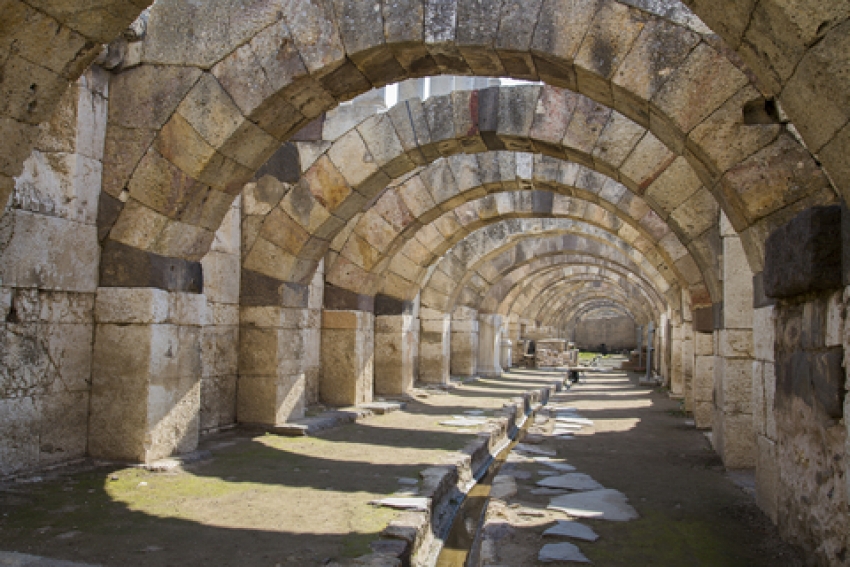
The remains of ancient Smyrna in Izmir, Turkey

This is what you must write to the angel of the church in Smyrna:

I am the first and the last. I died, but now I am alive! Listen to what I say.

I know how much you suffer and how poor you are, but you are rich. I also know the cruel things being said about you by people who claim to be Jews. But they are not really Jews. They are a group that belongs to Satan.

Don’t worry about what you will suffer. The devil will throw some of you into jail, and you will be tested and made to suffer for ten days. But if you are faithful until you die, I will reward you with a glorious life.

If you have ears, listen to what the Spirit says to the churches. Whoever wins the victory will not be hurt by the second death. (Contemporary English Version)

Jesus not only speaks in the four Gospels of the New Testament; Christ also speaks in the final biblical book of Revelation to seven different churches.

In today’s New Testament lesson, Jesus addresses the church at Smyrna – a large and beautiful port city in the ancient world, on the eastern coast of the Aegean Sea (present day Turkey). 

Jesus was letting the believers in Smyrna know they were about to experience severe persecution. However, they need not be fearful and can remain faithful because their Lord knows all about suffering. 

The church’s perseverance under such trouble would result in the crown of life, given to them by Jesus himself. Words coming directly from their Lord and Savior must surely have been an encouragement to the believers as they underwent extreme difficulty.

The congregation at Smyrna was facing imprisonment and, for some, even death for their faith. The heart of the message by Jesus is to remain faithful. 

The seven churches of Revelation which Jesus addressed

There will always be those who are faint of heart with weak faith, giving up when the going gets tough. Yet, persecution and hardship have a way of purging the soul, as well as the church, of its dross. Suffering is inevitable; how we handle adversity when it comes is completely under our own control.

Few of us will likely never face a hardship that could result in martyrdom. Knowing there are brothers and sisters in the faith throughout the world who do face daily hardship for devotion and beliefs puts our own troubles in a different light.

The daily irritations and trials that God puts in our way to refine us and shape our faith certainly seem small compared to imprisonment and martyrdom. Yet, no matter who we are and where we are located on this earth – whether facing uncommon hardship or banal difficulty – the afflictions of both body and soul come to us as opportunities to lean into faith and love Jesus to the end.

Jesus is not looking for perfect people – just faithful followers willing to endure suffering with the truth that our Lord stands with us. 

Whatever our current circumstances may be, Jesus offers us his perspective on it. He knows precisely what is going on and understands the spiritual resources you and I possess for each adverse situation we encounter.

In fact, few of us really discern the largess of internal resources within us because of Christ’s redemptive work and the Spirit’s abiding presence – not to mention the very personhood God graciously gave us in the womb before we were even born.

Even though it seems, at times, we lack the strength, wisdom, and courage for what is ahead – Jesus has supreme confidence in us to maintain faith and endure through our afflictions.

Life is not a sprint; life is a marathon. And to finish the race we need to be in good spiritual health. The perseverance of the saints will happen as we run – step by step, stride by stride – with boldness, despite fear of the unknown future around the bend.

Spiritual endurance requires becoming comfortable with risk, vulnerability, accountability, and the steadfast love which is both received and given.

Perhaps, most of all, it requires keeping our heads up and running toward the promise of reward at the finish. The crown of life is an image of both congratulation and celebration of a race well-run and the enjoyment of unending fellowship with our Lord for whom we have endured so much.

After all is said and done, and the end of the age has occurred, we will be able to look back in hindsight and see that it was really Jesus who all along was fortifying us to keep standing and keep going. Christ is so vested in us that he continually ensures our ultimate victory through a constant presence of help and encouragement. The heritage of both the Reformation and Holy Scripture testify to this truth:

“All our progress and perseverance are from God.”

John Calvin (1509-1564)

“I’m sure about this: the one who started a good work in you will stay with you to complete the job by the day of Christ Jesus.” (Philippians 1:6, CEB)

May the grace of Jesus sustain you; the love of God surround you; and the encouragement of the Spirit surprise you, today and every day. Amen.

Grant, O God, That we may never lose the way through our self-will, and so end up in the far countries of the soul; that we may never abandon the struggle, but that we may endure to the end, and so be saved; that we may never drop out of the race, but that we may ever press forward to the goal of our high calling; that we may never choose the cheap and passing things, and let go the precious things that last forever; that we may never take the easy way, and so leave the right way; that we may never forget that sweat is the price of all things, and that without the cross, there cannot be the crown.

So keep us and strengthen us by your grace that no disobedience and no weakness and no failure may stop us from entering into the blessedness which awaits those who are faithful in all the changes and chances of life down even to the gates of death; through Jesus Christ our Lord. Amen

William Barclay, Prayers for the Christian Year