Faith Helps Us Take the Long View of Life (Hebrews 11:23-28)

Moses is saved from the water by Pharaoh’s daughter, by Marc Chagall, 1966

It was by faith that Moses’ parents hid him for three months when he was born. They saw that God had given them an unusual child, and they were not afraid to disobey the king’s command.

It was by faith that Moses, when he grew up, refused to be called the son of Pharaoh’s daughter. He chose to share the oppression of God’s people instead of enjoying the fleeting pleasures of sin. He thought it was better to suffer for the sake of Christ than to own the treasures of Egypt, for he was looking ahead to his great reward. It was by faith that Moses left the land of Egypt, not fearing the king’s anger. He kept right on going because he kept his eyes on the one who is invisible. It was by faith that Moses commanded the people of Israel to keep the Passover and to sprinkle blood on the doorposts so that the angel of death would not kill their firstborn sons. (New Living Translation)

Sometimes we can’t see beyond the end of our nose. We get lost in the here-and-now worries of the moment. We need a better view.

Taking a long view of life happens whenever we place our faith in permanent and ultimate realities, and not merely live by what feels good or drives our anxiety in the temporal moment.

To have faith is to possess an indefatigable and unflagging trust in someone’s ability to achieve a desired outcome. The author of Hebrews describes it this way:

No one can please God without faith, for whoever comes to God must have faith that God exists and rewards those who seek him.

Hebrews 11:6, GNT

Faith looks ahead and sees as clearly as whatever is right now in front of your face. People of faith have the ability to take the long view of life, knowing that God has their backs. The mature person of faith can set aside temporary pleasure to attain a future hope. 

Moses, held up by the writer of Hebrews as an example of such faith, refused to identify himself as the daughter of Pharaoh. He chose to be mistreated in solidarity with his fellow Israelites, instead of having a good time with his high position in the most powerful empire of its day. Moses knew that the treasures of Egypt were not as wonderful as what he would receive from suffering for the sake of Messiah, and he looked forward to his reward.

It’s an understatement to say that our contemporary society embraces instant gratification. We want to feel good, and we want it now. Impulse control may just be one of the best life skills that kids (and adults!) need to learn in society. And one of the most effective ways to distract ourselves from a tempting pleasure we don’t want to indulge, is by focusing on another pleasure.

For the Christian who desires to follow Jesus in all things, looking ahead to better days is a confidence booster, namely because Jesus is better and superior to all things. This isn’t some wistful fanciful notion of positive thinking; this faith is based in the person and work of Christ. Spiritual endurance and perseverance through difficulty will have a reward – and it will be shared along with all of God’s people. 

But if we only consider today and what’s in it for me right now, there are scant resources for responding to the temptations and fluctuations of life. We must put some planning and energy into clarifying and embracing our most cherished values. Then, those values shall inform everything we do, or not do. In the scope of eternity, suffering a bit now is nothing compared to what Christ has yet in store for his people.

Deferred gratification causes us to live differently. In a twist of irony, folks who orient themselves toward the unseen world to come are able to effectively impact and change the visible world they currently reside within – whereas those who focus solely on this present world find themselves falling woefully short with their truncated view of life. We need the wisdom which faith provides us:

We are always confident, because we know that while we are living in the body, we are away from our home with the Lord. We live by faith and not by sight. We are confident, and we would prefer to leave the body and to be at home with the Lord. So, our goal is to be acceptable to him, whether we are at home or away from home. We all must appear before Christ in court so that each person can be paid back for the things that were done while in the body, whether they were good or bad. (2 Corinthians 5:6-10, CEB)

Future hope, fueled by faith, gives shape to how we live today. It enables us to live in solidarity with those who suffer and are mistreated. It ennobles us to live above short-sighted desires and act on behalf of the common good of all persons in the here-and-now.

Lord God Almighty, the One who is and was and is to come, may we, along with your servant Moses, see the plight of all those who suffer in our midst. Give us courage and compassion to live in solidarity with the poor, the oppressed, the forgotten, and all who live with misfortune and misery. May our hearts, burning with love, bear the burdens of all in our care. And may our loving example ignite the hearts of others to accompany the vulnerable in their affliction. We ask this in the gracious name of Jesus through the power of your Holy Spirit. Amen.

Real Forgiveness (Hebrews 9:23-28)

By Marc Chagall, 1941

It was necessary, then, for the copies of the heavenly things to be purified with these sacrifices, but the heavenly things themselves with better sacrifices than these. For Christ did not enter a sanctuary made with human hands that was only a copy of the true one; he entered heaven itself, now to appear for us in God’s presence. Nor did he enter heaven to offer himself again and again, the way the high priest enters the Most Holy Place every year with blood that is not his own. Otherwise Christ would have had to suffer many times since the creation of the world. 

But he has appeared once for all at the culmination of the ages to do away with sin by the sacrifice of himself. Just as people are destined to die once, and after that to face judgment, so Christ was sacrificed once to take away the sins of many; and he will appear a second time, not to bear sin, but to bring salvation to those who are waiting for him. (New International Version)

In truth, I could preach on the Cross every Sunday and never exhaust the immensely rich implications of Jesus Christ’s death for us. 

Perhaps, for many Christians, today’s New Testament lesson seems like a re-hashing of things we already know. Yet, it is important to keep plumbing the depths of Christ’s once-for-all sacrifice, because, through continual examination of Christ and the Cross:

  • We will know, both intellectually and experientially, that our forgiveness is real. 
  • We will be able, both spiritually and emotionally, to extend real forgiveness to others.

The original recipients of Hebrews were experiencing spiritual fatigue due to their difficult circumstances. The believers were so worn down from swimming upstream of their problems, that they considered throwing in the towel and giving up on Christianity (or at least the Church). 

The author of Hebrews truly believed that the way to combat this tiredness was through a robust understanding of Christ and the Cross. So, he sought to demonstrate that Jesus is superior to the old sacrificial system and has superseded it. 

There are three main distinctions between the old sacrificial system and the new way of Christ so that we will be encouraged to know that our forgiveness is real.

Reality vs. Simulation

The Old Testament sacrificial system, and its worship rituals in dealing with the sin issue, were only a copy and a shadow of the real sacrifice, which is Christ. The Temple sacrifices, in other words, were merely a facsimile of the real thing.

The difference between the old temple sacrifices and the sacrifice of Christ, is like the difference between riding a mechanical horse and an actual horse. Mechanical horses are merely a simulation of real riding.

Since Christ has come as the real sacrifice for sin, we need no longer be content with simulations and copies of the real deal. The Christian’s forgiveness is neither a simulation nor a copy because Christ is the real thing. 

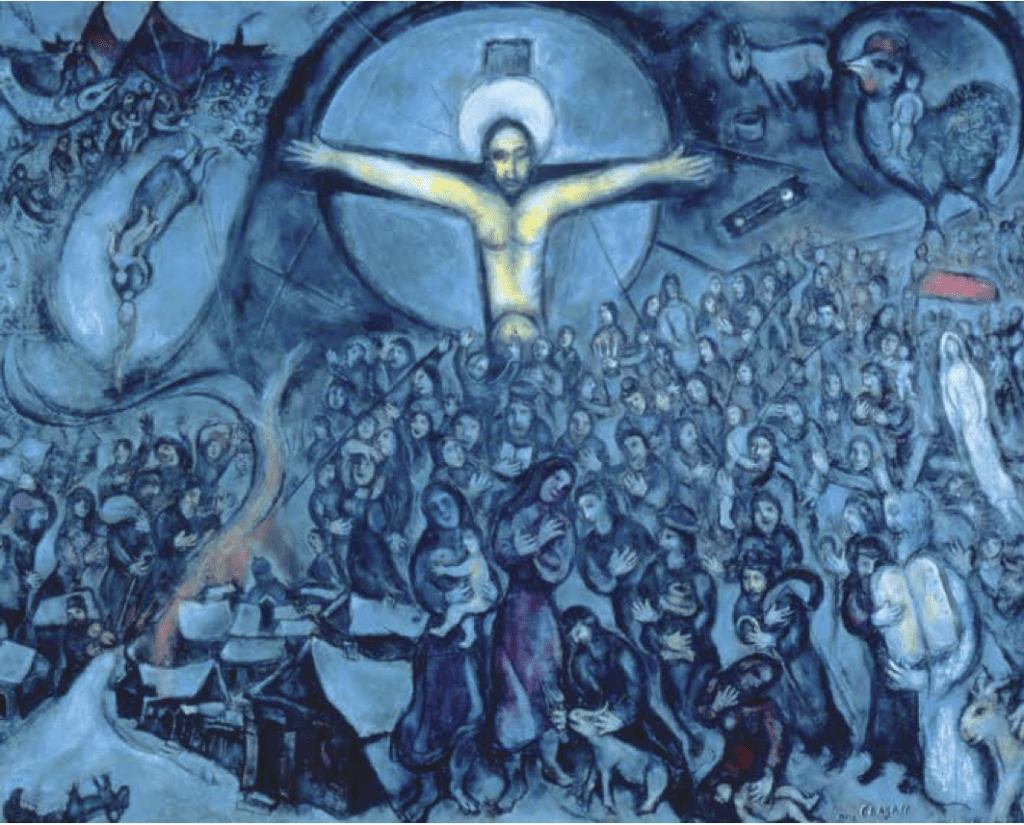
By Marc Chagall, 1952

Jesus did not just mechanically mouth words of forgiveness to us; Christ secured real forgiveness through his death on a cross. This is no cheap imitation of forgiveness. Christ died an actual violent death.

The emphasis in Scripture on blood and sacrifice can be upsetting for many people. Yet, we need to understand that the brokenness of this world is so bad that it requires drastic action. Christ’s death reflects the horrible sin of humanity. Since Jesus has secured forgiveness for us at such a steep price, we are to receive it with great humility and joy, knowing that God loves us that much.

Permanent vs. Temporary

Jesus Christ dealt with the sin issue once and for all through his blood. He came to do away with sin, not just veneer over it. The old sacrificial system was like whitewashing a barn – it took care of the issue for a while, but it would need to be done over and over again.

We are familiar with temporary arrangements. For example, annual fees need to be paid and renewal stickers have to be put on a car’s license plate every year. Christ’s atonement, however, is no temporary arrangement. The forgiveness Jesus offers is permanent.

There is no need to keep offering sacrifices over and over because Christ is the sacrifice to end all sacrifices. The forgiveness we possess is not like paying an annual fee and getting a forgiveness sticker for the year. In Jesus Christ, we are forgiven! And this forgiveness was purchased with Christ’s own blood.

The cross that held Christ’s naked and marred body, exposed the violence and injustice of this world. The Cross revealed what kind of world we have and what kind of God we have: a world of gross unfairness, and a God of sacrificial love. Because Jesus was willing to do this on our behalf, we have a permanent forgiveness, settled once and for all, through his blood.

This old world needs real forgiveness that lasts forever – not a cheap sentimental forgiving that is merely a flash in the pan. 

Salvation vs. Judgment

A lot of religious energy can be spent trying to figure out how to make ourselves acceptable to God.

Part of the good news is that, in Christ, we do not need to fear the future. We have been made right with God through the death of Jesus. Through Christ’s sacrifice, the doors to heaven and earth get flung wide open. The way has been secured, the trail has been blazed, and the road has been made smooth to come to God.

Jesus, unlike any Levitical priest, has entered God’s presence, providing access to the living God. Christ did not need to offer sacrifice for his own sins but offered himself solely on our behalf. Jesus did more than offer the sacrifice; he himself became the sacrifice. It was a sacrifice to bring deliverance to humanity, not judgment.

Either to justify or to judge is God’s business, not ours. Our concern is to believe in the once-for-all sacrifice of Jesus that brings a permanent forgiveness; and, to share that life-giving message with others so that they, too, can experience deliverance from sin, death, and hell.

We can have such a hard time forgiving others because we struggle with experiencing our own forgiveness. The path to extending grace to others is in deepening our knowledge, understanding, and awareness of God’s grace in Christ.

Conclusion

The author of Hebrews meant for the Christian life to be an exciting and abundant adventure of following Jesus, the pioneer of our salvation.

And yet, many Christians do not know anything about this kind of life. They only see the Christian life as a duty and a chore, a kind of cross to bear. We must recognize that it is the Savior, Jesus Christ, the object of our faith, who has delivered us so that we can live a new life of freedom, enjoying our forgiveness and inviting others on the journey.

For he has rescued us from the kingdom of darkness and transferred us into the Kingdom of his dear Son, who purchased our freedom and forgave our sins.

Colossians 1:13-14, NLT

Jesus didn’t die on a cruel cross, then rise from death so that we could live ho-hum Christian lives.

Christ has granted us forgiveness so that we will enjoy the Christian life, appreciate the Word of God; relish in laboring together for the Gospel; and look forward with anticipation to how the Spirit will transform lives through Christ’s forgiveness. 

Real forgiveness opens our minds, hearts, and energies to live for Jesus, the pioneer of our salvation.

Lord Jesus Christ, you stretched out your arms of love on the hard wood of the cross that everyone might come within the reach of your saving embrace. Clothe us in your Spirit that we, reaching forth our hands in love, may bring those who do not know you to the knowledge and love of you; for the honor of your Name. Amen.

Psalm 119:89-96 – Relying on the Eternal

Your word, O Lord, will last forever;
    it is eternal in heaven.
Your faithfulness endures through all the ages;
    you have set the earth in place, and it remains.
All things remain to this day because of your command,
    because they are all your servants.
If your law had not been the source of my joy,
    I would have died from my sufferings.
I will never neglect your instructions,
    because by them you have kept me alive.
I am yours—save me!
    I have tried to obey your commands.
The wicked are waiting to kill me,
    but I will meditate on your laws.
I have learned that everything has limits;
    but your commandment is perfect. (Good News Translation)

Our present life, currently in the here and now, is characterized by limitations and continual change. Whatever is up today can be down tomorrow, and vice versa. The people around us, as well as our own emotions, can be often frustratingly fickle. And our circumstances are constantly changing, not to mention our bodies and minds. For some, even their very life hangs in the balance due to either a personal enemy or the enemy of disease, disaster, or death.

In this orbit of revolving change, we are limited in our choices. We can make changes to our lifestyle that will hopefully extend the quality and quantity of life, yet every one of us will eventually die. There is decision-making we can make with our resources and finances, yet if a company closes and jobs are lost, or the market plunges and our investments tank, there is no nice seamless transition to getting back on our feet.

It might be easy to slide into discouragement, if we all we know is a domino effect of change, revolving circumstances, and an inability to influence very little of it all. Yet, there is hope because there is another side to the coin.

Although life situations change, and we experience limitations in both our choices and our abilities, there are some bedrock realities which will never change that we can bank and build our lives upon. God’s Word and God’s faithfulness are eternal; they will last forever.

Whenever it feels as if nothing is on solid ground, it is necessary to come back to the things we know which are permanent and reliable. Notice some of the unchangeable elements of God’s Word….

Love never dies. Inspired speech will be over some day; praying in tongues will end; understanding will reach its limit. We know only a portion of the truth, and what we say about God is always incomplete. But when the Complete arrives, our incompletes will be canceled.

When I was an infant at my mother’s breast, I gurgled and cooed like any infant. When I grew up, I left those infant ways for good.

We don’t yet see things clearly. We’re squinting in a fog, peering through a mist. But it won’t be long before the weather clears, and the sun shines bright! We’ll see it all then, see it all as clearly as God sees us, knowing him directly just as he knows us!

But for right now, until that completeness, we have three things to do to lead us toward that consummation: Trust steadily in God, hope unswervingly, love extravagantly. And the best of the three is love. (1 Corinthians 13:8-13, MSG)

Jesus Christ is the same yesterday, today, and forever! (Hebrews 13:8, CEB)

Notice the unchangeable nature of God’s faithfulness….

Your steadfast love, O Lord, extends to the heavens,
    your faithfulness to the clouds.
Your righteousness is like the mighty mountains,
    your judgments are like the great deep;
    you save humans and animals alike, O Lord. (Psalm 35:5-6, NRSV)

This saying is reliable:

“If we have died together, we will also live together.
        If we endure, we will also rule together.
        If we deny him, he will also deny us.
If we are disloyal, he stays faithful”
    because he can’t be anything else than what he is. (2 Timothy 2:11-13, CEB)

It is possible to have peace smack in the middle of hardship and adversity. Racing thoughts do not need to be a given experience whenever there are those who oppose us or give us grief. Relying upon God’s Holy Word is the very ballast and rock we need. It will never fail nor pass away….

Just thinking of my troubles
and my lonely wandering
    makes me miserable.
That’s all I ever think about,
    and I am depressed.
Then I remember something
    that fills me with hope.
The Lord’s kindness never fails!
If he had not been merciful,
    we would have been destroyed.
The Lord can always be trusted
    to show mercy each morning.
Deep in my heart I say,
“The Lord is all I need;
    I can depend on him!”

The Lord is kind to everyone
    who trusts and obeys him.
It is good to wait patiently
    for the Lord to save us. (Lamentations 3:19-26, CEV)

This present life with all its change, limitations, and transience can and will give way to that which is permanent, unending, timeless, immortal, imperishable, and indestructible.

Praise be to the God and Father of our Lord Jesus Christ! In his great mercy he has given us new birth into a living hope through the resurrection of Jesus Christ from the dead, and into an inheritance that can never perish, spoil or fade. (1 Peter 1:3-4, NIV)

May you know the joy and peace of relying upon the eternal and changeless reality of God.

Our God and Father, thank you that in a world of despair that you are our hope. In a world of darkness, you are our light. In a world of sorrow, you are our joy. Help us to strengthen and encourage one another with your eternal faithfulness and steadfast love, through Jesus Christ our Lord. Amen.