Day of Pentecost (John 14:8-17, 25-27)

Philip said to him, “Lord, show us the Father, and we will be satisfied.” Jesus said to him, “Have I been with you all this time, Philip, and you still do not know me? Whoever has seen me has seen the Father. How can you say, ‘Show us the Father’? Do you not believe that I am in the Father and the Father is in me? The words that I say to you I do not speak on my own, but the Father who dwells in me does his works. 

“Believe me that I am in the Father and the Father is in me, but if you do not, then believe because of the works themselves. Very truly, I tell you, the one who believes in me will also do the works that I do and, in fact, will do greater works than these, because I am going to the Father. I will do whatever you ask in my name, so that the Father may be glorified in the Son. If in my name you ask me for anything, I will do it.

“If you love me, you will keep my commandments. And I will ask the Father, and he will give you another Advocate, to be with you forever. This is the Spirit of truth, whom the world cannot receive because it neither sees him nor knows him. You know him because he abides with you, and he will be in you….

“I have said these things to you while I am still with you. But the Advocate, the Holy Spirit, whom the Father will send in my name, will teach you everything and remind you of all that I have said to you. Peace I leave with you; my peace I give to you. I do not give to you as the world gives. Do not let your hearts be troubled, and do not let them be afraid.” (New Revised Standard Version)

The Christian observance of Pentecost is much more than a date on the calendar or a cognitive belief about the Holy Spirit. Pentecost is a powerful reality for believers to be aware of and to live into.

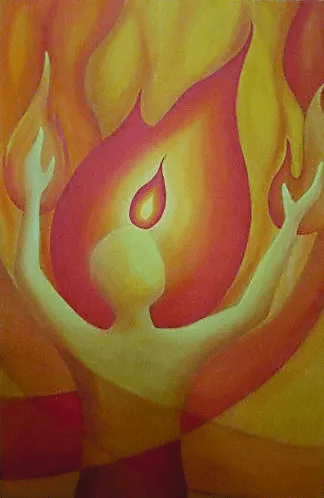
The symbols used to communicate this reality are the elements of wind and fire. They each have incredible potential for both help and harm, life and death. Tornadoes and wildfires bring awful destruction, whereas flame and wind power are necessary elements for life.

There is power in the Spirit. The Spirit of God dismantles and rearranges our lives to make something different or new altogether.

When the Spirit gets involved, nothing is the same again.

The Spirit upsets the status quo, brings energy and ability, heals broken lives, and establishes a truly egalitarian society. The New Testament knows the Christian as one given wholly to the Spirit in order to accomplish the will of God on this earth.

Therefore, this time of the year is hugely significant. Christians attune themselves to Holy Time because it is the age of the Spirit, the blessed opportunity of Pentecostal life and power. 

Jesus promised us an Advocate, the Spirit, and the era of the Spirit is here. We enjoy the very same Holy Spirit as our spiritual ancestors in the faith. This gives us great confidence and security knowing that the Spirit’s enablement, guidance, and power is available to us.

Pentecost flings every single believer into a congregational whole, the church, and lets us know that we are not to be rugged individualists acting alone, but are part of the Body of Christ.   

The Spirit uses us to forge spiritual bonds of kinship, fellowship, and solidarity.  Pentecost throws disparate people together in a unified whole, made up of every kind of language, nationality, ethnicity, gender, and race. We all use the gifts of the Spirit given to us for the benefit of building up one another.

Pentecost and the presence of the Spirit opens up the greatest of possibility in seeing our true selves emerge, and experiencing what is false melt away.

For most of us, we eventually discover that our egos are much thicker and predominant than we realized. And that ego gets in the way of bringing our authentic selves to the world. The Spirit comes along with fire to purify us, and then blows a mighty wind to drive the false self away.

Such true spiritual power helps us discern that issues of power in this world are difficult to deal with because things are not as they appear to be. Operating in the ego, far too many of us puff up ourselves to try and merely appear strong. People who present themselves as large and in charge end up hiding their vulnerabilities and insecurities in favor of keeping up appearances.

Jesus openly talked of real spiritual power, and promised to give the Spirit for our benefit. And Christ laid bear himself, stretching his arms out on a cross in a display of humiliation and degradation – all for us and our deliverance from false power and pesky egos.

If we go looking for earthly power and rely upon worldly power structures, we will likely be as confused as Philip and the other disciples of Jesus. But if we adopt the inner spiritual power provided for us, we find real effective strength which brings us the peace of Christ in any and all circumstances.

Life in the Spirit – spiritual life – happens within the depths of the soul. And it happens when we give up all pretense to alternative power sources, and participate with the Holy Spirit in allowing God to melt all that is false with spiritual fire and blow it all away with spiritual wind.

Pentecost was and is a watershed event. It’s effects are lasting, right up to the present time. Rather than settling for power-substitutes, we can imbibe ourselves of real spiritual power.

Living God, you have created all that is. Send forth your Spirit to renew and restore us, so that we may proclaim your good news in ways and words that everyone will understand and believe. Amen.

Our Creator and Sustainer (Psalm 104:24-34, 35b)

Our Lord, by your wisdom
    you made so many things;
the whole earth is covered
    with your living creatures.
But what about the ocean
    so big and wide?
It is alive with creatures,
    large and small.
And there are the ships,
    as well as Leviathan,
the monster you created
    to splash in the sea.

All of these depend on you
    to provide them with food,
and you feed each one
with your own hand,
    until they are full.
But when you turn away,
    they are terrified;
when you end their life,
    they die and rot.
You created all of them
    by your Spirit,
and you give new life
    to the earth.

Our Lord, we pray
that your glory
    will last forever
and that you will be pleased
    with what you have done.
You look at the earth,
    and it trembles.
You touch the mountains,
    and smoke goes up.
As long as I live,
I will sing and praise you,
    the Lord God.
I hope my thoughts
    will please you,
because you are the one
    who makes me glad…

With all my heart
I praise you, Lord!
    I praise you! (Contemporary English Version)

In the wake of the Day of Pentecost, we are reminded by the psalmist that the Spirit was not only involved in forming the church, but was already experienced in forming creation. Everything about the Spirit’s work at the origins of the earth was immensely good, wonderfully complex, and intricately interrelated. Indeed, it all reflects the wisdom and majesty of God.

According to the psalmist, God is the Creator and is therefore sovereign over all of this vast dominion of earthly space and ecological systems. We humans are workers in this ordered world; and created in God’s image and likeness as the Lord’s vice-regents over this incredible domain. Humanity is thus both intimately connected with and distinctly separate from all the rest of the world.

This sustaining force of God includes gracious, loving, and compassionate guidance. Everything holds together and has its meaning within God. The breath of God – the Spirit – gives life to both our physical and spiritual selves.

The psalmist paints a picture of creation as full of life – with life itself as the highest expression of its purpose. Our delight in living and being comes from a profound connection with the Creator, Sustainer, and Guide of the universe.

Because of humanity’s deep connection with God and the rest of creation, everything we do as people on this earth impacts God and God’s big world. Every human action exerts an influence. Theology, anthropology, and ecology all exist with complex interconnectedness. God, people, and the world are bound to each other. Since God is relationship itself, relational connection is built into all creation.

Humanity is the apex and climax of God’s creative activity; yet, at the same time, we are but one piece within this intricate whole of creation. We humans are tasked by God to serve the earth and care for it – not to rule in such a way that exploits its grand resources, but to maintain and strengthen the existing connected systems of the earth.

This means we are meant to think of the common good of all earth’s citizens, as well as to consider future generations, and equip them to steward our vast world with practical wisdom and spiritual sensitivity.

Everything that brings disconnection, and thus harm, is to be weeded out and discarded. Wickedness, injustice, oppression, exploitation, unrighteousness, and arrogance are to be purged from the good earth, so that all creatures great and small can thrive and enjoy what God has provided.

Even the seemingly uncontrollable elements of this world – sea monsters and leviathans, chaos and evil – are ultimately subject to the sovereign God of this realm. It is the Lord who brings order from chaos, life from death, and calms the churning waters – quieting all of those ancient leviathans which cause so much of a stir.

It would be great if everyone everywhere found joy in their lives, brought God joy, and enjoyed being with everyone else and caring for all creation. Yet, those chaotic disconnecting powers are there – causing harm and division, splitting that which is designed to be connected, and disrespecting the inherent goodness of God’s image bearers and God’s world.

By being in harmony and in sync with God’s Spirit, we can work together against wickedness and not separate or dismantle what God has built and joined. Through our spiritual awareness, we can help, and not harm. In maintaining our proper spiritual connections, we can be agents of upholding the good, the right, and the just; and not underhandedly undermining God’s sovereignty.

Let us then offer our hallelujahs; our praise, adoration, and gratitude, to God who is the source of life. Because it’s awfully hard to be bad when you’re being good.

May you be able to say with the psalmist – and with all creation, including the trees and even the rocks – that with my whole heart I praise you, almighty God, Creator and Sustainer of heaven and earth.

And may your prayers be pleasing to the Lord and be full of mercy and love. Amen, amen.

Pentecost (John 15:26-27, 16:4b-15)

The Holy Spirit, by He Qi

“When the Advocate comes, whom I will send to you from the Father, the Spirit of truth who comes from the Father, he will testify on my behalf. You also are to testify because you have been with me from the beginning…

“I did not say these things to you from the beginning, because I was with you. But now I am going to him who sent me, yet none of you asks me, ‘Where are you going?’ But because I have said these things to you, sorrow has filled your hearts. Nevertheless, I tell you the truth: it is to your advantage that I go away, for if I do not go away, the Advocate will not come to you, but if I go, I will send him to you. 

“And when he comes, he will prove the world wrong about sin and righteousness and judgment: about sin, because they do not believe in me; about righteousness, because I am going to the Father, and you will see me no longer; about judgment, because the ruler of this world has been condemned.

“I still have many things to say to you, but you cannot bear them now. When the Spirit of truth comes, he will guide you into all the truth, for he will not speak on his own but will speak whatever he hears, and he will declare to you the things that are to come. He will glorify me because he will take what is mine and declare it to you. All that the Father has is mine. For this reason I said that he will take what is mine and declare it to you. (New Revised Standard Version)

Pentecost, by John August Swanson (1938-2021)

This is the Christian Day of Pentecost. It is often referred to as the birthday of the Church. Pentecost marks the time when the Holy Spirit came upon the fledgling believers in power. 

Pentecost is significant for Christians because it marks the age of the Spirit, the era of new spiritual life and power. Ten days after recognizing Christ’s Ascension, and fifty days after Christ’s resurrection from death, the Christian Year observes the Day of Pentecost (which literally means “fifty” in Greek). 

An implication of Pentecost is that it brings both change and stability, of being uprooted as well as deeply grounded. To experience Pentecost, it is necessary to invite change and to allow ourselves to be changed.

To live a truly spiritual life, full of the Holy Spirit, means that things will never be the same again. With the Spirit, there is a new form of consciousness, an emerging awareness of both self and the world, and new interests and commitments which are followed.

Change involves unlearning old thinking and ways of doing things, becoming uprooted and planted in fresh spiritual soil. The spiritual person will discover new, necessary, and expansive ways of living the faith of Jesus Christ in today’s topsy-turvy world.

Today’s Gospel lesson has Jesus talking to his disciples for the last time before his crucifixion and resurrection. He communicated to them that he was going away, and they were sad and confused about it all. So, Jesus assured them that they would not be alone – his presence would be with them in the person of the Holy Spirit.

Jesus made it plain that the One who is coming, the Paraclete, is the One who comes alongside and offers to the disciples a ministry of advocating, testifying, speaking truth, glorifying, and proving the world wrong about sin and righteousness and judgment.

The Spirit advocates for us and all creation. The Spirit hears our pain, moaning, and desperation, bringing it all to God in helpful language (Romans 8:26). The Spirit testifies about Jesus to us and about his ministry. The Spirit speaks truth to us whenever we go astray from the words and ways of Jesus; and so, will challenge us and provoke us to live into our majesty as people created in God’s image and redeemed by Christ’s death and resurrection.

If and when our Christian life and worship becomes a ho-hum hodge-podge of ritualistic or legalistic goo, where no spiritual growth or life transformation is happening – and worse, if it becomes characterized by injustice – then the Spirit will have something to say in regard to sin, righteousness, and judgment.

A lack of faith can take many forms. For many Christians, the separation between belief and practice is a form of apostasy. Signing off on a set of doctrinal beliefs means nothing unless it has feet and hands to it by going after those who are suffering, giving restitution for what we’ve taken, and putting the love of Christ where love is not found.

A confession of faith is hollow and useless without first having a confession of sin. Jesus did not say that people will know Christians by their doctrinal confessions and ancient creeds, but that others will know the Christian by the fruit of a life given to righteousness and justice. (Matthew 7:16)

The worldly ruler is the one who perpetuates systems of evil and oppression; and ignores poverty, hunger, and need. The ruler of this world is condemned by the Spirit because of meanness, brutality, violence, and abject greed and selfishness.

Anyone who turns the life-giving good world which God has made into a death-dealing world of ignorance, sloth, and power politics is under the judgment of the Spirit, on orders by Judge Jesus. Whenever the bent of the will is developed into only being concerned with personal happiness, while ignoring communal needs, the person is existing far from the teachings of Jesus to his disciples.

On this Day of Pentecost, and into this proper Pentecostal season, our call is to have a genuine spiritual life that allows the true self to make a difference in this old fallen world. The spiritual person seeks to tap into the Spirit and insist on caring for others without prejudice or favoritism; and will ground themselves in healthy spiritual dynamics of positive change and transformation as living sacrifices to God. (Romans 12:1-3)

With the reality of Pentecost, believers in Jesus, and the whole Church everywhere, has the full power of the Holy Spirit with them at all times. This means our ultimate trust is not in the power of authoritative positions, economic budgets, polished programs, personal ingenuity, or a consumer self-realization.

Our trust is in the name of the Lord who made heaven and earth, in Jesus Christ, God’s only Son, and in the strength of the Holy Spirit who is the continuing presence of Jesus. Such power is given for a purpose. So let us be responsible and conscientious in living the Christian life.

And may the blessing of the Spirit move you to know Jesus better, love the world more, and be the person you were created to be – to the glory of God. Amen.

The Age of the Spirit (Joel 2:18-29)

“Come, Holy Spirit,” by Mary Anne Durnin

The Lord was deeply concerned
about his land
    and had pity on his people.
In answer to their prayers
    he said,
“I will give you enough grain,
wine, and olive oil
    to satisfy your needs.
No longer will I let you
    be insulted by the nations.
An army attacked from the north,
but I will chase it
    into a scorching desert.
There it will rot and stink
from the Dead Sea
    to the Mediterranean.”

The Lord works wonders
    and does great things.
So tell the soil to celebrate
and wild animals
    to stop being afraid.
Grasslands are green again;
fruit trees and fig trees
    are loaded with fruit.
Grapevines are covered
    with grapes.

People of Zion,
celebrate in honor
    of the Lord your God!
He is generous and has sent
the autumn and spring rains
    in the proper seasons.
Grain will cover
    your threshing places;
jars will overflow
    with wine and olive oil.

I, the Lord your God,
will make up for the losses
    caused by those swarms
and swarms of locusts
    I sent to attack you.
My people, you will eat
    until you are satisfied.
Then you will praise me
for the wonderful things
    I have done.
Never again will you
    be put to shame.

Israel, you will know
    that I stand at your side.
I am the Lord your God—
    there are no other gods.
Never again will you
    be put to shame.

Later, I will give my Spirit
    to everyone.
Your sons and daughters
    will prophesy.
Your old men
    will have dreams,
and your young men
    will see visions.
In those days I will even give
my Spirit to my servants,
    both men and women. (Contemporary English Version)

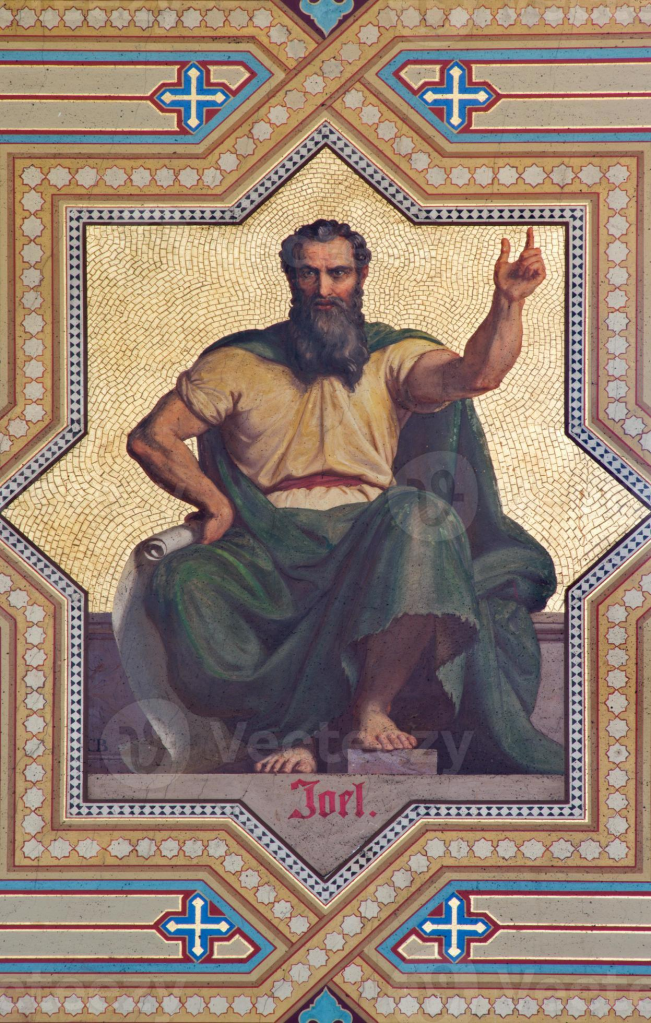
Fresco of the prophet Joel in the Altlerchenfelder Church, Vienna, Austria

We are in the wake of Pentecost Day. But it ought not to have come as a surprise. There were prophetic rumblings of the Spirit’s future tornadic activity, long before the time of Jesus.

The prophet Joel, along with all the Old Testament prophets, had both a message of grace and of judgment. And so, this prophetic book falls naturally into those two parts.

Within the first part of the prophecy, Joel speaks of a terrible locust plague that came over Israel as a judgment from God. The people had strayed from their spiritual and religious ways of covenant with God. The locusts, destroying every plant in their path, reflected the people’s lack of spiritually thriving and growing in grace. They, too, were vulnerable to destruction. They needed to repent and to return to their God.

Yet, the Lord’s anger lasts only a moment, but God’s mercy and blessing endure forever. So, words of grace were offered to the people. There is a time coming, Joel insisted, when God will pour out the divine Spirit far and wide to bless the people and contend with the nations who oppose the covenant community.

Put another way, the first part of the prophecy describes how God fought against God’s own people, to bring them back to their spiritual senses. And the second part of the prophecy describes how the Lord will fight against the nations who fight against God and God’s people.

The people’s affections and allegiance became attached to other things rather than God. So, the Lord sent an army of locusts to oppose them, to challenge their milquetoast and half-hearted attempts at following divine instructions.

Joel foresaw two things coming as the great Day of the Lord approaches: a great outpouring of the Holy Spirit; and a terrible time of divine judgment. 

Let’s take a few things to heart as a response to Joel’s prophecy:

Be aware of God’s purpose in history

From grasshopper swarms to world-wide judgment, to the dissolving of sun and moon—God’s purpose is to reveal divine glory to all the world.

“You will know that I am in the midst of Israel,
        and that I am the Lord your God—no other exists;
        never again will my people be put to shame.” (Joel 2:27, CEB)

“Father, the hour has come; glorify your Son so that the Son may glorify you.” Jesus (John 17:1, NRSV)

Stay close to the Lord

Don’t wander from God. But, if you do, the Lord will spend all kinds of energy in bringing us back and restoring us.

“But even now,” declares the Lord,
“return to me with all your heart—
with fasting, crying, and mourning.” (Joel 2:12, GW)

And the God of all grace, who called you to his eternal glory in Christ, after you have suffered a little while, will himself restore you and make you strong, firm and steadfast. (1 Peter 5:10, NIV)

Change the inside, not the outside

Repentance and faith are to be a way of life, and not simply a one time event. The way we present ourselves on the outside is a projection of what we want others to see. But God sees the heart, so we must go there and focus on the inner person.

Don’t rip your clothes
    to show your sorrow.
Instead, turn back to me
    with broken hearts.
I am merciful, kind, and caring.
I don’t easily lose my temper,
    and I don’t like to punish. (Joel 2:13, CEV)

Endure what you suffer as being a father’s punishment; your suffering shows that God is treating you as his children. Was there ever a child who was not punished by his father? If you are not punished, as all his children are, it means you are not real children, but bastards. In the case of our human fathers, they punished us and we respected them.

How much more, then, should we submit to our spiritual Father and live! Our human fathers punished us for a short time, as it seemed right to them; but God does it for our own good, so that we may share his holiness. When we are punished, it seems to us at the time something to make us sad, not glad. Later, however, those who have been disciplined by such punishment reap the peaceful reward of a righteous life. (Hebrews 12:7-11, GNT)

Earnestly seek the outpouring of the Holy Spirit

On the Day of Pentecost, the Apostle Peter said that the coming of the Holy Spirit was a fulfillment of Joel’s prophecy (Acts 2:16). That was just the beginning of the blessing. The Holy Spirit is still operative and active in the church and the world. The prophecy is far from complete.

In reply to those who were concerned about others prophesying and thereby possibly challenging authority, Moses said:

“Are you concerned what this might do to me? I wish the Lord would give his Spirit to all his people so everyone could be a prophet.” (Numbers 11:29, CEV)

And those who observed and heard the Spirit being poured out, exclaimed with slack jawed amazement:

“Aren’t these all Galileans? How come we’re hearing them talk in our various mother tongues?

Parthians, Medes, and Elamites;
Visitors from Mesopotamia, Judea, and Cappadocia,
    Pontus and Asia, Phrygia and Pamphylia,
    Egypt and the parts of Libya belonging to Cyrene;
Immigrants from Rome, both Jews and proselytes;
Even Cretans and Arabs!

“They’re speaking our languages, describing God’s mighty works!” (Acts 2:7-11, MSG)

The age of the Spirit is here. It hasn’t gone away. So, let’s pursue the spiritual life with all the energy given us, to the glory and praise of God. Amen.