
Christ’s Beatitudes (Matthew 5:1-12)

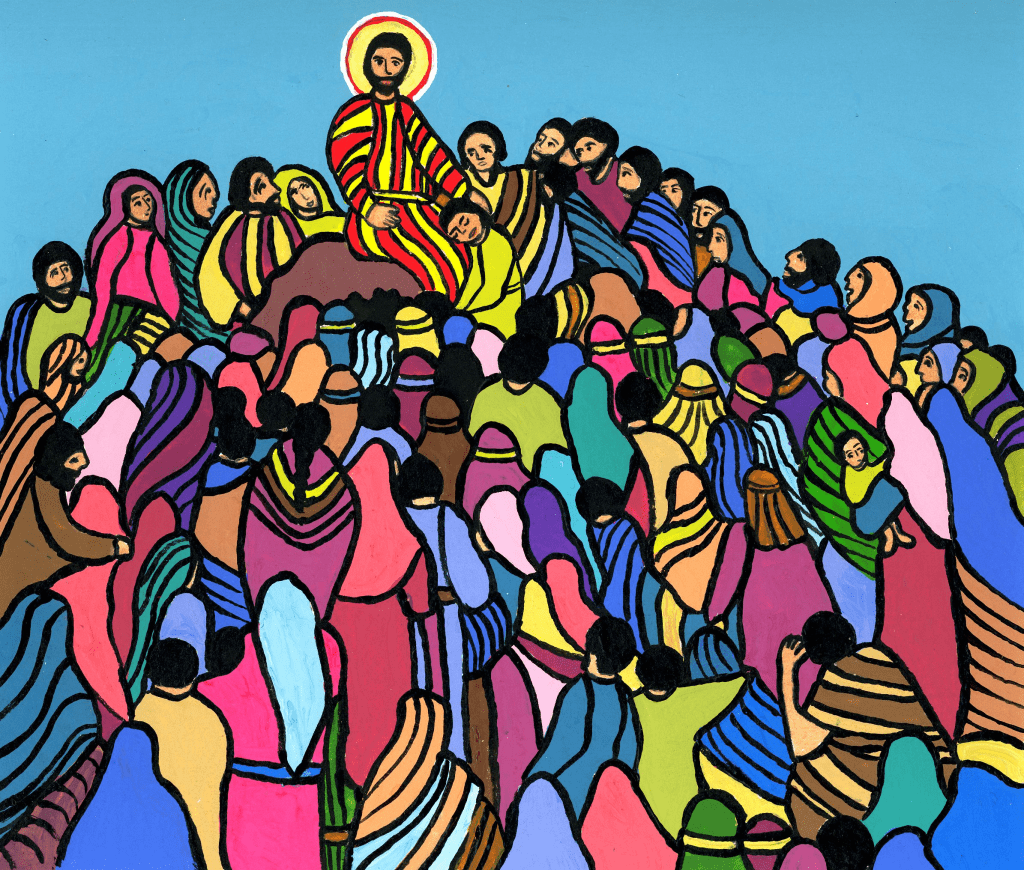
Sermon on the Mount by Gisele Bauche

When Jesus saw the crowds, he went up the mountain, and after he sat down, his disciples came to him. And he began to speak and taught them, saying:

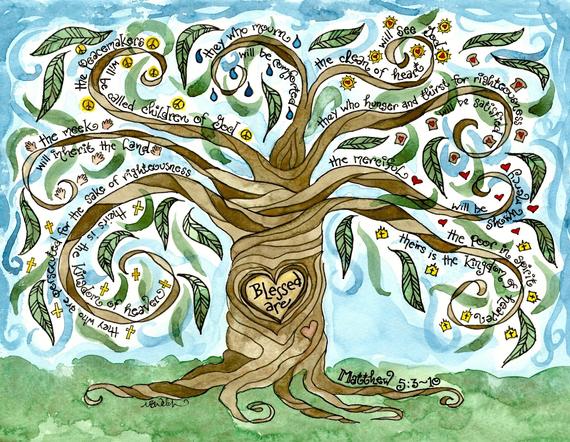
“Blessed are the poor in spirit, for theirs is the kingdom of heaven.

“Blessed are those who mourn, for they will be comforted.

“Blessed are the meek, for they will inherit the earth.

“Blessed are those who hunger and thirst for righteousness, for they will be filled.

“Blessed are the merciful, for they will receive mercy.

“Blessed are the pure in heart, for they will see God.

“Blessed are the peacemakers, for they will be called children of God.

“Blessed are those who are persecuted for the sake of righteousness, for theirs is the kingdom of heaven.

“Blessed are you when people revile you and persecute you and utter all kinds of evil against you falsely on my account. Rejoice and be glad, for your reward is great in heaven, for in the same way they persecuted the prophets who were before you. (New Revised Standard Version)

God’s Law (The Ten Commandments) was given on a mountain. That Law was restated and reframed on a mountain by Jesus in his Sermon on the Mount.

I believe that arguably one of the most important and impactful portions of Holy Scripture are the Beatitudes of Jesus, which serve as the foundation to all of Christ’s teaching.

Christ’s Beatitudes are not simply a random collection of pithy phrases from Jesus on what constitutes approval and blessing from God. They intentionally build upon each other and describe the nature of true righteousness.

The Poor in Spirit

Spiritual poverty, not wealth, is the spiritual base to the Christian life. Most of the original crowd listening to Jesus thought they were on the outside of the kingdom, on the margins of true religion. But Jesus told them they have a place in God’s reign as poor and pitiable people.

To be “poor in spirit” is to be a spiritual beggar who recognizes they have nothing to offer God. It is seeing oneself, one’s sin, and one’s life as spiritually bankrupt apart from God.

Beggars have neither the leverage nor the ability to strike deals with anybody; and so, they do one thing: beg continually.

The proud person would never be caught begging for anything. Yet, the humble spiritual beggar constantly prays because they need God. They discern that without God there is no hope. The kingdom of heaven belongs to the penitent and not to the proud.

The Mourners 

Mourning is the emotional response of acknowledging one’s spiritual poverty. 

Grief and lament have a central place in Christian theology and life. To avoid it, work around it, or short-circuit its process is to refuse Christ; there is no righteousness apart from mourning over sin. Crying, weeping, and even intense tears are important and necessary.

To experience personal grief over one’s sins and the sins of the church and the world is a Beatitude of Jesus. You neither need position, power, privilege, nor pedigree to be a mourner. All can mourn. This is the door by which we enter the kingdom of God.

The Meek

A meek and gentle spirit is the result of realizing poverty of spirit and practicing lament.

At the heart of what it means to be meek is a spirit of non-retaliation. Whenever we are flat on our backs before God, there is no place to look but up. Thus, there is no ability to look down on others.

To be meek is to be broken and moldable before God. A meek person takes personal responsibility for their attitudes and actions. The meek have no need to retaliate, even when egregiously wronged, because they fully entrust themselves to God alone who judges the living and the dead.

Ironically, brokenness is the path to righteous wholeness.

The Hungry and Thirsty

Only those who know their poverty of spirit, personally grieve over sin, and are gentle, end up longing for righteousness.

The desire for righteousness is a recognition that without God I will not make it. I cannot be righteous without Jesus. Simply put, righteousness is a right relationship with God and others.

Those who hunger and thirst for God’s righteousness know they cannot make things right by themselves; they need God’s help.

If we think we can live most days of our lives without God, we do not yet know true righteousness. People who understand their great need for Jesus are easy to spot. They crave and devour God’s Word as their daily food; and they cannot stop blabbering on about Jesus.
There are three practices of living that arise from being filled with God’s righteousness: mercy, purity, and peacemaking. These Beatitudes cannot be conjured up by our own will; instead, they organically grow within us and are freely expressed because of what God is doing in our lives.

You cannot force them any more than you can force a stalk of corn to grow on your terms. Rather, you work with the unforced rhythms of God’s grace and allow righteousness to take root in you.

Down below in the soil, spiritual poverty, mourning, and humility germinate. Then, when the plant breaks the soil and flowers, it produces mercy, purity, and peace-making.

The Merciful 

Mercy begins with a heart that seeks to be generous; it is a loving response to someone or a group of people in misery. We accept them and help them because we ourselves have been there.

The merciful person looks for ways to come alongside others and help, rather than pile expectations and burdens on others without mentoring them in the ways of God.

The Pure In Heart

Purity also results from true righteousness. A stalk of corn might look good, but if you shuck it and it’s filled with worms, it’s not worth much. Legalistic righteousness is concerned to look good; it’s obsessed with performance, perfection, and possessions.

Conversely, the righteousness of God fills our hungry hearts and makes us pure and holy, set apart for good use.

The Peacemakers 

Those who make peace intentionally put themselves in the middle of trouble because they want to live righteously with the mercy and purity that God has provided for them.

Peace is realized through peacemakers. It seems we all desire peace, and yet, peacemakers are hard to come by. It’s a tough gig. To achieve peace, one must first be at peace with God and self – which is why we need the cross of Jesus Christ.

The Persecuted 

Living righteously, as presented by Jesus, tends to bring persecution; and the persecuted consider it a small price to pay for realizing God’s justice in the world.

Folks who are offended by even slight criticisms are usually the ones who are privileged and in power. They have not yet learned the ways of Jesus. Pettiness is nothing more than a sign of unrighteousness.

Yoking up with Jesus, following him, and living into his words and ways has always been risky and dangerous. The Beatitudes of Jesus are not characteristics that lead to power, prestige, or possessions, but likely just the opposite.

“The Beatitudes, spoken with the community of Jesus’ disciples in view, are paradoxes – the standards of the world are turned upside down as soon as things are seen in their right perspective, which is to say, in terms of God’s values, so different from those of the world. It is precisely those who are poor in worldly terms, those thought of as lost souls, who are truly fortunate ones, the blessed, who have every reason to rejoice and exult in their suffering. The Beatitudes are promises resplendent with the new image of the world and humanity inaugurated by Jesus.”

Pope Benedict XVI

Truly righteous persons become living Beatitudes; they are walking, talking blessings to the world. They abide with Christ and are witnesses to a subversive, yet wonderful, way of life, where the last are first and the greatest are the least.

O Lamb of God, that takes away the sins of the world, have mercy upon me.

O Lamb of God, that takes away the sins of the world, have mercy upon me.

O Lamb of God, that takes away the sins of the world, grant me your peace.

Romans 5:1-5 – Maybe There Can Be Peace…

Therefore, since we have been justified through faith, we have peace with God through our Lord Jesus Christ, through whom we have gained access by faith into this grace in which we now stand. And we boast in the hope of the glory of God. Not only so, but we also glory in our sufferings, because we know that suffering produces perseverance; perseverance, character; and character, hope. And hope does not put us to shame, because God’s love has been poured out into our hearts through the Holy Spirit, who has been given to us. (New International Version)

Today, there are millions, perhaps billions, of people without peace in this world.

Maybe…

Maybe there isn’t much peace in your life. Because of that unsettled icky sense of agitation, your mind is somewhere else. It could be that you are upset about something that has happened or are worried about something that is going to happen. 

Maybe the lack of peace has to do with another person. They did or said something, and it’s been grinding on you. So, you are having conversations with that person in your head for which you will probably never say aloud. 

Maybe you have to deal with someone else who doesn’t have peace, and it’s creating stress for you. And you are wondering when things will settle down.

Maybe the lack of peace runs much deeper than your immediate circumstances and plans. 

Maybe every day, day-in-and-day-out, you are not quite sure about where you stand with a person or a group of people.

Maybe you aren’t sure about how you stand with God. You wonder whether God is really pleased with you, or not. 

Maybe you aren’t even in touch with your lack of peace because you are an expert at pushing whatever feelings you have so far down that you think you’re fine. But you really aren’t.

Maybe you are a perfectionist…

Perfectionists are never at peace. The specter of perfectionism always hangs in the air. There’s a steady stream of “should have’s,” and “could have’s” making noise in your head. Your work, no matter how good, is never good enough. “I should have done better.”  “I ought to do better.”  “I must be better.” 

Instead of viewing life’s opportunities as challenges to be welcomed, the perfectionist sees life as one unending mountain to climb, never quite reaching the top. 

The constant companions of perfectionistic people are disappointment, condemnation, frustration, and perceived failure. There is, for them, an internal world of self-loathing based on the lie that I am not enough – I have to be perfect. Peace, for the perfectionist, is a pipe dream.

Maybe we could focus a bit on God…

The Christian God is a triune God, existing in three persons – Father, Son, and Spirit – the great Three-in-One. The Trinity is the basis for all we are and all we do.

All of life is grounded in the triune God. God exists in perfect unity and harmony. God is God’s own community of glorious love. God’s glory is primarily seen on this earth through creation, through us, God’s creatures.

Glory is revealed as we reflect the image of God stamped on us in creation. Since God is love, God’s people are to be characterized by love – loving God, loving one another, and loving neighbor. God’s people are meant to exist together in unity and harmony, reflecting the very nature of the Holy Trinity. 

Yet, after the creation of the world and humanity, man and woman fell into guilt and shame through bucking God’s design for people. Ever since, God has been on a mission to reclaim the lost glory.

Maybe we need to focus on the Son… 

The ultimate expression of God’s mission was the sending of the Son to this earth. It is through Christ’s life, death, resurrection, and ascension that the way has been opened to a renewed relationship with our triune God.

The way is now clear for us to experience real practical peace. It has been achieved through the cross of Jesus Christ.

Therefore, since God has initiated a rescue mission for us by sending the Son, since we have been justified through faith, we have peace with God. 

To be justified means God made us righteous – has made things right between us. God has also provided access for us to be right with each other and the rest of creation. To put this in a contemporary vernacular, we ask God, “Are we good?” and God responds, “We’re good.”

Since then, we’re good with God, we have peace with God. 

Since then, that is true, we cannot try and get peace by another way.

Peace does not come through doing the right things, and by being a good person. 

Peace does not come through trying to obtain feelings of peace.

Peace is not merely the absence of conflict – of just keeping people from strangling each other and harming one another. 

Peace cannot be achieved by trying to relieve anxiety through better effort. 

Maybe grace is the answer…

The antidote to perfectionism, the resolution to feeling a lack of peace is unconditional approval from God. 

Grace is the elixir of life. 

Grace is the thing a perfectionist cannot work to obtain, and the thing that truly helps. 

Grace is freely given; it is a gift.   

Grace (God’s loving unconditional acceptance of us) is the true way of peace.

Some folks have so tied themselves to impossible performances and conditional love that the gift of grace is hard to accept. 

Change won’t happen overnight, and that’s okay – because God deals with us according to grace, not by earning spiritual merit badges. 

The renewal that brings transformation is a process, not an event. In Scripture it’s called “sanctification.” So, it’s important to enjoy the process. 

When you’ve caught yourself going back to the pigsty of perfectionism, instead of beating yourself up, go ahead and laugh at yourself and your own fallibility. Perfectionists take themselves way too serious. Anytime they can lighten up, it lights up the face of God (in a non-performance sort of way!).

Maybe peace is possible…

Peace delivers us from our brokenness.  Again, let’s return to the triune God. There is perfect peace within Father, Son, and Spirit. God is perfect unity, harmony, and love.

Peace means living, working, and playing together. 

Peace means experiencing wholeness, integrity, and contentment, even in the midst of hard circumstances. 

Peace means being a peacemaker.

The late Fred Rogers, from Mister Rogers’ Neighborhood, got into television because he didn’t like TV. During spring break of his senior year in seminary he encountered television for the first time. What he saw repulsed him because he saw people demeaning each other and not having peace.  

Fred Rogers worried that TV programming would create a generation of emotionally-bankrupt children. Faced with the decision to either sour on television itself or work to restore the medium, he chose the latter. He dropped out of seminary and began pursuing a career in broadcasting. Fourteen years later, he created a television show that shaped entire generations of children, running on PBS from 1968-2001.

Mr. Rogers was a devout Christian who rarely talked about his faith on the air. Yet, his show infused our society with beauty and grace. “You’ve made this day a special day by just your being you,” he’d famously sign off. “There is no person in the whole world like you, and I like you just the way you are.” 

In many ways, the lasting legacy of Mr. Rogers will not only be the greater emotional stability of generations of children, but also his wonderful example of peace and how to restore the world through basic human kindness.

Maybe the path of peace is different than I believed…

Having all our circumstances like we want them is not the basis of experiencing peace. That’s being delusional. Peace doesn’t happen whenever everything goes our way.

Instead, we are to rejoice in all our circumstances, even the ones which cause suffering – because they the Holy Spirit’s means of teaching us to experience the peace we long for.

Suffering is our triune God’s way of weaning us off all that divides and antagonizes so that we can attach ourselves to God’s peace. 

One of the most read Christian books of all time was written in the 1500’s by a French woman known as Madame Guyon. She saw the disunity of the world and the lack of peace in our individual lives as stemming from our lack of practicing God’s ways. 

Much of the world doesn’t know what to do with suffering, and does not accept it, because people want their own way with everything.

War and Peace by U.S. Air Force Staff Sgt. Jamal D. Sutter

To know God’s peace, we must practice just the opposite – by refusing all personal desires we have, whether good or bad. Why? Because the practice of refusing our own will breaks it free so it can attach to God’s will.  

We need our brains to be rewired in saying “no” to ourselves.

The other part of Madame Guyon’s practice is to accept every circumstance, even difficulty and suffering, with joy and thanksgiving. 

We can learn to say “yes, thank you” for each hard circumstance, whether good or bad. As in the case of Mr. Rogers, the evil we observe can spur us toward making peace in this world. We detach from personal desires so we can attach to what God wants to do.

Peace, on the practical level, comes from persevering under suffering and rejoicing in it. Why rejoice? Because suffering produces character and character hope. There cannot be hope without suffering. 

God the Father called God the Son to suffer; and God the Spirit leads us into suffering so that we might know peace and hope on a daily basis.

Conclusion

Abandon everything to God. Let it go – every dream, every personal desire, everything you have so that you are free to know God’s will for your life. 

Accept each circumstance you face with joy and thanksgiving. The Trinitarian love of God is poured into our hearts through every circumstance of life, even if it is difficult and hard. 

When we practice abandonment of our wills and acceptance of our circumstances, the result gives us hope, the confident expectation that nothing in our lives happens in vain. 

Every situation can lead us to know God and experience peace. This is very different from simply believing in the Trinity; it is to daily experience the Trinity. 

Glorious God, make your presence known through our worship, our prayer, and our reading of your Word. Father, Son, and Holy Spirit, within you lies unity, love, justice, peace, and power.

Fill our outstretched hearts with your Spirit and encircle us with your love. Make yourself known to us in new and challenging ways. Empower us to forsake every will but your own.  Inspire us toward your peace. Do with us what you will, through Christ our Lord in the power of the Holy Spirit. Amen.

James 3:17-18 – Be Wise

The wisdom that comes from heaven is, first, pure; then peace-loving, considerate, submissive, full of mercy and good fruit, impartial and sincere. Peacemakers who sow in peace reap a harvest of righteousness. (New International Version)

All New Testament epistles are letters written by Apostles to problems and situations within certain churches. When James sat down to pen a letter to the Jewish Christian churches in Gentile dominated countries, it was to address the state of their fellowship, their Christian lives, and an unhealthy church dynamic.

The believers faced lots of adversity as Christians. Sometimes, they responded well, and sometimes, they did not. They wavered between faith in Jesus and relying on other things to deal with their problems. James labeled this kind of inconsistent approach as double-minded or duplicitous. (James 1:5-8).

The church vacillated between knowing God loves them and wondering where God was in all their trouble. They investigated Holy Scripture, but then did not do what it says. (James 1:22-25) The church claimed faith in Christ, then schemed about ways to cozy-up to the wealthy so they could have a healthy budget. (James 2:1-4)

People professed faith, then sat on the fence, straddling the sacred and secular, doing nothing. The church was between two worlds of heavenly wisdom and worldly wisdom. James sought to knock them off the fence, to quit being in two worlds with one foot in each. He wanted them on a path of authentic faith and true wisdom which would support them in a difficult world. 

James provides a way to navigate this troublesome world. He highlights seven characteristics of godly wisdom needed to face adversity and live well….

Pure

Purity is holiness. It’s morality and ethics. The pure person has a singular devotion to Jesus Christ – they pursue God’s will and seek to follow God’s way in everything, without exception. Purity means there are no mixed motives, no hidden agendas, no secret self-serving desires. 

Those who are pure have experienced spiritual cleansing. The pure know this is a foolish messed-up world; living in it means facing envy and selfish ambition. So, they jump the fence into God’s big meadow of grace. They joyously roll in the green grass of forgiveness. 

“Blessed are the pure in heart, Jesus said, for they shall see God” (Matthew 5:8, NIV)

Peace-loving

Someone once asked a gentleman married for fifty years the secret to his marital bliss. He said, “The wife and I had this agreement when we first got married: When she was bothered about something, she would just tell me and get it off her chest. And if I was mad at her about something, I was able to take a long walk. I suppose you could attribute our happy marriage to the fact that I have largely led an outdoor life.”

That’s typically how we think about peace – the absence of conflict. But biblical peace is more than not fighting. Peace is harmony, working well together, and enjoying our relationships. Wise and godly people not only possess peace; they promote peace in all they do and say. Peace-lovers long for a real peace, which is more than keeping people from one another’s throats.

Just because there is no appearance of strife, doesn’t mean there is peace. Avoiding conflict is unhelpful. Jesus said:

“Blessed are the peace-makers, for they will be called children of God.” (Matthew 5:9, NIV) 

To enjoy the green pastures on God’s side of the fence means there are fences which have been mended….

“It is better to correct someone openly than to have love and not show it.” (Proverbs 27:5, NCV)

“Avoid saying anything hurtful,
    and never let a lie come out of your mouth.
Stop doing anything evil, and do good.
    Look for peace, and do all you can to help people live peacefully.” (Psalm 34:13-14, ERV)

“Christ himself has brought peace to us. He united Jews and Gentiles into one people when, in his own body on the cross, he broke down the wall of hostility that separated us. He did this by ending the system of law with its commandments and regulations. He made peace between Jews and Gentiles by creating in himself one new people from the two groups. Together as one body, Christ reconciled both groups to God by means of his death on the cross, and our hostility toward each other was put to death. He brought this Good News of peace to you Gentiles who were far away from him, and peace to the Jews who were near.” (Ephesians 2:14-17, NLT)

Considerate

Consideration of others means to be flexible, open to reason, level-headed in anxious situations, gentle, non-combative, non-retaliatory, and generally understanding of another’s point of view. The considerate person puts themselves in another person’s shoes. It’s the opposite of being judgmental and going-off with partial information and quick interpretations. 

To be considerate is to make allowances for the weaknesses and shortcomings of others. It takes the kindest possible perspective. The considerate person avoids jumping to conclusions. I wonder, do you know how another person thinks to the degree you could state their opinions or positions accurately in a way they would say, “Yes that is exactly what I think!” 

The opposite of being considerate is to have a critical spirit. Constant criticism is a clue that godly wisdom will not be coming from the other side of the fence.

Submissive

Submission is a good thing. It’s a choice. If a person is coerced into submission, that’s slavery, not submission.  To submit is to place oneself under someone else’s authority. The submissive person listens and obeys authority. Submissive people are teachable – not concerned with gaining authority so they can call the shots. They humbly receive correction and do what is right. 

“Submit to each other out of respect for Christ.” (Ephesians 5:21, CEB)

Full of Mercy and Good Fruit

Mercy is compassion in action. It empathizes with the needs of other, then, does something about it. Goodness results from mercy. Withholding mercy is a tactic of worldly wisdom, not godly wisdom. To believe we are letting someone off the hook or encouraging their bad behavior by showing mercy is completely foreign to Holy Scripture. Jesus said:

“Blessed are the merciful, for they will be shown mercy.” (Matthew 5:7, NIV)

Merciful people scan the horizon to see whom they can show mercy. King David did this with Saul’s grandson, Mephibosheth. While worldly kings on the other side of the fence were killing their rivals, David did the opposite by being merciful. He gave Mephibosheth a permanent seat at his dinner table (2 Samuel 9). David used his position and power to extend mercy. That’s why David was a man after God’s own heart. 

Impartial

To be impartial is to have no favoritism, to be the same person toward everyone. The impartial person is steady, consistent, and not swayed by the crowd. They don’t act one way with a certain group of people and different with another group. The person who sticks their finger to the wind to see which way it is blowing is unwise.

An impartial person is predictable – you never have to wonder if they are going to blow up at you, or not. Genuine wisdom is equitable in meeting needs. Impartiality doesn’t ask all kinds of qualifying questions to discern whether someone should get their needs met.

Withholding needs from others is unjust. God is just and impartial and expects people to reflect this basic approach to others. 

“The Lord your God is God of gods and Lord of lords, the great, powerful, and awe-inspiring God. He never plays favorites and never takes a bribe.” (Deuteronomy 10:17, GW) 

“Do not pervert justice; do not show partiality to the poor or favoritism to the great but judge your neighbor fairly.” (Leviticus 19:15, NIV) 

“Judge people fairly and honestly. Don’t twist the law. Don’t play favorites. Don’t take a bribe—a bribe blinds even a wise person; it undermines the intentions of the best of people.” (Deuteronomy 16:19, MSG)

Sincere

Sincerity means to be without hypocrisy. The sincere person is the same both inside and out; what you see is what you get. They are real, vulnerable, and willing to say what is needed – not what they think others want to hear. 

There are no ulterior motives and no skeletons in the closet with the sincere person. That’s because everything they say and do is above board. 

“Now that you have purified yourselves by obeying the truth so that you have sincere love for each other, love one another deeply, from the heart.” (1 Peter 1:22, NIV)

Sincerity creates true biblical fellowship, openness, and honesty in the church.

Conclusion

People dwelling with godly wisdom produce a harvest of righteousness. The sure signs of true wisdom are good deeds done from a devoted heart to God. The source is humility. Conversely, the telltale signs of false wisdom are envy and selfishness. They result in disorder and evil practices.

We must go hard after these seven characteristics of being pure, peace-loving, considerate, submissive, full of mercy and good fruit, impartial, and sincere. If we desire unity, harmony, and righteousness, then it’s imperative we pursue godly wisdom.

Be wise, my friends, without being wise guys.

Philippians 4:1-9 – The Way of Peace

Welcome, friends! Click the video below and let us today worship God and enjoy Holy Scripture.

Lord, grant us your peace and make us peacemakers in the church and the world.

May the peace of God which transcends all understanding guard your hearts and minds in Christ Jesus. Amen.
