Listen! (Psalm 81)

Shout for joy to God our defender;
    sing praise to the God of Jacob!
Start the music and beat the tambourines;
    play pleasant music on the harps and the lyres.
Blow the trumpet for the festival,
    when the moon is new and when the moon is full.
This is the law in Israel,
    an order from the God of Jacob.
He gave it to the people of Israel
    when he attacked the land of Egypt.

I hear an unknown voice saying,
“I took the burdens off your backs;
    I let you put down your loads of bricks.
When you were in trouble, you called to me, and I saved you.
    From my hiding place in the storm, I answered you.
    I put you to the test at the springs of Meribah.
Listen, my people, to my warning;
    Israel, how I wish you would listen to me!
You must never worship another god.
I am the Lord your God,
    who brought you out of Egypt.
Open your mouth, and I will feed you.

“But my people would not listen to me;
    Israel would not obey me.
So I let them go their stubborn ways
    and do whatever they wanted.
How I wish my people would listen to me;
    how I wish they would obey me!
I would quickly defeat their enemies
    and conquer all their foes.
Those who hate me would bow in fear before me;
    their punishment would last forever.
But I would feed you with the finest wheat
    and satisfy you with wild honey.” (Good News Translation)

I have a wife and three daughters. They talk – a lot! When my girls were small, it was hard to get their attention long enough for them to hear anything I was saying. So I oftentimes cupped my hands to their little faces so they couldn’t look around and get distracted. Then, I would speak, with them looking me straight in the eye.

It’s hard to listen. And listening seems to be a lost art and a skill we no longer care to develop. Maybe that’s because we’re obsessed with hearing ourselves talk. There’s so much chatter about so many things that we rarely even remember much of what we said; and a lot of those words get uttered before we even think. 

What’s more, when other people talk, most of it seems like a bunch of gibberish, due to our lack of focused attention. Perhaps we need an adult version of the hand-cupping we do with kids.

We really need the wisdom to know when to speak and when to be quiet. Whenever being quiet is required, it’s for the purpose of listening. And whenever words and noise are needed, it’s to praise God with our mouths and our musical instruments.

In this day and age, folks get so worked up to express their opinions, and say what they want to say, that the virtue of listening is not at all valued. However, God puts a premium on taking the stance of listening. 

The more you talk, the more likely you are to sin. If you are wise, you will keep quiet. (Proverbs 10:19, GNT)

Another reason listening is not well-practiced is that we esteem being busy and constant activity, to such a degree, that taking the time for silence long enough to listen is not of value to us. But if God’s people are going to hear the voice of the Lord, we must be still and silent, long enough to listen to what’s being said to us.

And yet another reason we eschew listening is that we are uncomfortable with silence, and seek to fill any quiet space with noise so as to not have to deal with what is really going on inside of us. Since God often speaks within the stillness and quietness of things, we’ll never hear, because our inner dialogue is drowning the words we need to listen to. (1 Kings 19:11-12)

I have a friend (I’ll call him Elmer) who spent eighteen hours in complete silence, without any talking whatsoever, in order to listen to God. You might think that Elmer is a monkish sort of introvert who likes that sort of thing. However, he’s actually an extrovert who lives in the inner city and comes from a large family. 

Elmer simply came to the point of understanding that he was so busy moving from one thing to another, and constantly talking, to the point that he was drowning-out the voice of the Lord. Here’s what Elmer said about his time of silence: 

“Those eighteen hours of silence were the loudest hours I have ever experienced. My mind was so noisy and so filled with stuff that it nearly drove me nuts. But after many hours passed, as the noise started to fade away, I could begin to hear the still small voice of God.” 

Elmer discovered that he was a person who kept pushing and projecting his agenda onto God. His lack of listening led to an inability to obey. After Elmer’s experience, he determined to start including times of solitude and silence into his everyday life, even if for only ten minutes, so he could listen to what God wants rather than tell God what to do.

The Lord came and stood there, and called as he had before, “Samuel! Samuel!” Samuel answered, “Speak; your servant is listening.” (1 Samuel 3:10, GNT)

Any fool can babble on about their gripes and opinions. In Holy Scripture, however, human speech is generally viewed as being overrated. Instead, silence and solitude, listening and learning, are the virtues practiced by Jesus; the kingdom of God cannot operate without them.

Therefore, we must take up the shield of faith with which to extinguish all the flaming arrows of the evil one who wants to keep us trapped in either a cycle of constant chatter without listening, or continual silence without acting upon what we hear from God. 

We must be quiet for the purpose of listening to God. Then, when we hear the Lord speak, we must act in faith to say and do what we are called to.

God of silence and of all sound, help me to listen! Enable me to be patient and wait for your still small voice calling me. Give me attentive ears that can separate the noise from the sounds that are you. Today help me to hear you anew so that I may obey with wisdom and obedience. Amen.

Who’s the Greatest? (Matthew 18:1-7)

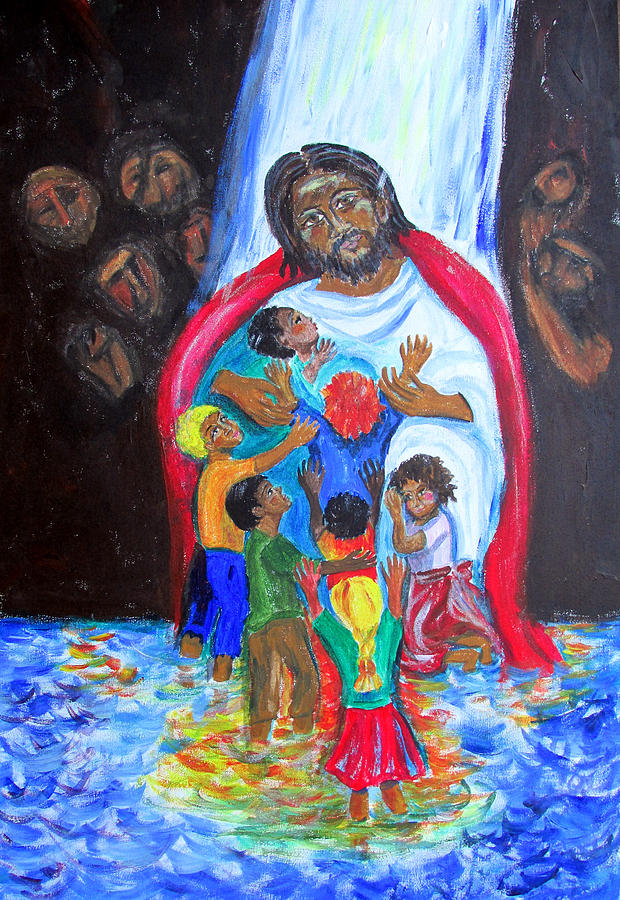
Jesus Loves the Children by Sarah Hornsby

At that time the disciples came to Jesus and asked, “Who is the greatest in the kingdom of heaven?”

Then he called a little child over to sit among the disciples, and said, “I assure you that if you don’t turn your lives around and become like this little child, you will definitely not enter the kingdom of heaven. Those who humble themselves like this little child will be the greatest in the kingdom of heaven. Whoever   one such child in my name welcomes me.

“As for whoever causes these little ones who believe in me to trip and fall into sin, it would be better for them to have a huge stone hung around their necks and be drowned in the bottom of the lake. How terrible it is for the world because of the things that cause people to trip and fall into sin! Such things have to happen, but how terrible it is for the person who causes those things to happen! (Common English Bible)

How would you answer the disciples’ question of who is the greatest in God’s kingdom?

Jesus answered the question by essentially stating that the least among us are the greatest. To be little is to be big. The kingdom hinges on being humble, gentle, meek, and lowly.

That definitely isn’t the way Western society looks at greatness – even the Western Church typically devalues the importance of such virtues and spiritual qualities.

In particular, many Americans takes pride in their can-do spirit. They seem always on the lookout for those who are assertive and can get things done efficiently and quickly. The tragedy of this is that, even though intentions may be noble, such a spirit often ends in causing others to stumble over their prideful beliefs of being hardworking and right.

Methinks Jesus and Horton the elephant would get along well together. In Dr. Seuss’s book, Horton Hears a Who, Horton exalted the littlest of persons whom others could neither see nor hear.

“A person’s a person no matter how small” said Horton to the people completely unconcerned for all the residents of Who Ville, living on a clover. They were unconcerned because the Who’s were invisible to them. 

Dr. Seuss chose to make Horton an elephant, a large creature able to hear with big ears and be attentive to the small. Largeness of heart comes from being attentive to the smallest ones among us – so small that the big people are unaware of them.

People who no one sees or notices, nonetheless matter to Jesus; and so, they should matter to us, too. 

Jesus often mingled with the little people of his time – children, women who had no rights, social misfits like lepers, the chronically ill, religious outsiders, tax collectors, and prostitutes. 

Our world is filled with similar people – angry adolescents, unwanted babies, forgotten old people, the mentally ill, moral failures, immigrants and refugees, and, if we have eyes to see and big ears to hear, lots of poor people who reside on the dark underbelly of society. They are around us, even if we fail to see or hear them.

The way to become great in the kingdom of God is to descend, not ascend, into greatness. The main enemy of any community is a desire to be prominent – it’s called “pride” and it will give us a terrible end if we hold onto it.

The disciples’ question is dripping with a desire for position and prestige. It’s a question meant to posture themselves into prominence and power. They want to know how to climb the ladder in God’s kingdom and be the important people.

I admire Christ’s grace for not throwing up his hands and going off on these guys: “What!? You’ve been with me how long and you ask me a stupid question like that?  Where have you been?  Have you learned nothing from me?” 

But instead, Jesus calmly called a child to him and used them as an example of his answer: Unless you become like this little child you will have no future at all with God. The way to have what you want is through humility.

In Jesus’ day children had no status or rights. Ancient culture was not kid oriented and there was no such thing as a youth culture. Children were, for the most part, viewed as potential adults – weak, small, and unable to contribute much of anything until they grew up. 

Christ’s disciples are to become like children, to become lowly; they are to give up their status and a desire to be important. They can only be big if they become small.

There’s another thing about the smallness of children that we ought to notice: Kids see what adults don’t. Whereas adults make distinctions between people on the basis of race, class, ethnicity, and gender, children see children and will play with just about anyone.

Only by getting on the same level as little people can we ever welcome Jesus; a person who is attentive to the lowly is attentive to Jesus. 

We are not to welcome people because they are great, wise, rich, powerful, good-looking, and just like you and me – but because they are noticed by Jesus. Christ stands for those we may tend to overlook.

The proud person who seeks prominence is forever looking for greener pastures, to do things that will impress others and help them advance up the ladder of success. In such a frame of mind, the proud person pays no attention to who they step on along the way. 

Christians, however, are to be different – giving socially insignificant people the time of day and treating them as important – because they are important to Jesus.

Here’s how Christ’s argument unfolds to the disciples:

  • Humility. Those who become like little children enter God’s kingdom, because it is only accessed through humility.
  • Attention. Those who pay attention and receive these little ones receive Jesus.
  • Rejection. Those who reject these little ones reject Jesus, and by their lack of loving them cause them to sin. 
  • Consequences. Leeching the poor and needy, ignoring the insignificant around us, and devaluing the littlest ones is damnable behavior, according to Jesus.

A person’s a person no matter how small. 

We need humility, to lower our sights in order to see and hear little people. No one is to be overlooked or to fall through the cracks under Christ’s rule and reign.

Loving Lord Jesus, you gave honor to the least, the forgotten, the overlooked, and the misunderstood and misjudged. You came to give first place to the last, those left behind and undervalued. You seek to provide a warm welcome to the lost, to the abandoned and the destitute.

Help us to be your ears to listen to their cries; your voice to speak love and acceptance; your feet to walk beside those in need; and your hands to clothe, feed and shelter them. Lord, in your mercy, hear our prayer. Amen.

Jacob’s Dream (Genesis 28:10-22)

Jacob’s Ladder by Darius Gilmont

Jacob left the town of Beersheba and started out for Haran. At sunset he stopped for the night and went to sleep, resting his head on a large rock. In a dream he saw a ladder that reached from earth to heaven, and God’s angels were going up and down on it.

The Lord was standing beside the ladder and said:

I am the Lord God who was worshiped by Abraham and Isaac. I will give to you and your family the land on which you are now sleeping. Your descendants will spread over the earth in all directions and will become as numerous as the specks of dust. Your family will be a blessing to all people. Wherever you go, I will watch over you, then later I will bring you back to this land. I won’t leave you—I will do all I have promised.

Jacob woke up suddenly and thought, “The Lord is in this place, and I didn’t even know it.” Then Jacob became frightened and said, “What a frightening place! It must be the house of God and the gateway to heaven.”

When Jacob got up early the next morning, he took the rock that he had used for a pillow and stood it up as a place of worship. Then he poured olive oil on the rock to dedicate it to God, and he named the place Bethel. Before that it had been named Luz.

Jacob solemnly promised God, “If you go with me and watch over me as I travel, and if you give me food and clothesand bring me safely home again, you will be my God. This rock will be your house, and I will give back to you a tenth of everything you give me.” (Contemporary English Version)

“Dreams are impartial, spontaneous products of the unconscious psyche, outside the control of the will. They are pure nature; they show us the unvarnished, natural truth, and are therefore fitted, as nothing else is, to give us back an attitude that accords with our basic human nature when our consciousness has strayed too far from its foundations and run into an impasse.

Carl Jung, Collected Works, Vol. 10

Not all unconscious dreams are the same, any more than all conscious experiences are alike.

Some dreams are not much more than a thing which occurs while we’re sleeping; they’re akin to the tedious or pedantic things we do while awake. Yet, other dreams are loaded with symbolic significance and have complex patterns of organization and relating.

However, all dreams which we carry with us into conscious waking – no matter whether mundane or extraordinary – are telling us a similar message: “Hey! Pay attention to this!”

In other words, our unconscious brains are usually aware of what we need more than our conscious minds; and dreams become the vehicle by which our unconscious alerts our conscious selves of something we need to focus upon.

Jacob’s Ladder by Ben Avram

Jacob needed to pay attention to something that he was not consciously aware of. Before his dream, Jacob had left home at the behest of his aging father. Mom and Dad wanted Jacob to have a good wife, so they sent him off to a specific place to find one.

Now, mind you, Jacob was a mama’s boy; he stuck close to home and was attached to his mother. Off on his first outing away from familiar confines, Jacob would have been understandably anxious and fearful. Although he had the blessing of his parents, Jacob’s unconscious self knew he also needed the blessing of almighty God.

So, the Lord showed up in a dream. To Jacob’s credit, he paid attention by acknowledging the importance of the dream. Jacob also made the Lord a promise that he would give back a tenth of anything and everything he acquired because of God’s blessing.

I wonder: How many times do you and I fail to acknowledge that the Lord’s presence is in the very place we are? Maybe our dreams are trying to tell us something – that the God of all things, including dreams, is with us in our own particular place and situation.

It can be frightening to be in a new place or new situation that you’ve never been in before. Yet, there is no place any of us can go where God is not already there.

You have looked deep
into my heart, Lord,
    and you know all about me.
You know when I am resting
    or when I am working,
and from heaven
    you discover my thoughts.

You notice everything I do
    and everywhere I go.
Before I even speak a word,
    you know what I will say,
and with your powerful arm
you protect me
    from every side.
I can’t understand all of this!
Such wonderful knowledge
    is far above me.

Where could I go to escape
from your Spirit
    or from your sight?
If I were to climb up
to the highest heavens,
    you would be there.
If I were to dig down
to the world of the dead
    you would also be there.

Suppose I had wings
like the dawning day
    and flew across the ocean.
Even then your powerful arm
    would guide and protect me.
Or suppose I said, “I’ll hide
in the dark until night comes
    to cover me over.”
But you see in the dark
because daylight and dark
    are all the same to you. (Psalm 139:1-12, CEV)

The Lord is with you. Your dreams have already confirmed it.

O God, give me strength for this day, and not to turn coward in the face of difficulty or duty. Let me not lose faith in other people. Keep my heart pure and caring, free from all ingratitude or meanness. Open wide the eyes of my soul so that I may see the good in all things. Grant me today a new vision of your truth; and for tonight, may the Lord Jesus be in my dreams so that I might awake again and serve him in joy and gladness, in the power of the Holy Spirit. Amen.

Pay Attention to the Word (2 Peter 1:16-21)

For we did not follow cleverly devised stories when we told you about the coming of our Lord Jesus Christ in power, but we were eyewitnesses of his majesty. He received honor and glory from God the Father when the voice came to him from the Majestic Glory, saying, “This is my Son, whom I love; with him I am well pleased.” We ourselves heard this voice that came from heaven when we were with him on the sacred mountain.

We also have the prophetic message as something completely reliable, and you will do well to pay attention to it, as to a light shining in a dark place, until the day dawns and the morning star rises in your hearts. Above all, you must understand that no prophecy of Scripture came about by the prophet’s own interpretation of things. For prophecy never had its origin in the human will, but prophets, though human, spoke from God as they were carried along by the Holy Spirit. (New International Version)

The Bible is a set of living documents. It breathes with a revitalizing and reliable message about Jesus Christ.

Rather than being merely an ancient book to be displayed as some sort of museum artifact on a coffee table, Holy Scripture has demonstrated amazing resilience of use and pertinence throughout the ages.

Millions of people have discovered it’s riches; and have found the Bible’s message of knowing Christ and him crucified, died, risen, and coming again as their hope and salvation. Indeed, God’s Word to people is a gracious revealing of God to humanity so that all persons may reconnect with divinity.

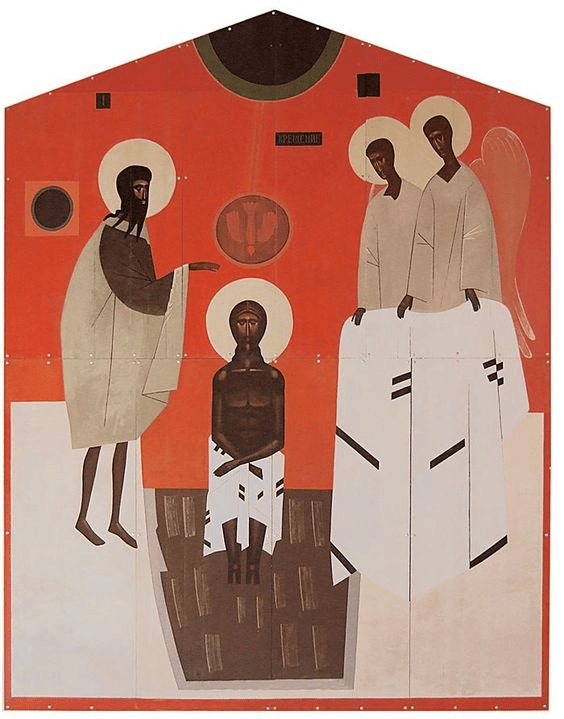
The earthly ministry of Christ had eyewitnesses and earwitnesses. The witness above all witnesses was the Most High who audibly affirmed Jesus with a voice from heaven:

“This is my dearly loved Son, who brings me great joy.” (Matthew 3:17, NLT)

Baptism of Christ, by Vitaly Melnichuk, 2009

Christianity is a religion of the book. Scripture unites us with believers across the world and throughout history. The Bible is to the Christian what weights and barbells are to a bodybuilder. 

The people of God need Holy Scripture, God’s Word, in order to spiritually grow and become mature. Christian character formation cannot truly occur apart from the continuous repetitions of reading the text of Scripture, and letting it build strength into the muscles of the soul.

Scripture is a powerful unifying force within the life of God’s people. We may not all explain every Bible verse in exactly the same way (hence the many different Christian traditions) but believers share a common desire to honor, apply, and obey God’s Word. Ultimately, a passion to listen, talk about, and apply God’s Word brings believers in Jesus together, rather than separates us. 

Perhaps because the average American household today has at least three or four Bibles, we take for granted the availability of God’s Word. It is always at our fingertips, on our smartphones and computers. Yet, because it is always present and available, we may let the busyness and business of life keep us from paying attention to it. 

A commitment to reading and listening to Holy Scripture ought not be done quickly or mechanically, and certainly not half-heartedly. For the Word to penetrate and seep into our souls, we must take the time to listen carefully and slowly.

A first century rabbi, Akiva, once noticed a tiny stream trickling down a hillside, dripping over a ledge on its way toward the river below. Below was a massive boulder. The rock bore a deep impression. The drip, drip, drip of water over the centuries had hollowed away the stone. Rabbi Akiva commented, “If mere water can do this to hard rock, how much more can God’s Word carve a way into my heart of flesh?”

Water flowing over a rock, all at once, leaves it unchanged. It is the slow but steady impact of each small droplet, year after year, decade after decade, that completely reforms the stone.

O how we desire quick answers to our questions! Yet we must take the time to prayerfully listen and reflect on God’s Word and allow it to do it’s work on us and in us. Truth is revealed over many days, months, and years. Big splashes aren’t usually God’s way of doing things. Instead, the slow drip of careful study, contemplative prayer, and meditative reflection, day after day, year after year, shapes us and spiritually forms us into the likeness of Christ.

Thus, a patient, humble, and teachable spirit is necessary. Sometimes the Bible is not apparently relevant. We oftentimes need others to help us and to encourage one another to stick with reading and learning, even when we aren’t sure about what it is saying. 

Rightly interpreting Scripture happens in community, both in present local churches and small groups and in the community of saints who have gone before us. It doesn’t occur in isolation.

Always an appropriate response to hearing God’s Word is to address and the problems of others and the issues of our day. That’s because God is not just concerned about you and me, but about other people, as well. 

What do you suppose would happen if we all committed to carefully reading and listening and meditating, even memorizing God’s Word on a daily basis? Would it transform our worship? Make a difference in our relationships? Change how we do life together?

Attention, people of God and of the Book! God is our God, the One and only!

Love the Lord your God with your whole heart:

Love God with all that is in you; love the Lord with all you’ve got! 

Write these foundational commands I’ve given you on your hearts. Get them inside of you. Then, get them inside your children. 

For this to happen, talk about God’s Word at home when you are eating supper together and when you are working or playing with each other. Start your day with God’s Word when you get up in the morning and end your day with God’s Word when you go to bed at night. 

Put God’s Word on your refrigerator and your car’s dashboard; have it on your smartphones and let it be available to you anywhere and anytime. Use every opportunity you have to incessantly chatter about God’s Holy Word.

(Deuteronomy 6:4-9, contemporary paraphrase)

Pay attention to the Word made flesh and the written Word proclaimed. It makes all the difference.

Our Great Physician, Your Word is like alcohol – when poured on an infected wound, it burns and stings, but only then can it kill germs. If it doesn’t burn, it doesn’t do any good. 

Father, we are all hungry baby birds this morning. Our heart-mouths are gaping wide, waiting for you to fill us. A cold wind seems to have chilled us. Wrap us in the blanket of your Word and warm us up. 

Lord, we find your Word like cabbage. As we pull down the leaves, we get closer to the heart. And as we get closer to the heart, it is sweeter.

–Daily Prayers of Haitian Christians, translated by Eleanor Turnbull (1924-2020) missionary to Haiti for over 50 years