The Parable of the Good Samaritan (Luke 10:25-37)

Good Samaritan, by Olga Bakhtina

An expert in the law stood up to test Jesus. “Teacher,” he said, “what must I do to inherit eternal life?” 

He said to him, “What is written in the law? What do you read there?” 

He answered, “You shall love the Lord your God with all your heart and with all your soul and with all your strength and with all your mind and your neighbor as yourself.” 

And he said to him, “You have given the right answer; do this, and you will live.”

But wanting to vindicate himself, he asked Jesus, “And who is my neighbor?” 

Jesus replied, “A man was going down from Jerusalem to Jericho and fell into the hands of robbers, who stripped him, beat him, and took off, leaving him half dead. Now by chance a priest was going down that road, and when he saw him he passed by on the other side. So likewise a Levite, when he came to the place and saw him, passed by on the other side. 

“But a Samaritan while traveling came upon him, and when he saw him he was moved with compassion. He went to him and bandaged his wounds, treating them with oil and wine. Then he put him on his own animal, brought him to an inn, and took care of him. The next day he took out two denarii, gave them to the innkeeper, and said, ‘Take care of him, and when I come back I will repay you whatever more you spend.’ 

“Which of these three, do you think, was a neighbor to the man who fell into the hands of the robbers?” 

He said, “The one who showed him mercy.”

Jesus said to him, “Go and do likewise.” (New Revised Standard Version)

The Good Samaritan, by Paula Modersohn-Becker

Let’s establish upfront that the chief point of Christ’s parable is mercy shown from one person to another. Mercy is at the heart of Holy Scripture. Mercy is the very heart of Christ – even more than routine obedience:

“Go and learn what this means, ‘I desire mercy, not sacrifice.’” (Matthew 9:13; 12:7; Hosea 6:6)

The message of the Old and New Testaments of the Bible continually reinforces mercy to those who are in need – mercy to immigrants, strangers, the poor, the infirmed, and foreigners.

Therefore, any system – no matter whether church, neighborhood, or government – which seeks to ignore, round up, or get rid of those in need of mercy, is in direct contradiction to the instruction of Jesus, the message of the prophets, and the consistent teaching of the early church fathers (and mothers).

We get in trouble whenever we distinguish between people who “deserve” our help from those who don’t. In truth, there is no such thing. Everyone needs mercy and deserves mercy, simply because they are created in the image and likeness of God.

There are no exceptions. And if we think there ought to be, we are playing the judge and trying to take the reins of decision-making away from God, so that we ourselves can execute our own standard of who deserves mercy and who deserves judgment.

In today’s Gospel lesson, the expert in the law started out by testing Jesus. Then, he changed tactics by trying to justify himself as one who deserves to be recognized as worthy of mercy. He believed that, as one who strictly observes the law and obeys the commandments, he is more deserving than others who are less observant.

It’s this privileged mentality which continually connects adjectival words to humans, and even Christians – when, in truth, there are no adjectives to being a human and/or a Christian.

But, in order to justify ourselves, many people like their adjectives, so they can make sure to distinguish before God who is worthy and right, and who is not. The following are just a smattering of adjectives I’ve heard in the church throughout the years:

  • Backslidden Christian
  • Lukewarm Christian
  • Weak Christian
  • Liberal Christian
  • Conservative Evangelical Christian
  • Real Christian
  • Born Again Christian
  • Committed Christian
  • Fairweather Christian
  • Christmas and Easter Christian
  • True Christian
  • Baptized Christian

Yet, in reality, a Christian is a Christian. If we feel the need to add adjectives in describing how less or more of a Christian they are, then we are no longer describing Christianity at all.

When it comes to the word neighbor, there are a plethora of adjectives that we might use to describe our neighbors. Again, all the words are meant to distinguish between “us” and “them.”

I once lived in a very diverse neighborhood. One day I was outside praying, and looking at all the various houses. I prayed for my neighbors by affixing adjectives to them: my black neighbor; my nerdy neighbor; my lesbian neighbors; my single neighbor; my agnostic neighbor; my mean obnoxious neighbor.

On and on I went, until I heard that still small voice of God whisper to me saying, “Tim, these are not your neighbors with adjectives. They are just your neighbors.”

I got the message. I was praying on my holy hill for all these other folks who were different than me, using my adjectives to keep separate from them. My neighbors, however, are simply my neighbors. We live together in the same neighborhood. We are neighbors – nothing more, nothing less.

Even though my neighbors have many differences about them, we all share the need for receiving mercy and giving mercy. Without mercy, neighborliness vanishes.

My sacrificial offerings of prayer for my neighbors didn’t make me better. But both my attitude of mercy and my actual extensions of mercy toward my neighbors, no matter how little, meant a great deal to them.

The priest and the Levite who passed by the man in need, likely only saw that they would become unclean by helping this needy person. “Besides,” they may have pondered, “there’s nothing in it for me.”

There was no way for the man lying in the ditch to reciprocate or pay back the priest or the Levite. A Samaritan (despised by both priests and Levites) ended up being the one to show mercy to the man.

It didn’t matter who helped the victimized person – whether it was a priest, a Levite, or a Samaritan. It didn’t matter how any of them might describe the other. Only mercy mattered.

I admit that I desperately want to see my national government have at least a little neighborly sense. When I observe the opposite, it’s hard for me to live with. I find myself not wanting to see any mercy extended to them, to the current administration.

Yet just because politicians may not show mercy, doesn’t infer that I should withhold it from them. I really do want to take my cues from Jesus by loving my enemies and doing good to them – even if they ignore, mistreat, or oppress others.

God will sort out the judgment thing. As for me, I’m called to a gospel of grace, not a gospel of judgment.

Nobody can justify themselves. In Christianity, only God can justify the person.

Christ’s mercy is not dependent on what kind of people we are but is based simply on need. God graciously gives us the gift of faith and the mercy of deliverance.

Divine Judge, You framed the earth with love and mercy, declaring it good. Yet we, desiring to justify ourselves, judge others harshly without knowledge or understanding. Keep us faithful so that we may be filled with the knowledge of Your will, and not ignore or pass by another’s need, but plumb the depths of love in showing mercy. Amen.


The Parable of the Tenants (Mark 12:1-12)

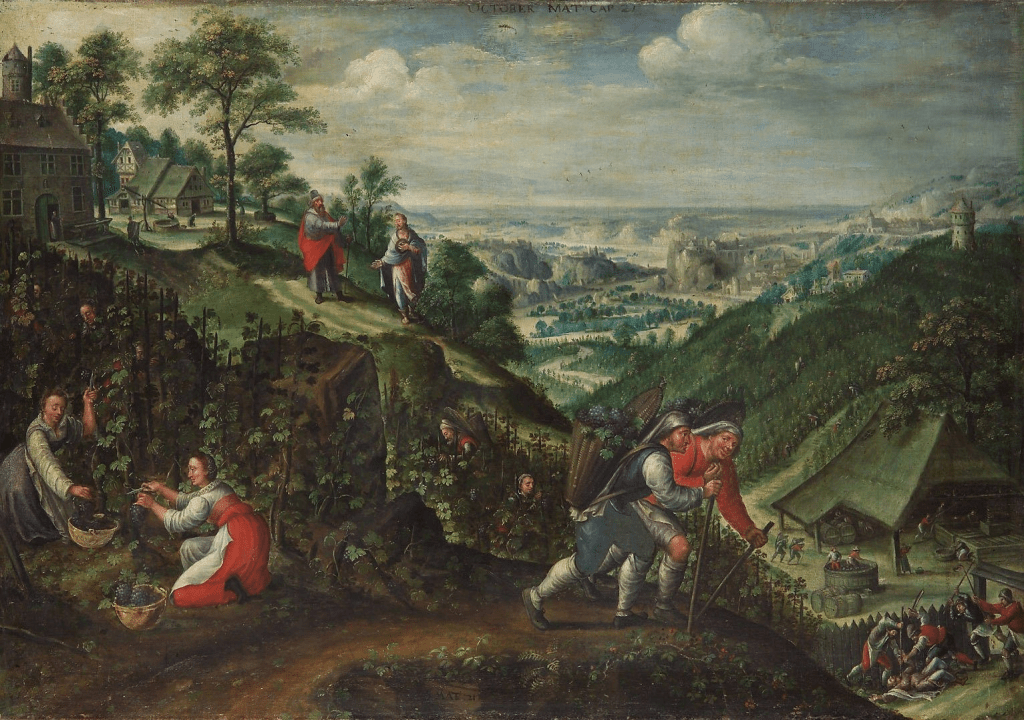
Parable of the Vineyard Workers, from Unknown Artist in the Middle Ages

Then he began to speak to them in parables. “A man planted a vineyard, put a fence around it, dug a pit for the winepress, and built a watchtower; then he leased it to tenants and went away. 

When the season came, he sent a slave to the tenants to collect from them his share of the produce of the vineyard. But they seized him and beat him and sent him away empty-handed. 

And again he sent another slave to them; this one they beat over the head and insulted. Then he sent another, and that one they killed. And so it was with many others; some they beat, and others they killed. 

He had still one other, a beloved son. Finally he sent him to them, saying, ‘They will respect my son.’ But those tenants said to one another, ‘This is the heir; come, let us kill him, and the inheritance will be ours.’ So they seized him, killed him, and threw him out of the vineyard. 

What then will the owner of the vineyard do? He will come and destroy the tenants and give the vineyard to others. Have you not read this scripture:

‘The stone that the builders rejected
    has become the cornerstone;
this was the Lord’s doing,
    and it is amazing in our eyes’?”

When they realized that he had told this parable against them, they wanted to arrest him, but they feared the crowd. So they left him and went away. (New Revised Standard Version)

Parable of the Wicked Tenants, by Maarten Van Valckenborg (1535-1612)

Jesus was at the temple in Jerusalem. While there, the religious leaders confronted him over his supposed ministerial authority. Jesus, rather than become defensive, took the initiative by telling a parable.

The parable’s imagery comes directly from the second chapter of the prophet Isaiah in the Old Testament. It, too, was a parable concerning a vineyard. Isaiah leveled an accusation against the entire nation of Israel.

Jesus picked up the same imagery and directed his accusation against the people in front of him, the Jewish religious leaders. The connection between the parable of Isaiah and the parable of Jesus would not have been lost on those leaders.

In many ways, I can relate to the parable’s setting in the land. I grew up on a farm, and appreciate the deep connection of working the land and caring for it. I know something of owning land and having renters work it, since that it was my family did in my parent’s later years.

Anytime there is a relationship between owners, and renters or tenants or servants, it is an unequal relation. And whichever situation you relate to will affect your perspective of the parable.

If you understand what it means to be a landowner, with all of the rights and responsibilities of that ownership, and with the people who work that land, then you likely resonate with the landowner in Christ’s parable. You also will likely detest what the tenants in the parable do.

Perhaps you relate more to being a renter or a tenant. Having an understanding of what it means to rent from another, you may likely see the how the tenants in the parable think, and why they do what they do.

Having personal experiences on both sides of the owner/renter situation – for both good and bad – I can easily see how the violence in the parable could happen. I have my own stories of justice and injustice when it comes to each, the owners and the renters/tenants.

Much like today, ancient power dynamics were a fundamental part of life for many people. And those relations were, and are, fraught with all sorts of inequality.

Christ’s parable is a rather violent story. It’s not really bedtime reading. Notice that the owner has slaves, whom he sends to collect what is due him. Several of them are beaten and/or killed.

There is no backstory to the tenants situation. Yet, at the time of Christ’s ministry, there were many lower class folk who lost their land to unscrupulous owners, in a system of inequity. It’s possible that some of the men Jesus was talking to owned some land. And the religious leaders in the Gospels are rarely presented in a positive light.

Even today, there are violent struggles regarding land, especially in the Middle East. And the power dynamics and inequities are rife with injustice which is claiming to be justice. There are no easy answers to quelling the constant violence.

Feelings of hatred, anger, and fear are common. The desire to kill too often overcomes the desire for life. A group of people are outraged for being the brunt of murder, killing, and evil. Another group already feels neglected and have been the victims of unjust usury and death. They feel justified in their violence toward those they view as perpetrators.

Imagine how people on this earth, such as Palestinians, Israelis, Native Americans, and Ukrainians – just to name a few – feel about land. Land involves life, because the land has water, the potential for farming, trees, and a place to live. Thus, whoever controls land, in many ways, controls life. Agribusiness owns large chunks of land in the United States – and not the smaller family farms. Ah, but that is a topic for another time….

In Christ’s parable, everybody suffered in some way. Servants died. The landowner’s son died. The tenants were destroyed. Life was permanently altered for all involved.

Is that how any of us really want to live?

If we take a theological perspective, God owns everything. But we think we own the land and its resources. We believe we have the right to do whatever we want with it. And that is where the problem arises.

Until we truly hold to the notion that we humans are a society of equals, and that we are all subject to a God who owns everything, then we will continue to experience the effects of injustice, war, and death.

Can we, at least, change our minds? Yes, we can. And Christians are called to do just that:

Do not be conformed to this age, but be transformed by the renewing of the mind, so that you may discern what is the will of God—what is good and acceptable and perfect.

For by the grace given to me I say to everyone among you not to think of yourself more highly than you ought to think but to think with sober judgment, each according to the measure of faith that God has assigned. (Romans 12:2-3, NRSV)

The religious leaders of Christ’s day needed to change their minds about Jesus. Yet, no matter what they did, he would still become the cornerstone, if they rejected him as just one of the stones in the edifice of God’s kingdom.

Today, the parable is still meant to speak to people, to you and me. We have the chance to embrace the Prince of Peace, and walk in the way of peace, not violence. We still yet have the opportunity to be peacemakers, and live in a way that promotes human flourishing, and not human carnage.

If, like the parable of the prophet Isaiah, Christ’s parable is meant to speak to everyone, then it is most necessary that we heed the words of Jesus.

Almighty God our heavenly Father, guide the nations of the world into the way of justice and truth, and establish among them peace, which is the fruit of righteousness, so that they may become the kingdom of our Lord and Savior Jesus Christ. Amen.

The Parable of the Mustard Seed (Mark 4:30-34)

Again he [Jesus] said, “What shall we say the kingdom of God is like, or what parable shall we use to describe it?It is like a mustard seed, which is the smallest of all seeds on earth. Yet when planted, it grows and becomes the largest of all garden plants, with such big branches that the birds can perch in its shade.”

With many similar parables Jesus spoke the word to them, as much as they could understand. He did not say anything to them without using a parable. But when he was alone with his own disciples, he explained everything. (New International Version)

Working with Seeds

I grew up on a rural Mid-West America farm. Working with seeds was our livelihood. Even though my farming father worried incessantly about the weather, there was one thing he was never anxious about: seeds.

My dad knew that when we planted seeds in the Spring, there would be a harvest in the Fall. That’s because he knew the seed already has within itself everything it needs to germinate, take root, grow, and produce a harvest. His role was simply to tend to it all by keeping the fields free of weeds, worms, and critters.

Since I was the youngest, I typically got the grunt work of our massive family garden. I was always excited when we planted things because I knew what was coming in a few months: some delicious veggies on my dinner plate which were fresh from the garden that I myself tended. I never wondered whether there would be food on the table, or not.

Seeds are, of course, small. If you think about it, they appear quite unimpressive. Yet, we know better. We understand that when planted, watered, and cultivated, those seeds turn into amazing plants. 

But it takes time. Even as dumb little kid, I clearly knew that my planting seeds would not result in seeing anything above ground the next day. I understood it would take a few weeks before new growth would break the ground.

Seeds and the Kingdom of God

The kingdom of God, Jesus told us, is like a mustard seed – a very small seed which can grow into a tree big enough for birds to nest. Unlike the mighty Roman Empire, or contemporary powerful national governments, the kingdom of God had humble beginnings. It grows, over a long period of time, to become a force greater than anything the world can produce.

While our world races forcefully on with the speed of the hare, Jesus is carefully and patiently building his Church at the pace of a tortoise. In the end, the kingdom of God will rule over all creation, while the kingdoms of this world shall no longer exist. 

Even though many of us now live in a society where quicker, faster, better, and stronger dominate everything, still the best things in life come as a result of tedious perseverance over an extended period of time. 

We are in such a hurry to accomplish our goals, make as much money as we can, and keep constant vigilance over our work. And for what purpose?

When we forget to slow down, or worse yet, believe slowness to be laziness and/or stupidity, there is a price to pay.

Lessons of the Seed

In graduate school, I typically read an average of 200 books per semester. Yes, you read that right. I had to keep up. I was on the clock with deadlines for papers and projects. In the factory, where I did a stent as a worker, I did piece work at the rate of 100 per hour for 8-10 hours. I had to go fast to survive and keep my job, let alone thrive. All of this, of course, impacted my mind, body, and emotions – in very uncaring ways. It was all done at the cost of my physical and mental health.

Indeed, our modern capitalist societies generate an unparalleled level of wealth and standard of living. But this has been achieved at the cost of devouring our planet faster than she can replenish herself. The stress we have put on mother earth we would never think of putting on our own mothers.

Even our attempts at leisure and self-care are anything but. We often end up racing to have as much fun and relaxation as we can cram into a few days or weeks of our “time off.” A return to the normal rat race has us telling each other, “I need a vacation from my vacation.”

There is such a thing as death by overwork. So, we desperately need to come back to the words and ways of Christ – to embrace the slow developing rhythms of grace. We need to age like a fine wine or an expensive bourbon, getting wiser as we get older.

Time is a precious gift given to us by a good and wise God. And that gift must be stewarded well. All the things that bind people together and make our lives worth living – family, faith, friendship, and community – all thrive on having copious amounts of time with each other (and God) in relational connection.

We are, I believe, in a pandemic of having no one to listen, of profound loneliness, and of incredible lostness of soul. The only real prescription for these debilitating maladies is slowing down and taking the time to be, and to be with each other.

Seeds are Slow

Instant gratification will not do the trick. We need to plant small seeds, and then take the time to nurture them and watch over them. While the rest of the world rages and roars on with their disease of speed, believers must carefully cultivate spiritual practices which foster healthy growth and development.

Whether we like it, or not, we serve a slow God. And what’s more, because slowness is built into the very nature of the world, decelerating our lives actually works. Life eventually becomes better, not worse.

You and I have the God-given right to determine our own pace and tempo – without anxious systems of power squeezing every ounce of speed and activity out of us, sucking our souls to serve a worthless idol.

I, for one, would not be opposed to creating a society known as “The Royal Order of Sloths,” or joining a group of slow walkers who label themselves as “Sauntering for Sanity,” or simply be straightforward with an organization known as “The Society for the Propagation of Slowness.”

That’s because the best things in life take time; and those things need us to slow ourselves enough to notice and enjoy them. Eventually, we shall find that the world is blessed because of our commitment to embracing the small and the slow.

Let us pray for all the world, and also for ourselves, knowing that what we ask in the name of the Lord, will be heard according to God’s mercy and patience.

Almighty God, we pray for faith, even as small as a mustard-seed, and for the love to nourish and nurture it, so that it may grow and flourish. We pray for the church throughout the world – that people of faith may work together in unity and in prayer to overcome evil and to promote true love among all people.

O Lord, you are the beginning of all our good, the wellspring of all our love and the source of all our freedom. Let your grace continue to work in us, that your will may be done through us, and that we may always rejoice in your presence. Lord, in your mercy, hear our prayer. Amen.

A Parable of Two Sons (Matthew 21:28-32)

The Lord of the Parables by Argentine artist Jorge Cocco Santángelo

“What do you think? A man had two sons. Now he came to the first and said, ‘Son, go and work in the vineyard today.’

“‘No, I don’t want to,’ he replied. But later he changed his mind and went.

“The father said the same thing to the other son, who replied, ‘Yes, sir.’ But he didn’t go.

“Which one of these two did his father’s will?”

They said, “The first one.”

Jesus said to them, “I assure you that tax collectors and prostitutes are entering God’s kingdom ahead of you. For John came to you on the righteous road, and you didn’t believe him. But tax collectors and prostitutes believed him. Yet even after you saw this, you didn’t change your hearts and lives and you didn’t believe him. (Common English Bible)

Contemporary persons aren’t the only ones who want to know whose in and whose out; it’s been around forever.

In the ancient world of Jesus, people were always concerned about conformity to the established system and society of the way things are. For religious folk, who gets in and who gets left out was an important issue .So, Jesus decided to tell a parable about entrance into the kingdom of God.

Turns out, there are spiritual insiders on the outside of the kingdom, and spiritual outsiders who are the true inheritors of the kingdom.

The parable, at its core, is a warning to all the spiritually serious insiders: Beware, lest your energies be spent in correctness of behavior, conformity of belonging, and cockiness of belief rather than following Jesus. And, at the same time, the parable encourages spiritually estranged outsiders with the wonderful possibilities of a changed life. 

Far too many people arrogantly assume they have the inside track by what they believe, and not by doing God’s will.

It may be challenging for us to imagine how truly offensive Christ’s story was to the original hearers of the parable, so I restate it in a more contemporary form:

There was a man who was well respected in the community and had two sons. One son grew up and became a respectable member of the community, too. He was a successful businessman and gave lots of money to causes in his community, including new lights for the school football field – which was no small cost. He only asked that appropriate and prominent recognition be given him with a plaque bearing his name on each of the light poles. 

The other son was not so successful. He was the one in school who the teachers said, “Why can’t you be more like your brother?” There was nothing spectacular about this son. In fact, he lived an “alternative lifestyle” and people murmured behind his back. 

The Parable of the Two Sons by Jorge Cocco Santángelo

One day the father said to this son: “Son, go and work at my place of business today; I am going away and need you to do some of the tedious paperwork I have gotten behind on.” “No way!” he answered, but later felt heartsick about the way he spoke to his father and decided to go and do all the grunt work his father needed done.

The father went to the well-respected son and said the same thing about needing him to do all the thankless paperwork that was piled up. That son answered, “Yes, sir, I will; anything you need I will do.” But that son did not go. Instead, he chose to go golfing with some people whom he was trying to coy favor with.

After telling the story, Jesus asked all the upstanding faith leaders and the people listening: “Which of the two did what his father wanted?” “The first,” they answered.

Jesus said, “I tell you the truth, folks with different sexual orientations, unemployed persons on the low rung of society, the religiously different with esoteric beliefs, immigrants from other countries, ex-convicts living in half-way houses, and persons with addictions are all entering the kingdom of God ahead of you.

For you have had heard thousands of sermons about grace and the way of righteousness, yet you did not believe by putting God’s Word into practice; but the others did. And even after you saw how God can change a person’s life from the inside-out, you yourselves did not repent and believe.

It was parables like this that created a religious scandal and eventually got Jesus killed.

The offense for many upstanding citizens is this: that their right doctrine and clean living is not the way of salvation.

Tax collectors and prostitutes were some of the most despised people in Christ’s time. It was simply assumed they were on the outside and would be judged by God.

However, the proof of genuine faith is not lip service but actively obeying God when no one is looking:

My friends, what good is it to say you have faith, when you don’t do anything to show that you really do have faith? Can that kind of faith save you? 

If you know someone who doesn’t have any clothes or food, you shouldn’t just say, “I hope all goes well for you. I hope you will be warm and have plenty to eat.” What good is it to say this, unless you do something to help? 

Faith that doesn’t lead us to do good deeds is all alone and dead!

Suppose someone disagrees and says, “It is possible to have faith without doing kind deeds.” I would answer, “Prove that you have faith without doing kind deeds, and I will prove that I have faith by doing them.” 

You surely believe there is only one God. That’s fine. Even demons believe this, and it makes them shake with fear. (James 2:14-19, CEV)

The Christian life comes down to obedience, not cheap talk. Jesus wants to bless a lost world in need of God’s love and grace.

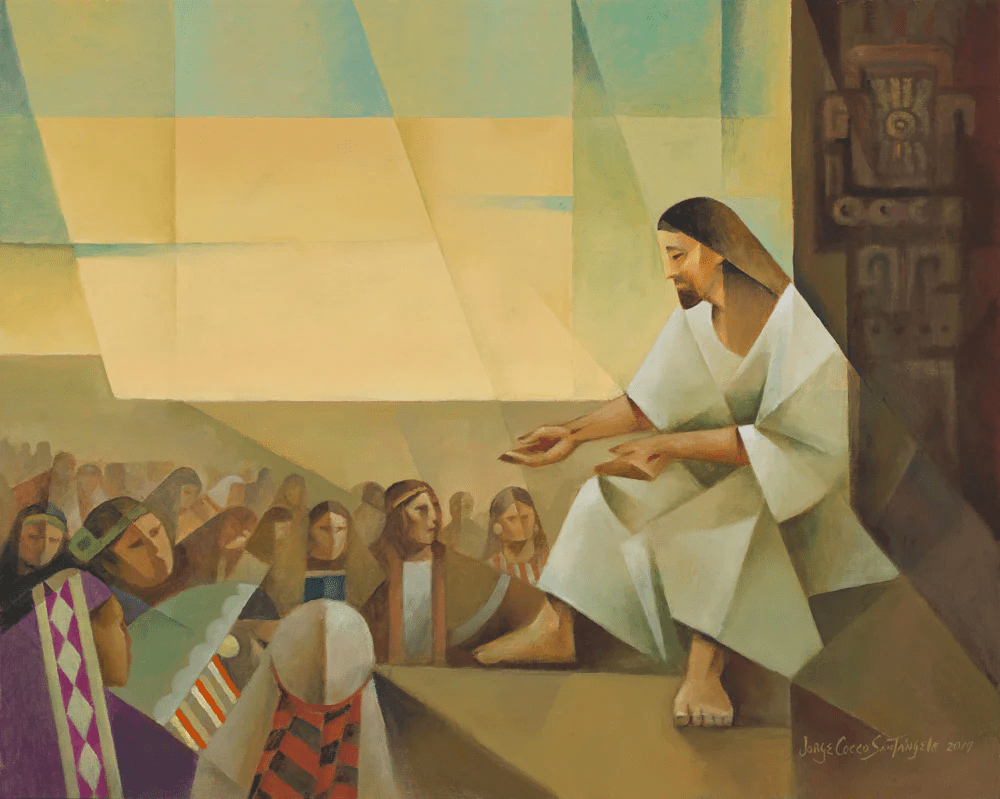
Jesus Preaching to the Multitude by Jorge Cocco Santángelo

If we have the spiritual ears to listen, we can hear numerous lost souls crying in the dark.

If we have the spiritual eyes to see, we can observe people overwhelmed with life circumstances standing in front of us.

If we have the spiritually strengthened hands willing to labor, we can support needy folks around us who can neither help themselves nor ask for it.

Whenever we take the focus off who is in and who is out, then without judgment and a heart full of compassion, we can address the:

  • Loneliness of so many people living alone and dying alone.
  • Shame which thousands secretly carry every day.
  • Pain of broken bodies, broken hearts, broken spirits, and broken minds experienced by individuals everywhere.

The Lord Jesus feels the loneliness, shame, and pain of people – which is why he told a parable like he did. Christ is looking to activate grace through his people, the church, to a world sinking in the depths of incredible human need.

Christ’s parable, however, is more than a warning; it is a story that flings open the door of mercy for unlikely people seemingly far from God – people who ruined their lives by saying “no” to God. The parable is an invitation for all the screw-ups and those with little faith to come to Jesus.

There is a rather obscure Scripture reference, tucked away in the Old Testament. David was on the outside looking in. King Saul was on the inside trying to capture and kill him, even though David had done nothing wrong. Here is what happened:

David got away and escaped to the Cave of Adullam. When his brothers and others associated with his family heard where he was, they came down and joined him. Not only that, but all who were down on their luck came around—losers and vagrants and misfits of all sorts. David became their leader. There were about four hundred in all. (1 Samuel 22:1-2, MSG)

This rag-tag group of outsiders in Israel became Israel’s insiders as David eventually became king and these were the “mighty men,” the ones who helped bring Israel into prominence. 

Jesus Christ came into this world and identified himself as the Savior to the outsider when he quoted the prophet Isaiah:

“The Spirit of the Lord is upon me,
    because he has anointed me
        to bring good news to the poor.
He has sent me to proclaim release to the captives
    and recovery of sight to the blind,
        to let the oppressed go free,
to proclaim the year of the Lord’s favor.”

And he rolled up the scroll, gave it back to the attendant, and sat down. The eyes of all in the synagogue were fixed on him. Then he began to say to them, “Today this scripture has been fulfilled in your hearing.” (Luke 4:18-21, NRSV)

In Christ, there are no lost causes and no persons too far on the outside to be redeemed.

Therefore, now is the time to act on what we believe – to not only affirm right doctrine, but to live out that doctrine in obedience to God’s call. Amen.