Amos 9:7-15 – A Promise of Restoration

“Are you Israelites more important to me
    than the Ethiopians?” asks the Lord.
“I brought Israel out of Egypt,
    but I also brought the Philistines from Crete
    and led the Arameans out of Kir.

“I, the Sovereign Lord,
    am watching this sinful nation of Israel.
I will destroy it
    from the face of the earth.
But I will never completely destroy the family of Israel,”
    says the Lord.
“For I will give the command
    and will shake Israel along with the other nations
as grain is shaken in a sieve,
    yet not one true kernel will be lost.
But all the sinners will die by the sword—
    all those who say, ‘Nothing bad will happen to us.’

“In that day I will restore the fallen house of David.
    I will repair its damaged walls.
From the ruins I will rebuild it
    and restore its former glory.
And Israel will possess what is left of Edom
    and all the nations I have called to be mine.”
The Lord has spoken,
    and he will do these things.

“The time will come,” says the Lord,
“when the grain and grapes will grow faster
    than they can be harvested.
Then the terraced vineyards on the hills of Israel
    will drip with sweet wine!
I will bring my exiled people of Israel
    back from distant lands,
and they will rebuild their ruined cities
    and live in them again.
They will plant vineyards and gardens;
    they will eat their crops and drink their wine.
I will firmly plant them there
    in their own land.
They will never again be uprooted
    from the land I have given them,”
    says the Lord your God.
(New Living Translation)

Guilt

Doom and hope, judgment and grace, suffering and glory. These are the movements and rhythms of the Old Testament prophets. The great sin of Israel which warranted divine wrath was not only that they trampled on the poor and needy. On top of it all, they saw nothing wrong with their way of life. 

This profound lack of awareness, rooted in the spiritual blindness of greed, is what led to judgment. It would take the form of having the Assyrian Empire come, seize the land, and take the people away to a place where they would have no chance to oppress others. Sadly, death would come to many.

“The work of restoration cannot begin until a problem is fully faced.”

Dan Allender

The sin of oppressing others and believing there’s nothing wrong with it comes with severe consequences. The people relied too much on their ethnicity. The ancient Israelites wrongly assumed that because they were the people of the covenant, this somehow inoculated them from disaster. Their belief in Jewish exceptionalism was their downfall.

Grace

Yet, all would not be an endless gloom. The Lord will not destroy completely. God’s anger lasts for a moment. However, God’s grace lasts forever. Restoration, renewal, and fruitful times will come because of God’s mercy. 

Yes, God pronounces judgment when it is warranted. But God also makes and keeps promises to people. In our lesson for today, the Lord promises to restore the fortunes of the people through rebuilding ruined cities and letting them inhabit them once again.

God steps in and graciously acts on behalf of all people because that is what God does. We might get the notion in our heads that God executes judgment to teach people a lesson or to make a point. In my line of work, it is common to hear people express the idea they are under divine punishment because of personal illness or hard circumstances. 

God, however, acts independently out of a vast storehouse of righteousness and mercy. The Lord maintains holy decrees while showing grace to the undeserving. The nation of Israel, in the days of the prophet Amos, deserved only judgment, not grace. 

It seems to me God would have been completely justified to never restore or renew a recalcitrant people. Yet, God’s grace overwhelms and swallows human sin. Try as you might to understand grace, you will end up befuddled. That’s because grace is wildly illogical, nonsensical, and unconditionally free. Grace shows radical acceptance where there ought to be only the punishing fire of hell.

Gratitude

The height of grace and the pinnacle of restoring the fortunes of Israel (from a Christian perspective) came through a baby and a humble birth in the small village of Bethlehem. Jesus came to save the people from their sins. God acted by entering humanity with divine free love so that there could be new life and fresh hope. 

So, let grace wash you clean. Allow mercy to renew your life. Receive the gift of gracious forgiveness, merciful love, and divine peace. Look ahead and see there is hope on the horizon. Give thanks for God’s indescribable kindness.

Merciful God, although you are careful to uphold your great holiness, your mercy extends from everlasting to everlasting. May the gospel of grace form all my words and actions so that true righteousness reigns in my life through Jesus, my Lord, in the power of the Holy Spirit. Amen.

Amos 8:1-7 – A Prophet’s Perspective on the Powerful and the Poor

This is what the Almighty Lord showed me: a basket of ripe summer fruit.

He asked, “What do you see, Amos?”

“A basket of ripe summer fruit,” I answered.

Then the Lord said to me, “My people Israel are now ripe. I will no longer overlook what they have done. On that day, the songs of the temple will become loud cries,” declares the Almighty Lord. “There will be dead bodies scattered everywhere. Hush!”

Listen to this, those who trample on the needy
and ruin those who are oppressed in the world.
You say to yourselves,
“When will the New Moon Festival be over
so that we can sell more grain?
When will the day of rest—a holy day, be over
so that we can sell more wheat?
We can shrink the size of the bushel baskets,
increase the cost,
and cheat with dishonest scales.
We can buy the poor with money
and the needy for a pair of sandals.
We can sell the husks mixed in with the wheat.”

The Lord has sworn an oath by Jacob’s pride:
“I will never forget anything that they have done.” (God’s Word Translation)

I’ve been in the church most of my life. I have listened to thousands of sermons, as well as preaching thousands of them myself. I can count on both hands how many times I’ve heard a sermon from one of the twelve minor prophets in the Bible. Although I personally have preached on them more times than that, it still pales in comparison with how many sermons I’ve preached from the New Testament gospels or epistles.

This, I believe, is an indictment on us, especially those with privilege and power. If you add the major prophets, we have sixteen books contained in Holy Scripture calling out powerful and influential people’s oppression of others. To overlook such a girth of text is to stick our fingers in our ears and refuse to listen to God.

Those with power, position, and privilege must continually be vigilant to use such influence for the benefit of all persons – not just themselves or people just like them. The books of the prophets make it quite plain that God cares about justice. God will uphold the needy. The Lord will stand with the oppressed. If we fail to share a divine sense of justice and injustice, there will be hell to pay.

“Extreme poverty anywhere is a threat to human security everywhere.”

Kofi Annan

God is longsuffering. The Lord patiently awaits us to pay attention. Yet, eventually, that patience will run its course. A prophet will be sent to voice God’s concerns. Like a basket of ripe fruit now finally ready to be eaten, so God’s justice is ripe and ready for action.

The prophet Amos delivered a scathing message to the ancient Israelites about their total disregard for the poor and needy in the land. The people in positions of authority and power only looked on the less fortunate as commodities – as pawns to be taken advantage of for the rich merchants. 

Because the wealthy never took the time to listen to the poor, God would not listen to them. Judgment was coming, and it would not go so well for the power brokers of society who only thought of their business and squeezing others for more money.

The bald fact of the matter is that few people rush to have poor folk as their friends. Those in poverty are often overlooked and disregarded. Either they are ignored altogether or are given hand-outs and services without ever having any significant human contact. Even when there is help, it comes from a distance.

In other words, those in authority rarely take the time to listen and get to know the real face of poverty. If there isn’t a photo opportunity, then encounters with the poor are not likely to happen with politicians, or anyone else. After all, so many are busy making money, checking stock portfolios, and considering how to get bigger market shares…. 

Oh, my, perhaps we have an answer as to why there is no revival in the land. God shows such solidarity with the poor that to ignore them is to ignore him.  No matter our financial picture and outlook, every one of us can grace the poor with the gift of time and listening.  For in doing so we might just be listening to the voice of God.

Gracious God, you are found everywhere – both the halls of power, and the back alleys of slums.  As I seek you more and more, may I see the face of Jesus in everyone I encounter, whether rich or poor so that I can share the gift of life with them all.  Amen.

Matthew 23:13-28 – Whoa, Here Comes the Woes!

Pharisees by German painter Karl Schmidt-Rottluff, 1912

“Woe to you, teachers of the law and Pharisees, you hypocrites! You shut the door of the kingdom of heaven in people’s faces. You yourselves do not enter, nor will you let those enter who are trying to.

“Woe to you, teachers of the law and Pharisees, you hypocrites! You travel over land and sea to win a single convert, and when you have succeeded, you make them twice as much a child of hell as you are.

“Woe to you, blind guides! You say, ‘If anyone swears by the temple, it means nothing; but anyone who swears by the gold of the temple is bound by that oath.’ You blind fools! Which is greater: the gold, or the temple that makes the gold sacred? You also say, ‘If anyone swears by the altar, it means nothing; but anyone who swears by the gift on the altar is bound by that oath.’ You blind men! Which is greater: the gift, or the altar that makes the gift sacred? Therefore, anyone who swears by the altar swears by it and by everything on it. And anyone who swears by the temple swears by it and by the one who dwells in it. And anyone who swears by heaven swears by God’s throne and by the one who sits on it.

“Woe to you, teachers of the law and Pharisees, you hypocrites! You give a tenth of your spices—mint, dill, and cumin. But you have neglected the more important matters of the law—justice, mercy, and faithfulness. You should have practiced the latter, without neglecting the former. You blind guides! You strain out a gnat but swallow a camel.

“Woe to you, teachers of the law and Pharisees, you hypocrites! You clean the outside of the cup and dish, but inside they are full of greed and self-indulgence. Blind Pharisee! First clean the inside of the cup and dish, and then the outside also will be clean.

“Woe to you, teachers of the law and Pharisees, you hypocrites! You are like whitewashed tombs, which look beautiful on the outside but on the inside are full of the bones of the dead and everything unclean. In the same way, on the outside you appear to people as righteous but, on the inside, you are full of hypocrisy and wickedness. (NIV)

I am not sure if today’s Gospel lesson was purposefully designed to fall on Halloween, or not. If it was, I guess the compilers of the Daily Lectionary wanted to scare the bejabbers out of us with Christ’s chilling pronouncement of woes upon hypocritical religious folk.

Christ’s scathing critique was directed against a distorted spirituality, a false Christianity, and a controlling religious leadership that stifled the true worship of God. The word “woe” literally means “disaster” “calamity” or “misery.” Jesus leveled seven of them squarely at the religiously committed who had an incongruent faith in which the outside did not match the inside.

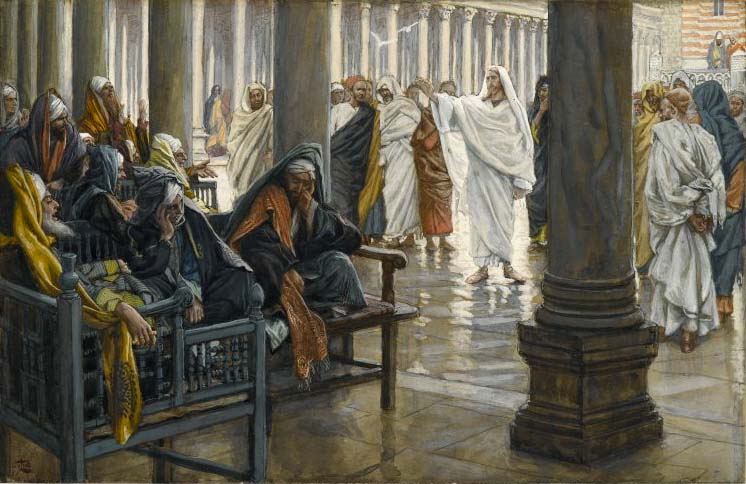
“Woe unto You, Scribes and Pharisees” by French painter James Tissot (1836-1902)

Woe to the Door Slammers

Jesus wanted no slamming the door of God’s kingdom in the faces of ordinary people. The Lord has a zero-tolerance policy for keeping others on the margins and out of the reach of resources and people who could help them.

Several years ago, while working on my graduate thesis in American religious history, I read hundreds of sermons from antebellum southern preachers. Most of them had a uniform biblical defense of the institution of black chattel slavery. Many of the clergymen pastored large churches and led many white people to Christ. Yet, they slammed the door of God’s kingdom smack in the faces of African American slaves, and taught others to do the same.

We might unwittingly door-slam people when we say God’s grace is for all, and then turn around and use policies and procedures to exclude certain people. Typically, behind it all, is a commitment to old-fogy-ism instead of Holy Scripture. 

Woe to the Exporters of Hell

The religious insiders were mission-oriented and wanted to make disciples just like themselves, which unfortunately meant loading others down with a heavy burden of legalistic mumbo-jumbo. In doing so, they were exporting their brand of religion which weighed people down instead of uplifting them.

In contrast to this, Jesus was concerned to form followers in and around the biblical virtues of humility, sensitivity to sin, meekness, purity, mercy, and peace-making. 

Woe to the Misguided Oath-Takers

Oath-taking was an art form with the religious authorities. There was so much complexity with their rules regarding oaths that it was common to make lots of promises to God which were never kept. Chiefly because there was no real intention of keeping them from the get-go. So, Jesus called them on it and railed about their blindness of truth. 

The leaders had lost sight of what is important to God. They either could not or would not distinguish between important and unimportant matters. In Christ’s Sermon on the Mount, Jesus addressed the issue of truth and oath-taking by saying, in essence, that if you’re going to play these games about promise-making and promise-keeping, then don’t swear or make promises at all. Just say “yes” or “no.” This was Christ’s way of saying that lies and liars come from Satan, not God. (Matthew 5:33-37)

Woe to Those Who Give to Get

It is good to give – not so good to give from selfish motives and as a means of avoiding other matters. The religious leaders neglected weightier issues of the law while focusing on their superb 10% giving skills. 

The way it worked was this: “Well, I do my part and give 10%, then I get to do whatever the heck I want with the other 90%.” Meanwhile, the things which God passionately cares about, like justice, mercy, and faith, took a back seat. Focusing on frivolous pennies instead of precious life is going to raise the ire of Jesus every time.

Life is supremely important to God. The Lord sees the single mom who struggles to make it; the lonely person who wonders if there is any worth to her existence; and the poor worker who is stuck in a job without a living wage. God cares about the needy persons around us:

This is what the Lord of Armies says: “Administer real justice and be compassionate and kind to each other. Do not oppress widows, orphans, foreigners, and poor people. And do not even think of doing evil to each other.” (Zechariah 7:9-10, GW)

He has shown you, O mortal, what is good. And what does the Lord require of you? To act justly and to love mercy and to walk humbly with your God. (Micah 6:8, NIV)

Speak out for those who cannot speak, for the rights of all the destitute. (Proverbs 31:8, NRSV)

Justice, mercy, and faithfulness all have to do with neighbor love. It is easy to love those who love us back. Yet, the one who loves another, the outsider, the person for whom no one else cares or loves is the one whom Jesus is looking for. We are to have a spiritual vision of living in the world for the sake of the world, without being of the world. Apart from this vision, there is blindness.

Woe to the Squeaky Clean

The teachers of the law had a compulsion for ritual cleanliness. For Jesus, it was an inner issue of the heart, and not about outward washings. For example, having a polished and immaculately clean church building means little if the parishioners within are full of greed and self-indulgence. Christian ministry ought to be centered in cleaning up the human heart, and not just making sure the outside looks good. 

The ancient leaders were obsessed with not making a mistake and becoming impure. In a strict legalistic system, making a mistake equals the unpardonable sin. However, in a system of grace, people are encouraged to freely pursue God, and if they fail, are allowed the grace to try something different or try again.

Woe to Perfect Hair

Okay, that is not quite what the text says, but it is darned close. At Passover, when multiple thousands of people came to Jerusalem, the Pharisees whitewashed all the tombstones to make sure no one would inadvertently step on a grave. Because if someone did, they became unclean and unable to celebrate Passover. 

Jesus said the perfect hair people were like those tombstones – all nice, clean, spiffy, and looking good on the outside, but on the inside full of death. 

Inordinate focus on the outside only prevents one from hearing the cries of people all around us and responding with justice. On the farm, we would say, if there is no manure in the barn, there is no life.

Conclusion

Jesus gave us some telltale signs of the hypocrite:

  • Fails to practice what they preach.
  • Keeps other people out of God’s kingdom.
  • Focuses on externals.
  • Majors on the minors.

The final word, however, is not hypocrisy but grace. At the end of his tirade, Jesus broke into a tear-filled, heart-rending love song for his wayward people. The set of woes from Jesus, then, are not just blast-the-bad-guys. Jesus has a very deep concern for all people to know the true worship of God.

Romans 13:1-7 – Good Citizenship

1960 Elementary Classroom

Be a good citizen. All governments are under God. Insofar as there is peace and order, it’s God’s order. So live responsibly as a citizen. If you’re irresponsible to the state, then you’re irresponsible with God, and God will hold you responsible. Duly constituted authorities are only a threat if you’re trying to get by with something. Decent citizens should have nothing to fear.

Do you want to be on good terms with the government? Be a responsible citizen and you’ll get on just fine, the government working to your advantage. But if you’re breaking the rules right and left, watch out. The police aren’t there just to be admired in their uniforms. God also has an interest in keeping order, and he uses them to do it. That’s why you must live responsibly—not just to avoid punishment but also because it’s the right way to live.

That’s also why you pay taxes—so that an orderly way of life can be maintained. Fulfill your obligations as a citizen. Pay your taxes, pay your bills, respect your leaders. (MSG)

Back in the day (way back!) when I was in elementary school every student received a grade on their report card for “citizenship.”  Even further back, my Dad’s report cards had grades for “deportment.” Both citizenship and deportment were words used by the public-school system to gauge how well individual students conducted themselves with the teacher’s authority, behaved with fellow students, and handled the responsibilities of their studies. It was a grade given for the overall obedience and submission of students with their duties and obligations, or the lack thereof.

Today’s New Testament lesson is one of those Scripture texts which has been used and abused throughout history. Since we no longer give grades on citizenship and deportment, a careful consideration of both what this biblical passage is, and is not, must be observed.

What Citizenship is Not: Irresponsible and Disobedient Injustice

Advocating a favored political philosophy or party to the point of avoiding a rival party or power and resisting their government through lack of submission, being uncivil and disrespectful, and stubbornly disobedient is poor deportment and will earn an “F” from God on the report card of life.

Picking-and-choosing which laws I will obey and which ones I will not is extremely far from the biblical teaching given. Rebellion against laws I do not like will only result in getting punished from the principal for being shortsighted and stupid.

On the other hand, blind and unthinking adherence to a government is irresponsible and can be unethical. Unjust leaders and immoral laws which merely champion certain people and not the common good of all need to be dislodged and dismantled. When one simply says, “I’m just doing my job,” or “I don’t want to get in trouble,” in the face of unjust laws and leadership, then we are complicit in the perpetuating of the evil person or system. Blind obedience keeps abusive people in the classroom.

Vigilante-ism is a form of “recess justice.” It is a refusal to accept what is taking place and takes matters into one’s own hands. Just before explaining citizenship, the Apostle Paul said, “Do not take revenge but leave room for God’s wrath,” and, “Do not be overcome by evil but overcome evil with good” (Romans 12:19, 21). There is no place for vigilante justice in the kingdom of God. At its basest form, vigilantes are resisting God’s justice and being extremely impatient with the divine plan.

Good Citizenship

What Citizenship is: Responsible and Submissive Justice

Submission is a choice. The word “submit” in the New Testament means “to place oneself under authority.” In other words, to submit to another person, group, system, or government is a human volitional choice. Obedience through coercion, as in totalitarian regimes, is not submission – it is oppression.

Good citizenship begins with humble submission to governing authorities who are trying to do their best and have everyone’s best interests at mind with responsible laws which benefit the common good of all. Most parents and school boards would do well to remember that.

Justice is primarily about provision, and not about being punitive. I realize that many, if not most, people use the term justice in the penal sense – wanting convictions and incarcerations when someone has committed a crime against the state and/or humanity. And, although this is a very important work of government, the biblical sense of justice is about provision – giving people their rights to life and liberty and ensuring that we all exist in an equitable form of union together as one people.

When people fall through the cracks of bureaucracy and do not have what they need to survive, let alone thrive, then this is an injustice which needs remedy sooner than later – without putting it off to another election cycle. So, put the spanking paddles of shame away (yes, kids at school got the paddle in my day) and instead find ways to uplift and support one another.

Responsible citizenship involves a proper deportment of volitional submission, careful obedience, proper payment of taxes for the benefit of all, and providing due respect to public servants. Keep in mind that the Apostle Paul originally wrote about how to conduct ourselves with government smack in the middle of a Roman Empire which was often fickle and careless about the rights of Christians, Jews, and others.

We submit not because we must, but because it is the right thing to do. To do otherwise is to not only violate the law but our consciences, as well.

Our consciences also need to be clear and clean about the need for justice in this old fallen world of ours. Christians have a continuing and outstanding debt to love one another. Having justice for some and injustice for others is not going to cut it with a Just God. Our Creator and Sustainer desires that every single individual on planet earth – regardless of race, gender, ethnicity, sexual orientation, class, or any other human contrived social construct – have their needs met without prejudice, favoritism, or cronyism.

God’s original plan for the world includes an egalitarian society, so we must be careful to remember and work toward the ideal, while at the same time dealing graciously and resolutely with the realities of injustice all around us. I wonder what grade Jesus would give us so far this year for our deportment.

Lord Jesus Christ, Son of God, just as you welcome us into your kingdom, help us to love each other deeply,
offer hospitality to one another without grumbling, encourage each to use the gifts we have received to serve others, and submit to the governing authorities with the good citizenship you have provided us so that every one of us will be a faithful steward of God’s grace in its various forms. Amen.