Matthew 23:13-28 – Whoa, Here Comes the Woes!

Pharisees by German painter Karl Schmidt-Rottluff, 1912

“Woe to you, teachers of the law and Pharisees, you hypocrites! You shut the door of the kingdom of heaven in people’s faces. You yourselves do not enter, nor will you let those enter who are trying to.

“Woe to you, teachers of the law and Pharisees, you hypocrites! You travel over land and sea to win a single convert, and when you have succeeded, you make them twice as much a child of hell as you are.

“Woe to you, blind guides! You say, ‘If anyone swears by the temple, it means nothing; but anyone who swears by the gold of the temple is bound by that oath.’ You blind fools! Which is greater: the gold, or the temple that makes the gold sacred? You also say, ‘If anyone swears by the altar, it means nothing; but anyone who swears by the gift on the altar is bound by that oath.’ You blind men! Which is greater: the gift, or the altar that makes the gift sacred? Therefore, anyone who swears by the altar swears by it and by everything on it. And anyone who swears by the temple swears by it and by the one who dwells in it. And anyone who swears by heaven swears by God’s throne and by the one who sits on it.

“Woe to you, teachers of the law and Pharisees, you hypocrites! You give a tenth of your spices—mint, dill, and cumin. But you have neglected the more important matters of the law—justice, mercy, and faithfulness. You should have practiced the latter, without neglecting the former. You blind guides! You strain out a gnat but swallow a camel.

“Woe to you, teachers of the law and Pharisees, you hypocrites! You clean the outside of the cup and dish, but inside they are full of greed and self-indulgence. Blind Pharisee! First clean the inside of the cup and dish, and then the outside also will be clean.

“Woe to you, teachers of the law and Pharisees, you hypocrites! You are like whitewashed tombs, which look beautiful on the outside but on the inside are full of the bones of the dead and everything unclean. In the same way, on the outside you appear to people as righteous but, on the inside, you are full of hypocrisy and wickedness. (NIV)

I am not sure if today’s Gospel lesson was purposefully designed to fall on Halloween, or not. If it was, I guess the compilers of the Daily Lectionary wanted to scare the bejabbers out of us with Christ’s chilling pronouncement of woes upon hypocritical religious folk.

Christ’s scathing critique was directed against a distorted spirituality, a false Christianity, and a controlling religious leadership that stifled the true worship of God. The word “woe” literally means “disaster” “calamity” or “misery.” Jesus leveled seven of them squarely at the religiously committed who had an incongruent faith in which the outside did not match the inside.
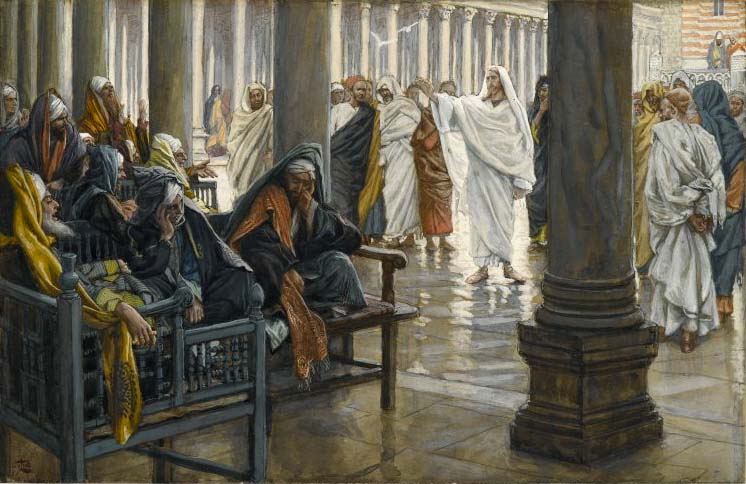
“Woe unto You, Scribes and Pharisees” by French painter James Tissot (1836-1902)

Woe to the Door Slammers

Jesus wanted no slamming the door of God’s kingdom in the faces of ordinary people. The Lord has a zero-tolerance policy for keeping others on the margins and out of the reach of resources and people who could help them.

Several years ago, while working on my graduate thesis in American religious history, I read hundreds of sermons from antebellum southern preachers. Most of them had a uniform biblical defense of the institution of black chattel slavery. Many of the clergymen pastored large churches and led many white people to Christ. Yet, they slammed the door of God’s kingdom smack in the faces of African American slaves, and taught others to do the same.

We might unwittingly door-slam people when we say God’s grace is for all, and then turn around and use policies and procedures to exclude certain people. Typically, behind it all, is a commitment to old-fogy-ism instead of Holy Scripture. 

Woe to the Exporters of Hell

The religious insiders were mission-oriented and wanted to make disciples just like themselves, which unfortunately meant loading others down with a heavy burden of legalistic mumbo-jumbo. In doing so, they were exporting their brand of religion which weighed people down instead of uplifting them.

In contrast to this, Jesus was concerned to form followers in and around the biblical virtues of humility, sensitivity to sin, meekness, purity, mercy, and peace-making. 

Woe to the Misguided Oath-Takers

Oath-taking was an art form with the religious authorities. There was so much complexity with their rules regarding oaths that it was common to make lots of promises to God which were never kept. Chiefly because there was no real intention of keeping them from the get-go. So, Jesus called them on it and railed about their blindness of truth. 

The leaders had lost sight of what is important to God. They either could not or would not distinguish between important and unimportant matters. In Christ’s Sermon on the Mount, Jesus addressed the issue of truth and oath-taking by saying, in essence, that if you’re going to play these games about promise-making and promise-keeping, then don’t swear or make promises at all. Just say “yes” or “no.” This was Christ’s way of saying that lies and liars come from Satan, not God. (Matthew 5:33-37)

Woe to Those Who Give to Get

It is good to give – not so good to give from selfish motives and as a means of avoiding other matters. The religious leaders neglected weightier issues of the law while focusing on their superb 10% giving skills. 

The way it worked was this: “Well, I do my part and give 10%, then I get to do whatever the heck I want with the other 90%.” Meanwhile, the things which God passionately cares about, like justice, mercy, and faith, took a back seat. Focusing on frivolous pennies instead of precious life is going to raise the ire of Jesus every time.

Life is supremely important to God. The Lord sees the single mom who struggles to make it; the lonely person who wonders if there is any worth to her existence; and the poor worker who is stuck in a job without a living wage. God cares about the needy persons around us:
This is what the Lord of Armies says: “Administer real justice and be compassionate and kind to each other. Do not oppress widows, orphans, foreigners, and poor people. And do not even think of doing evil to each other.” (Zechariah 7:9-10, GW)

He has shown you, O mortal, what is good. And what does the Lord require of you? To act justly and to love mercy and to walk humbly with your God. (Micah 6:8, NIV)

Speak out for those who cannot speak, for the rights of all the destitute. (Proverbs 31:8, NRSV)

Justice, mercy, and faithfulness all have to do with neighbor love. It is easy to love those who love us back. Yet, the one who loves another, the outsider, the person for whom no one else cares or loves is the one whom Jesus is looking for. We are to have a spiritual vision of living in the world for the sake of the world, without being of the world. Apart from this vision, there is blindness.

Woe to the Squeaky Clean

The teachers of the law had a compulsion for ritual cleanliness. For Jesus, it was an inner issue of the heart, and not about outward washings. For example, having a polished and immaculately clean church building means little if the parishioners within are full of greed and self-indulgence. Christian ministry ought to be centered in cleaning up the human heart, and not just making sure the outside looks good. 

The ancient leaders were obsessed with not making a mistake and becoming impure. In a strict legalistic system, making a mistake equals the unpardonable sin. However, in a system of grace, people are encouraged to freely pursue God, and if they fail, are allowed the grace to try something different or try again.

Woe to Perfect Hair

Okay, that is not quite what the text says, but it is darned close. At Passover, when multiple thousands of people came to Jerusalem, the Pharisees whitewashed all the tombstones to make sure no one would inadvertently step on a grave. Because if someone did, they became unclean and unable to celebrate Passover. 

Jesus said the perfect hair people were like those tombstones – all nice, clean, spiffy, and looking good on the outside, but on the inside full of death. 

Inordinate focus on the outside only prevents one from hearing the cries of people all around us and responding with justice. On the farm, we would say, if there is no manure in the barn, there is no life.

Conclusion

Jesus gave us some telltale signs of the hypocrite:

  • Fails to practice what they preach.
  • Keeps other people out of God’s kingdom.
  • Focuses on externals.
  • Majors on the minors.

The final word, however, is not hypocrisy but grace. At the end of his tirade, Jesus broke into a tear-filled, heart-rending love song for his wayward people. The set of woes from Jesus, then, are not just blast-the-bad-guys. Jesus has a very deep concern for all people to know the true worship of God.

Romans 13:1-7 – Good Citizenship

1960 Elementary Classroom

Be a good citizen. All governments are under God. Insofar as there is peace and order, it’s God’s order. So live responsibly as a citizen. If you’re irresponsible to the state, then you’re irresponsible with God, and God will hold you responsible. Duly constituted authorities are only a threat if you’re trying to get by with something. Decent citizens should have nothing to fear.

Do you want to be on good terms with the government? Be a responsible citizen and you’ll get on just fine, the government working to your advantage. But if you’re breaking the rules right and left, watch out. The police aren’t there just to be admired in their uniforms. God also has an interest in keeping order, and he uses them to do it. That’s why you must live responsibly—not just to avoid punishment but also because it’s the right way to live.

That’s also why you pay taxes—so that an orderly way of life can be maintained. Fulfill your obligations as a citizen. Pay your taxes, pay your bills, respect your leaders. (MSG)

Back in the day (way back!) when I was in elementary school every student received a grade on their report card for “citizenship.”  Even further back, my Dad’s report cards had grades for “deportment.” Both citizenship and deportment were words used by the public-school system to gauge how well individual students conducted themselves with the teacher’s authority, behaved with fellow students, and handled the responsibilities of their studies. It was a grade given for the overall obedience and submission of students with their duties and obligations, or the lack thereof.

Today’s New Testament lesson is one of those Scripture texts which has been used and abused throughout history. Since we no longer give grades on citizenship and deportment, a careful consideration of both what this biblical passage is, and is not, must be observed.

What Citizenship is Not: Irresponsible and Disobedient Injustice

Advocating a favored political philosophy or party to the point of avoiding a rival party or power and resisting their government through lack of submission, being uncivil and disrespectful, and stubbornly disobedient is poor deportment and will earn an “F” from God on the report card of life.

Picking-and-choosing which laws I will obey and which ones I will not is extremely far from the biblical teaching given. Rebellion against laws I do not like will only result in getting punished from the principal for being shortsighted and stupid.

On the other hand, blind and unthinking adherence to a government is irresponsible and can be unethical. Unjust leaders and immoral laws which merely champion certain people and not the common good of all need to be dislodged and dismantled. When one simply says, “I’m just doing my job,” or “I don’t want to get in trouble,” in the face of unjust laws and leadership, then we are complicit in the perpetuating of the evil person or system. Blind obedience keeps abusive people in the classroom.

Vigilante-ism is a form of “recess justice.” It is a refusal to accept what is taking place and takes matters into one’s own hands. Just before explaining citizenship, the Apostle Paul said, “Do not take revenge but leave room for God’s wrath,” and, “Do not be overcome by evil but overcome evil with good” (Romans 12:19, 21). There is no place for vigilante justice in the kingdom of God. At its basest form, vigilantes are resisting God’s justice and being extremely impatient with the divine plan.

Good Citizenship

What Citizenship is: Responsible and Submissive Justice

Submission is a choice. The word “submit” in the New Testament means “to place oneself under authority.” In other words, to submit to another person, group, system, or government is a human volitional choice. Obedience through coercion, as in totalitarian regimes, is not submission – it is oppression.

Good citizenship begins with humble submission to governing authorities who are trying to do their best and have everyone’s best interests at mind with responsible laws which benefit the common good of all. Most parents and school boards would do well to remember that.

Justice is primarily about provision, and not about being punitive. I realize that many, if not most, people use the term justice in the penal sense – wanting convictions and incarcerations when someone has committed a crime against the state and/or humanity. And, although this is a very important work of government, the biblical sense of justice is about provision – giving people their rights to life and liberty and ensuring that we all exist in an equitable form of union together as one people.

When people fall through the cracks of bureaucracy and do not have what they need to survive, let alone thrive, then this is an injustice which needs remedy sooner than later – without putting it off to another election cycle. So, put the spanking paddles of shame away (yes, kids at school got the paddle in my day) and instead find ways to uplift and support one another.

Responsible citizenship involves a proper deportment of volitional submission, careful obedience, proper payment of taxes for the benefit of all, and providing due respect to public servants. Keep in mind that the Apostle Paul originally wrote about how to conduct ourselves with government smack in the middle of a Roman Empire which was often fickle and careless about the rights of Christians, Jews, and others.

We submit not because we must, but because it is the right thing to do. To do otherwise is to not only violate the law but our consciences, as well.

Our consciences also need to be clear and clean about the need for justice in this old fallen world of ours. Christians have a continuing and outstanding debt to love one another. Having justice for some and injustice for others is not going to cut it with a Just God. Our Creator and Sustainer desires that every single individual on planet earth – regardless of race, gender, ethnicity, sexual orientation, class, or any other human contrived social construct – have their needs met without prejudice, favoritism, or cronyism.

God’s original plan for the world includes an egalitarian society, so we must be careful to remember and work toward the ideal, while at the same time dealing graciously and resolutely with the realities of injustice all around us. I wonder what grade Jesus would give us so far this year for our deportment.

Lord Jesus Christ, Son of God, just as you welcome us into your kingdom, help us to love each other deeply,
offer hospitality to one another without grumbling, encourage each to use the gifts we have received to serve others, and submit to the governing authorities with the good citizenship you have provided us so that every one of us will be a faithful steward of God’s grace in its various forms. Amen.

Exodus 3:16-25 – A Great Reversal

Moses and the Children of Israel by Richard McBee
“Moses and the Children of Israel” by Richard McBee

“Go, assemble the elders of Israel and say to them, ‘The Lord, the God of your fathers—the God of Abraham, Isaac and Jacob—appeared to me and said: I have watched over you and have seen what has been done to you in Egypt. And I have promised to bring you up out of your misery in Egypt into the land of the Canaanites, Hittites, Amorites, Perizzites, Hivites and Jebusites—a land flowing with milk and honey.’ 

“The elders of Israel will listen to you. Then you and the elders are to go to the king of Egypt and say to him, ‘The Lord, the God of the Hebrews, has met with us. Let us take a three-day journey into the wilderness to offer sacrifices to the Lord our God.’ But I know that the king of Egypt will not let you go unless a mighty hand compels him. So, I will stretch out my hand and strike the Egyptians with all the wonders that I will perform among them. After that, he will let you go. 

“And I will make the Egyptians favorably disposed toward this people, so that when you leave you will not go empty-handed. Every woman is to ask her neighbor and any woman living in her house for articles of silver and gold and for clothing, which you will put on your sons and daughters. And so, you will plunder the Egyptians.” (NIV) 

Moses spent forty years in the back side of the desert tending sheep. The first forty years were lived in the most powerful place on earth at the time, Egypt. Although Moses had a privileged position, he forsook his place to be in solidarity with the enslaved Israelites. With a skewed sense of timing and method, he slew a cruel Egyptian, and was forced to flee into the desert. 

The time eventually became ripe, and God was on the move. At eighty years old, God called Moses out of the desert and back to Egypt. The deliverance was going to be accomplished according to God’s designs and purposes, and not from the impetuous actions of a younger Moses. God knew exactly what he was doing and put Moses on a course which would strike at the heart of imperial Egypt and bring freedom to millions of slaves. 

Today’s story is laced thick with divine promises. After all, it is the promises of God which give people hope and a future. Referring to himself as the God of Abraham, Isaac, and Jacob, the Lord connects the generations-long covenant promise to the Israelites and reminded them they are not forgotten. God’s covenant has neither disappeared nor changed; it still exists. While the Jews were languishing in slavery, God was not aloof but watching – carefully inspecting, caring, and paying close attention. 

The inheritance of the Promised Land was coming, and it would be realized. God affirmed the covenant, knowing the plans he has for them – plans to give them abundance and joy. And God knew full well that dislodging the Israelites from Egypt would take some work, since Pharaoh relied so heavily on slave labor to support his massive imperial state. 

You, like me, have likely noticed that God tends to move rather slow by our standards. We might question and wonder about so much injustice going unabated for so long. Yet, that is our perspective of things, not God’s. Whereas we often have our own self-interest at mind, the Lord has the concern of an entire world. God is patient and long-suffering, providing full opportunity for both individual and national repentance. The Lord is on the lookout for people to amend their errant ways and return to their true purpose for living. He only judges at the proper time. 

And when that time comes, look out! Nothing can stand in the way of God’s good plans for the earth. The ancient Egyptians had built an empire on the backs of slavery, and everything went into supporting the power and wealth of the state. God was not okay with this situation. As he had done many times before, the Lord would thoroughly dismantle and destroy the powerful system of oppression. God is the expert at flip-flopping the status of people – the slaves become free, and the free are bound; the hated become favored, and those who enjoyed all the perks of power and privilege become the despised. 

Embracing God’s upside-down kingdom means advocating for justice, righteousness, and holiness for all people, not just a select few whom I like. Jesus, over 1,500 years after Moses and the exodus from Egypt, had this to say: 

“Those who are last now will someday be first, and those who are first now will someday be last.” (Matthew 20:16, NCV) 

“Blessed are you who are poor, 
    for yours is the kingdom of God. 
“Blessed are you who are hungry now, 
    for you will be filled. 
“Blessed are you who weep now, 
    for you will laugh. 

“Blessed are you when people hate you, and when they exclude you, revile you, and defame you on account of the Son of Man. Rejoice in that day and leap for joy, for surely your reward is great in heaven; for that is what their ancestors did to the prophets. 

“But woe to you who are rich, 
    for you have received your consolation. 
“Woe to you who are full now, 
    for you will be hungry. 
“Woe to you who are laughing now, 
    for you will mourn and weep. 

“Woe to you when all speak well of you, for that is what their ancestors did to the false prophets. (Luke 6:20-26, NRSV) 

And the Apostle Paul said to the Church: 

“For our present troubles are small and won’t last very long. Yet they produce for us a glory that vastly outweighs them and will last forever!” (2 Corinthians 4:17, NLT) 

The New Testament references are not meant to sanitize or put a positive spin on the very real suffering that so many people have endured both past and present. It is, however, meant to lift-up the reality that we have a sure and certain hope. Our trust in the promises and presence of God will eventually be realized and gives shape to how we live today in persistent prayers with patience and perseverance. 

So, may the Lord of all creation bless and protect you. May the Lord show you mercy and kindness in your affliction. And, may the Lord be good to you and give you peace. Amen. 

Psalm 142 – The Cry of Emotional Pain

crying face looking up

I cry out loud for help from the Lord.
I beg out loud for mercy from the Lord.
I pour out my concerns before God;
I announce my distress to him.
When my spirit is weak inside me, you still know my way.
But they’ve hidden a trap for me in the path I’m taking.
Look right beside me: See?
No one pays attention to me.
There’s no escape for me.
No one cares about my life.

I cry to you, Lord, for help.
“You are my refuge,” I say.
“You are all I have in the land of the living.”
Pay close attention to my shouting,
because I’ve been brought down so low!
Deliver me from my oppressors
because they’re stronger than me.
Get me out of this prison
so I can give thanks to your name.
Then the righteous will gather all around me
because of your good deeds to me. (CEB)

One of the reasons I love the psalms so dearly is that they are raw and real. There is no pretense with the psalmist. He opens his mind and heart and lets the genuine feelings of his life pour out in an offering to the God who bends his ear and pays attention to the humble and contrite. The proud and arrogant will forever be flummoxed by the psalms, not understanding why they are even in the canon of Scripture.

Yet, here they are, in Holy Scripture for all to experience. Whereas the piously insincere are continually putting up a false front of godliness and keeping up appearances of superior spirituality, here we have authentic religion right here in front of our faces. To me, the psalms liberate me from the shackles of trying to be someone I am not and enable me to connect with a God who encourages me in my wondering, my pain, my situations – and who is perfectly at home with crying aloud and shouting prayers to heaven.

Those who oppress others, I believe, are easy to spot: the only questions they ask are rhetorical to just make a point and are not really asking a question; they make faulty assumptions, and, so, think nothing of leveling false accusations; and, they have no curiosity to listen or learn – just a desire to make their own message known.

If such oppressors are the ones in power, then, it feels like being in prison with no ability to leverage a release. However, there is One who is always on the lookout for the oppressed and the needy who are raising their voices to heaven.

When no one else will listen because they are too smug in their delusions of rightness and strength, God hears and will advocate on behalf of those experiencing injustice and maltreatment.

Since God takes a posture of listening to those in need of mercy, this is precisely the disposition we are to adopt as people created in God’s image. The proud, convinced of their superiority, either cannot or will not see those languishing underneath power structures. For there is no space in the hearts of the proud to accommodate those who cry out on behalf of justice. The only recourse for the oppressed is God – and God will act with equity and with integrity.

It is not the oppressed who need our pity; it is the ungodly. The poor and the needy would like to show empathy – but that would take knowing another, which the oppressor has no stomach for. Systems of oppression keep people at a distance and turn a blind eye to the genuine screams of those under their boot.

The weak, the distressed, and the spiritually tired people on this fallen planet of ours very much have an appeal to the God who knows them and their situations. Although cries for deliverance may not happen immediately, we can be assured that divine help is forthcoming.

cave

This psalm was crafted by David in a cave before he was king. David was on the run from King Saul, who was trying to take his life. David was hiding and just trying to stay alive. There was nothing in David’s life in which he deserved such treatment. It was sheer jealousy on Saul’s end of things that caused him to give his soul over to oppressive pride. And David was the brunt of that oppression.

We know the end of the story. Saul is eventually killed in battle and David is exalted as the new king. Yet, here, in today’s psalm, we have the genuine cry of a desperate man who longed for the justice of God. One of the reasons David was a person after God’s own heart is that he exhibited humility and remained connected to God without succumbing to the bitterness of his situation. I would suggest strongly that David was able to keep his life free from pride because he regularly liberated his spirit through real and raw expressions of his emotions and experiences to God.

Spiritual confidence cannot be ginned-up through pretending that all is well, and everything is okay. Rather, spiritual courage is forged in the most awful of circumstances through real expressions of need and loud cries of emotional pain to the God who truly hears it all. Anyone who tells you different is flimsily trying to maintain their puny sense of delusional power. God sees you in the dark place and he hears your cry for mercy.

Lord Jesus Christ, by your patience in suffering you made my earthly pain sacred and gave me the example of humility. Be near to me in my time of weakness and pain; sustain me by your grace so that my strength and courage may not fail. Heal me according to your will. Loving Jesus, as you cried out on the cross, I cry out to you in my desperation. Do not forsake me. Grant me relief and preserve me in your perfect peace. Amen.