Impatience and Grumbling Are Poisonous (Numbers 21:4-9)

Moses and the Serpent on the Rod

The Israelites left Mount Hor and went on the road toward the Red Sea, in order to go around the country of Edom. But the people became impatient on the way and grumbled at God and Moses. They said, “Why did you bring us out of Egypt to die in this desert? There is no bread and no water, and we hate this terrible food!”

So the Lord sent them poisonous snakes; they bit the people, and many of the Israelites died. The people came to Moses and said, “We sinned when we grumbled at you and the Lord. Pray that the Lord will take away these snakes.” So Moses prayed for the people.

The Lord said to Moses, “Make a bronze snake, and put it on a pole. When anyone who is bitten looks at it, that person will live.” So Moses made a bronze snake and put it on a pole. Then when a snake bit anyone, that person looked at the bronze snake and lived. (New Century Version)

Impatience and irritability. Grumbling and complaining. Show me a person with ants-in-their-pants and I will show you a person who bellyaches and squawks like an old chicken. The antsy person sticks their hand in the glove of criticism, loudly griping about missed expectations for all to hear. Little do they realize that venomous snakes are slithering toward them, attracted by the continual vibrations of complaint.

The ancient Israelites were miraculously delivered from Egyptian bondage by the mighty hand of God. But the celebration soon turned sour. Millions of people were out in the desert, discovering they had no food or water.

There is no account of the people using their spiritual connection with God to ask for help. Instead, their reflexive response was to grumble against God and God’s appointed leader Moses.

God had enough of their constant complaints. The Lord had repeatedly shown mercy and committed love to the people over-and-over again. Yet, they kept putting on their grumpy faces any time something didn’t go their way.

God kept showing patience toward the people, but the people kept demonstrating impatience toward God.

A mosaic of the serpent in the desert in All Saints Church, London, England, by Matthew Digby Wyatt (1820-1877)

If you stop and think about the pathology of our own impatience and complaining (which we all do – come on, admit it) you’ll likely discover that at the heart of it all is a picture in your mind of how you think circumstances ought to go for you to be happy. 

The Israelites expected a nice clean break from Egypt with a smooth transition into the Promised Land. They didn’t sign up for hard circumstances and a bunch of adversity and trouble getting there.

We aren’t so different. Believers go to faith gatherings expecting to be fed and encouraged. Students expect that school will be enjoyable and that they’ll get a good paying job after graduation. Employees expect to go to work and have healthy working relationships and a good boss. Parents expect their kids to listen and obey. You expect your friend or spouse to give you focused attention, the weather to be better, the drivers on the road to be respectful, the little plastic things on the end of your shoelaces to last for the life of your shoes….

And it doesn’t happen, or at least fails to go as planned. So, what happens when all those expectations aren’t realized? 

In a perfect world, we would always respond in a reasoned, wise, and healthy manner. But if we’re feeling like we’re in an emotional place of insecurity out in the desert, our response is more likely to be an impatient and complaint-filled litany about how things are all screwed up.

A great deal of disobedience, bad behavior, angry speech, and poor decision-making has its origins in impatience.

The minute you become impatient, take a long deep breath before you make your next mental decision. Check-in with yourself. Be mindful of what your real expectations are for the circumstance or person in the present moment of becoming upset. Make the decision, from the very beginning, not to complain or argue. Instead, choose to say what you want without grumbling.

It is truly possible to stand for holiness, live for righteousness, and uphold the words and ways of Jesus without being a jerk about it through impatient sighs, annoying facial expressions, and terse words of carping at another person who is made in God’s image.

Monitor yourself throughout the day today. Notice the times you become annoyed. Stop and take a minute to analyze what you are expecting to unfold throughout the day. Instead of grumbling, ask God to strengthen your faith through your upcoming events and encounters. 

God is there to help you, and not to pick on you. If you find yourself having made a poor decision and are suffering the consequences of it, the way of dealing with it isn’t to avoid it. One of the reasons God instructed Moses to make a snake is to clearly demonstrate to the people that they must go through their problems and not try and get around them.

Fortunately, in Christianity, Jesus becomes our bronze snake of deliverance:

In the same way that Moses lifted the serpent in the desert so people could have something to see and then believe, it is necessary for the Son of Man to be lifted up—and everyone who looks up to him, trusting and expectant, will gain a real life, eternal life. (John 3:14-15, MSG)

Holy God, your patience is incredible in the face of human impatience. Yet, your boundaries are firm, and you will not put up with our petulant ways forever. Help me to live into the model of your Son, the Lord Jesus, who with you and the Holy Spirit are attentive to come alongside me to your own glory and honor. Amen.

Numbers 27:12-23 – Humble Leadership

Moses Blesses Joshua by Marc Chagall, 1966

One day the Lord said to Moses, “Climb one of the mountains east of the river and look out over the land I have given the people of Israel. After you have seen it, you will die like your brother, Aaron, for you both rebelled against my instructions in the wilderness of Zin. When the people of Israel rebelled, you failed to demonstrate my holiness to them at the waters.” (These are the waters of Meribah at Kadesh in the wilderness of Zin.)

Then Moses said to the Lord, “O Lord, you are the God who gives breath to all creatures. Please appoint a new man as leader for the community. Give them someone who will guide them wherever they go and will lead them into battle, so the community of the Lord will not be like sheep without a shepherd.”

The Lord replied, “Take Joshua son of Nun, who has the Spirit in him, and lay your hands on him. Present him to Eleazar the priest before the whole community, and publicly commission him to lead the people. Transfer some of your authority to him so the whole community of Israel will obey him. When direction from the Lord is needed, Joshua will stand before Eleazar the priest, who will use the Urim—one of the sacred lots cast before the Lord—to determine his will. This is how Joshua and the rest of the community of Israel will determine everything they should do.”

So, Moses did as the Lord commanded. He presented Joshua to Eleazar the priest and the whole community. Moses laid his hands on him and commissioned him to lead the people, just as the Lord had commanded through Moses. (New Living Translation)

Moses was one of the most humble persons who ever lived on this earth (Numbers 12:3). Whereas many people are concerned for their legacy at end of life, Moses, instead, had a deep pastoral concern for his fellow Israelites. He didn’t want them without a capable and godly leader. So, in his humility, Moses was willing to obey God, let go of power, and share his authority so that the people would be well-cared for.

“All streams flow to the ocean because it is lower than they are. Humility gives it its power.”

Lao Tzu (Chinese philosopher, 6th century B.C.E.)

I believe humility is the queen of all virtue, especially that of leadership. Yet, humility is one of the hardest virtues to practice because it requires that we willingly put aside pride, ego, and personal agendas in order to embrace God’s agenda.

Rather than having large statues erected to honor us and our proud accomplishments, or having our names plastered on buildings (and churches!) to recognize our wonderful charity, we really need to orient our energies toward passing the baton to trustworthy people who are capable of faithfully fulfilling the role of servant leader. (2 Timothy 2:2)

Being poor in spirit (Matthew 5:3), becoming like a little child (Matthew 18:3), and thinking of others as better than ourselves (Philippians 2:3) are the cornerstones to becoming open to what God has for us. To be a humble leader means to steadfastly seek God’s will and way in everything. Then, to have the courage in leading others toward God’s direction, despite resistance and opposition from those who want to follow a different path.

Therefore, a leader’s task is to be consumed with seeking God’s direction rather than living purely according to instinct, pragmatic desire, or personal views. We continually need a radical openness to God. So, we must work to develop an ever-deepening awareness of where God is leading us. 

God, in divine mercy, is always up to something good. The Lord has plans for us and for the people we lead.  It’s humility that allows us to listen well to God’s Spirit and gain the direction needed for leadership.

Yet, being open to God is not quite as easy as it sounds. We must recognize that not everyone is open to God.  There are those, maybe even including us, who may be closed to God. 

If our focus is more on creating safety and security or trying to do enough good deeds to be recognized by God and others, or having our institution be what we want it to be, then we have become closed to what God wants.  This comes out in a couple of different ways….

  1. Maintaining tradition, at all costs. Whenever we do everything the way we have always done it, to make us feel safe and secure, then anything that threatens that security angers us. This is where folks practice either fight or flight – they wage either a holy war or just leave. Living with uncertainty and ambiguity is too much for them. But faith is what it takes if we are going to follow God. Like Abraham in the Old Testament, we are called to move and change without always knowing the destination.
  • Getting rid of traditions, at all costs. Sometimes folks who want new or different, desire to create a place of their own making to serve them and their needs. They aren’t really focused on what God is calling them to do. Rather, like Timothy in the New Testament, we are to hold onto the great deposit of doctrine and heritage given to us and not always be looking for the next new thing to turn things around.

So, what to do? Have the humility to ask the question continually and constantly: “What is God’s will?”  We need leadership that is incredibly open to God, allowing decision-making to come from a position of faith, and not fear. This enables us….

  • To let God, flow in and through us, rather than willfully insisting it should be our way or the highway.
  • To practice hope and love, rather than relying on our own strength and desires.
  • To make prayer and discernment the foundation of what we do, always seeking what God wants and then leading others in that direction by inviting them to the same kind of prayerful process.
  • To read our Bibles as if our lives depended on it and pray like there is no tomorrow.

If we have humility and a deep openness to God; a conviction that we are primarily called to follow Jesus Christ; a willingness to let God’s power flow through us; and, a determined readiness to move people lovingly and graciously in God’s direction, then amazing things can happen. 

Let our prayer together be this: I am yours, God, no matter where you call me to go, what you call me to do, and how you call me to be. I will seek your will and way as I lead others to do the same. Amen.

Numbers 10:11-36 – The Center of Worship

On the twentieth day of the second month of that same year, the cloud over the sacred tent moved on. So, the Israelites broke camp and left the Sinai Desert. And sometime later, the cloud stopped in the Paran Desert. This was the first time the Lord had told Moses to command the people of Israel to move on.

Judah and the tribes that camped alongside it marched out first, carrying their banner. Nahshon son of Amminadab was the leader of the Judah tribe, Nethanel son of Zuar was the leader of the Issachar tribe, and Eliab son of Helon was the leader of the Zebulun tribe.

The sacred tent had been taken down, and the Gershonites and the Merarites carried it, marching behind the Judah camp.

Reuben and the tribes that camped alongside it marched out second, carrying their banner. Elizur son of Shedeur was the leader of the Reuben tribe, Shelumiel son of Zurishaddai was the leader of the Simeon tribe, and Eliasaph son of Deuel was the leader of the Gad tribe.

Next were the Kohathites, carrying the objects for the sacred tent, which was to be set up before they arrived at the new camp.

Ephraim and the tribes that camped alongside it marched next, carrying their banner. Elishama son of Ammihud was the leader of the Ephraim tribe, Gamaliel son of Pedahzur was the leader of the Manasseh tribe,and Abidan son of Gideoni was the leader of the Benjamin tribe.

Dan and the tribes that camped alongside it were to protect the Israelites against an attack from behind, and so they marched last, carrying their banner. Ahiezer son of Ammishaddai was the leader of the tribe of Dan, Pagiel son of Ochran was the leader of the Asher tribe, and Ahira son of Enan was the leader of the Naphtali tribe.

This was the order in which the Israelites marched each time they moved their camp.

Hobab the Midianite, the father-in-law of Moses, was there. And Moses said to him, “We’re leaving for the place the Lord has promised us. He has said that all will go well for us. So come along, and we will make sure that all goes well for you.”

“No, I won’t go,” Hobab answered. “I’m returning home to be with my own people.”

“Please go with us!” Moses said. “You can be our guide because you know the places to camp in the desert. Besides that, if you go, we will give you a share of the good things the Lord gives us.”

The people of Israel began their journey from Mount Sinai. They traveled three days, and the Levites who carried the sacred chest led the way, so the Lord could show them where to camp. And the cloud always stayed with them.

Each day as the Israelites began their journey, Moses would pray, “Our Lord, defeat your enemies and make them run!” And when they stopped to set up camp, he would pray, “Our Lord, stay close to Israel’s thousands and thousands of people.” (Contemporary English Version)

“The most important feature of sacred space is found in what it is by definition: the place of God’s presence. The cosmic-temple idea recognizes that God is here and that all of this is his. It is this theology that becomes the basis for our respect of our world.”

John Walton

These verses from the book of Numbers might, at first glance, seem irrelevant to contemporary worshipers of God. The Old Testament book of Numbers matter-of-factly informs us of how the ancient Israelites set out in the desert by stages according to their respective tribes and how they proceeded when stopping their sojourns. Yet, if we take the time to engage in pilgrimage with the Israelites, we observe the heart of worship and life for God’s people.

The tabernacle, that is, the ark of the covenant with its accompanying tent and holy articles, was the primary symbol for Israel of God’s presence. As such, the tabernacle was at the actual center of Israelite life, both physically and spiritually. The tabernacle would leave first and be set up by the tribe of Levites before the other tribes came and encamped around it – completely encircling the tent housing the ark.

Observing this constant ancient ritual in the desert begs several questions for us today: 

Is God at the center of our life and worship? 

Or do we expect the Lord to come and bless our already camped-out thoughts, ideas, and practices? 

If God is truly at the center of all we do, what is the evidence this is so? 

Are we patient to wait for God’s leading to present itself? 

Or do we act and then seek God to give his stamp of approval over it? 

The wise believer will allow God to set the agenda and pace of our life journey, and not the other way around.

Sovereign God, you always lead in a way that is good, just, and right. Help me to slow down long enough to enter into the rest and connection with your will that I so desperately need through Jesus my Lord. Amen.

*Above painting: Israel Encamped Roundabout the Tabernacle in the Wilderness of Sinai
by John W. Kelchner (1866-1942)

Numbers 6:22-27 – A Blessing

The Lord spoke to Moses: Tell Aaron and his sons: You will bless the Israelites as follows. Say to them:

The Lord bless you and protect you.
The Lord make his face shine on you and be gracious to you.
The Lord lift his face to you and grant you peace.

They will place my name on the Israelites, and I will bless them. (Common English Bible)

Life operates by blessing, not cursing.

The world cannot stand up under the curse. The new earth will endure forever with a blessing.

People wither without a blessing. They die when cursed. Not necessarily in body. Most definitely in spirit.

Something must be said about the word “blessing.” It gets used and misused a lot, especially by Christians.

As with most words in the Old Testament, “blessing” is a relational word. It means to have God’s stamp of approval on your life. It’s meant to convey that the Lord’s presence is with us. To be blessed by God is a multi-dimensional experience – receiving promises, enjoying peace, having right relationships with both God and other people, and knowing divine comfort and security.

A blessing isn’t simply having money and/or family and a good job. One could have none of those and still be blessed by God. And being blessed is not getting everything you want. Some people continually get what they want and are cursed, not blessed.

Blessing is tied not to human activity but divine initiative. We can’t finagle a blessing out of God. Plenty of folks try to do that, and, like Jacob, they might get away with it in their family – but it will not work with God. The grace of blessing is freely bestowed by a benevolent and merciful Lord.

Everything comes down to God. The Lord is not stingy but generous – not subject to the whimsy of human cajoling but deeply influenced by the unending unity, harmony, and love within the divine godhead.

In other words, divine blessing is a gift – not something earned or cleverly received through trickery or manipulation.

Blessing one another is also a gift. In fact, God clearly communicated to Moses and Aaron how they were to bless the people with powerful words.

I believe we all intuitively know that words and language have the power of life and of death, of blessing and cursing. And withholding words of blessing and keeping silent is to withhold goodness and love from another. Speaking words of blessing and backing up those words with an active commitment, is vital to humanity’s spiritual and emotional health.

Fathers and mothers everywhere across the world stand in a unique and special position as those who have the power of bestowing a blessing on their children – a blessing of being with them, approving of them, affirming their gifts and abilities, envisioning for them a special future of how God can use them. Those words of blessing have the power to help children navigate the world with assurance and confidence. Armed with blessing, they can filter-out the choices in front of them and walk in the way of God.

Notice in the New Testament Gospels how the God the Father blessed the Son:

And when Jesus had been baptized, just as he came up from the water, suddenly the heavens were opened to him and he saw the Spirit of God descending like a dove and alighting on him. And a voice from heaven said, “This is my Son, the Beloved, with whom I am well pleased.” (Matthew 3:16-17, NRSV)

God provided a constant presence and an active commitment through the Spirit; God spoke words of approval and affirmation; God the Father had a special future for Jesus the Son, which helped Jesus to repel the words of Satan. Since Jesus needed and received a blessing from his Father, how much more do we? 

Jesus passed the blessing to his disciples with a promise of presence and commitment:

Jesus came near and spoke to them, “I’ve received all authority in heaven and on earth. Therefore, go and make disciples of all nations, baptizing them in the name of the Father and of the Son and of the Holy Spirit, teaching them to obey everything that I’ve commanded you. Look, I myself will be with you every day until the end of this present age.” (Matthew 28:18-20, CEB)

Jesus informed the disciples his presence would be with them; communicated an active commitment to give them authority to do the job of disciple-making; pictured for them a special future of reaching the nations; affirmed and approved them. “The Great Commission” is really a statement of God’s blessing.

One reality needs to be recognized and affirmed with all confidence: You and I already possess God’s blessing; there is no need to try and earn it. The words of blessing state what is, in fact, already true.

We have the privilege and the ability to reverse the world’s curse and turn it into blessing. Those blessed with money can be a blessing by giving it away. Those blessed by growing up in a loving family can provide love to others who are unloved and need a special blessing. Those blessed with wisdom can mentor and instruct those who need wisdom. Those blessed with the mercy of God can be merciful to others. Those blessed with a wonderful relationship with God can pray people into the kingdom of God.

Parents, it is never too late to bless your children, even if they are adults. Children, it is never too late to bless your parents and your siblings, even if they are prickly and hard. To not bless is to curse. Bless through words that build up, and do not tear down. Use those words to picture a special future of what God can do. Follow through with those words by demonstrating an active commitment to embodying blessing.

I leave you with a blessing:

May God answer you when you are in distress; may the name of Jesus protect you. 

May the Lord send help when you need it and give you support when you cry out to him. 

May the God of heaven remember your good deeds done in faith and accept you just as you are. 

May the Lord give you the desire of your heart and make all your plans succeed.

When the Almighty goes out of the way to answer your prayers, then I will be the first to shout with joy!

I know the Lord is God. There is a special future for you beyond what you can even ask or think. And I will be there on the sidelines, encouraging you all the way.

Some people trust in the political process, others trust in the strength of the economy; but we trust in the name of the Lord our God. 

May God answer when you call.

May God bless you with an everlasting love. 

May you know Christ, and him crucified, risen, and coming again. 

May God’s presence and power be with you now and forever.  Amen.

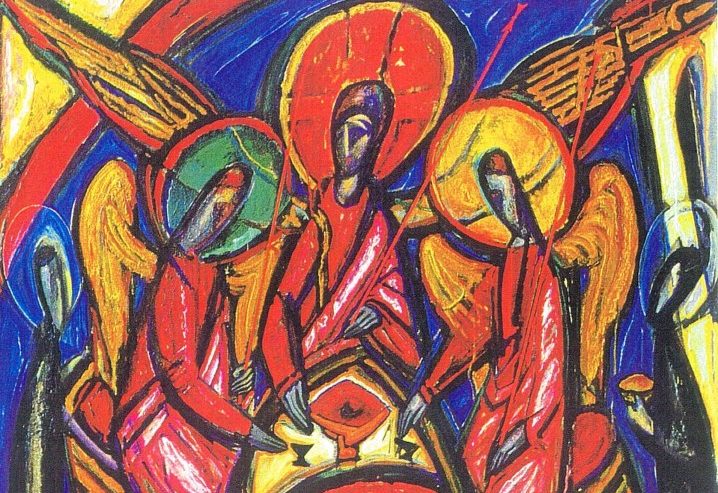
*Above painting of the Trinity by Alek Rapaport, 1994