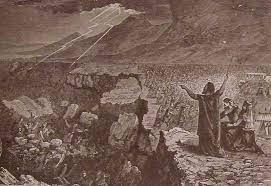
Rebellion In the Community (Numbers 16:1-19)

Korah and His Company Refuse to Obey Moses, by Wheatfield Media

Korah son of Izhar, the son of Kohath, the son of Levi, and certain Reubenites—Dathan and Abiram, sons of Eliab, and On son of Peleth—became insolent,and rose up against Moses. With them were 250 Israelite men, well-known community leaders who had been appointed members of the council. 

They came as a group to oppose Moses and Aaron and said to them, “You have gone too far! The whole community is holy, every one of them, and the Lord is with them. Why then do you set yourselves above the Lord’s assembly?”

When Moses heard this, he fell facedown. Then he said to Korah and all his followers: “In the morning the Lord will show who belongs to him and who is holy, and he will have that person come near him. The man he chooses he will cause to come near him. You, Korah, and all your followers are to do this: Take censers and tomorrow put burning coals and incense in them before the Lord. The man the Lord chooses will be the one who is holy. You Levites have gone too far!”

Moses also said to Korah, “Now listen, you Levites! Isn’t it enough for you that the God of Israel has separated you from the rest of the Israelite community and brought you near himself to do the work at the Lord’s tabernacle and to stand before the community and minister to them? He has brought you and all your fellow Levites near himself, but now you are trying to get the priesthood too. It is against the Lord that you and all your followers have banded together. Who is Aaron that you should grumble against him?”

Then Moses summoned Dathan and Abiram, the sons of Eliab. But they said, “We will not come! Isn’t it enough that you have brought us up out of a land flowing with milk and honey to kill us in the wilderness? And now you also want to lord it over us! Moreover, you haven’t brought us into a land flowing with milk and honey or given us an inheritance of fields and vineyards. Do you want to treat these men like slaves? No, we will not come!”

Then Moses became very angry and said to the Lord, “Do not accept their offering. I have not taken so much as a donkey from them, nor have I wronged any of them.”

Moses said to Korah, “You and all your followers are to appear before the Lord tomorrow—you and they and Aaron. Each man is to take his censer and put incense in it—250 censers in all—and present it before the Lord. You and Aaron are to present your censers also.” 

So each of them took his censer, put burning coals and incense in it, and stood with Moses and Aaron at the entrance to the tent of meeting. When Korah had gathered all his followers in opposition to them at the entrance to the tent of meeting, the glory of the Lord appeared to the entire assembly. (New International Version)
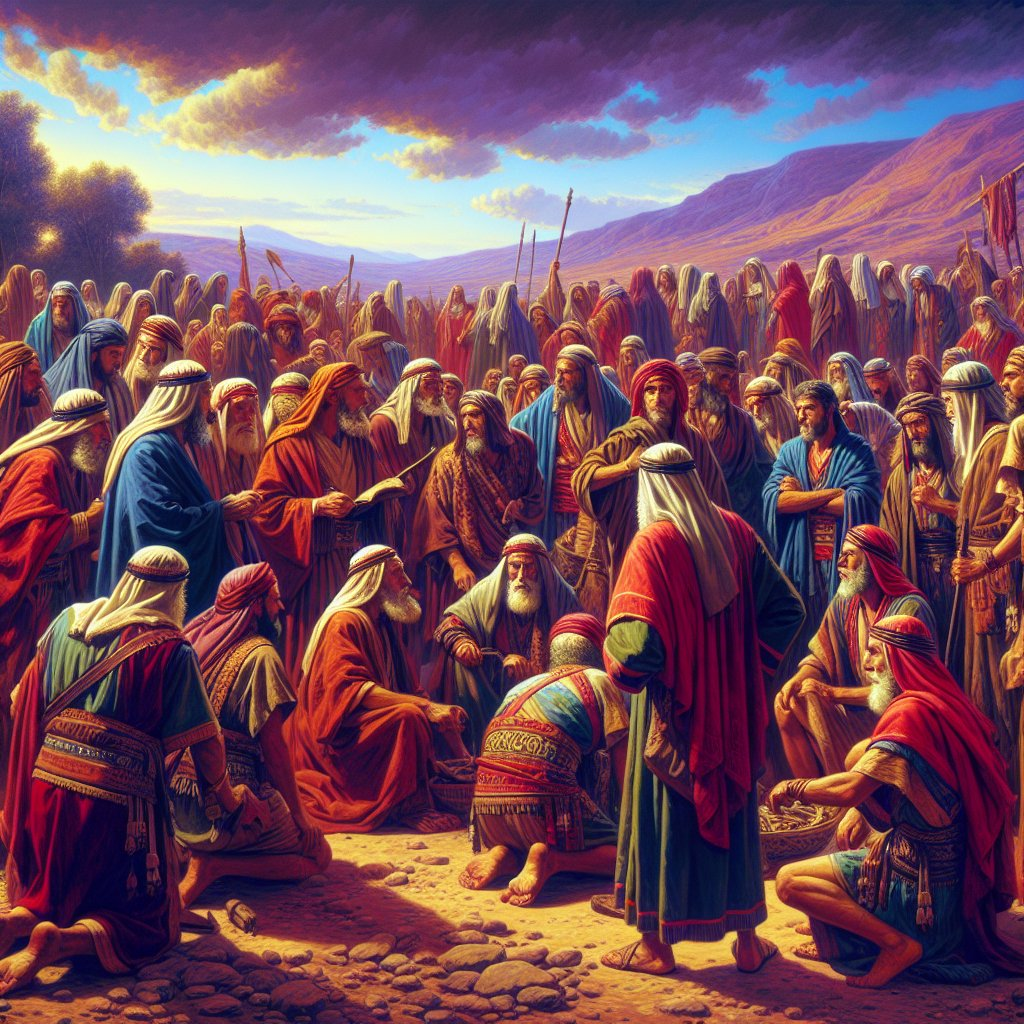
By Bible Art

I must admit that, having been a church pastor for decades, today’s story sounds eerily like several parishioners I’ve known over the years. They, along with the story’s antagonist Korah, strike me as ungrateful and continually concerned about angling for more power and authority within the community.

Rebellions are nothing new. They happen everywhere, from faith communities to neighborhood associations, from local politics to national governments.

The Book of Numbers is a rather depressing part of the Bible, largely because of the nature of the Israelite grumblings, without much gratitude happening.

The murmurings turned to complaints, and then to outright rebellion. It seems to have been a pattern with the Israelites in the desert. The animosities were directed against God or Moses, and sometimes both.

In each one of the various stories of rebellion in the desert, the rebellious people died in various ways by means of a plague, a fire, or in a battle. We get the sense with today’s story that a whopper of a divine judgment is going to happen.

The punishments mentioned in the Old Testament are meant to highlight, with rather strong illustrations, that the political and religious systems set up through the covenant code were divinely originated and sanctioned. In other words, don’t mess with God’s authority.

So then, a rebellion against Moses and Aaron was, in reality, a rebellion against God. And it would bring divine wrath on the rebels.

Having been in various leadership capacities in my life, to me the most insidious kind of rebellion is the subtle sort. Authority is challenged indirectly, in passive-aggressive forms through gossip, back-biting, and building a coalition from false information.

I also think that those subtle forms of rebellion really upset God. Which is why the Lord extended divine wrath on such rebels.

Korah was a Levite, like Moses. But that is about all he had in common with Israel’s leader. Korah’s rebellion was precisely directed against the leadership of Moses (and Aaron).

Similar to many arguments I’ve encountered throughout my ministerial life, Korah framed his argument with pious sounding language – as if Moses was the problem the one opposed to holiness.

Lord, have mercy. I really do despise religious gaslighting.

Korah implied that Moses was raising himself above the others, that the entire Israelite community was holy, therefore, there’s no need for a leader like Moses. The people’s holiness is enough. That’s all anybody needs, right?

Apparently, no.

Neither Moses nor Aaron dealt with the argument. Rather, Moses was satisfied to leave the matter with God as to what to do with the rebels.

It’s always good to let God reaffirm God’s own way of doing things. It was God who raised up Moses, and it would be God to whom Korah would have to answer.

The reason these sorts of situations keep popping up in every generation of history is that they deal with a problem which all humans encounter. Every person, group, faith community, and nation must contend with the tension between authority and freedom.

Like so many arrogant demagogues, Korah believed he was the guardian of freedom – and that the people ought to follow him. Yet, even though many did, the most important person in the room, God, did not.

Give peace in our time, O good and gracious God, a peace which the world cannot give. To those who have taken up arms in anger or revenge, or even in the cause of justice, grant the grace of conversion to the path of peaceful dialogue and constructive collaboration. And to those who are victims of human cruelty, open wide your arms and enfold them in the embrace of your compassion, healing, and life. Amen.

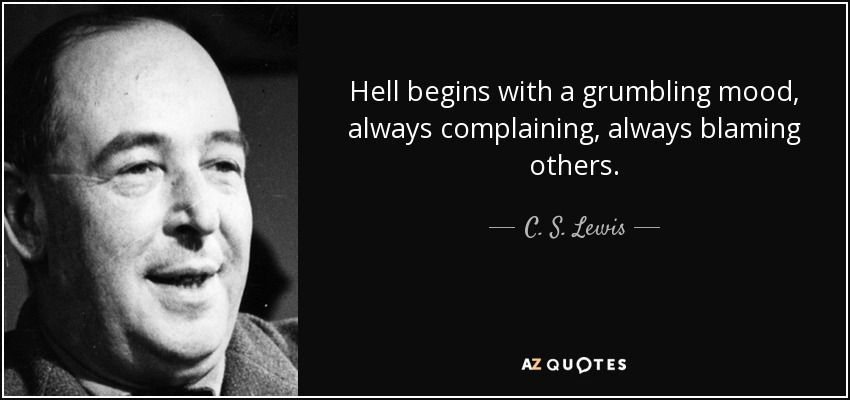
Get Rid of Grumbling (Numbers 16:41-50)

Grumbling broke out the next day in the community of Israel, grumbling against Moses and Aaron: “You have killed God’s people!”

But it so happened that when the community got together against Moses and Aaron, they looked over at the Tent of Meeting and there was the Cloud—the Glory of God for all to see.

Moses and Aaron stood at the front of the Tent of Meeting. God spoke to Moses: “Back away from this congregation so that I can do away with them this very minute.”

They threw themselves face down on the ground.

Moses said to Aaron, “Take your censer and fill it with incense, along with fire from the Altar. Get to the congregation as fast as you can: make atonement for them. Anger is pouring out from God—the plague has started!”

Aaron grabbed the censer, as directed by Moses, and ran into the midst of the congregation. The plague had already begun. He put burning incense into the censer and atoned for the people. He stood there between the living and the dead and stopped the plague.

Fourteen thousand seven hundred people died from the plague, not counting those who died in the affair of Korah. Aaron then went back to join Moses at the entrance to the Tent of Meeting. The plague was stopped. (The Message)

grum-bled, grum-bling, grum-ble:

  • to murmur or mutter in discontent; complain sullenly
  • an expression of discontent; complaint; unhappy murmur; growl.

Out of all the bad things in this old world, grumbling and murmuring aren’t typically at the top of our list of heinous sins. Yet, they’re bad. The reason grumbling needs squelching is because complaining is like a gateway drug – start using it and it will surely lead to worse things, unless stopped.

A surefire way to divide a community of people is by grumbling and complaining. This was the deliberate tool of Korah – a Levite who was angling for more power and authority amongst the Israelites in their sojourn in the desert. His stirring up rebellion through constant complaints was a high-handed sin, meant to undercut Moses as the leader.

The revolt he incited resulted in a dramatic intervention of God in causing the earth to open up and swallow Korah and the rebels. The Lord has a zero tolerance policy toward satanic plans of upending godly leadership and replacing it with a lust for power.

The Punishment of Korah, Holman Illustrated Bible, 1890

Unfortunately, this was not the end of the story. Aftershocks of grumbling erupted around the community. And it was dealt with by God with the same sort of wrath that Korah experienced. A plague broke out and many more died.

So, why all the death? This was far more than a bunch of malcontents who were griping about how things were going. It was an assault against the Lord – in the same way Lucifer once brought rebellion to heaven. In both cases, swift action was taken.

Please keep in mind that we need a nuanced understanding of complaining, grumbling, and arguing. A great deal of complaining is an expression of grief, of pushing back against the hurt. There’s also the grumbling that comes because everybody else is doing it. But then there is the sort of grumbling that is intended to topple God as the authority and place oneself in that position. That’s the nasty sort which will get one in a heap of trouble.

I once had a parishioner, several years back, who continually complained about me. More than that, he seemed to be always trying to get others to join him in his constant grumbling. I certainly tried to be as meek as Moses. Whether that happened, or not, I’m not sure.

It got bad enough that one Sunday, the grumbler invited me to come outside after church and settle things “like men,” which meant with fisticuffs. Oy.

About a month later, the man was standing in his driveway, then fell straight over. He was dead before he even hit the pavement. I’ll leave it to you for an interpretation. I’ll also say that, obviously, the grumbling and rebellion stopped.

The people’s grumbling and revolt against Moses was tantamount to rebelling against God.

Grumbling is not okay. Whenever folks dig in and complain in order to overturn something or someone which the Lord has established, their plans for destruction get turned in on themselves. In other words, what happens to themselves is what they were planning all along for another.

The New Testament author of Hebrews picked up this tone of grumbling from the ancient Israelites, and offered a warning to his own contemporary audience:

“Today, if you hear his voice,
    do not harden your hearts
as you did in the rebellion,
    during the time of testing in the wilderness,
where your ancestors tested and tried me,
    though for forty years they saw what I did.
That is why I was angry with that generation;
    I said, ‘Their hearts are always going astray,
    and they have not known my ways.’
So I declared on oath in my anger,
    ‘They shall never enter my rest.’ ”

See to it, brothers and sisters, that none of you has a sinful, unbelieving heart that turns away from the living God. (Hebrews 3:8-12, NIV)

The author also provided some simple yet profound exhortation for keeping grumbling and murmuring at bay:

But encourage one another daily, as long as it is called “Today,” so that none of you may be hardened by sin’s deceitfulness. (Hebrews 3:13, NIV)

Encouragement is the daily practice which prevents a hard heart and soul rot – the very things which lead a person to begin complaining and rebelling.

If there is no encouragement, complaints will take root. And if complaints take root, bitterness begins to grow. And if bitterness begins to grow, it will feed itself on grudge-bearing. And if grudge-bearing persists, it will have very unpleasant results.

See to it that no one falls short of the grace of God and that no bitter root grows up to cause trouble and defile many. (Hebrews 12:15, NIV)

So, let us cultivate the fruit of the Spirit, and put aside the shameful deeds of darkness. Let us look for ways to encourage one another, rather than tearing down each other. Let us:

Fix our eyes on Jesus, the pioneer and perfecter of faith. For the joy set before him he endured the cross, scorning its shame, and sat down at the right hand of the throne of God. Consider him who endured such opposition from sinners, so that you will not grow weary and lose heart. (Hebrews 12:2-3, NIV)

Holy God, you work in us to will and to act in order to fulfill your good purpose. Help us to do everything without grumbling or arguing, so that we may become blameless and pure, without fault in a warped and crooked generation, through Jesus Christ our Lord, in the power of the Holy Spirit. Amen.