Out of the Slimy Pit (Psalm 40:1-11)

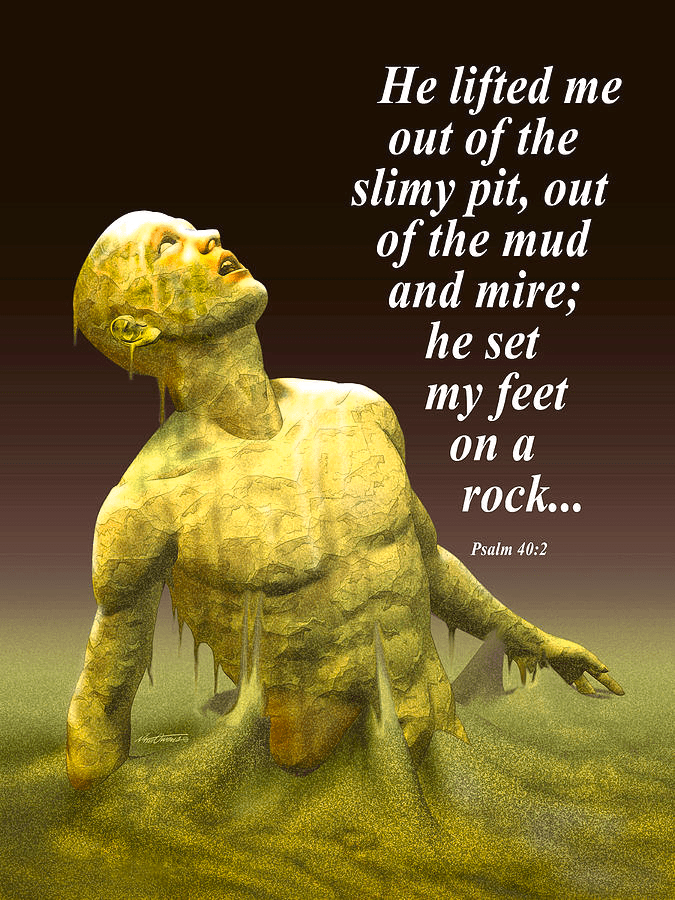
He Lifted Me by Nate Owens

I put all my hope in the Lord.
    He leaned down to me;
    he listened to my cry for help.
He lifted me out of the pit of death,
    out of the mud and filth,
    and set my feet on solid rock.
        He steadied my legs.
He put a new song in my mouth,
    a song of praise for our God.
Many people will learn of this and be amazed;
    they will trust the Lord.
Those who put their trust in the Lord,
    who pay no attention to the proud
    or to those who follow lies,
    are truly happy!

You, Lord my God!
    You’ve done so many things—
    your wonderful deeds and your plans for us—
        no one can compare with you!
    If I were to proclaim and talk about all of them,
        they would be too numerous to count!
You don’t relish sacrifices or offerings;
    you don’t require entirely burned offerings or compensation offerings—
    but you have given me ears!
So I said, “Here I come!
    I’m inscribed in the written scroll.
    I want to do your will, my God.
    Your Instruction is deep within me.”
I’ve told the good news of your righteousness
    in the great assembly.
    I didn’t hold anything back—
        as you well know, Lord!
I didn’t keep your righteousness only to myself.
    I declared your faithfulness and your salvation.
I didn’t hide your loyal love and trustworthiness
    from the great assembly.

So now you, Lord—
    don’t hold back any of your compassion from me.
Let your loyal love and faithfulness always protect me. (Common English Bible)

Every follower of the Lord has a powerful story of God’s grace in lifting them out of a slimy pit experience. 

We live in a profoundly broken world; and no one is exempt from its effects upon us. Whether physical problems, emotional trials, or relational hardships, there is always something going on in our lives – with the added pull toward trusting in things other than God. 

The temptation to say unjust words and do unjust actions is always over-promised and under-delivered. 

It’s easy to get sucked-in to poor decisions and be stuck in an empty hole with seemingly no way out. We often find ourselves slipping into a slimy pit because of our own bad decisions, as well as by no fault of our own. 

Living in a fallen world means that we inevitably experience troubles and hardships.

So, what do we do if we find ourselves in a slimy pit?

Look for Hope

David, the psalmist, waited patiently for the Lord. With great expectation, he fully anticipated God to act on his behalf. The sort of patience he practiced was an intense waiting – a waiting filled with longing and expectant hope, a patience that kept looking and praying and seeking.

The reason believers in Jesus keep hoping beyond hope is that we know that God is ultimately the One who delivers from the pit. 

But what if you have been looking for deliverance from the slimy pit experience and you have not seen it come to pass? 

Expectantly expect God to act. Wait patiently. Do not give up. Keep praying and watching. Like the father in the story of the prodigal son, keep looking out the window, waiting for the son to return, and picture the deliverance coming – because our waiting is not in vain.

flickr.com/photos/joshtinpowers

The psalmist, David, was eventually delivered. The Lord leaned down to him. God listened and lifted him. The Lord God set him on a firm place to stand and put a new song in his mouth. 

This was not only a personal matter for David; it was also an occasion that other people needed to know about.

Look for God

We all must finally come to the end of ourselves and look up. Whenever the deliverance doesn’t come quickly, we may look to other people or things to give us the freedom we long for. It’s easy to become impatient and begin searching for answers in everything else but God. 

Yet, if we will let patient hope have its way, we are blessed when we trust in the Lord.

In all my years of churchgoing as a kid, I had never read my Bible. But God was gracious to me. I remembered all those sermons I heard about Jesus. I gained a newfound sense of my own inner darkness, as well as the desire to read God’s Word. And God saved me. 

My circumstances did not change, but I did. My loneliness turned to joy; my aimlessness turned into purpose; and my selfishness became a deep concern for others. My heart had been black, and what God did to change it was nothing less than miraculous.

Look Within

The person who looks for hope and seeks God is also a person who looks into their own heart and there finds the attitude which God will bless. 

Blessing does not come from great sacrifice, but by syncing one’s heart with the heart of God. 

The Lord cares little about how much money or stuff you have, or how many sacrifices were made for God; that’s because God wants your heart, your mind, your will, and your emotions. In other words, God wants you! 

And God desires you because the Lord made you with a heart that beats for the same things God cares about: justice, mercy, and humility.

If you and I will but look within at the very spirit God has put within us, we shall find resources beyond what we can ask or think.

Look to Bless Others

We possess more than a personal faith which is to benefit ourselves; we also have an equal responsibility to bless the community with our experiences of what God has done in our lives. 

The telling of stories about what God has done for us is a necessary part of building up the church and helping others move forward in faith, hope, and love.

The psalmist proclaimed his testimony in the great assembly, that is, publicly. This isn’t about standing behind a microphone in front of lots of people; it’s about being so touched by God that we cannot keep our mouths shut about the Lord’s deliverance on our behalf.

So, let’s not shelve the idea of giving testimony to others as if it were only for pastors, missionaries, or other very religious people. 

When a person decides to play hockey in -20 degrees below zero weather, we might think that person is a little crazy;  but, hey, we reason, if they love hockey that much, more power to them. 

We must not think about Christianity in the same way, that if a person is passionate about Jesus and desires to tell others about what God has done for them, more power to them; just don’t expect me to go out in the cold and do that because it isn’t my thing. 

Christianity is a life, not a hobby; it’s about humble service, and not a means to look respectable; it cannot be reduced to a few practices, such as church attendance or putting money in an offering plate.

Christianity is a relationship with God through Jesus. Try looking at marriage as simply showing up for supper and paying the bills and see how far that gets you.

Look to Get Lost to Get Found

We may become obsessed with getting out of our slimy pit of illness, infirmity, pain, adversity, hardship, or discord. If that happens, we will likely lose our proper focus.

Instead, get lost in the wonder of God. The Lord does wondrous things when we are immersed in God’s wonders.

“Any of you who try to save the life you have will lose it. But you who give up your life for me will find true life.” Jesus (Matthew 16:25, ERV)

New life comes from a change of heart, not a change of circumstances. Wherever there is a firm reliance on God; a glad obedience to God; and a readiness to give testimony to God’s actions, then we are living into the spirit of today’s psalm.

Lamb of God, who takes away the sins of the world, have mercy on us.
Lamb of God, who takes away the sins of the world, grant us your peace. Amen.


Cyber-Monday Is (Not) My Master (Romans 6:1-11)

What shall we say, then? Shall we go on sinning so that grace may increase? By no means! We are those who have died to sin; how can we live in it any longer? Or don’t you know that all of us who were baptized into Christ Jesus were baptized into his death? We were therefore buried with him through baptism into death in order that, just as Christ was raised from the dead through the glory of the Father, we too may live a new life.

For if we have been united with him in a death like his, we will certainly also be united with him in a resurrection like his. For we know that our old self was crucified with him so that the body ruled by sin might be done away with, that we should no longer be slaves to sin— because anyone who has died has been set free from sin.

Now if we died with Christ, we believe that we will also live with him. For we know that since Christ was raised from the dead, he cannot die again; death no longer has mastery over him. The death he died, he died to sin once for all; but the life he lives, he lives to God.

In the same way, count yourselves dead to sin but alive to God in Christ Jesus. (New International Version)

Not many Christians can quote these verses of the Apostle Paul to the Romans, even though they encapsulate the heart of Christian theology about God, humanity, and sin. Maybe that’s why so many people have their own alternative story:

So what do we do? We get on-line and do some shopping, that’s what we do!

Should we keep on missing out on sales so that the great market economy keeps on slashing prices, so I have to compete for what I want? I should hope not! If we’ve left Black Friday, where sales is sovereign, how can we avoid Cyber-Monday? Or didn’t you realize what kind of price cuts are going on?

You were baptized into the ultimate deal. When you signed up for those holiday sale alerts, you left that old country of brick and mortar sales behind; you’ve entered into the new country of one touch shopping—a new life in a new cyber world!

That’s what baptism into the market economy means. When we are immersed into the ways of the savvy shopper, we are raised up with a whole new credit line! Each of us is raised into a light-filled computer screen world so that we can see where we’re going in our new sales-sovereign country.

Could it be any clearer? Our old way of a newspaper coupon clipping life was nailed to that old printing press, a decisive end to that miserable life—no longer captive to the mail carrier’s showing up at the mailbox!

If we get included in the on-line list, we also get included in those life-saving sales. We know that when the price drops it will eventually rise again. But never again will the end of the sale have the last word. The sale’s been brought to us; we don’t have to go to it. Think of it this way: physical stores and newspapers speak a dead language that means nothing to you; Cyber-Monday speaks your mother tongue, and you hang on every word.

Cyber-Monday. It’s no wonder Americans keep creating new holidays centered in sales events. After all, the impulse to shop runs high in most Westerners. Shopping can quite easily move from necessity to compulsion. Before you know it, we can be consuming without much restraint. 

On-line shopping, especially, is just so darn easy and can trigger the brain just as much as any addiction. There is often a very thin line between justified shopping and sinful rationalization of consumption. So, how do we say “no” in the face of competing choices? Whatever besetting sin is in our lives, how do we put it aside and rid ourselves of it? 

One of the practical ways of approaching this answer is to read Romans 6, not from a generic standpoint, but make it very personal. In other words, it could be quite helpful to make all of the pronouns personal and name the specific sin when sin is mentioned. For example, it could look something like this:

“What shall I say, then? Shall I go on shopping so that grace may increase? By no means! I died to shopping; how can I live in it any longer?  Or don’t I know that I am baptized into Christ Jesus and, so, am baptized into his death? I am therefore buried with him through baptism into death in order that, just as Christ was raised from the dead through the glory of the Father, I, too, may live a new life.”

You can put your own besetting sin or struggle into the text: 

“If I have been united with him like this in his death, I will certainly also be united with him in his resurrection. For I know that my old self was crucified with him so that shopping or gossiping or lying or overeating or alcoholism or legalism, etc. might be done away with, that I should no longer be a slave to shopping – because I have died and have been freed from the compulsive and obsessive need to shop.”

I think you get the idea. We are to count ourselves dead to all the addictions, compulsions, and activities that we use to replace the finished work of Christ. Instead, we are to reckon ourselves dead to it but alive to God in Christ. 

The struggle against sin comes down to daily affirmations of faith that we belong to God through Jesus – and not to some other master. Yes, the daily work of spiritually affirming our identity might seem mundane, but it is quite necessary to achieving practical victory.

Lord God, as we begin this season of Advent, grant us grace for seeking your kingdom first; and our fiefdom of self, last. Rather than spending more money and expending more worry, help us invest our time and treasures, talent and tears into your just and right way of life. Free us to love and serve others with joy, with the same generous love and sacrificial care you lavish on us. Amen.

Jesus Is Lord (Revelation 21:5-27)

“The Risen Lord” by Chinese artist He Qi, 2001

Then the one who sits on the throne said, “And now I make all things new!” He also said to me, “Write this, because these words are true and can be trusted.” And he said, “It is done! I am the first and the last, the beginning and the end. To anyone who is thirsty I will give the right to drink from the spring of the water of life without paying for it. Those who win the victory will receive this from me: I will be their God, and they will be my children. But cowards, traitors, perverts, murderers, the immoral, those who practice magic, those who worship idols, and all liars—the place for them is the lake burning with fire and sulfur, which is the second death.”

One of the seven angels who had the seven bowls full of the seven last plagues came to me and said, “Come, and I will show you the Bride, the wife of the Lamb.” The Spirit took control of me, and the angel carried me to the top of a very high mountain. He showed me Jerusalem, the Holy City, coming down out of heaven from God and shining with the glory of God.

The city shone like a precious stone, like a jasper, clear as crystal. It had a great, high wall with twelve gates and with twelve angels in charge of the gates. On the gates were written the names of the twelve tribes of the people of Israel. There were three gates on each side: three on the east, three on the south, three on the north, and three on the west. 

The city’s wall was built on twelve foundation stones, on which were written the names of the twelve apostles of the Lamb. The angel who spoke to me had a gold measuring stick to measure the city, its gates, and its wall. The city was perfectly square, as wide as it was long. The angel measured the city with his measuring stick: it was fifteen hundred miles long and was as wide and as high as it was long. The angel also measured the wall, and it was 216 feet high, according to the standard unit of measure which he was using. The wall was made of jasper, and the city itself was made of pure gold, as clear as glass. 

The foundation stones of the city wall were adorned with all kinds of precious stones. The first foundation stone was jasper, the second sapphire, the third agate, the fourth emerald, the fifth onyx, the sixth carnelian, the seventh yellow quartz, the eighth beryl, the ninth topaz, the tenth chalcedony, the eleventh turquoise, the twelfth amethyst. The twelve gates were twelve pearls; each gate was made from a single pearl. The street of the city was of pure gold, transparent as glass.

I did not see a temple in the city, because its temple is the Lord God Almighty and the Lamb. The city has no need of the sun or the moon to shine on it, because the glory of God shines on it, and the Lamb is its lamp. The peoples of the world will walk by its light, and the kings of the earth will bring their wealth into it. 

The gates of the city will stand open all day; they will never be closed, because there will be no night there. The greatness and the wealth of the nations will be brought into the city. But nothing that is impure will enter the city, nor anyone who does shameful things or tells lies. Only those whose names are written in the Lamb’s book of the living will enter the city. (Good News Translation)

“The Risen Christ” by He Qi, 2004

So, I’m just going to put something out there and see if you resonate with it, or not:

Sometimes we long for Christ’s return, the end of time, and eternal bliss because we don’t want to deal with being our true selves right now in this present moment in time. We just want out of our current reality.

At times, we take ourselves so darned seriously that the true self never comes through to others. Yet, when I’m real, authentic, and genuine, I connect with others from the very core of my being, and not from some contrived self that I’ve put up for others to see.

I say all this because, if we want to see the New Jerusalem, the heavenly city, and experience the very presence of God and the Lamb, then it comes because you and me are being our real selves. Only the true, the brave, and the vulnerable shall have their names written in the Lamb’s Book of Life.

I think the reason why we have such a detailed description of the New Jerusalem is that this is a sure thing; it’s real, man. And only real authentic people can inhabit the city.

Please know that, even though we may want things to change from the way they are now, things will not always be this way. Life will not always consist of heartache, suffering, and tears. The world, as we now know it, will eventually pass away with its constant barrage of war, famine, hunger, sickness, misunderstanding, conflict, and pain. 

There is a coming a day when Jesus will return and make everything new. The vision of this next-to-last chapter of the Bible portrays a sovereign Lord who is in charge, and whose authority, in the end, shall be seen for what it truly is. 

Everything wrong will be made right; all that is crooked shall be made straight; and the endless struggle to do what is right and just will prevail once and for all.

Whenever we get caught in some seemingly endless cycle of addiction, or insecurity, or fear; whenever we find ourselves having to endure yet another day of undeserved backtalk; and whenever we see that perseverance has become our abiding companion; it is in those times – much like the original recipients of the Apostle John’s vision of the final apocalypse – that we are strengthened and encouraged with the truth that Jesus is Lord. 

Jesus Christ reigns as King over all creation; his rule will be revealed to all nations. In Christ’s benevolent kingdom, everyone who is thirsty for justice will receive from a life-giving fountain; and all who hunger for righteousness will be filled and satisfied.

Yet, until that time comes, we hold to our hope that Jesus shall return to judge the living and the dead. 

For righteous persons, this is truly good news. For the wicked, not so much. 

Only those whose names are written in the Lamb’s Book of Life will be in the celestial city. 

So, today is the day to be a real, authentic, vulnerable Christian who puts on words and deeds that are appropriate for God’s kingdom.

Lord Jesus, you are making everything new. You are the Alpha and Omega, the beginning and the end. All things hinge on your gracious rule in this world. Help me to so embrace your kingdom ethics that every word I say and each deed I do is consistent with your divine justice and mercy through the power of the Holy Spirit, to the glory of God. Amen.

A Living Hope (1 Peter 1:3-9)

Let us give thanks to the God and Father of our Lord Jesus Christ! Because of his great mercy he gave us new life by raising Jesus Christ from death. This fills us with a living hope, and so we look forward to possessing the rich blessings that God keeps for his people. He keeps them for you in heaven, where they cannot decay or spoil or fade away. They are for you, who through faith are kept safe by God’s power for the salvation which is ready to be revealed at the end of time.

Be glad about this, even though it may now be necessary for you to be sad for a while because of the many kinds of trials you suffer. Their purpose is to prove that your faith is genuine. Even gold, which can be destroyed, is tested by fire; and so your faith, which is much more precious than gold, must also be tested, so that it may endure. Then you will receive praise and glory and honor on the Day when Jesus Christ is revealed. 

You love him, although you have not seen him, and you believe in him, although you do not now see him. So you rejoice with a great and glorious joy which words cannot express, because you are receiving the salvation of your souls, which is the purpose of your faith in him. (Good News Translation)

There’s no need for hope if everything’s going just the way you like it. I remember when I was a college undergraduate, I hoped for Christ’s return toward the end of every semester. The prospect of all those final exams and the pressure of grades had me longing for heaven.

But that’s life. Maturity, resilience, perseverance, and just about every virtue you can think of comes as a result of life’s trials and sufferings. The Christian has hope, precisely because things aren’t the way they’re supposed to be.

Faith has to be tried and tested. And hard circumstances are the way of purifying it. Like gold being purged of any dross by being exposed to extreme heat, so our faith becomes strong, robust, and genuine by the purgative fires of life’s many large and small sufferings.

The whole point of it all is to make us people worthy of our spiritual calling. Resurrection only happens because there’s been a death. Glory is only realized through suffering.

New life, the Christian life, isn’t a matter of making a new set of resolutions, as if it were nothing more than aspirations at the beginning of a calendar year. Rather, Christian faith is a response to the mercy of God in Jesus Christ.

One of my all-time favorite stories is Victor Hugo’s Les Miserables. It’s a story of grace and new life, of a hopeless man given the chance at hope.

The main character is Jean Valjean, who spends nineteen years in jail for stealing a loaf of bread for his starving family. The experience in prison caused him to become a bitter and cynical man. After his release, Jean Valjean has nowhere to go. 

In desperation, he seeks lodging one night at the home of a Catholic bishop, who treats him with genuine kindness, which Valjean sees only as an opportunity to exploit. In the middle of the night, he steals the bishop’s silver and skedaddles. 

The next day, however, Valjean is caught by the police. When they bring him back to the bishop’s house for identification, the police are surprised when the bishop hands two silver candlesticks to Jean, implying that he had given the stolen silver to him, saying, “You forgot these.” 

After dismissing the police, the bishop turns to Jean Valjean and says, “I have bought your soul for God.” In that moment, by the bishop’s act of mercy, Valjean’s bitterness is broken. Hope springs to life.

Jean Valjean’s forgiveness is the beginning of a new life. The bulk of Victor Hugo’s novel demonstrates the utter power of a redeemed life. Jean chooses the way of mercy, as the bishop had done. Valjean raises an orphan, spares the life of a parole officer who spent fifteen years hunting him, and saves his future son-in-law from death, even though it nearly cost him his own life. 

“Jean Valjean, my brother, you no longer belong to what is evil but to what is good. I have bought your soul to save it from black thoughts and the spirit of perdition, and I give it to God.” ― Victor Hugo, Les Misérables

Throughout Jean Valjean’s new life, there are trials and temptations all along the way. Yet, mercy keeps his faith strong, and hope kindled. Whereas before, Valjean responded to mercy with a brooding melancholy and inner anger, now – after being shown grace – he responds to each case of unjust suffering with gratitude, deeply thankful for the chance to live a new life full of grace.

Hope is kept alive because of suffering. Faith is strengthened by means of adversity. And both originate because of mercy and grace.

Christianity is a worldview perspective that enables one to rejoice in difficulty. For the Christian, there is no empty meaningless grief; there is the hope that our suffering means something. Like the athlete who endures all the painful practice in order to realize a future hope, so the believer in Jesus goes into strict training for the development of faith – all in the confident expectation of a fulfilled salvation.

It’s a hard lesson to learn, this seemingly weird alchemy of faith, suffering, hope, joy, and new life. And every generation of Christians needs to experientially discover it. Each believer eventually learns, in the crucible of hard circumstances, that the promises of God are the ballast to persevere in faith and patience throughout life.

Christian hope is a confident expectation that the promises of God will be completely realized.

A Christian’s salvation encompasses past, present, and future.

We were saved back there in the past when Christ died on the cross for us. We were crucified with him.

We are presently being saved from the world, the sinful nature, and the devil, through the sanctifying work of the Spirit in making us holy.

And we will be saved in the future when Christ returns to judge the living and the dead. Then, our salvation will be fully realized. Since that hasn’t happened yet, we have hope to sustain us.

It was hope that sustained me in college. I endured all the hours of study, all the exams, all the various courses taken, with the confident expectation that I would someday walk across that stage, receive my diploma, and graduate with my intended degree.

We ourselves, who have the first fruits of the Spirit, groan inwardly as we wait eagerly for our adoption to sonship, the redemption of our bodies. For in this hope we were saved. But hope that is seen is no hope at all. Who hopes for what they already have? But if we hope for what we do not yet have, we wait for it patiently. (Romans 8:23-25, NIV)

The Christian’s hope for ultimate deliverance is imperishable, undefiled, and unfading. This means we can live through a difficult day or week or month or a year, or even decades, with spiritual endurance. Our goal shall come in all its fullness. 

Then I saw a new heaven and a new earth, for the first heaven and the first earth had passed away, and the sea was no more. And I saw the holy city, the new Jerusalem, coming down out of heaven from God, prepared as a bride adorned for her husband. And I heard a loud voice from the throne saying,

“See, the home of God is among mortals.
He will dwell with them;
they will be his peoples,
and God himself will be with them and be their God;
he will wipe every tear from their eyes.
Death will be no more;
mourning and crying and pain will be no more,
for the first things have passed away.” (Revelation 21:1-4, NRSV)

Eventually, suffering will have done its work and we will be with Christ forever. Until that day, let us explore all that God has for us, embracing both the meaning and the mystery of faith. 

Since our salvation is assured, let us live with confidence and run the race marked out for us.

Heavenly Father, you created us and lovingly care for us. We accept all our sufferings willingly, and as truly obedient children we submit ourselves to your holy will. Give us the strength to accept your loving visitation to us through adversity, and never let us grieve your heart by giving-in to impatience. We offer you our pains to be used for your honor and glory, through Jesus Christ our Lord, in the strength of the Holy Spirit. Amen.