Matthew 22:36-40 – Who Do We Minister To?

“Teacher, which is the greatest commandment in the Law?”

Jesus replied: “‘Love the Lord your God with all your heart and with all your soul and with all your mind.’ This is the first and greatest commandment. And the second is like it: ‘Love your neighbor as yourself.’ All the Law and the Prophets hang on these two commandments.” (New International Version)

I love my three daughters. I think God made them beautiful to compensate for all the ornery things they did as kids so I would not go crazy. Once the oldest was at the top of the stairs with the youngest (who was two years old at the time). She put her in a laundry basket and pushed her down with the middle kid at the bottom to catch her. 

I love my wife with all my heart and soul. Yet, she always thought it would be a good idea to have an open-door policy for the girls to come into our bed at night whenever they needed us. I have been puked on, peed on, kicked on and pushed out of bed. Sometimes it was like living with a bunch of drunks. Raising this girl version of “Malcom in the Middle” was often stressful. However, I gladly dealt with it all because I love my girls with all my heart, soul, mind, and strength.

Who do we minister to? The short answer: everyone. The reason we are to pay attention to everyone within our orbit is that God does. The way of loving our neighbor is to experientially know the heart, soul, mind, and strength of our great God.

Love God with All Your Heart

God has children across planet earth, and the Lord loves them all. To love God with all our heart is to begin seeing God’s big expansive heart for people all around the world. God’s compassionate heart is close to the broken-hearted, near to those in need. In fact, God’s wrath is a response of love to make things right in this fallen world. As early as the book of Genesis, just a few chapters in, it says:

The Lord saw that the human beings on the earth were very wicked and that everything they thought about was evil. He was sorry he had made human beings on the earth, and his heart was filled with pain. (Genesis 6:5-6, NCV)

God is disturbed with violent and evil hearts. God is heartbroken about the dark places within the human heart. God is deeply concerned for suffering, injustice, oppression, and death.

Every year fifteen-million children die of starvation. Human trafficking of women and girls has increased six-fold over the past five years resulting in forty-million victims of forced sex worldwide. Five and a half million people worldwide have died from COVID-19 Hundreds of millions are locked in grinding poverty, have no clean water to drink, and face a lifetime of illiteracy and poor wages.

The breadth and depth of human need and suffering goes on and one and on….

This is just a small glimpse of what God sees every day. And God knows each one of their names. For us, people need to move from being numbers to being names. God wants us to champion vital causes and aim our collective love toward people in need of Christ’s compassion and deliverance.

Love is a deliberate decision to meet a need in another person. One who fails to see the needs of others will suffer a shrinking heart. But the one close to God’s heart and aware of another’s need will gain an expansive heart. God also sees the good and the beautiful: every obedient act done in secret, each prayer uttered in the privacy of our closet, and all the places of selfless love toward another.

Love God with All Your Soul

I believe the world will experience a mass turning to God whenever Christians reclaim the soul of Christianity by experiencing a newfound sense of God’s wonder and beauty.

If loving God with all my heart means my heart breaks for the things that break God’s heart, then loving God with all my soul has my life flooded with God’s glory – awed by Divine majesty, mystery, and beauty. Loving God with all my soul is to perceive the glory and wonder of God all around me. It is to be profoundly grateful for everything – even and especially for the lessons learned from personal hardship and suffering.

Without a divine perspective, we only see the world as we are and not as it is. The ways to cultivate a beautiful love for God with all my soul is to meditate on Scripture and creation. Literally take time to smell the roses. If we walk or drive the same route every day, be mindful to observe one thing you have never seen before. Then, praise God for it. Each time Holy Scripture is read, do it slowly and carefully, noticing one thing you have never seen before. Then, praise God for that perception.

Take the extra step of sharing your wonderful and beautiful observations with others, especially unbelievers. It does no good to try and scare or cajole people into the kingdom of God. It makes all the difference when the world can see Christians captivated by the beauty and majesty of Christ.

Love God with All Your Mind

True love has an insatiable desire to know more and more about the object of its affection. To love God with all our mind is a desire to learn and experientially know more about the Lord. It is to have a constant curiosity about God.

Loving God takes our full faculties. God wants all our brains, not just one half of it.

Left-brain dominant people rely on the logical, analytical, practical, and think chiefly in concrete ways. Right-brain dominant folks are artistic, intuitive, creative, imaginative, humorous, even sarcastic, often speaking poetically and with satire or metaphor. Loving God with all our minds means we will use all our brains, both the right and the left hemispheres.    

One obstacle to loving God with our brains is that the mind of sinful humanity is death (Romans 8:6). A sinful mind is a small brain; it is not interested in genuine critical thinking – only in stubbornly expressing opinions. Such individuals are merely using a ridiculously small part of their brains. God, however, wants to sanctify our whole brains, to transform us by the renewing of our minds (Romans 12:2). 

We are to use our full cognitive capacities to love God – meaning we will value the left brain hemisphere of order and discipline, using all the tools of reason and logic, learning critical thinking skills, and pursuing the life of the mind.

We will also value the right brain hemisphere of mystery, paradox, and gray areas, enjoying the process of discovery, and probing the deepest issues of divinity and humanity – being comfortable with asking questions and not always having the answers.

Love God with All Your Strength

God loves the smell of your sweat. You might stink to high heaven from hard work but for God it is a sweet aroma and sacred incense. Love is measured not only by words spoken but by calories burned. Using our hands and our effort is as valuable to God as using our brains. 

Go hard after God with all your strength! Yet also be mindful that we all have a finite amount of energy. Because of this, we need to ensure we do not inordinately waste our energy pursuing power and control. Pride, anger, and selfishness saps our strength. Guilt, shame, and regret follow it up by draining our spiritual stamina. So, we need to keep busy doing the right things.

Our priorities need to reflect God’s values. Therefore, we will worship the Lord with all our strength, pray like there is no tomorrow, read Scripture like its our favorite food, fellowship with others as if they are adored old friends, and engage in mission with a continual sense that today could be the day of the Lord’s return.

Loving God with all our strength requires helping others in need whether they believe in Jesus, or not.

Since the Lord is truly concerned for all people’s welfare, putting our energy into sponsoring a refugee family, helping someone with their budget or their bills, providing for at-risk children, or organizing the neighborhood to work together, we let people know we care about them – and not just about whether they end up attending church, or not.

At the same time, we never need to ignore genuine opportunities to share our faith with folks we have connected with. Even if we are functioning with tangible help, we can make the extra effort of connecting people with Jesus.

Conclusion

The power of the gospel is strongest when people experience the full life that God desires for their entire existence. That will happen, I firmly believe, when people are in relationships with believers and with Christ.

When a church or faith community pays attention to the holistic needs of all persons within their sphere of influence, the effect on an individual, a family, a neighborhood, and a city is dramatic.

We love God by being obedient to his great command to love the world through meeting needs and establishing caring relationships. We can do this. It’s what we were saved from sin to do.

Gracious God, we give you thanks that you did not leave us in our misery and suffering, but that in love and mercy, you reached out to us. Thank you that while we were still sinners, Christ died for us. Thank you that Jesus humbled himself, even to death on a cross. Thank you for your heart that seeks the lost. We were once lost, desperately needing you, and going our own way. We are sorry for having hearts that rebelled against you and sought darkness. Thank you for saving us from ourselves.

Please give us hearts that care for the people who are in darkness. Teach us to care for them as you do. Thank you for including us in the mission of reaching other people for your Name. Grow us to care for humanity, both believers and unbelievers. We pray our conversations will be seasoned with salt and full of grace. We pray our friends will see the love of Jesus in us. Enlarge our hearts and make them passionate to see people delivered from their guilt and shame, through Jesus Christ, our Savior and Lord, in the mighty strength of your Holy Spirit. Amen

Psalm 72 – Justice and Righteousness

Give the king your justice, O God,
    and your righteousness to a king’s son.
May he judge your people with righteousness,
    and your poor with justice.
May the mountains yield prosperity for the people,
    and the hills, in righteousness.
May he defend the cause of the poor of the people,
    give deliverance to the needy,
    and crush the oppressor.

May he live while the sun endures,
    and as long as the moon, throughout all generations.
May he be like rain that falls on the mown grass,
    like showers that water the earth.
In his days may righteousness flourish
    and peace abound, until the moon is no more.

May he have dominion from sea to sea,
    and from the River to the ends of the earth.
May his foes bow down before him,
    and his enemies lick the dust.
May the kings of Tarshish and of the isles
    render him tribute,
may the kings of Sheba and Seba
    bring gifts.
May all kings fall down before him,
    all nations give him service.

For he delivers the needy when they call,
    the poor and those who have no helper.
He has pity on the weak and the needy,
    and saves the lives of the needy.
From oppression and violence he redeems their life;
    and precious is their blood in his sight.

Long may he live!
    May gold of Sheba be given to him.
May prayer be made for him continually,
    and blessings invoked for him all day long.
May there be abundance of grain in the land;
    may it wave on the tops of the mountains;
    may its fruit be like Lebanon;
and may people blossom in the cities
    like the grass of the field.
May his name endure forever,
    his fame continue as long as the sun.
May all nations be blessed in him;
    may they pronounce him happy.

Blessed be the Lord, the God of Israel,
    who alone does wondrous things.
Blessed be his glorious name forever;
    may his glory fill the whole earth.
Amen and Amen.

The prayers of David son of Jesse are ended. (New Revised Standard Version)

Today’s psalm is a prayer of King David – beseeching the Lord to help him rule with justice and righteousness – because G-d is just and right in all divine dealings with humanity.

“Justice” in the Old Testament is neither fairness nor the good being rewarded and the wicked punished. Rather, justice (Hebrew משפט, pronounced “mish-pot”) in its most basic sense is caring for the poor. A society is “just” to the degree in which every person has enough for the basic necessities of life and is lifted up as persons worthy of care and respect.

So, the way in which David measured his kingly rule was not by how big of an army he had, or how much gold there was in the royal treasury. Rather, a successful rule for David was measured by whether the interests of the poor were defended and provided for.  

A similar word to justice, “righteousness,” is neither some sort of smug godliness nor a sense of superior piety. Instead, righteousness (Hebrew צדקה pronounced “zed-a-ka”) is a relational term of being in sync with G-d and G-d’s ways. It works itself out in a philanthropic spirit of giving what is needed – both physically and spiritually – through acts of mercy such as forgiveness, debt relief, friendship, charity, etc.

Together, justice and righteousness are concerned for giving needed resources with a compassionate spirit of relationship. It seeks to meet the holistic needs of underprivileged people.

Psalm 72 is read in this Christian liturgical season of Christmas (December 25-January 5) because the celebration of the Christ child entering humanity gives great hope for the poor, the needy, the indigent, and all those who struggle to daily survive grinding situations of hardship and adversity.

This is why, when Jesus announced his earthly ministry, he made it clear the nature of that work would be upholding and extending justice and righteousness:

“The Spirit of the Lord is upon me,
    because he has anointed me
        to bring good news to the poor.
He has sent me to proclaim release to the captives
    and recovery of sight to the blind,
        to let the oppressed go free,
to proclaim the year of the Lord’s favor.” (Luke 4:18-19, NRSV)

The least, the lost, the lonely, and the lame have a champion – a Divine Advocate who will take up their cause and ensure they are treated as deserving human beings, with adequate care of both body and soul. Done properly, our living a just and right life requires we share compassion and empathy along with the monetary and physical resources.

“Whoever gives justice to the poor with a sour expression and in a surly manner, even if he gives a thousand gold pieces, loses his merit. One should instead give cheerfully and joyfully and empathize with him in his sorrow.”

Maimonides (1138-1204, C.E.)

Both the hand and the heart are always involved in biblical justice and righteousness. That way both the giver and the recipient benefit. Whereas the poor receive money or other material assistance, the donor receives the merit of sharing in G-d’s work.

So then, righteousness and justice involve giving assistance with the hand as well as encouragement with the mouth so that needs are met with no residual bitterness of heart.

Each of you should give what you have decided in your heart to give, not reluctantly or under compulsion, for God loves a cheerful giver. And God is able to bless you abundantly, so that in all things at all times, having all that you need, you will abound in every good work. As it is written:

“They have freely scattered their gifts to the poor;
    their righteousness endures forever.” (2 Corinthians 9:7-9, NIV)

May you know the joy and celebration of both giving and receiving with a grateful heart, attuned to the blessings of a generous G-d who stands behind it all.

Acts 17:16-31 – How to Effectively Communicate

While Paul was waiting for them in Athens, he was greatly distressed to see that the city was full of idols. So, he reasoned in the synagogue with both Jews and God-fearing Greeks, as well as in the marketplace day by day with those who happened to be there. A group of Epicurean and Stoic philosophers began to debate with him. Some of them asked, “What is this babbler trying to say?” Others remarked, “He seems to be advocating foreign gods.” They said this because Paul was preaching the good news about Jesus and the resurrection. Then they took him and brought him to a meeting of the Areopagus, where they said to him, “May we know what this new teaching is that you are presenting? You are bringing some strange ideas to our ears, and we would like to know what they mean.” (All the Athenians and the foreigners who lived there spent their time doing nothing but talking about and listening to the latest ideas.)

Paul then stood up in the meeting of the Areopagus and said: “People of Athens! I see that in every way you are deeply religious. For as I walked around and looked carefully at your objects of worship, I even found an altar with this inscription: to an unknown god. So, you are ignorant of the very thing you worship—and this is what I am going to proclaim to you.

“The God who made the world and everything in it is the Lord of heaven and earth and does not live in temples built by human hands. And he is not served by human hands, as if he needed anything. Rather, he himself gives everyone life and breath and everything else. From one man he made all the nations, that they should inhabit the whole earth; and he marked out their appointed times in history and the boundaries of their lands. God did this so that they would seek him and perhaps reach out for him and find him, though he is not far from any one of us. ‘For in him we live and move and have our being.’ As some of your own poets have said, ‘We are his offspring.’

“Therefore, since we are God’s offspring, we should not think that the divine being is like gold or silver or stone—an image made by human design and skill. In the past God overlooked such ignorance, but now he commands all people everywhere to repent. For he has set a day when he will judge the world with justice by the man he has appointed. He has given proof of this to everyone by raising him from the dead.” (New International Version)

“Focus on clarifying what is being observed, felt, and needed rather than on diagnosing and judging,”

Marshall Rosenberg

The city of Athens was a major intellectual center in the ancient world. Ideas, philosophy, reason, rhetoric, and debate were standard fare amongst the citizens. At the time of the Apostle Paul’s arrival in the city, Greece knew next to nothing about Christianity. Paul’s response to what he saw and felt, dictated what he did and said; it was both wise and deeply impactful to the people of Athens. It’s almost akin to a seminar in how to communicate with folks who believe and live very differently than ourselves.

Observation

Paul entered the city and made a simple observation: Athens is full of idols. Out of all the observations Paul could have made, this one would not likely be made by most people visiting the city. Athens was a glorious place with its unparalleled architecture. The Acropolis and the Agora were resplendent with the arts and democracy.

For all its physical beauty and brilliance, the one thing Paul homed-in on was the idols. This would have struck many folks as odd – something like focusing on the dog collar instead of the dog. Yet, Paul was using more than his physical eyes – his spiritual sight was making a big observation – that Athens was very much a religious place.

Feeling

The Apostle felt upset and distressed. Paul was disturbed down deep in his gut with the spiritual state of this renowned city-state. The sheer volume of idols and the practice of idolatry created an overwhelming sense of both pity and anger.

Paul handled his emotions well. By freely acknowledging them, he was then able to choose his response. Had he not done so, it is likely Paul might have just gone on some frustrating tirade, thereby never truly connecting relationally with the people. There’s nothing wrong with being irritated or exasperated; its what we do with those feelings which are important.

Need

It is our emotions, not our thoughts, which move us to act. Paul knew why he was feeling disturbed and decided not to stuff those feelings but step out and address the great need he was observing. He decided to meet the Athenians on their turf and on their level by reasoning with them every day in the great buildings and open spaces of the city.

While in Athens, it seems Paul understandably utilized the Socratic method of dialogue – involving questions and answers. Its impressive that throughout the Acts of the Apostles, Paul demonstrated a deft ability to communicate and connect with a broad range of people.

Appeal

Paul wasn’t interacting and dialoging just for the fun of it; he wanted to make an appeal, a request to seriously consider the Christian good news of Jesus Christ’s resurrection as a viable philosophy of life. He made his appeal with Jews, Greeks, and passers-by, as well as philosophers.

Since the massive intellect of Paul could handle any reasoned debate, he was invited to the Areopagus, which was the place where the best-of-the-best carried-on their discussions.

Paul’s address to them was incredibly cogent and well-reasoned – finding common ground from which to debate and maintaining outward grace amidst his inward disturbance.

Conclusion

The late British exegete, John R.W. Stott, reflected on today’s New Testament lesson and gave us words which are still relevant:

“Why is it that, in spite of the great needs and opportunities of our day, the church slumbers peacefully on, and that so many Christians are deaf to Christ’s commission, and dumb with tongues-tied in testimony? The major reason is this: We do not speak as Paul spoke because we do not feel as Paul felt. We have never had his indignation. Divine jealousy has not stirred within us. We constantly pray, ‘Hallowed be Thy Name,’ yet we do not seem to mean it… Paul saw people created in the image and likeness of God giving to idols the homage which was due to God alone… and he was deeply pained by it.”

John R.W. Stott

May the good news be so pressed into our minds, hearts, and guts that what comes out of us is deep compassion, wise dialogue, and effective ministry for the sake of our Lord. Amen.

*Above picture: ruins of the Greek Acropolis in Athens where the Apostle Paul addressed the Areopagus.

Matthew 12:43-45 – True Repentance

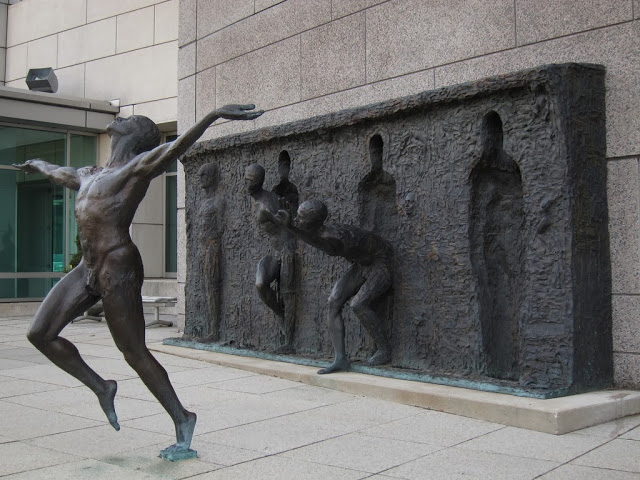
Freedom by Zenos Frudakis in Philiadelphia, Pennsylvania

Jesus said, “When an evil spirit comes out of a person, it travels through dry places looking for a place to rest, but it finds none. So, it says, ‘I will go back to the home I left.’ When it comes back, it finds that home still empty. It is all neat and clean. Then the evil spirit goes out and brings seven other spirits more evil than itself. They all go and live there, and that person has even more trouble than before. It is the same way with the evil people who live today.” (ERV) 

Nature abhors a vacuum. A tilled plot of soil will be overtaken with weeds if nothing is planted and nurtured in the turned-over dirt. The pecking order of a brood of chickens cannot handle the death of the top hen without filling the position almost immediately. And, in the spiritual realm, the exorcising of a demon will not simply leave a person empty of evil – his/her life will be filled with something in its place. 

Today’s Gospel story, told by Jesus, about the man who is delivered from an unclean spirit, is a powerful and simple narrative on the necessity of true repentance. Genuine freedom is more than getting rid of something bad and destructive; the evil must be replaced with something good and useful. That is, biblical repentance is both a turning away from ungodliness and an embrace of righteousness.

We are delivered from evil so that we can start living into the righteousness and peace intended for us. 

For example, the Apostle Paul exhorted the Ephesian believers to not only stop stealing but also to get a job and start sharing with others. They were not only to stop lying and using their tongues for gossip and slander and start using their words to speak truth that builds up others. (Ephesians 4:25-32) 

The spiritual principle is the same as the nature principle: A empty vacuum will always be filled. The man who did not fill his life with God ended up having a problem with evil seven times greater than when he started. 

If anything, or anyone, is emptied of its unhealthy elements and practices, it is imperative that the hole be immediately filled with healthy disciplines for life. 

Whether dealing with addictions, bad habits, or any kind of evil influence, a two-pronged approach is needed for its eradication. We expel the evil by replacing it with godliness. The man struggling with pornography or adultery must not only stop the behavior but take up the mantle of being a champion for women’s issues. The woman who has no healthy boundaries and allows herself to be used and abused must not only separate from the problem or person but adopt her identity in Christ as a precious child of God and enforce righteous limitations.   

None of these examples are meant to be simplistic answers to complex situations. Rather, they illustrate why so many people do not experience freedom and continue to have even greater enslavement to their passions and sufferings. 

Freedom is realized through replacing old practices with new disciplines that directly attack the old. 

We all have needs. How we get those needs met is often a mixed bag of both legitimate and illegitimate ways. In a perfect world, everyone would be aware of their needs and be able to express them to one another without shame, anxiety, or anger. Since we live on a blemished fallen planet, we end up trying to meet our needs indirectly through hustling for love, hoarding resources, and controlling others – all harmful ways which destroys souls and relationships. 

So, unless we focus on positively meeting our needs, we must go a step beyond dropping a toxic relationship, cutting up a credit card, or saying “no” to another responsibility. We often get into our mess to begin with because we are out of touch with ourselves and our needs. We need affection and encouragement, and there is no shame in needing this. We need security and safety, and there is no problem in acquiring this. There are some things we need to control, and that is okay. 

If we fail to address our needs, we might do the necessary work of deliverance, then turn right around and become worse off than before by filling the empty place of our lives with:  

  • Being all things to all people, as if we were the Messiah.  
  • Being successful so that we stay ahead of being needy.  
  • Pulling inside ourselves and trusting nobody.  
  • Distancing from our needs and pretending they are not there.  
  • Being continually vigilant so that we are never hurt that way again.  
  • Keeping a positive spin on everything, as if there is no negative stuff in the world.  
  • Challenging other’s opinions and behaviors to keep the focus off our needs.  
  • Becoming a wallflower so that we can never be the brunt of someone else’s vitriol or evil. 

Instead, we can let Jesus fill the emptiness with love, purpose, peace, joy, attention, and grace. Christ is the Savior who delivers us from evil, and the Holy Spirit is the Sanctifier who carefully applies the work of salvation to our lives.

When our hearts and minds are full of God, there is no place for the demons to get in. 

True repentance equally forsakes evil and embraces righteousness; replaces the unhealthy with the healthy; jettisons the illegitimate and seeks the legitimate; and puts away unnecessary suffering and pursues peace and joy in the Spirit.  

O God, I no longer want to live with saying I’m sorry and going right back to the old pig slop of sin. I cannot change on my own.  I need Jesus to both take away the sin and give me a new life of living for him.  Lead me not into temptation but deliver me from evil Help me to make choices that put to death the old way of life, and the courage to live into my forgiveness in the power of the Holy Spirit. Amen.