
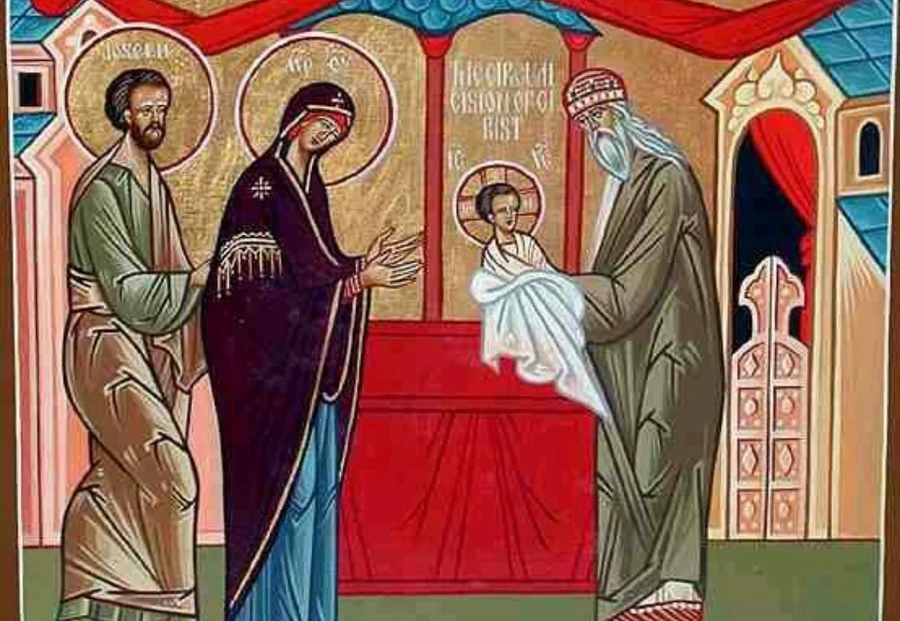
The Holy Name of Jesus (Luke 2:15-21)

Orthodox depiction of the circumcision and naming of Jesus

When the angels had left them and gone into heaven, the shepherds said to one another, “Let us go now to Bethlehem and see this thing that has taken place, which the Lord has made known to us.” So they went with haste and found Mary and Joseph and the child lying in the manger. When they saw this, they made known what had been told them about this child, and all who heard it were amazed at what the shepherds told them, and Mary treasured all these words and pondered them in her heart. The shepherds returned, glorifying and praising God for all they had heard and seen, just as it had been told them.

When the eighth day came, it was time to circumcise the child, and he was called Jesus, the name given by the angel before he was conceived in the womb. (New Revised Standard Version)

“The Holy Name of Jesus” is a celebration, observed by some Christian traditions, each year on January 1 – which is the eighth day after the birth of Jesus, when he was named and circumcised at the temple in Jerusalem.

An angel of the Lord appeared to him in a dream and said, “Joseph, son of David, do not be afraid to take Mary as your wife, for the child conceived in her is from the Holy Spirit. She will bear a son, and you are to name him Jesus, for he will save his people from their sins.” (Matthew 1:20-21, NRSV)

In the Law of Moses, all male infants are to be circumcised on the eighth day after their birth (Leviticus 12:3). Throughout most of the history of the Christian Church, January 1 has been celebrated as a feast day devoted to the naming of Jesus.

The name “Jesus” comes from the Hebrew Yeshuah (Joshua) which means “Yahweh will save.” It is a name fitting for the person and work of Christ.

Therefore God exalted him even more highly
    and gave him the name
    that is above every other name,
so that at the name given to Jesus
    every knee should bend,
    in heaven and on earth and under the earth,
and every tongue should confess
    that Jesus Christ is Lord,
    to the glory of God the Father. (Philippians 2:9-11, NRSV)

Faith is always followed by obedience. So, the faith of Joseph and Mary in believing the words of the angel Gabriel, translated into the obedient naming of their son as “Jesus.” (Luke 1:31-32)

Jesus, bearing the name of savior, is holy in every way. Not only does the name of Jesus point to his divinity – because of his miraculous conception by the Holy Spirit – but it also directs us toward the special mission for which he entered this world.

Jesus Christ, the Son of God, and Son of Humanity, is God’s agent of deliverance for both Israel and the whole world.

“Do not be afraid, for see, I am bringing you good news of great joy for all the people: to you is born this day in the city of David a Savior, who is the Messiah, the Lord….” (Luke 2:10-11, NRSV)

The Gospel writer Luke provides us with a birth narrative “pregnant” with theological information and importance:

  • Jesus has divine sonship, and possesses the status of king (Luke 1:31-35)
  • Jesus comes from the city of David, which is Bethlehem, not Jerusalem (Luke 2:4, 11)
  • Jesus is described by the angel Gabriel as Son of the Most High, Son of God, Savior, Messiah, and Lord; each of these titles direct us to his identity and mission (Luke 1:32, 35; 2:11)

I like the collective response of the shepherds, after they received heavenly good news from a group of angels.

They could have dismissed the entire thing as having drunk too much brandy on a brisk winter night. They could have kept the whole affair to themselves, reasoning that nobody would believe a bunch of stinky shepherds.

Instead, much like Mary who hurried off to Elizabeth after receiving the angelic message, the shepherds dropped everything to go and see the feeding trough with a newborn baby wrapped in swaddling cloth.

In other words, the shepherds belief in what they heard and experienced, quickly translated into action. It was only appropriate that it was shepherds who discovered the newborn king, the Son of David, himself a shepherd who was anointed by God.

The shepherds went and followed the signs given to them by the angel. And they believed. A motley group of shepherds returned to their fields, kicking up their heels, praising and glorifying God. They knew that things would never be the same again.

The name of Jesus is holy, simply because the Lord Jesus Christ is the Holy One. Christians recognize Jesus as Savior, the fulfillment of all God’s promises. His singular birth, life, death, resurrection, and ascension is exactly, I believe, what this old fallen world is most in need of.

It is never too late to resolve knowing Jesus. At the beginning of this year, there is perhaps no better resolution to make, again and again, of knowing Jesus Christ and honoring his holy name.

Eternal Father, you gave to your incarnate Son the holy name of Jesus to be the sign of our salvation. Plant in our hearts the love of Jesus, truly God and truly human, and grant that we may praise and bless your Holy Name with our whole mind, heart, body, and spirit, that we may know your boundless compassion and mercy. In Christ’s name, we pray. Amen.

Jesus Prays For Us (John 17:6-19)

Word of Life, by Millard Sheets

“I have made your name known to those whom you gave me from the world. They were yours, and you gave them to me, and they have kept your word. Now they know that everything you have given me is from you, for the words that you gave to me I have given to them, and they have received them and know in truth that I came from you, and they have believed that you sent me.

I am asking on their behalf; I am not asking on behalf of the world but on behalf of those whom you gave me, because they are yours. All mine are yours, and yours are mine, and I have been glorified in them. And now I am no longer in the world, but they are in the world, and I am coming to you.

“Holy Father, protect them in your name that you have given me, so that they may be one, as we are one. While I was with them, I protected them in your name that you have given me. I guarded them, and not one of them was lost except the one destined to be lost, so that the scripture might be fulfilled. 

But now I am coming to you, and I speak these things in the world so that they may have my joy made complete in themselves. I have given them your word, and the world has hated them because they do not belong to the world, just as I do not belong to the world. 

“I am not asking you to take them out of the world, but I ask you to protect them from the evil one. They do not belong to the world, just as I do not belong to the world. Sanctify them in the truth; your word is truth. As you have sent me into the world, so I have sent them into the world. And for their sakes I sanctify myself, so that they also may be sanctified in truth. (New Revised Standard Version)

It seems to me only fitting that Jesus concluded his time with the disciples in the Upper Room before his betrayal, crucifixion, and death with prayer. It also seems to me that if you really want to know the heart of a person, listen to them pray.

The prayer of Jesus was thoroughly oriented toward the spiritual needs of his followers – even potential believers who will follow him in the future. And it was a prayer completely devoted toward honoring the heavenly Father through praying consistent with God’s will for this world.

Without the physical presence of Jesus – which would soon be gone – his followers would have to rely on prayer. And Christ was intent on instilling within his disciples the confidence and hope they needed for a solid life of prayer.

For post-resurrection Christians living in an ever-expanding world of oppression, greed, and indifference, we can be encouraged not to settle into despair or loneliness. Why? Because believers can have a solid hope and an abiding trust in the continuing presence of Jesus by means of the Holy Spirit.

God Gives

God gives. Jesus gives. Both the Father and the Son are givers. This is a major reason and motivation for prayer because God is not a reluctant giver. In the act of giving, the Father and the Son are fully on the same page; God is ready and willing to give. The Holy Trinity – Father, Son, and Spirit – are in complete unity, and act as One, in giving to us what we need.

“Those who drink of the water that I will give them will never be thirsty. The water that I will give will become in them a spring of water gushing up to eternal life.” (John 4:14, NRSV)

“Do not work for the food that perishes but for the food that endures for eternal life, which the Son of Man will give you.” (John 6:27, NRSV)

“I give them eternal life, and they will never perish. No one will snatch them out of my hand.” (John 10:28, NRSV)

We Belong

Through giving we are included. Believers and followers of Jesus – having been given the grace of faith – know that they belong to God. Christians are in union with Christ. The redemption which Jesus has secured is a million billion times stronger, and bonds us closer, than any sort of Gorilla glue. And, what’s more, once we belong, we are never forgotten, but always remembered by God.

“The Father knows me, and I know the Father. And I lay down my life for the sheep. I have other sheep that do not belong to this fold. I must bring them also, and they will listen to my voice. So there will be one flock, one shepherd.” (John 10:15-16, NRSV)

Christ the King, statue in Swiebodzin, Poland

The Name of Jesus

Because we belong, we know God’s name. The divine name stands for all that God is and all that God has done. It’s all focused in Christ. In the name of Jesus, through the person and work of Jesus Christ, we have everlasting life, spiritual power, and eternal security.

Now Jesus did many other signs in the presence of his disciples that are not written in this book. But these are written so that you may continue to believe that Jesus is the Messiah, the Son of God, and that through believing you may have life in his name. (John 20:30-31, NRSV)

We Have the Word

The Word became flesh and dwelt among us (John 1:14). Jesus has given to his disciples only those words which he first received from the Father. Those who accept the enfleshed Word and his words have been given power to become God’s children (John 1:12). Because believers belong to God, they know the truth and that truth has set them free.

It is the Christian’s mission to live into the words and ways of Jesus, to follow Christ in thought, word, and deed. The very glory of Jesus in his cross and resurrection is focused within the believing community, who is in union with Christ and belongs to God.

In his prayer, Jesus claimed an intimate oneness in the sharing of concern for people who are the objects of the Father’s gracious giving of love through the Son. All who belong to Christ belong to God, and vice versa. All the love that went into the cross was poured out upon us.

Those who believe in the name of Jesus Christ are the very glory of Jesus, and thus, the glory of God.

Sent Into the World

Because of the Father’s name—because of who the Father is and what the Father has given in love to the Son—we are set apart for truth; the words of God are truth.

Since we belong to God and bear the name of Christ, we don’t belong to the world’s systems of guilt, shame, injustice, and evil. And yet, we are separated from the world for precisely the reason of immersing ourselves in the world. In other words, Christianity is meant for the life of the world, and not as a religion that’s only concerned for itself.

To reach the world, we must be different from it. To reach the world, we need to have boots-on-the-ground in it. To reach the world, Christians are to be both far from the world, and near to the world.

As the Father sent the Son, so the Son sends us into the world – not to be like the world, but to embody the words and ways of Jesus to and for the world.

Just as the world rejected Jesus in his suffering and death, so the world, too, will reject his followers. Which means we will need to pray, a lot! And there is no better scriptural prayer to emulate than the very words of the Lord Jesus, who loved us and gave himself for us.

Holy Father, guard our hearts and minds in Jesus, as we pursue this Christian life which you gave as a gift through Christ, so that we can be united, just as the Father and the Son are one. Although we long for heaven, don’t take us out of the world until we have fulfilled our sacred mission to carry the words and ways of our Lord to the world. Make us holy, and give us everything we need for life in this present evil age; through Jesus Christ your Son, our Lord, who with you and the Holy Spirit are one God, now and forever. Amen.

The Power of a Name

jesus and mary magdalene

It is more than ironic that one of the most powerful emotions on the planet is a feeling that is simply overlooked and often not recognized: the sense of being forgotten.  I’m not talking about rejection, but just being looked past by another, neglected, or an afterthought.  The sense that you are on no one’s radar can be more than disappointing – it can be devastating and destructive.  Yet, there is a way in which you and I can push back on this reality for the benefit of others and ourselves.  And on the other side of it, there is immense joy and satisfaction.

Notice that I didn’t mention the feeling of rejection along with the sense of being forgotten.  Rejection is certainly something you don’t like to experience.  It’s not a pleasurable emotion.  But it isn’t the same as being overlooked.  At least with getting a repudiating brush-off you are acknowledged by another.  That is, someone noticed you enough to even give a rebuff your way.  But with being neglected and forgotten, there is nothing.  If you have ever gotten the silent treatment from a parent, a co-worker, or a parishioner, then you likely know that getting any kind of words, even harsh ones, can seem better than being ignored altogether.

Sometimes neglect is a life and death issue.  There was an occasion when Greek-speaking widows in the book of Acts were overlooked.  They were not given their share when the food supplies were handed out each day (Acts 6:1).  When this came to the Apostles attention, it was a serious enough situation to warrant a major overhaul to the ministry system.  Deacons were formed, roles were clarified, and a group of women received much needed food.  In our society today, elder abuse is real.  Sometimes we might forget (again with the irony) that leaving senior citizens alone and ignoring them is also a potent form of abuse.

Then, there is the situation of Mary Magdalene.  She had a “past.”  This Mary was immoral and influenced by the darkness (Mark 16:9; Luke 8:2).  She was only a nameless person to be used for the benefit of others.  Then, she met Jesus and her world changed.  The darkness turned to light.  Jesus treated her like no other before.  Mary was as much a follower, maybe even more, than the twelve disciples.  It was she who poured the expensive perfume on Christ’s feet and applied it with her hair and her tears (John 12:1-8).  If there was anyone who loved Jesus, it was Mary.

So, you can imagine Mary’s grief when she saw her Lord tortured, crucified, and dead.  The one person on earth who looked at Mary and saw something more than an immoral woman, who looked beyond the infiltration of demonic influence and observed a woman who needed to be seen and truly loved was now gone.  But the story doesn’t end there….

“Mary stood outside near the tomb, crying. As she cried, she bent down to look into the tomb. She saw two angels dressed in white, seated where the body of Jesus had been, one at the head and one at the foot.  The angels asked her, ‘Woman, why are you crying?’  She replied, “They have taken away my Lord, and I don’t know where they’ve put him.” As soon as she had said this, she turned around and saw Jesus standing there, but she didn’t know it was Jesus.  Jesus said to her, ‘Woman, why are you crying? Who are you looking for?’ Thinking he was the gardener, she replied, ‘Sir, if you have carried him away, tell me where you have put him, and I will get him.’  Jesus said to her, ‘Mary.’ She turned and said to him in Aramaic, ‘Rabboni’ (which means Teacher).  Jesus said to her, ‘Don’t hold on to me, for I haven’t yet gone up to my Father. Go to my brothers and sisters and tell them, ‘I’m going up to my Father and your Father, to my God and your God.’”  Mary Magdalene left and announced to the disciples, ‘I’ve seen the Lord.’ Then she told them what he said to her.” (John 20:11-18, CEB)

Take note of how Jesus dealt with Mary.  He asked her two questions: “Woman, why are you crying?” and “Who are you looking for?”  Jesus didn’t ignore Mary.  He didn’t immediately get on with the business of prepping for ascension and overlook her grief.  Jesus also didn’t talk down to Mary.  By asking questions, our Lord entered her grief and was present to Mary in her sheer lament over not knowing where Jesus was.  What Jesus did instead is, I believe, one of the most powerful things which can happen and is clearly the antidote to all feelings of being overlooked, forgotten, and neglected.  Jesus said one word: “Mary.” He said her name.

Nameless people are forgotten people.  But those with names are real.  Saying someone’s name acknowledges, recognizes, and even validates another person.  That’s why when we are upset and mad at someone, we often don’t like to say their name.  Instead, they get referred to with some other moniker such as “his mother” or “that pastor” or “some guy.”  But when we use a name, it opens to us all a realm of grace, love, and compassion.  It’s easy to ignore another if they have no name.  Knowing a name and using it is the secret superpower which is available to everyone.  Even those without academic degrees and special training have ability to change the world with only the knowledge of one word: a person’s name.

Mary’s immense grief was turned upside-down in a moment to exuberant joy – through the power of her name being spoken by the Lord who cared enough to say it.

Jesus knows your name.  What’s more, he is pleased to say it.  Even now, Jesus sits at the right hand of his Father in heaven interceding for you by using your name.

If there is a skill which is worth developing, it is the ability to know people’s names and to say them.  Sometimes folks remark to me that they can’t believe my memory with names.  Um, not so much.  My memory is not really very good anymore.  It’s just that, if I want to know someone’s name I use it as often as I possibly can without sounding weird about it.  Repetition sinks it into my pea brain, not intelligence or some gift.

Which gets us back to the feeling of being forgotten, unnoticed, and/or ignored.  Acknowledging a person through using their name shoos away those negative feelings for others as well as helps give us connection with others.  In other words, it’s more than good sense to use people’s names – it is the very stuff of healthy relationships.  Relations don’t sour because of differences; they go south when we stop using given names.

Those who care don’t have a special caring gene.  They just know the power of a name.  And it matters to them to liberally validate others with the grace which comes with knowing and using another’s name.  And speaking of names, the Scriptures tell us that there is only one “Name” under heaven by which we are saved: The Name of Jesus (Acts 4:12).  There is such power in naming, that it is truly a life and death affair.  In the name of Jesus Christ there is no overlooking, no neglect, no being forgotten.  With Jesus, there is connection, relationship, attention, and remembrance.