Keep the Rule of Law (Numbers 17:1-11)

The Lord said to Moses, “Speak to the Israelites and get twelve staffs from them, one from the leader of each of their ancestral tribes. Write the name of each man on his staff. On the staff of Levi write Aaron’s name, for there must be one staff for the head of each ancestral tribe. Place them in the tent of meeting in front of the ark of the covenant law, where I meet with you. The staff belonging to the man I choose will sprout, and I will rid myself of this constant grumbling against you by the Israelites.”

So Moses spoke to the Israelites, and their leaders gave him twelve staffs, one for the leader of each of their ancestral tribes, and Aaron’s staff was among them. Moses placed the staffs before the Lord in the tent of the covenant law.

The next day Moses entered the tent and saw that Aaron’s staff, which represented the tribe of Levi, had not only sprouted but had budded, blossomed and produced almonds. Then Moses brought out all the staffs from the Lord’s presence to all the Israelites. They looked at them, and each of the leaders took his own staff.

The Lord said to Moses, “Put back Aaron’s staff in front of the ark of the covenant law, to be kept as a sign to the rebellious. This will put an end to their grumbling against me, so that they will not die.” Moses did just as the Lord commanded him. (New International Version)

Issues of power – who has it, and who doesn’t, and how it is used – has been with us throughout all of human history.

And the issues of power are always tied to values, morals, and ethics. It ultimately comes down to who is truly in control, and whether that control is good or bad, moral or immoral, ethical or unethical.

One way of looking at the whole of the Bible is that it is a collection of books about power, control, and authority – mostly between God and humans, but also between one another as people.

If we fail to consider power issues, then a society will devolve into injustice, power inequities, and the few controlling the many.

In today’s Old Testament lesson, there were people questioning the authority system, and who had the power to act as a religious priest in the nation of Israel.

The covenant code, handed down from God to Moses on Mount Sinai, and then to the people, included only the tribe of Levi acting as priests. The other eleven tribes could not have a priestly class of people.

Specifically, only the Levite Aaron and his descendants could serve as a priest. And this structure did not sit well with some of the Levites from clans other than Aaron’s, as well as some of the other tribes.

Among all the tribes of Israel, the Lord chose the tribe of Levi. And among the Levites, Aaron is to alone be the priest, with his descendants serving after him in history.

A lot of grumbling in the tents of the Israelite tribes was happening. And God heard all the murmurings under their breath.

Therefore, God instructed each tribe to bring the symbol of their tribal authority – the staff – to Moses. They were all left overnight before the Lord, in front of the altar in the tent of meeting.

In the morning, the Levite’s staff with Aaron’s name alone engraved on it, was the only one that budded and sprouted almonds – all in a single night.

God was clarifying that Aaron was the divine choice as priest in Israel. The staff was then stored and kept as a continual reminder that when the Lord makes a choice, that is exactly what is going to happen.

The purpose of displaying the tribal staffs was to stop the incessant complaining of people about the Levites, and Aaron in particular, holding the power and authority of handling and officiating the sacrificial system in Israel.

Only Aaron could approach the tabernacle of God – and only then with detailed prescriptions of how to do it – and anyone else who would try to act as only a priest could, would die. The authority structure was that serious in Israel.

Nobody gets to do whatever the heck they want to do, when it comes to authority structures and systems of power. The rule of law is important; it’s serious business.

God bestowed an honorable privilege and responsibility on the family of Aaron. In doing so, their work, worship, and ministry was meant to contribute to the public welfare of all Israelite families.

And that is the case for all of us, when it comes to possessing any sort of authority. An authoritative position is never meant for personal use, but to be a public service for the good of everyone in the community, and in the leader’s constituency.

I suppose there will always be persons who arrogantly believe they ought to be in charge, or in some position of authority in order to wield power. They will, unfortunately, rarely examine their motives for wanting power; or consult wise persons who could help direct them.

If one has been elected – either by the people in a lawful election, or by God in a divine decree – then to murmur and grumble about that person who was chosen comes from a dark place in the complainer’s heart.

An unwillingness to submit to the rule of law only brings harm to others, and eventually to oneself. And it raises the ire of God.

Through the covenant law handed down to the Israelites, God intended to provide human justice, protect human rights, promote a good and just society, establish a fair economy, curb human sin and corruption, and bring peace and security to all the tribes of Israel.

If the power structure is unjust through an abusive individual, that’s another thing altogether. But if a good rule of law is in place, and appropriate people are serving the community, then it is our place and our duty to be properly submissive, obedient, and supportive.

It’s a question of being helpful or harmful to what is going on. And we always have a choice about how we are going to respond.

So, how will you use your own personal agency?

Almighty God, save us from violence, discord, and confusion; from pride and arrogance, and from every evil way. Defend our liberties, and make us one united people who are mindful of the rule of law.

Give the spirit of wisdom to those in the authority of government, so that there may be justice and peace at home, and that, through obedience to your law, we may show forth your praise among the nations of the earth.

In the time of prosperity, fill our hearts with thankfulness, and in the day of trouble, suffer not our trust in you to fail. Amen. 

Divine Goodness, Despite Human Ingratitude (Psalm 78:23-29)

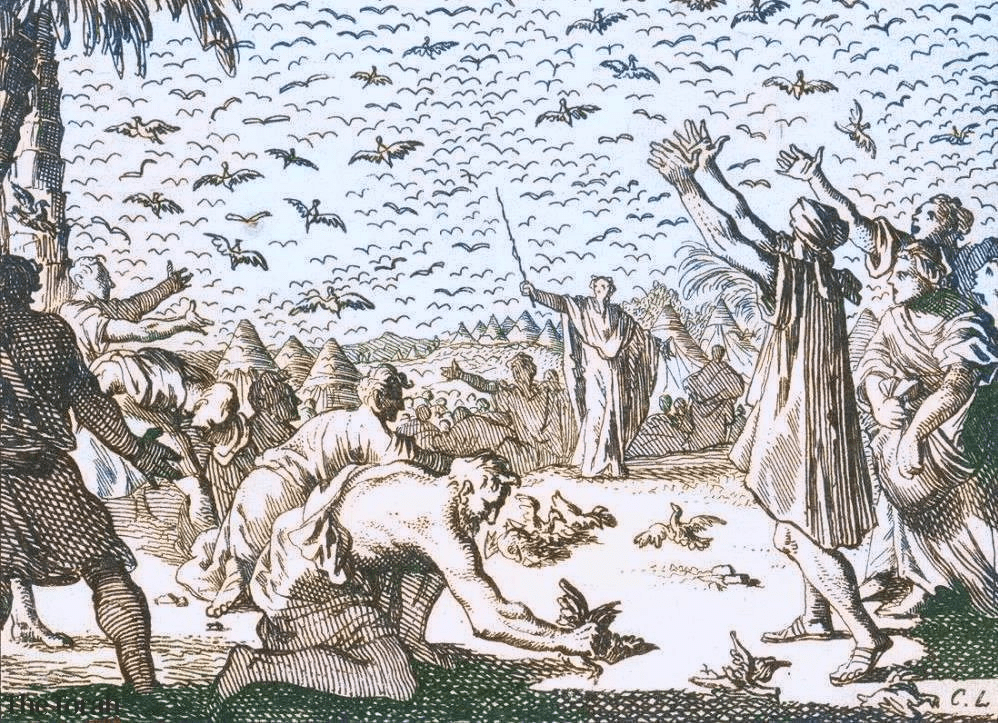
Quail in the Wilderness, by Caspar Luyken, 1698

Yet he commanded the skies above
    and opened the doors of heaven;
he rained down on them manna to eat
    and gave them the grain of heaven.
Mortals ate of the bread of angels;
    he sent them food in abundance.
He caused the east wind to blow in the heavens,
    and by his power he led out the south wind;
he rained flesh upon them like dust,
    winged birds like the sand of the seas;
he let them fall within their camp,
    all around their dwellings.
And they ate and were well filled,
    for he gave them what they craved. (New Revised Standard Version)

Today’s psalm is the second longest in the psalter (72 verses, with Psalm 119 the longest at a hefty 176 verses). Along with Psalms 105-106, Psalm 78 remembers and rehearses the history of Israel. This is a psalm which is meant for teaching and passing on important lessons.

The upshot of this psalm’s historical recollection is that the people’s ancestors were faithless; therefore, those reading the psalm now should live differently in a positive life of goodness, having observed how the past actors serve as a negative example of ingrates.

The psalmist, Asaph, viewed past events as highly informative for present circumstances. His purpose for crafting the psalm was explicit. He wanted the people:

 to put their hope in God—
        never forgetting God’s deeds,
        but keeping God’s commandments—
    and so that they won’t become like their ancestors:
    a rebellious, stubborn generation,
        a generation whose heart wasn’t set firm
        and whose spirit wasn’t faithful to God. (Psalm 78:7-8, CEB)

The verses for today’s lectionary reading have a unique place within the psalmist’s rehearsal of the past. They connect to the previous section (verses 9-22) which recounts the Lord’s angry response concerning Israel’s unbelief and rebellion.

In many ways, Psalm 78 has a consistent theme of human stubbornness, lack of faith, and wanting to do their own thing apart from God. Bucking God’s covenant code and moral law was ever-present in Israel’s history. And yet…

The Lord remained the same: Faithful and true. Furthermore, God stubbornly showed steadfast divine love and covenant loyalty to the people, despite their herky-jerky commitment and fickle faith.

Manna from heaven

Although the theme of human failure runs throughout the psalm, the dominant idea points to God’s gracious mercy, eternal faithfulness, and steadfast love. Most of all, the psalmist wanted his readers to remember the goodness and grace of God.

The people’s unbelief in no way stymied the promises of God. That’s because salvation and deliverance, faith and hope, do not originate and are not sustained by humans, but by the Lord God almighty who created heaven and earth.

Even though the people were faithless, and thus, had no trust in God’s power; nevertheless, the Lord opened the doors of heaven in order to meet the needs of people who did not deserve divine help.

The verses for today remember the story of God’s provision of manna and quail in the desert (Exodus 16). The Lord was gracious, merciful, and kind to the Israelites, despite their incessant grumbling. God responded to them because of their sheer need, and not because of any righteousness coming from them.

God not only provided food, but gave the manna in abundance, and the quail in superabundance. The contrast could not be any more glaring: Israel murmured, grumbled, complained, and demonstrated a lack of faith; God granted the Israelites a ridiculous amount of food, and evidenced steadfast faithfulness to the covenant.

The supreme goodness of God brings out, in stark relief, the incredible foolishness of Israel’s attitude. In the Exodus account, while the meat was still in their mouths, God’s anger flared because of the people’s recalcitrance.

On the surface, the divine response of judgment may appear out of sorts to the divine grace shown to Israel. Yet, the Lord cares about the holistic needs of people, and not only in giving sustenance.

God wants faithful and obedient people. The Lord desires goodness, righteousness, and justice to be the hallmark of the community.

To have your belly full and your spirit empty is an affront to God – because the Lord is good, right, and just, and does not tolerate impertinence, impudence, and impetuousness. Vice and ingratitude only makes a person an imbecile who is worthless to their fellow humanity.

Divine punishment – anywhere you find it in Holy Scripture – is meant to draw people back into relationship with God. Another way of phrasing this, is that God delivers people and grants them freedom, so that they will have no obstacles toward living a good, right, and just life.

No matter the response of God – whether it is by miraculous provision or by divine punishment – it’s always a response of grace; the Lord consistently acts from a place of compassion and commitment to doing what is best for the community.

Whereas the Israelites repeatedly cycled themselves through spirals of faith and unbelief, gratitude and grumbling, obedience and disobedience; God, however, constantly demonstrated the presence of grace and mercy, righteousness and justice, holiness and love.

The only reason the Israelites (and the entire human race, for that matter) are not wiped out is because God forgave their iniquity and did not destroy them. What’s more, the Lord didn’t even let them destroy themselves, unwittingly by their own unawareness and foolishness. (Psalm 78:36-39)

I am profoundly glad that God is the bigger person in the relationship with humanity. The Lord is continually mindful of who we are, as well as God’s own divine essence and power.

Yet he, being compassionate,
    forgave their iniquity
    and did not destroy them;
often he restrained his anger
    and did not stir up all his wrath.
He remembered that they were but flesh,
    a wind that passes and does not come again. (Psalm 78:38-39, NRSV)

As people created in the image and likeness of God, we find our highest joy and greatest fulfillment in receiving the good things from God with gratitude; and of giving goodness to others in a spirit of love – no matter what.

Gracious and almighty God: Open wide the eyes of my soul that I may see the good in all things. Grant me today a new vision of your truth. Inspire me with the spirit of joy and gladness. Make me a cup of strength to suffering souls. Amen.

The Problem with Complaining (Exodus 15:22-27)

Then Moses led the people of Israel away from the Red Sea, and they moved out into the desert of Shur. They traveled in this desert for three days without finding any water. When they came to the oasis of Marah, the water was too bitter to drink. So they called the place Marah (which means “bitter”).

Then the people complained and turned against Moses. “What are we going to drink?” they demanded. So Moses cried out to the Lord for help, and the Lord showed him a piece of wood. Moses threw it into the water, and this made the water good to drink.

It was there at Marah that the Lord set before them the following decree as a standard to test their faithfulness to him. He said, “If you will listen carefully to the voice of the Lord your God and do what is right in his sight, obeying his commands and keeping all his decrees, then I will not make you suffer any of the diseases I sent on the Egyptians; for I am the Lord who heals you.”

After leaving Marah, the Israelites traveled on to the oasis of Elim, where they found twelve springs and seventy palm trees. They camped there beside the water. (New Living Translation)

I like children’s books. I suppose it’s because I’m still a kid at heart. It’s fun to read to my grandkids. One of the books I read to them is “Alexander and the Terrible, Horrible, No Good, Very Bad Day.” The book begins with Alexander recounting when he awoke one morning:

“I went to sleep with gum in my mouth and now there’s gum in my hair and when I got out of bed this morning, I tripped on the skateboard and by mistake I dropped my sweater in the sink while the water was running and I could tell it was going to be a terrible, horrible, no good, very bad day…. I think I’ll move to Australia.”

Alexander and the Terrible, Horrible, No Good, Very Bad Day, by Judith Viorst

For the remainder of the story, Alexander’s day was a mishap of messes. Nothing seemed to go his way, and no one appeared to notice or even to care.

One of the reasons the book has been read so many times by so many children (and obviously adults, like me) is because we can all relate to the feelings of having a day where nothing seems to go right. In the middle of it we just feel like being somewhere else, like Australia.

In such times, when life is topsy-turvy and upside-down, it is so amazingly easy to grumble and complain. The ancient Israelites were having an Alexander-like day. Unlike having gum in your hair, not having water to drink is a big deal, a vital problem. So, we might understand why there was so much grumbling going on among the people. I am sure they were anxious, nervous, and scared.

Yet, complaining, unlike our emotions, is a volitional response. We choose to grumble. The problem with gripes and complaints is that it sets a person down a dark path. Oh, the criticisms and grievances begin easily and are seemingly harmless, at first. They are, however, anything but innocuous.

A mere grumble under the breath did not stop with finally getting water to drink. If we look ahead in the story of God’s people in the exodus event, the moaning and complaining quickly returned the minute something did not go their way. Then, the people became so disillusioned with their circumstances that they began longing for the “good old days” back in Egypt when they had plenty to eat and drink, forgetting about their cruel bondage in slavery. (Exodus 16:1-3)

The psychological progression continued with beginning to blame their situation on God, as if he were some mean malevolent deity. From that point, it was inevitable that the people would disobey God and eventually succumb to the idolatry of the golden calf. (Exodus 32:1-8)

Despite the grand celebration of leaving Egypt and experiencing a miraculous deliverance through the Red Sea, the people quickly forgot because of their present circumstance of lacking water. It is only logical and makes sense that the mighty God who saved them with incredible acts of power would care for the people in a desert. Yet, for many, there was no faith to be found in a new situation they had not faced before.

Failure of faith begins neither with ignorance nor an egregious sin. It begins with grumbling and complaining. And if allowed to run amok, complaints will bear the fruit of discouragement, disobedience, and eventually a disavowal of God.

The author of the New Testament letter to the Hebrews reflected on the grumbling of their forebears and had this to say in response:

See to it, brothers and sisters, that none of you has a sinful, unbelieving heart that turns away from the living God. But encourage one another daily, as long as it is called “Today,” so that none of you may be hardened by sin’s deceitfulness. We have come to share in Christ, if indeed we hold our original conviction firmly to the very end. As has just been said:

“Today, if you hear his voice,
    do not harden your hearts
    as you did in the rebellion.” (Hebrews 3:12-15, NIV)

Encouragement is the insecticide which eliminates the worm of complaints. If left alone, we stew in our own bitterness over missed expectations. Grumbling bores its way into our soul and eats away at our faith. We need the continual encouragement of one another to remember our collective deliverance and express gratitude for our salvation.

May it be so to the glory of God.

We give you thanks, Lord God, because you give food and drink to all, heal all, create wonders in this world, forge wisdom within us, and give refuge beneath the shadow of your wings. From your wisdom grant us wisdom, from your love grant us love, from your understanding grant us understanding.

Feed us when we are hungry, give us strength when we are weak, raise us up when we are bent over, set us free when we are enslaved. Just as our spiritual ancestors were blessed – may you grant us the blessing of peace, strength, and gratitude. Amen.

Rejoice instead of Complain (Philippians 2:14-18, 3:1-4a)

Do everything without grumbling or arguing, so that you may become blameless and pure, “children of God without fault in a warped and crooked generation.” Then you will shine among them like stars in the sky as you hold firmly to the word of life. And then I will be able to boast on the day of Christ that I did not run or labor in vain. But even if I am being poured out like a drink offering on the sacrifice and service coming from your faith, I am glad and rejoice with all of you. So you too should be glad and rejoice with me…

Further, my brothers and sisters, rejoice in the Lord! It is no trouble for me to write the same things to you again, and it is a safeguard for you. Watch out for those dogs, those evildoers, those mutilators of the flesh. For it is we who are the circumcision, we who serve God by his Spirit, who boast in Christ Jesus, and who put no confidence in the flesh—though I myself have reasons for such confidence. (New International Version)

Here is a simple observation: Complaining and rejoicing cannot come out of the same mouth at the same time. The two of them mix about as well as toasters and bathtubs.

Everything is to be done without grumbling or arguing. Sheer willpower is insufficient for the task. Instead, you and I need to replace words of complaint with words of joy. Rejoicing is the antidote to murmuring. The world already has more than enough curmudgeons who crank on about everything from politics and religion to the weather and social media. Grumblers seem to always find the negative in just about everything.

Any fool can complain. It’s easy. Complaining takes little effort, and even less brains. Joy, however, takes some work. The sage person practices gratitude and joy so that it becomes the default response to most situations. We need a lot more folks with joy in this sad world.

Yesterday I visited a dear woman who was just diagnosed with cancer, and is expected to have only months to live. She had many tears, yet she also had lots of smiles. In fact, she was either crying or smiling most of the time. And her smile was genuine, not forced.

Whenever I encounter folks like this, who do not complain but rather rejoice, I ask them, “What gives you such joy in the midst of such sorrow?” This particular woman answered, “I have a simple faith. I trust God. I believe the Lord is good. I am blessed with many friends, a supportive family, and a God who loves me.” May her tribe increase.

On this same day, I visited another woman. She also had just been diagnosed with cancer and was facing a shortened lifespan. She yelled at the doctor and argued with the nurse, screamed at and quarreled with her family, and cried without any joy in my presence. Eventually, she left the hospital against medical advice because all she did was complain about everything and everyone.

Although I believe it is quite appropriate to have anger against disease, it’s inappropriate to rage against other people. The woman was miserable and had no smiles. I couldn’t help but see the incredible contrast between the two women in a single day of visits.

For all the talk we hear about how important it is to be positive, it is, unfortunately, negativity that sells, wins elections, and moves people. The irony of it all is that a large chunk of people continually grumbles, complains, and argues about all the negativity in the world. *Sigh*

Complaining and arguing are nasty practices; they breed disunity and division within groups and families. Murmuring only warps the ones who do it and infects others with spiritual disease.

Grumbling is always the first building block of a crooked and depraved generation. Conversely, being blameless and pure is winsomely attractive and unites folks together as a cohesive force for the world. Joy inoculates people from divisive pathogens. A people who rejoice together produce generations of individuals who impact their culture with delight and satisfaction.

Not even suffering and hard circumstances can curtail the comfort and cheer of the joyful. Rejoicing is a way of life – a path which no one and nothing can take away from us. Unwanted situations can be imposed on us, yet a person’s joy cannot be dislodged.

Eleanor Porter’s 1913 storybook character, Pollyanna, learned to take such a look upon life from her parents. Even after losing them to an accident and being orphaned, she honored their memory by saying, “… there is something about everything that you can be glad about, if you keep hunting long enough to find it.” Pollyanna went on to teach an entire community about her way of life:

“What people need is encouragement. Their natural resisting powers should be strengthened, not weakened…. Instead of always harping on a person’s faults, tell them of their virtues. Try to pull them out of their rut of bad habits. Hold up to them their better self, the real self that can dare and do and win out! … The influence of a beautiful, helpful, hopeful character is contagious, and may revolutionize a whole town…. People radiate what is in their minds and in their hearts. If a person feels kindly and obliging, their neighbors will feel that way, too. But if a person scolds and scowls and criticizes—their neighbors will return scowl for scowl and add interest! … When you look for the bad, expecting it, you will get it. When you know you will find the good—you will get that…”

Pollyanna, by Eleanor H. Porter, 1913

I wonder what our world would look like if we all took such an approach of finding joy in our lives. We are meant to guard ourselves from those who boast and brag, who belligerently bully others with their bellicose blustering and bellyaching.

We are designed by our Creator for better things. Joy is more than the spice of life; it is life itself. Moving mindfully and without rush through our days, setting aside times for contemplation and rest, offering gratitude to God and encouragement to others, and exploring our own heart’s desire are all ways we can tap into the large hidden reservoir of joy within each of us.

Complaining is cheap and easy. Joy is rich, full, satisfying, and takes practice to master. Rejoice in the Lord, take joy in the presence of the Spirit, and exult in Christ our Savior. In doing so, we shoo the devil away and create a better society.

God is good all the time. And all the time God is good.

O Lord, you have searched me out and known me; you know my sitting down and my rising up; you discern my thoughts from afar. You mark out my journeys and my resting place and are acquainted with all my ways. Lord of creation, whose glory is around and within us: Open our eyes to your wonders so that we may serve you with reverence and know your peace and joy in our lives, through Jesus Christ our Lord. Amen.