Deuteronomy 9:6-14 – Remember and Learn

Moses and the Masks by Israel Tsvaygenbaum, 2002

So, understand this: It’s not because you’ve been living right that the Lord your God is giving you this good land to possess. You are impossible to deal with!

Never forget how you made the Lord your God angry in the desert. You’ve rebelled against the Lord from the day you left Egypt until you came here. Even at Mount Horeb you made the Lord so angry that he wanted to destroy you. When I went up on the mountain to get the stone tablets, the tablets of the promise that the Lord made to you, I stayed on the mountain 40 days and 40 nights without food or water. Then the Lord gave me the two stone tablets inscribed by God himself. On them were written all the words that the Lord spoke to you from the fire on the mountain on the day of the assembly.

At the end of the 40 days and 40 nights, the Lord gave me the two stone tablets with his promise on them. He told me, “Leave right away. Your people whom you brought out of Egypt have ruined everything. They’ve quickly turned from the way I commanded them to live. They’ve made an idol for themselves.”

The Lord also said to me, “I’ve seen these people, and they are impossible to deal with. Leave me alone! I’ll destroy them and wipe their name off the earth. Then I’ll make you into a nation larger and stronger than they are.” (God’s Word Translation)

Significant things happen on mountains in the Bible. In the anticipation of Transfiguration Sunday, in which Christ’s glory is revealed on a mountain top, today’s Old Testament lesson reminds us of a great mountain event. And it was not all bunnies and butterflies. 

The book of Deuteronomy is a restatement of the Law. Moses recalled and recounted an oral history of Israel. They were about to enter the Promised Land, and Moses wanted the people to remember and never forget God’s saving actions and God’s Law. 

Forty years earlier, God graciously met with Moses on the mountain and gave him the Ten Words (Ten Commandments). However, the ugly truth was that, while Moses was with God on the mountain, the people became impatient, insolent, and rebellious. They degenerated into a chaotic mass riot who quickly worshiped an idol. Definitely not Israel’s best moment.

In restating Israel’s Law and history, Moses wanted the people to remember the Mount Sinai event in all of its foulness and degradation. It was important for them to not forget how stubborn and pig-headed their parents and grandparents were in running from the one true God to a false god. The people needed to avoid the sins of the previous generation so that they could enjoy God and thrive in the new land being given to them.

It does no one any good to whitewash the past or to altogether ignore it. 

Whether it is one’s personal past, a previous generation, or even a national history, we must face the sins of our forebears, to remember and not forget. We must neither be so extremely individualistic that we disconnect ourselves from our generational moorings, nor be dismissive of past sins – as if they have no influence upon us today. 

Mountain experiences can either be glorious, turn very dark, or a bit of both. We are meant to learn from them all, to remember and not forget.

Yet not all remembered. Which is why, over a millennium later, the New Testament issued it’s own remembrance and warning so that we will learn and not forget – contrasting the two mountains of Sinai and Zion:

Unlike your ancestors, you didn’t come to Mount Sinai—all that volcanic blaze and earthshaking rumble—to hear God speak. The earsplitting words and soul-shaking message terrified them, and they begged him to stop. When they heard the words— “If an animal touches the Mountain, it’s as good as dead”—they were afraid to move. Even Moses was terrified.

No, that’s not your experience at all. You’ve come to Mount Zion, the city where the living God resides. The invisible Jerusalem is populated by throngs of festive angels and Christian citizens. It is the city where God is Judge, with judgments that make us just. You’ve come to Jesus, who presents us with a new covenant, a fresh charter from God. He is the Mediator of this covenant. The murder of Jesus, unlike Abel’s—a homicide that cried out for vengeance—became a proclamation of grace.

So don’t turn a deaf ear to these gracious words. If those who ignored earthly warnings didn’t get away with it, what will happen to us if we turn our backs on heavenly warnings? His voice that time shook the earth to its foundations; this time—he’s told us this quite plainly—he’ll also rock the heavens: “One last shaking, from top to bottom, stem to stern.” The phrase “one last shaking” means a thorough housecleaning, getting rid of all the historical and religious junk so that the unshakable essentials stand clear and uncluttered.

Do you see what we’ve got? An unshakable kingdom! And do you see how thankful we must be? Not only thankful, but brimming with worship, deeply reverent before God. For God is not an indifferent bystander. He’s actively cleaning house, torching all that needs to burn, and he won’t quit until it’s all cleansed. God himself is Fire! (Hebrews 12:18-29, MSG)

The old adage from the late philosopher, George Santayana, stated in his 1905 book, The Life of Reason, is true: “Those who cannot remember the past are condemned to repeat it!”

Winston Churchill, restating the phrase for the British House of Commons in 1948 said, “Those who fail to learn from history are condemned to repeat it.”

Let us, then, ascend the mountain with Jesus and learn from him. And let us descend into the valley of the world remembering Christ’s words and ways for ourselves and for the next generations of believers.

God of history, your sovereign reign and rule extends to all creation and has existed for all time. You know the sins of my past, the heart of my present, and the soul of my future. Do not let me forget my sins, not because you hold them over my head, but because your grace has saved me from them all through Jesus Christ, my Savior. Amen.

Exodus 19:16-25 – An Awesome God

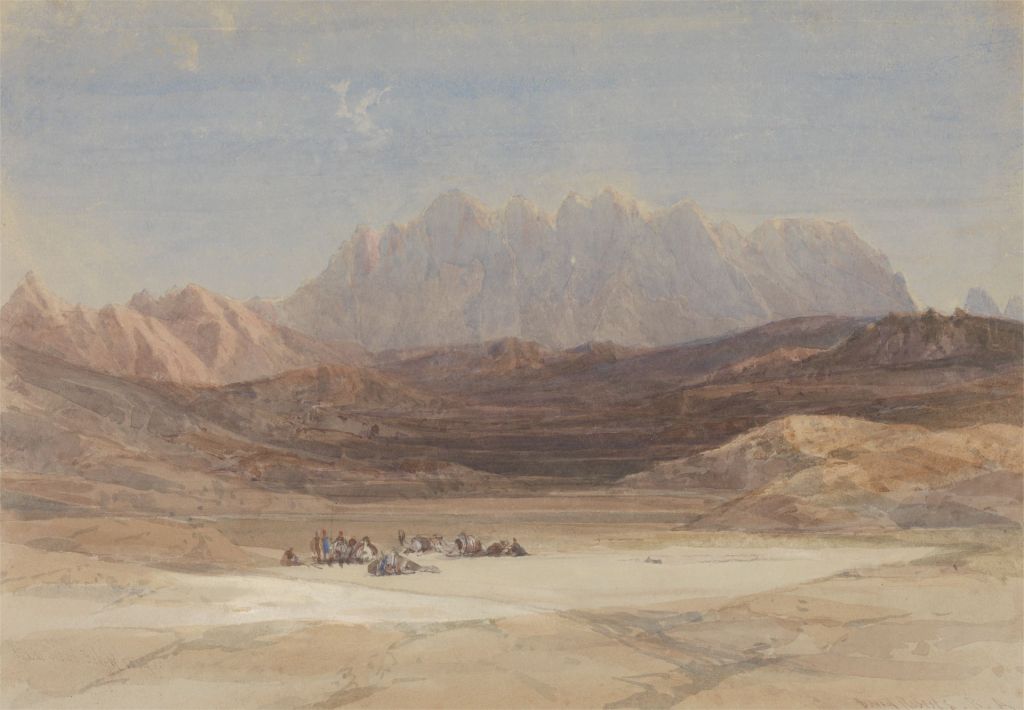
Mount Sinai by Scottish painter David Roberts (1796-1864)

On the morning of the third day, thunder roared, and lightning flashed, and a dense cloud came down on the mountain. There was a long, loud blast from a ram’s horn, and all the people trembled. Moses led them out from the camp to meet with God, and they stood at the foot of the mountain. All of Mount Sinai was covered with smoke because the Lord had descended on it in the form of fire. The smoke billowed into the sky like smoke from a brick kiln, and the whole mountain shook violently. As the blast of the ram’s horn grew louder and louder, Moses spoke, and God thundered his reply. The Lord came down on the top of Mount Sinai and called Moses to the top of the mountain. So, Moses climbed the mountain.

Then the Lord told Moses, “Go back down and warn the people not to break through the boundaries to see the Lord, or they will die. Even the priests who regularly come near to the Lord must purify themselves so that the Lord does not break out and destroy them.”

“But Lord,” Moses protested, “the people cannot come up to Mount Sinai. You already warned us. You told me, ‘Mark off a boundary all around the mountain to set it apart as holy.’”

But the Lord said, “Go down and bring Aaron back up with you. In the meantime, do not let the priests or the people break through to approach the Lord, or he will break out and destroy them.”

So, Moses went down to the people and told them what the Lord had said. (NLT)

As Christians await Easter and the resurrected Christ, the Revised Common Lectionary reminds us of another great anticipation from the Old Testament. The ancient Israelites were amazingly delivered from Egyptian slavery, miraculously walked through the Red Sea, and traveled with wondrous anticipation to Mount Sinai. Now, in today’s reading, they are about to meet with God!

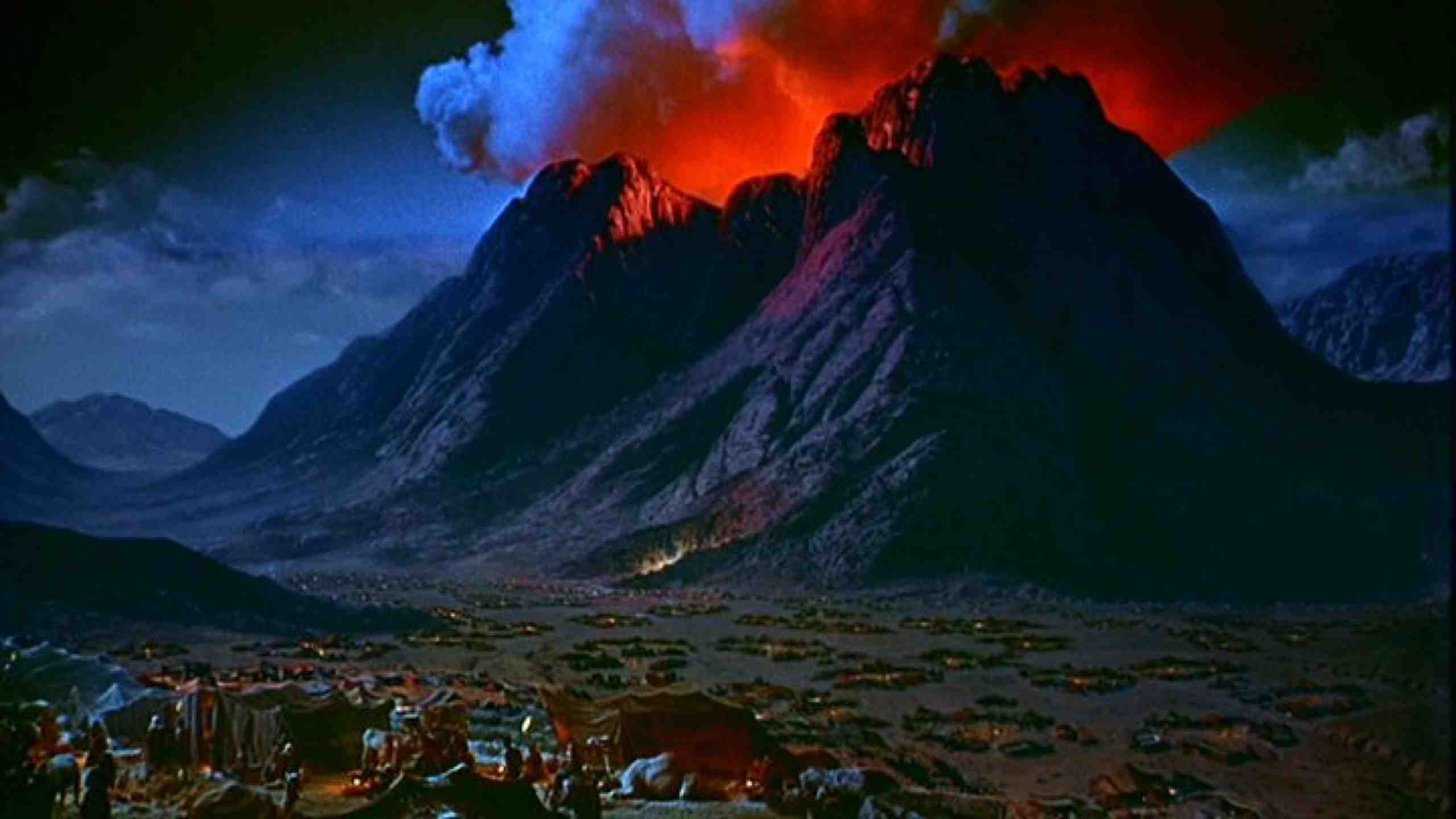
The scene of this meeting is not exactly the romantic highland encounter of the Man from Snowy River (my wife’s all-time favorite movie). The landscape is much more akin to the dark and volcanic Mount Doom from The Lord of the Rings. The picture appears more foreboding than loving. The thing about mountain top experiences is that they are not all monolithic one-size-fits-all encounters with bright rainbows and happy skipping unicorns.

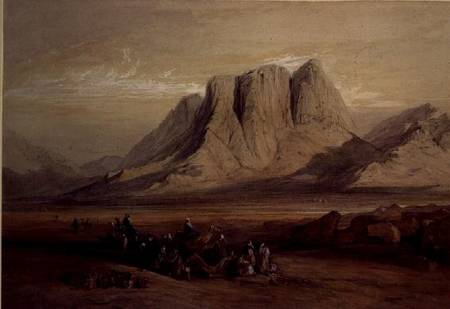
Mount Sinai by English painter Edward Lear (1812-88)

Mountain Top Experiences

Holy Scripture is replete with mountain experiences. Mountains serve as symbols for significant encounters with a mighty God. Whether it is Christ’s transfiguration on a mountain, or the giving of the law on a mountain, the awesome mountain serves as a tangible symbol of divine majesty, strength, and sovereignty. And, I might add, conversely, valleys in Scripture are symbolic of difficulty and suffering. Our God is Lord of both mountain and valley. The God of the Bible is both transcendent and immanent, ruling with power and might high above us on the holy mountain. Yet, the Lord also comes near to us in the valley of the shadow of death.

Leading up to the giving of the Ten Words (Commandments) in Exodus 20, Exodus 19 portrays an awesome scene of God in transcendent holiness and power. In fact, the experience was so otherworldly that the people were afraid to even come near the mountain. The Israelites needed limits placed on themselves because of God’s holy presence. Just like coming too near the immense power of the sun will destroy us, so getting near to God can ruin us if we do not respect divine holiness.

The Lord of the Mountain

Respecting God’s power and transcendence brings the reality of the Lord’s immanence into greater appreciation. God has gone to extreme lengths of self-revelation to people. For the Christian, it all culminates through the incarnation of Christ, the sending of the Son. In Jesus, the transcendence and immanence of God meet perfectly to bridge the chasm between humanity and the divine. Because of Jesus, the awesome sounds of thunder and trumpet do not lead to fear; they announce grace to those who approach God by faith.

You have not come to a mountain that can be touched and that is burning with fire; to darkness, gloom and storm; to a trumpet blast or to such a voice speaking words that those who heard it begged that no further word be spoken to them, because they could not bear what was commanded: “If even an animal touches the mountain, it must be stoned to death.” The sight was so terrifying that Moses said, “I am trembling with fear.” But you have come to Mount Zion, to the city of the living God, the heavenly Jerusalem. You have come to thousands upon thousands of angels in joyful assembly, to the church of the firstborn, whose names are written in heaven. You have come to God, the Judge of all, to the spirits of the righteous made perfect, to Jesus the mediator of a new covenant….

See to it that you do not refuse him who speaks. If they did not escape when they refused him who warned them on earth, how much less will we, if we turn away from him who warns us from heaven? At that time, his voice shook the earth, but now he has promised, “Once more I will shake not only the earth but also the heavens.” The words “once more” indicate the removing of what can be shaken—that is, created things—so that what cannot be shaken may remain. Therefore, since we are receiving a kingdom that cannot be shaken, let us be thankful, and so worship God acceptably with reverence and awe, for our “God is a consuming fire.” (Hebrews 12:18-29, NIV)

Our God is an awesome God. The divine dramas of God’s victory over Egypt and Christ’s victory over sin, death, and hell, have provided God’s people with spiritual power. Both the deliverance of the Israelites from Egyptian slavery by God and the deliverance secured on Mount Zion from spiritual slavery by Jesus are meant to free us to do the will of God. With God’s Word and God’s Spirit given to us, we are emancipated from an empty way of life to experience the fullness of Christ.

May the peace of God which surpasses all understanding, keep your hearts and minds in the knowledge and love of God, and of the Son, Jesus Christ, our Lord, and the blessing of God almighty. May Father, Son, and Spirit be among you and remain with you always. Amen.

Exodus 19:16-25 – An Awesome God

Mount Sinai

On the morning of the third day, thunder roared, and lightning flashed, and a dense cloud came down on the mountain. There was a long, loud blast from a ram’s horn, and all the people trembled. Moses led them out from the camp to meet with God, and they stood at the foot of the mountain.  All of Mount Sinai was covered with smoke because the Lord had descended on it in the form of fire. The smoke billowed into the sky like smoke from a brick kiln, and the whole mountain shook violently. As the blast of the ram’s horn grew louder and louder, Moses spoke, and God thundered his reply. The Lord came down on the top of Mount Sinai and called Moses to the top of the mountain. So, Moses climbed the mountain.

Then the Lord told Moses, “Go back down and warn the people not to break through the boundaries to see the Lord, or they will die. Even the priests who regularly come near to the Lord must purify themselves so that the Lord does not break out and destroy them.”

“But Lord,” Moses protested, “the people cannot come up to Mount Sinai. You already warned us. You told me, ‘Mark off a boundary all around the mountain to set it apart as holy.’”

But the Lord said, “Go down and bring Aaron back up with you. In the meantime, do not let the priests or the people break through to approach the Lord, or he will break out and destroy them.”

So, Moses went down to the people and told them what the Lord had said. (NLT)

As Christians await the Day of Pentecost and the giving of the Spirit, the Revised Common Lectionary reminds us of another great anticipation from the Old Testament. The ancient Israelites were amazingly delivered from Egyptian slavery, miraculously walked through the Red Sea, and traveled with wondrous anticipation to Mount Sinai. Now, in today’s reading, they are about to meet with God!

The scene of this meeting is not exactly the romantic highland encounter of the Man from Snowy River (my wife’s all-time favorite movie). The landscape is much more akin to the dark and volcanic Mount Doom from The Lord of the Rings. The picture appears more foreboding than loving. The thing about mountain top experiences is that they are not all monolithic one-size-fits-all encounters with bright rainbows and happy skipping unicorns.

Holy Scripture is replete with mountain experiences. Mountains serve as symbols for significant encounters with a mighty God. Whether it is Christ’s transfiguration on a mountain; or, the giving of the law on a mountain; the awesome mountain serves as a tangible symbol of divine majesty, strength, and sovereignty. And, I might add, conversely, valleys in Scripture are symbolic of difficulty and suffering.  Our God is a God of both mountain and valley. That is, the God of the Bible is both transcendent and immanent; he rules with power and might high above us on his holy mountain; yet, he also comes near to us in the valley of the shadow of death.

Leading up to the giving of the Ten Words (Commandments) in Exodus 20, Exodus 19 portrays an awesome scene of God in his transcendent holiness and power. In fact, the experience was so otherworldly that the people were afraid to even come near the mountain. The Israelites needed limits placed on themselves because of God’s holy presence. Just like coming too near the immense power of the sun will destroy us, so getting near God can ruin us if we do not respect his holiness.

Respecting God’s power and transcendence brings the reality of his immanence into greater appreciation. God has gone to extreme lengths to reveal himself to his people. For the Christian, it all culminates through the incarnation of Christ, the sending of the Son. In Jesus, the transcendence and immanence of God meet perfectly to bridge the chasm between humanity and the divine.  Because of Jesus, the awesome sounds of thunder and trumpet do not lead to fear; they announce grace to those who approach God by faith.

You have not come to a mountain that can be touched and that is burning with fire; to darkness, gloom and storm; to a trumpet blast or to such a voice speaking words that those who heard it begged that no further word be spoken to them, because they could not bear what was commanded: “If even an animal touches the mountain, it must be stoned to death.” The sight was so terrifying that Moses said, “I am trembling with fear.” But you have come to Mount Zion, to the city of the living God, the heavenly Jerusalem. You have come to thousands upon thousands of angels in joyful assembly, to the church of the firstborn, whose names are written in heaven. You have come to God, the Judge of all, to the spirits of the righteous made perfect, to Jesus the mediator of a new covenant….

See to it that you do not refuse him who speaks. If they did not escape when they refused him who warned them on earth, how much less will we, if we turn away from him who warns us from heaven? At that time, his voice shook the earth, but now he has promised, “Once more I will shake not only the earth but also the heavens.” The words “once more” indicate the removing of what can be shaken—that is, created things—so that what cannot be shaken may remain.

Therefore, since we are receiving a kingdom that cannot be shaken, let us be thankful, and so worship God acceptably with reverence and awe, for our “God is a consuming fire.” (Hebrews 12:18-29, NIV)

Our God is an awesome God. As Christians anticipate Pentecost, we connect the consuming fire of Mount Sinai with the fire of the Spirit. The divine drama of both experiences has provided God’s people with spiritual power. Both the deliverance of the Israelites from Egyptian slavery by God and the deliverance secured on Mount Zion from spiritual slavery by Jesus are meant to free us to do the will of God. With God’s Word and God’s Spirit given to us, we are emancipated from an empty way of life to experience the fullness of Christ.

May the Spirit who hovered over the waters at creation breathe life into your spirit.

May the Spirit whose presence on the mountain was a consuming fire grant you a revived spirit.

May the Spirit who overshadowed the virgin Mary at the conception of our Lord overwhelm your spirit with joy.

May the Spirit who set the Church afire on Pentecost aflame every spirit on earth with the love of Christ.

And, may the Spirit who exhorts, encourages, helps, and comforts be your blessing and your life today and always. Amen.