Deuteronomy 5:1-21 – Ten Basic Rules for Life

Invitation to the Decalogue by Romanian sculptor Liviu Mocan

Moses called out to all Israel, saying to them: “Israel! Listen to the regulations and the case laws that I’m recounting in your hearing right now. Learn them and carefully do them. The Lord our God made a covenant with us at Mount Horeb. The Lord didn’t make this covenant with our ancestors but with us—all of us who are here and alive right now. The Lord spoke with you face-to-face on the mountain from the very fire itself. At that time, I was standing between the Lord and you, declaring to you the Lord’s word, because you were terrified of the fire and didn’t go up on the mountain.”

The Lord said:

I am the Lord your God, who brought you out of Egypt, out of the house of slavery.

You must have no other gods before me. Do not make an idol for yourself—no form whatsoever—of anything in the sky above or on the earth below or in the waters under the earth. Do not bow down to them or worship them because I, the Lord your God, am a passionate God. I punish children for their parents’ sins—even to the third and fourth generations of those who hate me. But I am loyal and gracious to the thousandth generation of those who love me and keep my commandments.

Do not use the Lord your God’s name as if it were of no significance; the Lord won’t forgive anyone who uses his name that way.

Keep the Sabbath day and treat it as holy, exactly as the Lord your God commanded: Six days you may work and do all your tasks, but the seventh day is a Sabbath to the Lord your God. Don’t do any work on it—not you, your sons or daughters, your male or female servants, your oxen or donkeys or any of your animals, or the immigrant who is living among you—so that your male and female servants can rest just like you. Remember that you were a slave in Egypt, but the Lord your God brought you out of there with a strong hand and an outstretched arm. That’s why the Lord your God commands you to keep the Sabbath day.

Honor your father and your mother, exactly as the Lord your God requires, so that your life will be long and so that things will go well for you on the fertile land that the Lord your God is giving you.

Do not kill.

Do not commit adultery.

Do not steal.

Do not testify falsely against your neighbor.

Do not desire and try to take your neighbor’s wife.

Do not crave your neighbor’s house, field, male or female servant, ox, donkey, or anything else that belongs to your neighbor. (CEB)

Whenever I take my wife’s pooch to our local spacious dog park, he knows he will need to stick to just a few of my basic rules. Although he doesn’t need the leash and is free to roam, he understands not to bark at people or approach them and other dogs without my permission. Those few simple rules are for both his well-being, and others.

We as people are free to live our lives as creatures in God’s image. The Lord has just a few basic rules for us to live by to honor both divinity and humanity, as well as to protect others and ourselves. Most folks know them as “The Ten Commandments.”

The Ten Commandments (The Decalogue or The Ten Words) were given to the ancient Israelites nearly 3,500 years ago. These words have stood the test of time and continue to be understood as a universal standard of morality and relational interactions.

There are hundreds of commands in Holy Scripture – approximately 613 in the Old Testament, and 437 in the New Testament – a whopping 1,050 total commands throughout the entirety of the Bible. So, what, then, makes these Ten so special?  Why do we stick to The Ten Words?
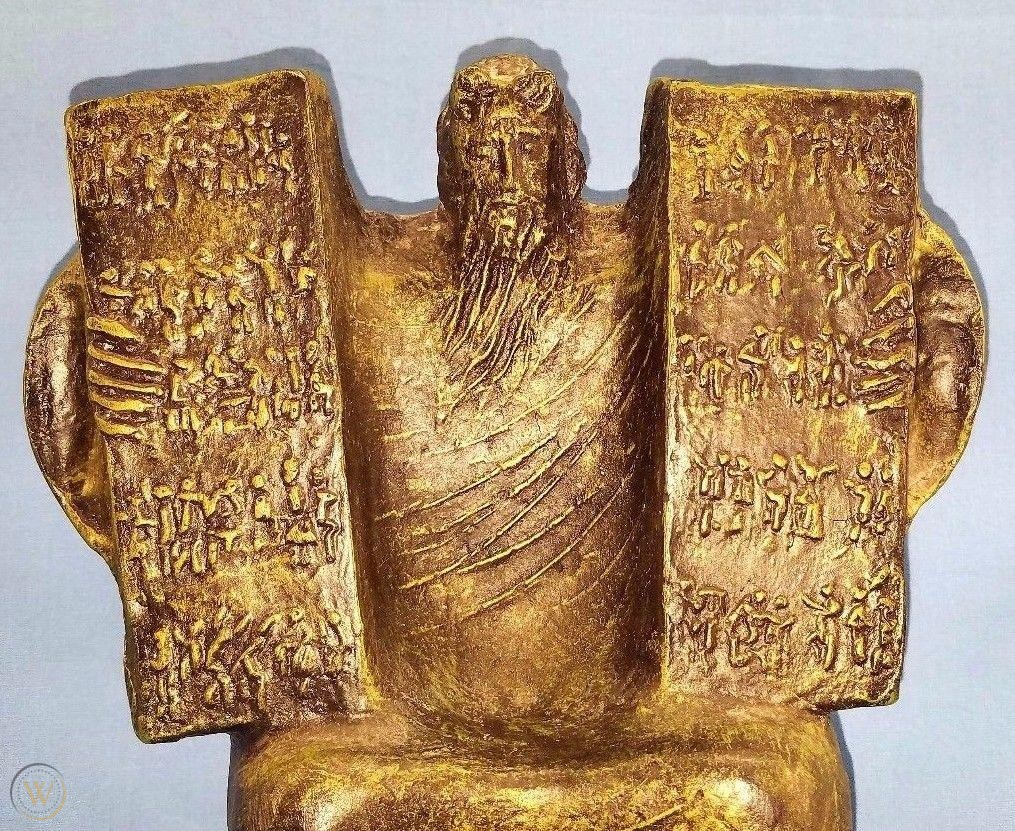
Moses and the Ten Commandments by Italian sculptor Giuseppe Macri (1913-1991)

The reason The Ten Commandments have endured and continue to be learned, spoken, and adhered is that they are foundational commands. Following the Ten Words in the Old Testament are a string of specific commands from God to Moses and then to the people (Exodus 21-23 and Deuteronomy 6-26). Those commands are all a fleshing-out of how to live the basic Decalogue in the Israelites’ context of entering and being in the Promised Land.

In short, every single command of Holy Scripture can be ethically and morally tied back to The Ten Commandments in some way. Whereas many Old Testament laws were given to the Israelites in their ancient Middle Eastern socio-economic culture, The Decalogue was designed to be universal and flexible for every culture and society everywhere, for any time, and every generation.

Therefore, we need to distinguish between The Law (capital “L”) and the law (little “l”). God’s fundamental and foundational ethical Law has always existed and continues to exist – and it is encapsulated in ten short and simple commands which everyone everywhere can obey, whether they are at their jobs, at home, church, or out having fun.

In fact, these ten basic commands are so important that Jesus restated them for us in his Sermon on the Mount (Matthew 5-7). Christ got down to the heart of the commands and let everyone know what it truly means to hold, keep, and obey The Ten Words. For example, Jesus said concerning the seventh command:

“You have heard that it was said to our people long ago, ‘You must not murder anyone. Anyone who murders another will be judged.’ But I tell you, if you are angry with a brother or sister, you will be judged. If you say bad things to a brother or sister, you will be judged by the council. And if you call someone a fool, you will be in danger of the fire of hell” (Matthew 5:21-22, NCV).

It had become easy over the centuries for people to think everything was jim-dandy if they didn’t physically kill anyone. Yet, Jesus knew that well before any person is murdered by another that anger has been nursed through bitter grudges toward another. 

The Ten Words are the very heart of God’s desire for all humanity, and this is precisely why it is important to know and obey them in their full intent. They contain how to relate to God (Commands 1-4); and, how to relate to one another (Commands 5-10).  Jesus would later say, in response to what is the greatest command of all:

“Love the Lord your God with all your heart, all your soul, and all your mind. This is the first and most important command. And the second command is like the first: ‘Love your neighbor as you love yourself.  All the law and the writings of the prophets depend on these two commands.” (Matthew 22:36-40, NCV)

Question and answer 115 of the Heidelberg Catechism, a Confession of Faith crafted by Protestant Reformers in the sixteenth century, addresses a significant issue:

Question: Since no one in this life can obey the Ten Commandments perfectly, why does God want them preached so pointedly? 
Answer: First, so that the longer we live the more we may come to know our sinfulness and the more eagerly look to Christ for forgiveness of sins and righteousness.

Second, so that we may never stop striving, and never stop praying to God for the grace of the Holy Spirit, to be renewed more and more after God’s image, until after this life we reach our goal: perfection.

When all is said and done, grace will have the last word. Yes, none of us will ever perfectly live-out and embody The Ten Words in their entirety all the time. Yet, the grace of God in Jesus Christ does for us what we cannot do for ourselves: deliver us from the realm of sin, death, and hell.

Stuff happens. We often fail to live-into the ways of God for our lives through The Decalogue. However, God, always the hound of heaven, will track us down and mercifully redeem us.

So, embrace The Ten Words. Know them, memorize them, and understand them. Post them on the wall of your office or in your house. Most of all, seek to practice them, obey them, and embody them so that you can enjoy all the freedom of God’s big world.

And you just gotta love it that Johnny Cash once sang about them…

Hebrews 11:23-29 – Taking the Long View

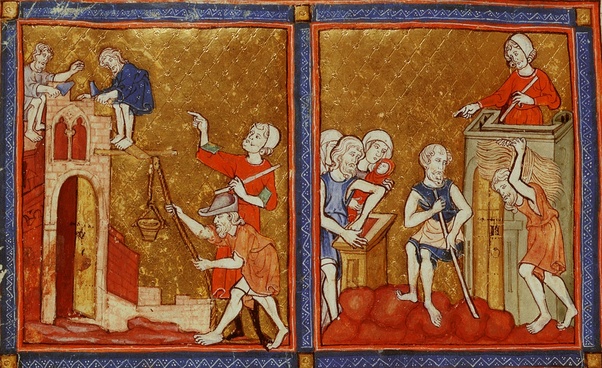
Enslavement of the Israelites

By faith Moses’ parents hid him for three months after he was born, because they saw he was no ordinary child, and they were not afraid of the king’s edict.

By faith Moses, when he had grown up, refused to be known as the son of Pharaoh’s daughter. He chose to be mistreated along with the people of God rather than to enjoy the fleeting pleasures of sin. He regarded disgrace for the sake of Christ as of greater value than the treasures of Egypt because he was looking ahead to his reward. By faith he left Egypt, not fearing the king’s anger; he persevered because he saw him who is invisible. By faith he kept the Passover and the application of blood, so that the destroyer of the firstborn would not touch the firstborn of Israel.

By faith the people passed through the Red Sea as on dry land; but when the Egyptians tried to do so, they were drowned. (NIV)

Faith looks ahead and sees as clearly as is right now in front of your face. Taking the long view of life, the mature person of faith can set aside temporary pleasure to attain a future hope. Moses, held up as such an example, refused to identify himself as the daughter of Pharaoh. He chose to be mistreated in solidarity with his fellow Israelites, instead of having a good time with his high position in the most powerful empire of its day. Moses knew that the treasures of Egypt were not as wonderful as what he would receive from suffering for the Messiah, and he looked forward to his reward.

It is an understatement to say that our contemporary society assumes practicing instant gratification. We want to feel good, and we want it now. Impulse control may just be one of the best life skills that kids (and adults!) need to learn today. A Psychology Today article effectively demonstrates through some classic and current research that “one of the most effective ways to distract ourselves from a tempting pleasure we don’t want to indulge is by focusing on another pleasure.”

For the Christian who desires to follow Jesus in all things, looking ahead to a future heavenly reward which will be shared along with all God’s people needs to be kept at the forefront of our thinking. If we only consider today, there are scant resources for responding to the temptations and fluctuations of life. However, if we will put some energy into clarifying and embracing our most cherished values, we will then let those values inform everything we do, or not do. In the scope of eternity, suffering a bit now is nothing compared to what Christ has yet in store for his people.

Deferred gratification causes us to live differently. In a twist of irony, folks who orient themselves toward the next world are able to effectively impact and change the world they currently reside within – whereas those who focus solely on this present world find themselves falling woefully short with their short view of life. We need the wisdom which faith provides us:

We are always confident, because we know that while we are living in the body, we are away from our home with the Lord. We live by faith and not by sight. We are confident, and we would prefer to leave the body and to be at home with the Lord. So, our goal is to be acceptable to him, whether we are at home or away from home. We all must appear before Christ in court so that each person can be paid back for the things that were done while in the body, whether they were good or bad. (2 Corinthians 5:6-10, CEB)

Future hope, fueled by faith, gives shape to how we live today. It enables us to live in solidarity with those who suffer and are mistreated. It ennobles us to live above short-sighted desires and act on behalf of the common good of all persons in the here-and-now.

Lord God Almighty, the One who is and was and is to come, may we, along with your servant Moses, see the plight of all those who suffer in our midst. Give us courage and compassion to live in solidarity with the poor, the oppressed, the forgotten, and all who live with misfortune and misery. May our hearts, burning with love, bear the burdens of all in our care. And may our loving example ignite the hearts of others to accompany the vulnerable in their affliction. We ask this in the gracious name of Jesus through the power of your Holy Spirit. Amen.

Exodus 10:21-29 – From Darkness to Light

Darkness

Then the Lord said to Moses, “Stretch out your hand toward the sky so that darkness spreads over Egypt—darkness that can be felt.” So, Moses stretched out his hand toward the sky, and total darkness covered all Egypt for three days. No one could see anyone else or move about for three days. Yet all the Israelites had light in the places where they lived.

Then Pharaoh summoned Moses and said, “Go, worship the Lord. Even your women and children may go with you; only leave your flocks and herds behind.”

But Moses said, “You must allow us to have sacrifices and burnt offerings to present to the Lord our God. Our livestock too must go with us; not a hoof is to be left behind. We have to use some of them in worshiping the Lord our God, and until we get there, we will not know what we are to use to worship the Lord.”

But the Lord hardened Pharaoh’s heart, and he was not willing to let them go. Pharaoh said to Moses, “Get out of my sight! Make sure you do not appear before me again! The day you see my face you will die.”

“Just as you say,” Moses replied. “I will never appear before you again.” (NIV)

The ancient Israelites were in bondage to the mighty Egyptian empire. After four-hundred years of bondage, God called Moses to lead them out from Egypt to the Promised Land. The only kink was the Egyptian Pharaoh’s outright reluctance. As the most powerful human on the planet at the time, Pharaoh was used to getting his way on everything. God knew it would be a process of deliverance, and not just a sudden event.

So, a series of ten wonders or miracles occurred that struck at the heart of Egyptian power and religion. A discernible pattern quickly developed in which Pharaoh refused cooperation; God sent an incredible devastation on the land; Pharaoh relented with a half-repentance; God lifted the devastation; and, with things “back to normal” Pharaoh’s heart was hardened and he would not let God’s people go. Rinse and repeat a lot more times.

Today’s Old Testament lesson recounts the ninth wonder done by God, using Moses. Although the miracle of complete and total darkness lasted a full three twenty-four-hour long days without harming any human or animal, the sheer fear and terror it brought to the Egyptians left them in a three-day state of suspense. Living on the edge in anxious apprehension is psychologically overwhelming. At least with the other plagues, you could see what you were up against.

Fear in the dark

In the land known as the “eternally rising sun,” the uncertainty of the perpetual darkness was meant to humble Egypt and put it in its place. Yet, with nine strong and full wonders from God, Pharaoh remained intransigent and stubborn. He was not going to let all that slave labor walk away while he was in charge.

I “wonder” what it takes for most of us to make a major change in our lifestyle – what we need to go through before we cry “uncle” and let go. The more power and control we have, the harder it is to do so. Humans are creatures of habit, and wherever there are long standing routines there you will find great difficulty in changing those practices.

No one simply wakes up in the morning and decides to be a jerk. Instead, it is likely that one day a person will arise, look in the mirror, and not recognize who is looking back at them. A series of choices and habits over a long stretch of time eventually formed the undistinguished blockhead. The Apostle James once described the pathology behind the person in the mirror:

You are tempted by the evil things you want. Your own desire leads you away and traps you. Your desire grows inside you until it results in sin. Then the sin grows bigger and bigger and finally ends in death. (James 1:14-15, ERV)

By reading today’s story Christologically we have a clue as to the remedy and reformation needed to form newer and better habits. Just as all Egypt was in three days of darkness due to sin, so Jesus was three days in the dark grave because of the world’s sin. And just as the ancient Israelites were delivered from their cruel bondage from Egypt and entered the Promised Land, so in Jesus Christ humanity is liberated from their power-hungry, money-grubbing, control-obsessing ways of being insensitive dolts to forming new habits of humility, justice, and love. The Apostle Peter said:

You are a chosen race, a royal priesthood, a holy nation, God’s own people, in order that you may proclaim the mighty acts of him who called you out of darkness into his marvelous light. (1 Peter 2:9, NRSV)

It is the aim of the Christian to look out at the world and bring love where love is not; to discover it is more blessed to give than to receive; and, to have a deep sense of justice which works for egalitarian ways and the equity of all people, not just people of privilege.

So, may we gain a proper perspective of ourselves, others, and the world. And, may we resist the Pharaoh’s among us, while championing the needs of the downtrodden of this old fallen world. May we be like Christ and see Jesus in each person we encounter.

God, you have given all peoples one common origin. It is your will that they be gathered as one family in yourself. Fill the hearts of humanity with the fire of your love and with the desire to ensure justice for all. By sharing the good you give us, may we secure an equality for all our brothers and sisters throughout the world. May there be an end to division, strife, and war. May there be a dawning of a truly human society built on love and peace. We ask this in the name of Jesus, our Lord, through the might of the Holy Spirit. Amen.

Exodus 3:16-25 – A Great Reversal

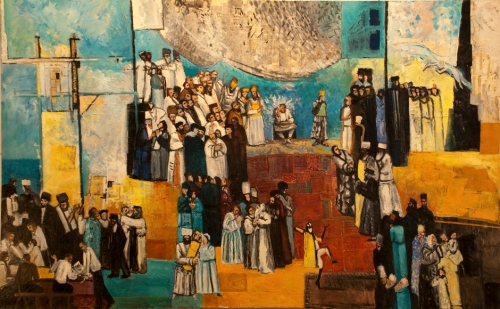
Moses and the Children of Israel by Richard McBee
“Moses and the Children of Israel” by Richard McBee

“Go, assemble the elders of Israel and say to them, ‘The Lord, the God of your fathers—the God of Abraham, Isaac and Jacob—appeared to me and said: I have watched over you and have seen what has been done to you in Egypt. And I have promised to bring you up out of your misery in Egypt into the land of the Canaanites, Hittites, Amorites, Perizzites, Hivites and Jebusites—a land flowing with milk and honey.’ 

“The elders of Israel will listen to you. Then you and the elders are to go to the king of Egypt and say to him, ‘The Lord, the God of the Hebrews, has met with us. Let us take a three-day journey into the wilderness to offer sacrifices to the Lord our God.’ But I know that the king of Egypt will not let you go unless a mighty hand compels him. So, I will stretch out my hand and strike the Egyptians with all the wonders that I will perform among them. After that, he will let you go. 

“And I will make the Egyptians favorably disposed toward this people, so that when you leave you will not go empty-handed. Every woman is to ask her neighbor and any woman living in her house for articles of silver and gold and for clothing, which you will put on your sons and daughters. And so, you will plunder the Egyptians.” (NIV) 

Moses spent forty years in the back side of the desert tending sheep. The first forty years were lived in the most powerful place on earth at the time, Egypt. Although Moses had a privileged position, he forsook his place to be in solidarity with the enslaved Israelites. With a skewed sense of timing and method, he slew a cruel Egyptian, and was forced to flee into the desert. 

The time eventually became ripe, and God was on the move. At eighty years old, God called Moses out of the desert and back to Egypt. The deliverance was going to be accomplished according to God’s designs and purposes, and not from the impetuous actions of a younger Moses. God knew exactly what he was doing and put Moses on a course which would strike at the heart of imperial Egypt and bring freedom to millions of slaves. 

Today’s story is laced thick with divine promises. After all, it is the promises of God which give people hope and a future. Referring to himself as the God of Abraham, Isaac, and Jacob, the Lord connects the generations-long covenant promise to the Israelites and reminded them they are not forgotten. God’s covenant has neither disappeared nor changed; it still exists. While the Jews were languishing in slavery, God was not aloof but watching – carefully inspecting, caring, and paying close attention. 

The inheritance of the Promised Land was coming, and it would be realized. God affirmed the covenant, knowing the plans he has for them – plans to give them abundance and joy. And God knew full well that dislodging the Israelites from Egypt would take some work, since Pharaoh relied so heavily on slave labor to support his massive imperial state. 

You, like me, have likely noticed that God tends to move rather slow by our standards. We might question and wonder about so much injustice going unabated for so long. Yet, that is our perspective of things, not God’s. Whereas we often have our own self-interest at mind, the Lord has the concern of an entire world. God is patient and long-suffering, providing full opportunity for both individual and national repentance. The Lord is on the lookout for people to amend their errant ways and return to their true purpose for living. He only judges at the proper time. 

And when that time comes, look out! Nothing can stand in the way of God’s good plans for the earth. The ancient Egyptians had built an empire on the backs of slavery, and everything went into supporting the power and wealth of the state. God was not okay with this situation. As he had done many times before, the Lord would thoroughly dismantle and destroy the powerful system of oppression. God is the expert at flip-flopping the status of people – the slaves become free, and the free are bound; the hated become favored, and those who enjoyed all the perks of power and privilege become the despised. 

Embracing God’s upside-down kingdom means advocating for justice, righteousness, and holiness for all people, not just a select few whom I like. Jesus, over 1,500 years after Moses and the exodus from Egypt, had this to say: 

“Those who are last now will someday be first, and those who are first now will someday be last.” (Matthew 20:16, NCV) 

“Blessed are you who are poor, 
    for yours is the kingdom of God. 
“Blessed are you who are hungry now, 
    for you will be filled. 
“Blessed are you who weep now, 
    for you will laugh. 

“Blessed are you when people hate you, and when they exclude you, revile you, and defame you on account of the Son of Man. Rejoice in that day and leap for joy, for surely your reward is great in heaven; for that is what their ancestors did to the prophets. 

“But woe to you who are rich, 
    for you have received your consolation. 
“Woe to you who are full now, 
    for you will be hungry. 
“Woe to you who are laughing now, 
    for you will mourn and weep. 

“Woe to you when all speak well of you, for that is what their ancestors did to the false prophets. (Luke 6:20-26, NRSV) 

And the Apostle Paul said to the Church: 

“For our present troubles are small and won’t last very long. Yet they produce for us a glory that vastly outweighs them and will last forever!” (2 Corinthians 4:17, NLT) 

The New Testament references are not meant to sanitize or put a positive spin on the very real suffering that so many people have endured both past and present. It is, however, meant to lift-up the reality that we have a sure and certain hope. Our trust in the promises and presence of God will eventually be realized and gives shape to how we live today in persistent prayers with patience and perseverance. 

So, may the Lord of all creation bless and protect you. May the Lord show you mercy and kindness in your affliction. And, may the Lord be good to you and give you peace. Amen.