Why Did Jesus Come? (Matthew 9:14-17)

Then John’s disciples came and asked him, “How is it that we and the Pharisees fast often, but your disciples do not fast?”

Jesus answered, “How can the guests of the bridegroom mourn while he is with them? The time will come when the bridegroom will be taken from them; then they will fast.

“No one sews a patch of unshrunk cloth on an old garment, for the patch will pull away from the garment, making the tear worse. Neither do people pour new wine into old wineskins. If they do, the skins will burst; the wine will run out and the wineskins will be ruined. No, they pour new wine into new wineskins, and both are preserved.” (New International Version)

The late Abigail Van Buren, better known in her day as the columnist, “Dear Abby,” was the person who made famous the phrase, “The church is a hospital for sinners, not a museum of saints.”

We occasionally need words like Dear Abby’s that are reminders of why Christians and Churches exist in the first place. The Church does not remain on this earth solely for its own benefit, any more than a hospital exists for the benefit of doctors or insurance companies. 

The Church exists to extend the mission of Jesus through proclamation of the gospel, the good news of forgiveness and new life in Christ. The Church calls people who are ensnared, entrapped, and in bondage to guilt and shame, and who need the restorative touch of grace. 

Our calling is not to find out what others can do for us (e.g. tithing and attendance) but what we can do for others. That’s why we are the continuing presence of Jesus on this earth as the temple of the Holy Spirit. 

Even though I am a church pastor, it is not my church. The church is not your church. It is Christ’s Church and we are to act in accordance with that truth.

Some of you reading this blog post are unhealthy. Some of you are sick with sin; some are heart-sick; others are just plain sick and tired of being sick and tired. Jesus (nor me!) is not looking to heap on you a load of expectations and guilt for things you are not doing; but instead is pointing you to the source of healing and change and inviting you to admit your need and come to him. 

Conversely, you may be healthy, spiritually alive and well. Therefore, it’s your job to roll up your sleeves and serve, to participate fully in the mission of Jesus for the church and the world.

Why did Jesus come? 

Jesus came to set up a new structure that could embrace his mission of bringing new life to people.

Christ used the occasion of John’s disciples asking him about fasting to communicate that his mission of reaching people through mercy and forgiveness will need a significant structural change. 

The two illustrations Jesus used – cloth and wineskins – is to simply point out that old and new wineskins are incompatible; and old and new pieces of cloth don’t go together. I would put it this way: You don’t put a new collar on a dead dog.

The Lord Jesus didn’t come to this earth just to perpetuate the status quo; he didn’t enter this world through the incarnation to simply dress up the Jewish religion, or to make a few minor adjustments to what already is going on. No! Christ came to change the old and do something new so that his mission could go forward through us.

We need a structural system which can accommodate the finished work of Jesus on the cross.

The entire sacrificial system and ritual laws of the Old Testament were only a matter of food and drink and various ceremonial washings – external regulations applying until the time of the new order.(Hebrews 9:10)

Christ is the one who arranges a new covenant, so that those who have been called by God may receive the eternal blessings that God has promised. This can be done because there has been a death which sets people free from the wrongs they did while the first covenant was in effect. (Hebrews 9:15, GNT)

Jesus canceled the first covenant in order to put the second into effect; the old is obsolete and has served it’s purpose. Now, Christ’s new covenant is in effect – a system big enough to hold the mission of the Church. (Hebrews 8:13; 10:9)

I wonder:

  • Is there anything in your life or in your church that is obsolete?
  • Is there a practice, ministry, system, or structure that is ineffective and not contributing to the mission that Jesus has for us in reaching others? 
  • Are there any dead dogs you keep trying to prop up on its legs?
  • Are you focused on what is important to Jesus? Do you know what’s important to him?
  • Do you keep performing the same rituals over and over because that is what you’ve always done?
  • What needs to change in your life to accommodate the mission of Jesus?

If the mission of Jesus is to occur we must develop:

  1. A relationship with Jesus. Engaging in spiritual disciplines of prayer, giving, fasting, reading and meditating on Scripture, are activities that put us in a position to know Christ better and respond to what is important to him.
  2. Relationships with each other that are not superficial but help one another to grow in Christ. We need to hold one another accountable for how the mission of Jesus is being accomplished, or not.
  3. Relationships with those outside of the church. This world is filled with sick, needy, hurting, lonely, unhealthy people who are stuck. They need a major change of life that can come from Jesus working through his followers. 

May it be so. Soli Deo Gloria.

The Necessity of Mentoring Relationships: Paul, Tom, and Timothy (2 Timothy 3:10-15)

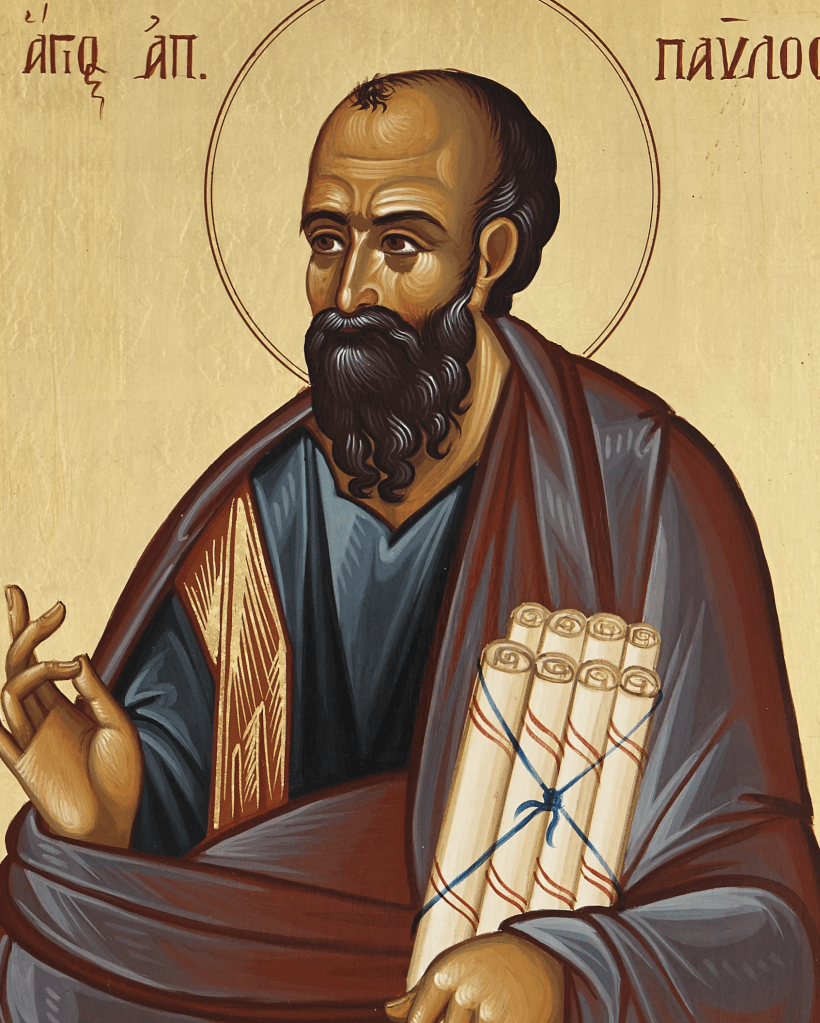
Orthodox icon of St. Paul
Orthodox icon of St. Timothy

You’ve been a good apprentice to me, a part of my teaching, my manner of life, direction, faith, steadiness, love, patience, troubles, sufferings—suffering along with me in all the grief I had to put up with in Antioch, Iconium, and Lystra. And you also well know that God rescued me! Anyone who wants to live all out for Christ is in for a lot of trouble; there’s no getting around it. Unscrupulous con men will continue to exploit the faith. They’re as deceived as the people they lead astray. As long as they are out there, things can only get worse.

But don’t let it faze you. Stick with what you learned and believed, sure of the integrity of your teachers—why, you took in the sacred Scriptures with your mother’s milk! There’s nothing like the written Word of God for showing you the way to salvation through faith in Christ Jesus. (The Message)

Paul and Timothy had a special relationship. Paul, the Apostle and mentor in the faith; and Timothy, the apprentice.

Together, they saw it all – and experienced it all. And through it all, the Christian tradition was passed on because of Paul’s purposeful mentoring of others, especially Timothy, by both verbal teaching and life example. In this, Paul helped set Christianity on a trajectory of modeling the words and ways of Jesus.

Faith is a gift given by God through Scripture and faithful people – and then received by us. Christianity is designed for community; it is not merely a solitary affair between the individual and God. Anyone trying to go it alone in the Christian life will soon discover they are overwhelmed and in over their heads with trouble.

Contemporary pastoral ministry still needs to follow in the footsteps of the Apostle Paul. Just one of the many reasons why churches in the West are in such decline is that Christian leaders are not intentionally focused to passing-on a solid body of teaching, along with a consistent example of how to put it into practice, through close relationships.

Anyone who has been in the pastoral ministry gig for a long time, remaining consistent and faithful, has most certainly had a good spiritual teacher and guide shepherding them through their Christian experience. A good long ministerial life isn’t happenstance; it’s the result of a solid foundation through a Paul-and-Timothy sort of relationship.

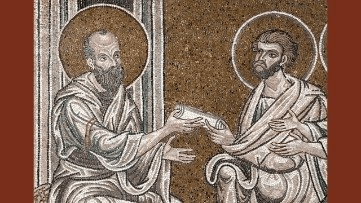
Mosaic of Paul and Timothy, Cathedral of Monreale, Sicily, Italy

By God’s grace, I’ve had several persons influence my life in profound ways in such a relationship. One of the earliest and longest was with Tom – a campus minister on my university who built into my life as an undergraduate and a very young Christian. We remained connected and became good friends for nearly four decades until his untimely death.

Tom knew what he was doing with me. To this day, even with multiple academic degrees and many professional ministry experiences, I attribute most of what I know about Christian faith and practice as simply saying and doing what I saw Tom say and do. And, I might add, Tom consistently saw my true self, even when I didn’t see it myself.

A good model in the faith has the same qualities and insights as the Apostle Paul of old. For example, here are just a few of the important things I learned from Tom:

  • Christian ministry is interpersonal; time must be spent with others, getting to know them and building relationships. Doing pastoral ministry from afar is an oxymoron. From what we know of Paul, at times he had a team of up to seventy persons following him around on missionary endeavors.
  • There are always going to be charlatans and bad apples around. Don’t simply ignore them. Confront them in grace and truth. I still remember a time when I went along with Tom, not knowing where we were going or what he was up to. In retrospect, he probably knew I would bolt if I caught wind of what he was about to do. We went to the dorm room of a believer whom Tom flat-out confronted on his talking and living being inconsistent with his professed Christianity. My eyes got huge when Tom said, “In the name of Jesus Christ I rebuke you and I call you to repent.” This was said in a gracious and conversational tone, not in anger, which communicated concern and love for this individual student.
  • Develop relationships. And the best way of doing this is by having the Timothy tag along with the Paul. Tom continually brought me along to whatever he was doing, whether it was a weekend retreat he was leading, or going to the grocery store. We cannot learn from others if we aren’t around them, and Tom understood this better than most. As a result, I learned more than lessons; I learned a life.
  • It’s not about me. Tom never took himself too seriously. And because of that, I observed him never becoming overwhelmed or obsessing over the trouble he would sometimes get into. In fact, he typically welcomed the trouble whenever he saw it was not of his own making.
  • Openness and vulnerability are necessary. More than once, Tom strolled into a bible study with me and some other guys, flopped down and said, “Man, I really blew it today…” and then went on to explain some boneheaded thing he did. We unpacked the entire situation together. Not once do I ever recall Tom trying to look like the perfect Christian leader. He embraced who he was and was always willing to shine the light on the shadowy places of his heart.
  • Holy Scripture is central to Christian life and ministry. Inevitably, Tom’s question to us, after describing his bonehead move, was to ask, “What are you learning in God’s Word? Do you have any encouragement for me?” On a daily basis, without fail, Tom asked this question of me: “So, what is God teaching you in the Word?”

Through both Holy Scripture and the significant relationships I’ve had throughout my life, I can confidently state that there are two indispensable elements to effective Christian ministry:

  1. It must be firmly grounded in objective theory derived from God’s Word.
  2. It must be intentionally practiced with subjective experience derived from interpersonal relationships.

Objective theory without lived practice leads to being puffed-up with knowledge and no love – because love requires people. And subjective experience without a grounded theory is nothing but a form of spiritual A.D.D. in which whatever shiny thing we see grabs our attention.

I always considered Tom as my spiritual father (and his wife as a dear spiritual mother!). They have shown me not only how to live the faith, but also how to be a spiritual father myself. And as a result, my own dear wife and I have many spiritual children scattered throughout the country.

This is the consummate Christian: Coming to faith by God’s grace, mediated to us through actual flesh-and-blood people; being taught and mentored in that faith by proven Christians; and then, simply saying and doing what you have seen and heard from holy leaders and Holy Scripture.

It’s not rocket science. It’s not abstract art. It’s a life. It’s relationships. And it’s absolutely necessary in order for both the church and the world to be blessed.

But he’s already made it plain how to live, what to do,
    what God is looking for in men and women.
It’s quite simple: Do what is fair and just to your neighbor,
    be compassionate and loyal in your love,
And don’t take yourself too seriously—
    take God seriously. (Micah 6:8, MSG)

Soli Deo Gloria. Amen.

What’s On Your Wish List? (Acts 26:24-29)

Before Paul finished defending himself, Festus shouted, “Paul, you’re crazy! Too much learning has driven you out of your mind.”

But Paul replied, “Honorable Festus, I am not crazy. What I am saying is true, and it makes sense. None of these things happened off in a corner somewhere. I am sure that King Agrippa knows what I am talking about. That’s why I can speak so plainly to him.”

Then Paul said to Agrippa, “Do you believe what the prophets said? I know you do.”

Agrippa asked Paul, “In such a short time do you think you can talk me into being a Christian?”

Paul answered, “Whether it takes a short time or a long time, I wish you and everyone else who hears me today would become just like me! Except, of course, for these chains.” (Contemporary English Version)

The Apostle Paul was quite the guy – a zealous, indefatigable, intense, Type-A dude. Yet it wasn’t those characteristics that Paul wanted others to see in him. He simply desired others to see Christ in him. 

Having been arrested for preaching the good news of forgiveness and new life in Jesus Christ, Paul found himself before King Agrippa, engaging in a DTR (define the relationship) talk; and making a strong apologetic for the Christian faith. 

Agrippa asked Paul, “In such a short time do you think you can talk me into being a Christian?” Paul answered with confidence and conviction, “Whether it takes a short time or a long time, I wish you and everyone else who hears me today would become just like me!” 

“Trial of the Apostle Paul” by Nikolai Bodarevsky, 1875

I wonder how many of us could boldly say the same thing as Paul. 

Are we the sort of Christians that others could emulate? 

Has our faith journey led us to the place of being a solid model of what a follower of Christ should look like? 

Do we expect others to change while avoiding change ourselves? 

Do we deeply desire and work toward others coming to know Jesus? 

So, what is on your wish list?

  • I wish each Christian everywhere would spend their relational and emotional energy making this world a better place by living into the words and ways of Jesus Christ.
  • I wish every person I encounter would have the privilege of knowing Christ as I have.
  • I wish all my parishioners and patients would become what I am, except, of course, for my self-made chains.

Perhaps we all must look in the mirror and examine our true desires. It’s easy to put our energy into good yet lesser wishes in life. Yet, if Christians are to become like their ancient forefather in the faith, the Apostle Paul, we will begin focusing our energies into things such as the following:

  • Making outreach a priority. We do what is most important to us. That’s probably self-evident. But churches and believers that do not make outreach a primary priority are really making it no priority, at all.

Paul said, “Do the work of telling the Good News. Do all the duties of a servant of God.” (2 Timothy 4:5, ERV)

  • Mentoring others into the words and ways of Jesus. Many church laypersons believe that training other Christians is what we pay the clergy to do.But this is really the responsibility of every believer.

Paul said, “You have often heard me teach. Now I want you to tell these same things to followers who can be trusted to tell others.” (2 Timothy 2:2, CEV)

  • Taking responsibility for spreading the good news. Blaming and shaming gets us nowhere. Pastors complain about churches. Churches bellyache about Pastors. And both attack the culture, the denomination, or some other external scapegoat. It’s time for all of us to own what needs to be said and done.

Paul said, “Be ready to spread the word whether or not the time is right. Point out errors, warn people, and encourage them. Be very patient when you teach.” (2 Timothy 4:2, GW)

  • Connecting prayer with telling the message of Christ. It doesn’t take a lot of energy to pray for Aunt Mable’s bunions to go away. It’s altogether another thing to pray sustained, focused, and passionate prayers for the people in my life to know Christ and him crucified, risen, ascended, and coming again.

Paul said, “Don’t forget to pray for us, that God will open doors for telling the mystery of Christ… Pray that every time I open my mouth I’ll be able to make Christ plain as day to them.” (Colossians 4:3-4, MSG)

  • Being compassionate and kind, like Christ, to others. There not only needs to be a clear articulation of the gospel, but also a clear demonstration of basic human kindness. Many Christians never get the opportunity to share the gospel because they’re just downright obnoxious.

Set Christ apart as Lord in your hearts and always be ready to give an answer to anyone who asks about the hope you possess. Yet do it with courtesy and respect, keeping a good conscience. (1 Peter 3:15-16, NET)

  • Establishing every Christian ministry as an opportunity to share the gospel. Intentional effort and energy toward proclaiming the gospel in both word and deed needs to go into everything we do.

Paul said, “So take special care how you conduct yourselves. Don’t be unwise but be wise. Make use of any opportunity you have because these are wicked times we live in.” (Ephesians 5:15-16, NTE)

  • Caring, not at all, that new Christians will change our lives or our church too much. I’m serious. I’ve heard the line many times by church folk in my years of pastoral ministry that new believers come in and change things we like. Come on, man. Get over it. Change is built into the Christian experience. God said:

I am about to do a new thing; now it springs forth; do you not perceive it? I will make a way in the wilderness and rivers in the desert. (Isaiah 43:19, NRSV)

You don’t need a personality like the Apostle Paul to live into your calling as a Christian. You and I only need to put our will and energy into things that matter most to God.

Risen and ascended Lord, you are the king of all creation. May your rule and reign take over my life to such a degree that everything that comes out of my mouth, and every action I take would be worthy of emulation in your way of love. Amen.

Acts 2:1-21 – The Day of Pentecost

When Pentecost Day arrived, they were all together in one place. Suddenly a sound from heaven like the howling of a fierce wind filled the entire house where they were sitting. They saw what seemed to be individual flames of fire alighting on each one of them. They were all filled with the Holy Spirit and began to speak in other languages as the Spirit enabled them to speak.

There were pious Jews from every nation under heaven living in Jerusalem. When they heard this sound, a crowd gathered. They were mystified because everyone heard them speaking in their native languages. They were surprised and amazed, saying, “Look, aren’t all the people who are speaking Galileans, every one of them? How then can each of us hear them speaking in our native language? Parthians, Medes, and Elamites; as well as residents of Mesopotamia, Judea, and Cappadocia, Pontus and Asia, Phrygia and Pamphylia, Egypt and the regions of Libya bordering Cyrene; and visitors from Rome (both Jews and converts to Judaism), Cretans and Arabs—we hear them declaring the mighty works of God in our own languages!” They were all surprised and bewildered. Some asked each other, “What does this mean?” Others jeered at them, saying, “They’re full of new wine!”

Peter stood with the other eleven apostles. He raised his voice and declared, “Judeans and everyone living in Jerusalem! Know this! Listen carefully to my words! These people aren’t drunk, as you suspect; after all, it’s only nine o’clock in the morning! Rather, this is what was spoken through the prophet Joel:

In the last days, God says,
I will pour out my Spirit on all people.
    Your sons and daughters will prophesy.
    Your young will see visions.
    Your elders will dream dreams.
    Even upon my servants, men and women,
        I will pour out my Spirit in those days,
        and they will prophesy.
I will cause wonders to occur in the heavens above
    and signs on the earth below,
        blood and fire and a cloud of smoke.
The sun will be changed into darkness,
    and the moon will be changed into blood,
        before the great and spectacular day of the Lord comes.
And everyone who calls on the name of the Lord will be saved. (Common English Bible)

The Holy Spirit is the distinguishing mark of the believer in Jesus Christ.

Therefore, since the Spirit is given, the main responsibility of Christians is to receive. 

Christianity is distinctive in this sense – it is primarily a religion of receiving. The Christian life is lived by the power of the Holy Spirit, and not in our own strength. The function of faith is to receive what grace offers. 

We are saved and sanctified by grace alone through faith. God lives in and through us by means of the Spirit. The miraculous and the supernatural cannot, obviously, be done by any human person.  It can, however, be accomplished through the power of the Holy Spirit.

People tend to put a lot of pressure on themselves to be a certain way and to do certain things. The result? Tiredness. Discouragement. Imbalance. Lots of giving. Little receiving.

Christianity is not chiefly about giving but receiving. The Christian life is about putting oneself in a position to receive through prayer and humility. In Christianity, the opposite of receiving is not giving – it’s pride. 

Maybe this kind of talk makes you uncomfortable. I’m not talking about being passive or lazy. I’m highlighting the need of receiving grace from God by means of the Holy Spirit. Then, the Spirit to work in and through us. 

Jesus said we would do greater works than even he himself with the advent of the Spirit! (John 14:12-14)

The question then becomes: Will we let God be God? Will we allow the Spirit to do work in us?

The Spirit is elsewhere described in Holy Scripture as a gentle presence, an encourager, counselor, and comforter. Yet, not here at Pentecost – the Spirit is portrayed like a violent wind and an unusual fire.

The Holy Spirit on the Day of Pentecost was not some gentleman caller entering politely when invited. Instead, the Spirit appears more like a drunken sailor who bursts into the room and causes a big ruckus. There’s nothing subtle about the Spirit at Pentecost. The Spirit is electric, bombastic, and volcanic, causing a huge scene and upheaving the status quo.

Because of Pentecost, Christians are marked and defined by God’s Spirit living within them and being full of the Spirit. God wants to pour out the Spirit on all kinds of people to overflowing so that what comes out of them is “prophecy.” 

The prophet Joel and the Apostle Peter do not intend the word “prophecy” to mean predicting the future. Rather, they are referring to inspired speech coming from a heart overflowing with the Spirit. 

Just as an inebriated person says and does things they would not typically say or do because they are filled with alcohol, so the person filled with God’s Spirit says things and does things they would not typically say or do because their inspiration and courage come as a result of God within them.

Thus, we must cast off the unholy spirits of inebriation and receive the Holy Spirit of God.

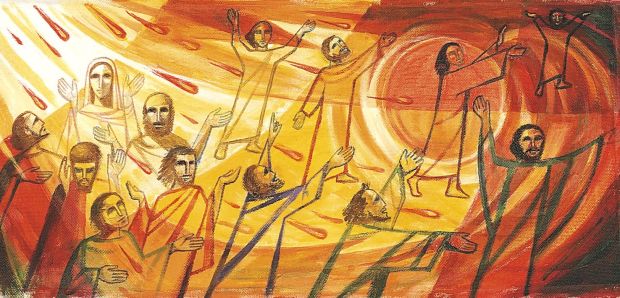
Descent of the Holy Spirit at Pentecost mosaic by Anna Wyner

God sobered-up the little band of Christ followers from learners to practitioners, sending them into the world with a mission.

Being on a mission from God is not really about ability; it’s about being filled and sent. 

First time parents may read and learn all they can about parenting before their child is born. Yet, when that little bundle comes into the world, and the hospital puts this kid in your arms and sends you out, you feel inadequate for the task. Parenting becomes a kind of supernatural affair where you pray and learn on the fly, finding out that you need something beyond yourself to get anywhere in raising this screaming, pooping, sleeping person who depends completely on you for everything. 

God sends us into the world to make disciples. And we may feel very inadequate for the task. However, this has more to do with receiving the Spirit. The Spirit comes looking to turn our lives upside-down with new life in Jesus Christ. 

Pentecost means that the Spirit came to shake things up and accomplish among God’s people what they could never do on their own.

Everyone who calls on the name of the Lord will be saved. 

The Church in the New Testament was not a country club for people to simply enjoy the perks of membership.  The community of the redeemed, the Church, is actually more like a place where the people seem drunk because they are all talking with inspired speech from the Holy Spirit. 

Maybe we don’t need to be saved in the sense that we have already called on the name of the Lord concerning forgiveness in Christ. Yet, maybe we need to call on the name of the Lord to be delivered from our misguided attempts to see the Christian life as a pleasant affair.

Perhaps we need deliverance from disordered priorities and misguided loves. We may need to be saved from ourselves so that we are open to the Holy Spirit with palms up receiving from God whatever it is the Spirit wants to do in and through us, rather than telling God how we think things ought to go. 

Prayer, then, is more about receiving the Spirit and God’s purposes for us rather than giving God an earful and expecting the Lord to bless our plans.

Pentecost is the launching pad of the church’s mission – it was explosive because the Spirit is a kind of wild man who fills people up to overflowing so that what comes out of them is inspired speech and missional actions.

If a language barrier cannot stop the Spirit from operating, then how much more can God transform us and use us in the lives of those around us?

Joel’s prophecy, quoted by Peter, is only partially fulfilled. Events have been set in motion by Pentecost for the complete fulfillment of God’s justice. So, there’s some urgency for people to fill their vacuous souls with the grace freely offered to them in Christ.

The outpouring of the Spirit is a sign: The end is near. And the generous giving of the Spirit is inclusive – there is room for all kinds of people. Through the Spirit, God saves all who call on the name of the Lord.

Today is not just another day on the calendar. It is the Day of Pentecost! 

Just as marriages occasionally need a spark and a fire and a fresh wind, so we need the Holy Spirit to breathe on us, comfort us, and inspire us.

May we be filled with the Spirit as we anticipate what our God will do now, and in the years to come.

Spirit of the living God, through the reading and proclamation of the Word, may you refresh our spirits, reshape our desires, recreate our hearts, and reform our ways so that we will shine with your enduring glory, through Jesus Christ, our risen and ascended Lord. Amen.