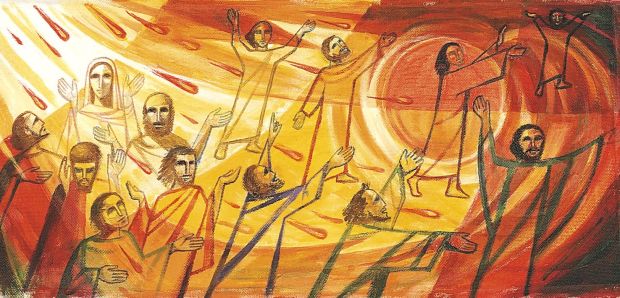
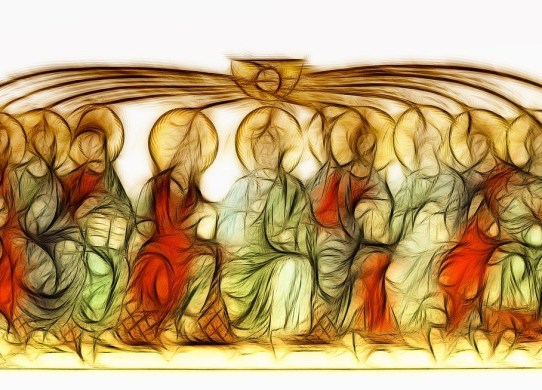
Organizational Leadership (Exodus 18:13-27)

Jethro and Moses, by James Tissot, c.1898

The next day Moses took his seat to serve as judge for the people, and they stood around him from morning till evening. When his father-in-law saw all that Moses was doing for the people, he said, “What is this you are doing for the people? Why do you alone sit as judge, while all these people stand around you from morning till evening?”

Moses answered him, “Because the people come to me to seek God’s will. Whenever they have a dispute, it is brought to me, and I decide between the parties and inform them of God’s decrees and instructions.”

Moses’ father-in-law replied, “What you are doing is not good. You and these people who come to you will only wear yourselves out. The work is too heavy for you; you cannot handle it alone. Listen now to me and I will give you some advice, and may God be with you. You must be the people’s representative before God and bring their disputes to him. Teach them his decrees and instructions, and show them the way they are to live and how they are to behave. But select capable men from all the people—men who fear God, trustworthy men who hate dishonest gain—and appoint them as officials over thousands, hundreds, fifties and tens. Have them serve as judges for the people at all times, but have them bring every difficult case to you; the simple cases they can decide themselves. That will make your load lighter because they will share it with you.If you do this and God so commands, you will be able to stand the strain, and all these people will go home satisfied.”

Moses listened to his father-in-law and did everything he said. He chose capable men from all Israel and made them leaders of the people, officials over thousands, hundreds, fifties and tens. They served as judges for the people at all times. The difficult cases they brought to Moses, but the simple ones they decided themselves.

Then Moses sent his father-in-law on his way, and Jethro returned to his own country. (New International Version)

I’ll be the first to say that administration is not my gift – much like I think Moses would have said. So, wading out into the ocean of organizational theory might be a bit like a pastoral walking-the-plank for me. Yet, on the other hand, I have found myself time and again in leadership situations where significant organizational change is needed.  

Maybe God has a sense of humor, or maybe the Lord just wants to use somebody who recognizes he isn’t going to get anything done on the organizational level without a lot of divine intervention. Because of this, I like the K.I.S.S. approach to organizing a group of people (Keep It Simple Stupid). For me, that means sticking with a results-oriented organizational system as opposed to task-oriented organization.

In a task-oriented system, everything lives or dies with the “To Do” list. The focus is accomplishing a few core functions. For example, as a church pastor it might mean preparing sermons, visiting shut-ins, and attending meetings. As a hospital chaplain it could mean serving communion to patients, and listening to complaints from cranky staff persons. For an Administrator it might involve overseeing a sizable budget, leading several committee meetings, and keeping track of the organization’s numbers.

With task-oriented organization, church members feel good about attending worship services and putting money in the offering plate. The problem? People are unlikely to see a need for change and a transformation of the heart because these few tasks are simply what they do. It’s a sort of spiritual cruise-control, driving the car of mediocrity.  
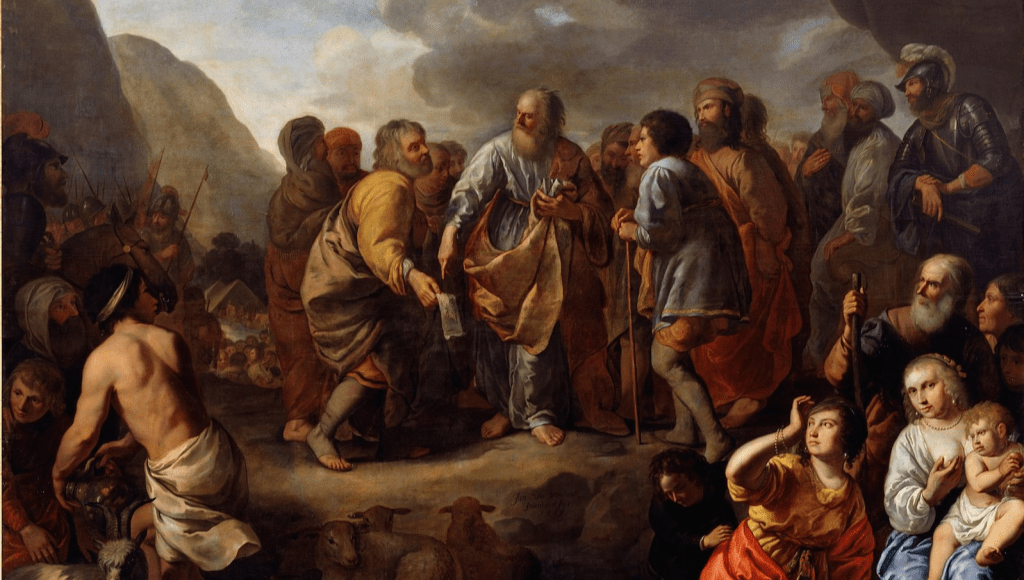
Jethro advising Moses, by Jan Gerritsz van Bronckhorst (1603-1661)

Meetings and church services within the task-oriented system tend to be ends in themselves (frustrating and boring!) because the meeting itself is just something that gets scratched off the to do list. Churches that have a hard time making decisions are probably stuck in the task-oriented mode, because there is no over-arching framework from which to decide anything.  

So, people entrench themselves in positions based in personal preferences. It’s the world of heated conversations and worship wars. If motivation and morale is dependent on people getting their way, no one is likely to be happy. The great need for a task-oriented church is a big picture vision that seeks results.

The results-oriented organization focuses on achieving some desired outcomes. This is the kind of organization that Jethro was thinking of when he observed Moses engaged in the endless task orientation of hearing people’s cases.

Tasks and functions are not ends in themselves, but will continually change in order to accomplish the results we want. This is a church or organization oriented around mission.  

Jesus came to this earth to accomplish the salvation of the world. He was on a mission of love – intent on extending grace to lost sinners. In this setting, decision-making becomes exciting. A group of people come up with ideas and tasks about loving people and reaching them with the grace we have received from God.  

A results orientation has personal preferences taking a back seat to the great needs of the community. There is freedom to experiment and imagine together, instead of guilt for not getting something crossed off the “To Do” list.

In truth, I like to create lists; it feels good when everything is scratched off the list at the end of the day. But I make sure that those things are a means to an end, and not the end itself.  

By orienting my ministry around mission (God’s, not mine) I am able to create tasks and functions that contribute to seeing the kingdom of God break into the church and the world. So, here are two K.I.S.S. questions for every leadership team:  

What result(s) would you like to see in your church?  

What kind of tasks will help you get the results you want?

Jesus is building his church, and the gates of hell will not overtake it. We can participate, change, grow, live, and learn, without fear of screwing up the church and making it more complicated than it is. Why? Because Jesus is the One building it.

All we need is a bit of grace with each other to step out by faith and make a difference by focusing and planning for some worthy, good, and just outcomes.

Almighty God, we pray for leaders everywhere in every place, that you will guide them in the ways of freedom, justice, and truth, so that all persons may live in peace. Lord, in your mercy, hear our prayer. Amen.


Together As One (Philippians 1:1-11)

From Paul and Timothy, servants of Christ Jesus—

To all God’s people in Philippi who are in union with Christ Jesus, including the church leaders and helpers:

May God our Father and the Lord Jesus Christ give you grace and peace.

I thank my God for you every time I think of you; and every time I pray for you all, I pray with joy because of the way in which you have helped me in the work of the gospel from the very first day until now. And so I am sure that God, who began this good work in you, will carry it on until it is finished on the Day of Christ Jesus. You are always in my heart! And so it is only right for me to feel as I do about you. For you have all shared with me in this privilege that God has given me, both now that I am in prison and also while I was free to defend the gospel and establish it firmly. God is my witness that I tell the truth when I say that my deep feeling for you all comes from the heart of Christ Jesus himself.

I pray that your love will keep on growing more and more, together with true knowledge and perfect judgment, so that you will be able to choose what is best. Then you will be free from all impurity and blame on the Day of Christ. Your lives will be filled with the truly good qualities which only Jesus Christ can produce, for the glory and praise of God. (Good News Translation)

One In Purpose

The Church is the community of the redeemed, the Body of Christ. In order to maintain health, the spiritual body needs unity, joy, and fellowship. This happens through a shared purpose of embracing the good news of Jesus Christ and proclaiming it to others.

Paul emphasizes throughout his letter that the church is to be a common community, sharing life together, working on supporting one another and reaching out to others.

Every pronoun, “you,” used in today’s text is plural, not singular. And that’s significant. We’re in the Christian life and the Christian Church together. Just as God is one, we too, in union with Christ, are one Body.

Wherever there is an absence of shared purpose, there you will find complaining, arguing, and a bunch of crotchety curmudgeons who nobody wants to be around. Without being one in purpose, we become divided and fight one another.

A Common Mission

Our common life together as believers, revolves around a shared mission of gospel proclamation, namely, that the kingdom of God is near. Through repentance and faith in the person and work of Jesus, there is forgiveness of sins, new life, and participation in the life of God.

Christian mission is not for larger church attendance, although that is nice and may happen; it isn’t to do more, or to get other people to stop swearing, avoid tattoos, or vote Republican.

The Apostle Paul knew without a focus on mission, on encouraging one another with the good news and sharing the gospel with others, the lack of purpose would create spiritual sickness. Apart from a deliberate focus on centering life and mission around the person and work of Christ, a group of people will nit-pick one another to death with their various opinions and wants.

Conversely, with a polestar on mission, the community of the redeemed work closely together and enjoy one another. Happy people are a breath of fresh air to be around. A good healthy spirit is a delight to others. Folks will inevitably find hope and healing through a common purpose of life together which imbibes liberally from the redemptive events of Jesus.

Good news is fun to share. It is joyful. The gospel of Jesus Christ is wonderful news, worthy of exuberant celebration. The Apostle Paul had fond memories of his partnership in the gospel with the Philippian believers. Although he had been jailed and beaten in the city of Philippi, Paul joyously sang in the prison – to the point where the jailer took notice and listened to the gospel of new life in Christ. The jailer and his entire family became followers of Jesus. (Acts 16:16-34)

Shared Experiences

The Philippians were Paul’s spiritual children. They had sacrificed with Paul toward the shared vision of proclaiming good news. So, Paul wanted them to remember their own significant events of coming to faith, enjoying fellowship together, and working toward common objectives.

In reminding the Philippian believers, Paul hoped to help get their heads screwed on straight again. He was confident this would happen, having an unshakable belief that God would continue the good work started within them.

This confidence was the basis of Paul’s prayers for the church. He beseeched God to unleash the Philippians’ collective love in a grand experiential knowledge of the divine so that they might discern well, making solid decisions which place the gospel as central to all of life.

There is an incredible depth to human need – a deep spiritual longing for what is good and beautiful. Relational unity brings out the beauty and majesty of humanity. Sometimes, when we are facing hard circumstances, we need to recall our collective shared experiences, to remember why we were joyful.

In difficult times of injustice, we need a vision of humanity which locks arms in unity without vilifying one another. When we place priority on the good news, I believe we will again discover the joy of life, of knowing Christ.

Perhaps, with a watching world observing basic human kindness and joyful relations, we will find ways of being better together and working toward the common good of all persons. And methinks, Jesus wants to help with this, if we will only let him.

God and Father of our Lord Jesus Christ: Give us grace to set aside our cranky unhappiness and divisive spirits. Take away all hatred and prejudice, and everything which hinders us from godly union and connection: that, as there is but one Body, and one Spirit, and one hope of our calling, one Lord, one faith, one baptism, one God and Father of us all; so we may be all of one heart, and of one soul, united in one holy bond of truth and peace, of faith and love, and with one mind and one mouth to glorify you, through Jesus Christ our Lord, and in the strength of the Holy Spirit. Amen.

Why Did Jesus Come? (Matthew 9:14-17)

Then John’s disciples came and asked him, “How is it that we and the Pharisees fast often, but your disciples do not fast?”

Jesus answered, “How can the guests of the bridegroom mourn while he is with them? The time will come when the bridegroom will be taken from them; then they will fast.

“No one sews a patch of unshrunk cloth on an old garment, for the patch will pull away from the garment, making the tear worse. Neither do people pour new wine into old wineskins. If they do, the skins will burst; the wine will run out and the wineskins will be ruined. No, they pour new wine into new wineskins, and both are preserved.” (New International Version)

The late Abigail Van Buren, better known in her day as the columnist, “Dear Abby,” was the person who made famous the phrase, “The church is a hospital for sinners, not a museum of saints.”

We occasionally need words like Dear Abby’s that are reminders of why Christians and Churches exist in the first place. The Church does not remain on this earth solely for its own benefit, any more than a hospital exists for the benefit of doctors or insurance companies. 

The Church exists to extend the mission of Jesus through proclamation of the gospel, the good news of forgiveness and new life in Christ. The Church calls people who are ensnared, entrapped, and in bondage to guilt and shame, and who need the restorative touch of grace. 

Our calling is not to find out what others can do for us (e.g. tithing and attendance) but what we can do for others. That’s why we are the continuing presence of Jesus on this earth as the temple of the Holy Spirit. 

Even though I am a church pastor, it is not my church. The church is not your church. It is Christ’s Church and we are to act in accordance with that truth.

Some of you reading this blog post are unhealthy. Some of you are sick with sin; some are heart-sick; others are just plain sick and tired of being sick and tired. Jesus (nor me!) is not looking to heap on you a load of expectations and guilt for things you are not doing; but instead is pointing you to the source of healing and change and inviting you to admit your need and come to him. 

Conversely, you may be healthy, spiritually alive and well. Therefore, it’s your job to roll up your sleeves and serve, to participate fully in the mission of Jesus for the church and the world.

Why did Jesus come? 

Jesus came to set up a new structure that could embrace his mission of bringing new life to people.

Christ used the occasion of John’s disciples asking him about fasting to communicate that his mission of reaching people through mercy and forgiveness will need a significant structural change. 

The two illustrations Jesus used – cloth and wineskins – is to simply point out that old and new wineskins are incompatible; and old and new pieces of cloth don’t go together. I would put it this way: You don’t put a new collar on a dead dog.

The Lord Jesus didn’t come to this earth just to perpetuate the status quo; he didn’t enter this world through the incarnation to simply dress up the Jewish religion, or to make a few minor adjustments to what already is going on. No! Christ came to change the old and do something new so that his mission could go forward through us.

We need a structural system which can accommodate the finished work of Jesus on the cross.

The entire sacrificial system and ritual laws of the Old Testament were only a matter of food and drink and various ceremonial washings – external regulations applying until the time of the new order.(Hebrews 9:10)

Christ is the one who arranges a new covenant, so that those who have been called by God may receive the eternal blessings that God has promised. This can be done because there has been a death which sets people free from the wrongs they did while the first covenant was in effect. (Hebrews 9:15, GNT)

Jesus canceled the first covenant in order to put the second into effect; the old is obsolete and has served it’s purpose. Now, Christ’s new covenant is in effect – a system big enough to hold the mission of the Church. (Hebrews 8:13; 10:9)

I wonder:

  • Is there anything in your life or in your church that is obsolete?
  • Is there a practice, ministry, system, or structure that is ineffective and not contributing to the mission that Jesus has for us in reaching others? 
  • Are there any dead dogs you keep trying to prop up on its legs?
  • Are you focused on what is important to Jesus? Do you know what’s important to him?
  • Do you keep performing the same rituals over and over because that is what you’ve always done?
  • What needs to change in your life to accommodate the mission of Jesus?

If the mission of Jesus is to occur we must develop:

  1. A relationship with Jesus. Engaging in spiritual disciplines of prayer, giving, fasting, reading and meditating on Scripture, are activities that put us in a position to know Christ better and respond to what is important to him.
  2. Relationships with each other that are not superficial but help one another to grow in Christ. We need to hold one another accountable for how the mission of Jesus is being accomplished, or not.
  3. Relationships with those outside of the church. This world is filled with sick, needy, hurting, lonely, unhealthy people who are stuck. They need a major change of life that can come from Jesus working through his followers. 

May it be so. Soli Deo Gloria.

Acts 2:1-21 – The Day of Pentecost

When Pentecost Day arrived, they were all together in one place. Suddenly a sound from heaven like the howling of a fierce wind filled the entire house where they were sitting. They saw what seemed to be individual flames of fire alighting on each one of them. They were all filled with the Holy Spirit and began to speak in other languages as the Spirit enabled them to speak.

There were pious Jews from every nation under heaven living in Jerusalem. When they heard this sound, a crowd gathered. They were mystified because everyone heard them speaking in their native languages. They were surprised and amazed, saying, “Look, aren’t all the people who are speaking Galileans, every one of them? How then can each of us hear them speaking in our native language? Parthians, Medes, and Elamites; as well as residents of Mesopotamia, Judea, and Cappadocia, Pontus and Asia, Phrygia and Pamphylia, Egypt and the regions of Libya bordering Cyrene; and visitors from Rome (both Jews and converts to Judaism), Cretans and Arabs—we hear them declaring the mighty works of God in our own languages!” They were all surprised and bewildered. Some asked each other, “What does this mean?” Others jeered at them, saying, “They’re full of new wine!”

Peter stood with the other eleven apostles. He raised his voice and declared, “Judeans and everyone living in Jerusalem! Know this! Listen carefully to my words! These people aren’t drunk, as you suspect; after all, it’s only nine o’clock in the morning! Rather, this is what was spoken through the prophet Joel:

In the last days, God says,
I will pour out my Spirit on all people.
    Your sons and daughters will prophesy.
    Your young will see visions.
    Your elders will dream dreams.
    Even upon my servants, men and women,
        I will pour out my Spirit in those days,
        and they will prophesy.
I will cause wonders to occur in the heavens above
    and signs on the earth below,
        blood and fire and a cloud of smoke.
The sun will be changed into darkness,
    and the moon will be changed into blood,
        before the great and spectacular day of the Lord comes.
And everyone who calls on the name of the Lord will be saved. (Common English Bible)

The Holy Spirit is the distinguishing mark of the believer in Jesus Christ.

Therefore, since the Spirit is given, the main responsibility of Christians is to receive. 

Christianity is distinctive in this sense – it is primarily a religion of receiving. The Christian life is lived by the power of the Holy Spirit, and not in our own strength. The function of faith is to receive what grace offers. 

We are saved and sanctified by grace alone through faith. God lives in and through us by means of the Spirit. The miraculous and the supernatural cannot, obviously, be done by any human person.  It can, however, be accomplished through the power of the Holy Spirit.

People tend to put a lot of pressure on themselves to be a certain way and to do certain things. The result? Tiredness. Discouragement. Imbalance. Lots of giving. Little receiving.

Christianity is not chiefly about giving but receiving. The Christian life is about putting oneself in a position to receive through prayer and humility. In Christianity, the opposite of receiving is not giving – it’s pride. 

Maybe this kind of talk makes you uncomfortable. I’m not talking about being passive or lazy. I’m highlighting the need of receiving grace from God by means of the Holy Spirit. Then, the Spirit to work in and through us. 

Jesus said we would do greater works than even he himself with the advent of the Spirit! (John 14:12-14)

The question then becomes: Will we let God be God? Will we allow the Spirit to do work in us?

The Spirit is elsewhere described in Holy Scripture as a gentle presence, an encourager, counselor, and comforter. Yet, not here at Pentecost – the Spirit is portrayed like a violent wind and an unusual fire.

The Holy Spirit on the Day of Pentecost was not some gentleman caller entering politely when invited. Instead, the Spirit appears more like a drunken sailor who bursts into the room and causes a big ruckus. There’s nothing subtle about the Spirit at Pentecost. The Spirit is electric, bombastic, and volcanic, causing a huge scene and upheaving the status quo.

Because of Pentecost, Christians are marked and defined by God’s Spirit living within them and being full of the Spirit. God wants to pour out the Spirit on all kinds of people to overflowing so that what comes out of them is “prophecy.” 

The prophet Joel and the Apostle Peter do not intend the word “prophecy” to mean predicting the future. Rather, they are referring to inspired speech coming from a heart overflowing with the Spirit. 

Just as an inebriated person says and does things they would not typically say or do because they are filled with alcohol, so the person filled with God’s Spirit says things and does things they would not typically say or do because their inspiration and courage come as a result of God within them.

Thus, we must cast off the unholy spirits of inebriation and receive the Holy Spirit of God.

Descent of the Holy Spirit at Pentecost mosaic by Anna Wyner

God sobered-up the little band of Christ followers from learners to practitioners, sending them into the world with a mission.

Being on a mission from God is not really about ability; it’s about being filled and sent. 

First time parents may read and learn all they can about parenting before their child is born. Yet, when that little bundle comes into the world, and the hospital puts this kid in your arms and sends you out, you feel inadequate for the task. Parenting becomes a kind of supernatural affair where you pray and learn on the fly, finding out that you need something beyond yourself to get anywhere in raising this screaming, pooping, sleeping person who depends completely on you for everything. 

God sends us into the world to make disciples. And we may feel very inadequate for the task. However, this has more to do with receiving the Spirit. The Spirit comes looking to turn our lives upside-down with new life in Jesus Christ. 

Pentecost means that the Spirit came to shake things up and accomplish among God’s people what they could never do on their own.

Everyone who calls on the name of the Lord will be saved. 

The Church in the New Testament was not a country club for people to simply enjoy the perks of membership.  The community of the redeemed, the Church, is actually more like a place where the people seem drunk because they are all talking with inspired speech from the Holy Spirit. 

Maybe we don’t need to be saved in the sense that we have already called on the name of the Lord concerning forgiveness in Christ. Yet, maybe we need to call on the name of the Lord to be delivered from our misguided attempts to see the Christian life as a pleasant affair.

Perhaps we need deliverance from disordered priorities and misguided loves. We may need to be saved from ourselves so that we are open to the Holy Spirit with palms up receiving from God whatever it is the Spirit wants to do in and through us, rather than telling God how we think things ought to go. 

Prayer, then, is more about receiving the Spirit and God’s purposes for us rather than giving God an earful and expecting the Lord to bless our plans.

Pentecost is the launching pad of the church’s mission – it was explosive because the Spirit is a kind of wild man who fills people up to overflowing so that what comes out of them is inspired speech and missional actions.

If a language barrier cannot stop the Spirit from operating, then how much more can God transform us and use us in the lives of those around us?

Joel’s prophecy, quoted by Peter, is only partially fulfilled. Events have been set in motion by Pentecost for the complete fulfillment of God’s justice. So, there’s some urgency for people to fill their vacuous souls with the grace freely offered to them in Christ.

The outpouring of the Spirit is a sign: The end is near. And the generous giving of the Spirit is inclusive – there is room for all kinds of people. Through the Spirit, God saves all who call on the name of the Lord.

Today is not just another day on the calendar. It is the Day of Pentecost! 

Just as marriages occasionally need a spark and a fire and a fresh wind, so we need the Holy Spirit to breathe on us, comfort us, and inspire us.

May we be filled with the Spirit as we anticipate what our God will do now, and in the years to come.

Spirit of the living God, through the reading and proclamation of the Word, may you refresh our spirits, reshape our desires, recreate our hearts, and reform our ways so that we will shine with your enduring glory, through Jesus Christ, our risen and ascended Lord. Amen.