Living Bread from Heaven (John 6:51-58)

Art by Nigel Wynter (1957-2024)

I am the living bread that came down from heaven. Whoever eats of this bread will live forever, and the bread that I will give for the life of the world is my flesh.”

The Jews then disputed among themselves, saying, “How can this man give us his flesh to eat?” 

So Jesus said to them, “Very truly, I tell you, unless you eat the flesh of the Son of Man and drink his blood, you have no life in you. Those who eat my flesh and drink my blood have eternal life, and I will raise them up on the last day, for my flesh is true food, and my blood is true drink. Those who eat my flesh and drink my blood abide in me and I in them. Just as the living Father sent me and I live because of the Father, so whoever eats me will live because of me. This is the bread that came down from heaven, not like that which the ancestors ate, and they died. But the one who eats this bread will live forever.” (New Revised Standard Version)

To the religious leaders of Christ’s day, Jesus was making more noise than a couple of skeletons dancing on a tin roof. And they neither liked it, nor appreciated him drawing so much attention to himself.

Tensions had been escalating between Jesus and the religious establishment. The atmosphere was thick with grumbling leaders, as they tried to make some sense of Christ’s words to them.

Jesus offering his body for people to eat was causing far too much noise for the Jewish leaders. What in the world is this guy talking about?

Rather than making the meaning clear for them, Jesus added drinking his blood to the discussion. What’s more, Christ got up in their grill and confronted them with a choice, instead of a straightforward explanation.

Using some good old double negative language, Jesus flatly stated that there’s no life without any eating of his flesh and drinking of his blood. Then conversely, stated positively, Jesus affirmed that eternal life is found in those who eat his flesh and drink his blood.

This was next level communication of Jesus to the religious leaders. Earlier, Christ let them know that they needed to make the choice of coming to himself, of engaging in a life-giving relationship with him.

Yet now, it’s a matter of outright participation in Jesus, of eating and drinking the body and blood of Christ. Both the choice of relationship and of participation are radical decisions, which requires ditching some old traditions, and beginning some new ones.

Christ’s words are difficult, because they demand a change in thinking and behavior. Indeed, his words demand a change in our very way of being.

Christian discipleship requires that we stop the false ways of being in this world, and start a different way of being, according to the true self. In other words, Jesus was insisting on repentance and faith.

We are all on the hook to not just talk some theology and take some communion elements. It’s a lot more involved than that. Jesus demands our very lives, and not simply to sign off on some doctrinal statement about him. It’s about life itself, the power of life and death.

By eating and drinking Christ, there is meaningful relational connection, and ongoing participation in his life and ministry.

None of this is about literal cannibalism, and not even about actual bread and wine. This is deep metaphorical stuff which is meant to convey to us who Jesus is and how we can be related to him.

When we ingest food and drink, it goes into us and throughout our entire body. You cannot get much closer to something than by eating it and having it inside you. Just as eating bread goes to our very core and helps sustain life, so ingestingJesus is about allowing him to be as close to us as possible, into the very depths of our soul.

And by taking Christ into us, we will truly live and connect; and not be separated and die.
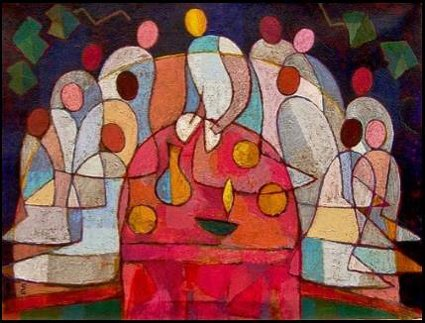
Art by Soiche Watanabe

We can no more spiritually live without taking Jesus into us, as we could live without eating on a regular basis. Christ is our breakfast, lunch, and dinner; our midnight snack and our birthday cake. Jesus is all that, and more.

Perhaps you are wondering why Jesus didn’t just state plainly who he is, why he came, and what will happen. Because it’s too much to handle.

We don’t simply accept Jesus into our heart, and then go on our merry way. Jesus Christ is someone to search for and discover, as if we were looking for fresh water or for the best baguette in the world.

Anyone can affirm a few belief statements, or do some good deeds. But it takes real courage to go hard after the spiritual life and find out what it’s all about:

It requires some solid bravery to explore the depths of your own true self and face the internal crud that’s been hiding in the shadows of your soul.

It demands identifying the bogus ways we prop up a false self for others to see – wanting to control how people view us and treat us.

It takes some real chutzpah to pursue the God life without worrying about where it will take you or who it will upset.

Jesus is a force to contend with. He is the Son of God, sent from above, to provide the world with real spiritual food and drink. Christ is the one who sustains life, and makes abundance possible. He is the Lord who speaks, calls out, and draws us to himself.

Jesus Christ helps us fit, even though we come from the island of misfit toys.

Even more pertinent than the question of “Who is Jesus?” is the probing question, “And what will you do with him?”

Christ cannot fit into your neat theological system, your tidy doctrinal statements, and on your nicely cleaned coffee table within the attractive Bible. Sooner or later, we all must contend with the divine force which gives life to everything. We cannot get away from him.

So, go after Jesus. Find out who he is. Determine how to deal with a mercy so powerful that it melts away guilt and shame as if it were in a 500 degree oven. After all, it’s better to have a tasty loaf of bread than to become a hard slice of burnt toast.

But let’s not worry about how hot it is in here, but how noisy it’s getting.

Gracious Lord, move us, your people, to experience your love more deeply. Fill us with the energy that comes from a desire for service. Connect us with creation to care for your world. Engage us in the scriptures and increase our knowledge of you. Raise up your power and come among us. May your bountiful grace and mercy equip us. Amen.

Micah 4:6-8 – Belonging

“In that day,” declares the Lord,

“I will gather the lame;
    I will assemble the exiles
    and those I have brought to grief.
I will make the lame my remnant,
    those driven away a strong nation.
The Lord will rule over them in Mount Zion
    from that day and forever.
As for you, watchtower of the flock,
    stronghold of Daughter Zion,
the former dominion will be restored to you;
    kingship will come to Daughter Jerusalem.” (New International Version)

One of the great tragedies of our world, as well as one of the worst feelings of humanity, is the sense that one does not belong.

Since people are hard-wired by God for community, belonging is essential, not optional. The image of the rugged individualist who gets things done on their own terms and marches to the beat of a different drum might be an appealing picture to many Westerners – but it falls woefully short of real lived human experience.

Since the fall of humanity, people have tended to group themselves into insiders and outsiders. In other words, discrimination is the enemy of true belonging. And, what’s more, there always seems to be people who are ready to create such division for their own purpose and profit. Indeed, it’s an age old tale, perhaps best told by Dr. Seuss in his classis book, Sneetches and Other Stories (1961).

In the story, Sneetches with stars on their bellies discriminate against and shun those without. A slick entrepreneur, Sylvester McMonkey McBean, offers the Sneetches without stars on their bellies the chance to get them with his Star-On machine, for three dollars, of course.

The application of stars upon thars is instantly and wildly popular. However, this abjectly upsets the original star-bellied Sneetches. They are in danger of losing their special status! So, McBean then tells them about his Star-Off machine, costing ten dollars, of course, and the Sneetches who originally had stars happily pay the money to have them removed.

Since McBean only cares about profit, he allows the recently starred Sneetches through this machine, as well. Ultimately, the entire affair escalates, with all the Sneetches running from one machine to the next…

“…until neither the Plain nor the Star-Bellies knew

whether this one was that one… or that one was this one…

or which one was what one… or what one was who.”

The Sneetches end up penniless. McBean leaves a rich man. The Sneetches learn from the experience that neither plain-belly nor star-belly Sneetches are superior. They finally become friends. Dr. Suess intended his story to be a satire of discrimination between races and cultures.

The kingdom of God is an egalitarian realm. There are no walls and barriers dividing people into opposing groups. And there isn’t such a thing as marginal, excluded, insignificant, forbidden, or discounted people.

Micah’s prophecy tells not of the privileged and powerful coming together for renewal but the lame. God’s care in maintaining a remnant and gathering them for restoration will be made up of the wounded, the ones who have no ability to bring themselves to the center.

The upside-down kingdom of God makes the last first, and the first, last. The Lord’s rule and reign champions the disabled and the misfits – those without an ability to come. They may be forgotten by others but never by God.

Like Santa coming to the island of misfit toys, rescuing and airlifting forgotten toys so that they can become treasured gifts for boys and girls – so God creates belonging where there seems none to be had. And leading the effort is a tossed aside reindeer named Rudolph, using his unique “deformity” to cut through the tough winter storm.

Perhaps you feel a bit, or maybe a lot, like the square peg trying to fit into a round hole. It could be that you wonder whether there is a place for you. You have experienced life as something of an oddity, as if the normal world around you is not aware of your very personhood.

The good news is that a prominent place is given to the humble, for those attempting to make a difference in the world that gives them no place to belong. God sees. God hears. God knows. God cares.

The Lord sends a Savior, a Deliverer, who will himself be a peculiar individual on this earth. It will seem as if he is from another place… which he is. But, then again, aren’t we all? Each of us was crafted with divine care and attention.

You are the one who created my innermost parts;
    you knit me together while I was still in my mother’s womb.
I give thanks to you that I was marvelously set apart.
    Your works are wonderful—I know that very well.
My bones weren’t hidden from you
    when I was being put together in a secret place,
    when I was being woven together in the deep parts of the earth.
Your eyes saw my embryo,
    and on your scroll every day was written that was being formed for me,
    before any one of them had yet happened. (Psalm 139:13-16, CEB)

The Lord has good plans for you and me. It might seem as if there are times God is placing a heavy hand upon us, even punishing. Yet, restoration is in the future. In this season of the year, we celebrate that Jesus is our Immanuel, God with us.

May Christ, who by his incarnation gathered into one, things earthly and heavenly, fill you with joy and peace. Amen.

Matthew 8:14-17 – A Changed Life

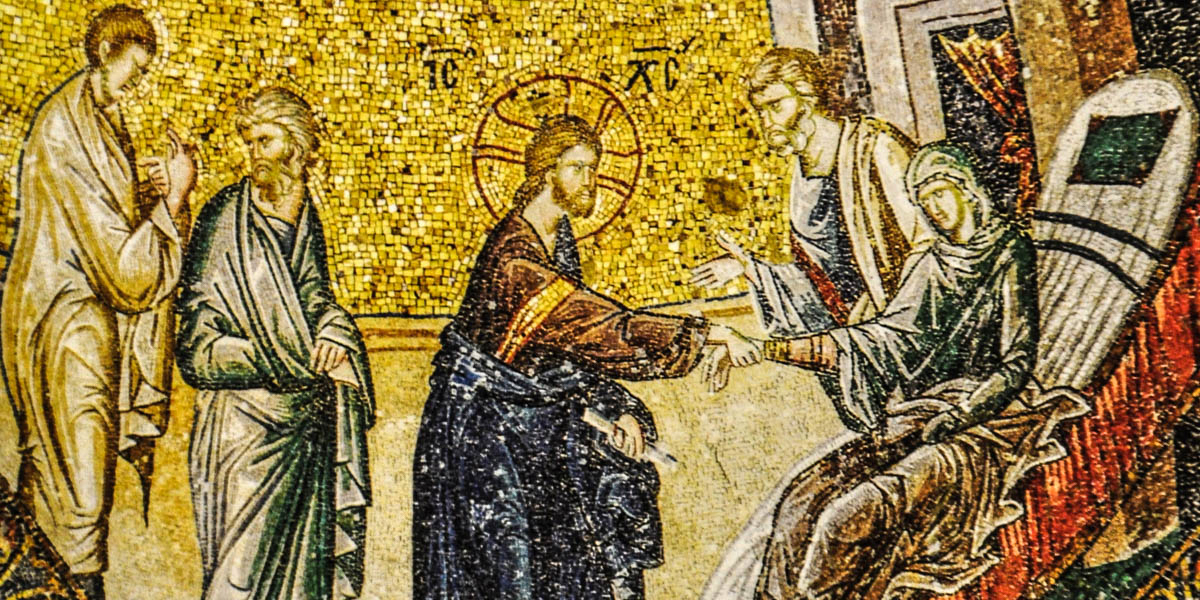
Jesus Heals Peters Mother In Law
A mosaic of Jesus healing Peter’s mother-in-law, from a Byzantine Church, c.1100 C.E.

When Jesus came into Peter’s house, he saw Peter’s mother-in-law lying in bed with a fever. He touched her hand and the fever left her, and she got up and began to wait on him.

When evening came, many who were demon-possessed were brought to him, and he drove out the spirits with a word and healed all the sick. This was to fulfill what was spoken through the prophet Isaiah:

“He took up our infirmities
    and bore our diseases.” (NIV)

One of the great realities we run headlong into with the New Testament Gospels is that Jesus has the authority to heal and transform the world… and me. Forty-one years ago, today, I experienced the reviving and revolutionizing work of Jesus Christ. I realize not everyone has a specific time they can point to when God does something miraculous, and I also do not expect that everyone’s experience of the divine must conform or be like my own. No, my encounter with God was just that, mine alone. Yet, I hope you find some encouragement and solace in my brief story.

I was probably the least likely person to become a follower of Jesus, let alone to have shown any promise toward the pastoral and religious life. I had serious reservations about the veracity of faith, the relevance of church, and the importance of religion. Although, outwardly, my family made attending our local church mandatory, inwardly, I felt the entire Christianity thing to be boring, irrelevant, and contrived. I was much more likely to behave passive-aggressively than piously.

But I began to rethink and revisit my doubts and epistemic assumptions about all things God and Christianity. The love of Christians around me stirred the internal upheaval. I had come to view the world as a cruel place and saw other people through jaded lenses. Relationships were for me a necessary evil. So, when love and grace entered my orbit, it threw me into sort of an existential angst. Having come to settled-thinking in my understanding of a dark world and having learned to navigate it with the tools of sarcasm and skepticism, genuineness and authenticity were a complete monkey wrench in my cosmology.

To put the whole matter succinctly, Jesus touched me. My small sin-sick heart was healed and enlarged. I walked away completely changed. I cannot accurately say what happened any more than I could tell you how a transplant doctor puts a new heart into the chest of a person. I can only speak to the results: newfound joy instead of nihilism; new desires to bless others and the world instead of looking for ways to disengage from people; new speech and wanting to edify and encourage people instead of sly words of putting others down; and, perhaps most surprising of all (to me) a thoroughly new desire to glorify God and enjoy him forever.

Pastor Tim

The love of God in Christ made all the difference for me – and still does, all these years later. I stand in a long Christian tradition of outsiders and misfits entering the kingdom of God through spiritual metamorphosis – going all the way back to today’s story of Jesus healing and transforming.

In the first century, Jewish women were not allowed as far inside the temple as Jewish men.  Lepers could not go in, at all.  Centurions and Gentiles could only get into the outer court, emphasizing that they were outsiders.  In the synagogue service, women sat in the back, under the balcony. There were pious men who would pray, not in a spirit of humility, but thanking God they were not women.  In this healing account of a woman, no one asks Jesus for healing; he just walks into a house and heals Peter’s mother-in-law just because he wants to!

Christ’s authority, concern, and healing power even extended to the demonic realm. It perhaps goes without saying that most people would not want to hang-out with demonized people who carry a load of problems and sickness with them; they are yet another example of the classic outsiders.  If we take seriously that Jesus is our model for ministry, then we need to take passages like this seriously and connect with outsiders and bring them to Jesus.

The Old Testament quote comes from Isaiah 53:4. Sickness relates to sin – not always personal sin, but from living in a fallen and fundamentally broken world.  In other words, when the biblical text says that Jesus took up our infirmities and carried our diseases, it is saying that Christ takes our sin upon himself. His healing acts are tied to the cross.  There is new life and spiritual health in the cross of Jesus Christ.  We come to the foot of the cross as spiritual beggars, looking for grace and mercy in our time of need because Jesus has the authority to extend healing and deliverance from every sin and every sickness and every problem known to people.

Through Jesus Christ there is and can be healing for damaged emotions, broken hearts, pain-ridden bodies, and sin-sick souls. There shall be joy through mourning. There is life through death. A new day will dawn, carrying fresh grace and unique mercies for the journey ahead. Behind it all is the God who is still in the business of renewing minds and hearts, and reforming attitudes and actions through extravagant and inexhaustible love.

God of all creation forgive my foolish thoughts and errant ways; clothe me in my right mind; and, calm my troubled heart. My soul is off, and I cannot seem to find my balance, so I stumble and worry constantly. Give me the strength and clarity of mind to find my purpose and walk the path you have laid out for me. I trust your love, God, and know that you will heal this stress, and mend my spirit. Just as the sun rises each day against the dark of night, bring me clarity with the light of God, through Jesus Christ, Savior and Lord, in the power of your Holy Spirit. Amen.