Exodus 10:21-29 – From Darkness to Light

Darkness

Then the Lord said to Moses, “Stretch out your hand toward the sky so that darkness spreads over Egypt—darkness that can be felt.” So, Moses stretched out his hand toward the sky, and total darkness covered all Egypt for three days. No one could see anyone else or move about for three days. Yet all the Israelites had light in the places where they lived.

Then Pharaoh summoned Moses and said, “Go, worship the Lord. Even your women and children may go with you; only leave your flocks and herds behind.”

But Moses said, “You must allow us to have sacrifices and burnt offerings to present to the Lord our God. Our livestock too must go with us; not a hoof is to be left behind. We have to use some of them in worshiping the Lord our God, and until we get there, we will not know what we are to use to worship the Lord.”

But the Lord hardened Pharaoh’s heart, and he was not willing to let them go. Pharaoh said to Moses, “Get out of my sight! Make sure you do not appear before me again! The day you see my face you will die.”

“Just as you say,” Moses replied. “I will never appear before you again.” (NIV)

The ancient Israelites were in bondage to the mighty Egyptian empire. After four-hundred years of bondage, God called Moses to lead them out from Egypt to the Promised Land. The only kink was the Egyptian Pharaoh’s outright reluctance. As the most powerful human on the planet at the time, Pharaoh was used to getting his way on everything. God knew it would be a process of deliverance, and not just a sudden event.

So, a series of ten wonders or miracles occurred that struck at the heart of Egyptian power and religion. A discernible pattern quickly developed in which Pharaoh refused cooperation; God sent an incredible devastation on the land; Pharaoh relented with a half-repentance; God lifted the devastation; and, with things “back to normal” Pharaoh’s heart was hardened and he would not let God’s people go. Rinse and repeat a lot more times.

Today’s Old Testament lesson recounts the ninth wonder done by God, using Moses. Although the miracle of complete and total darkness lasted a full three twenty-four-hour long days without harming any human or animal, the sheer fear and terror it brought to the Egyptians left them in a three-day state of suspense. Living on the edge in anxious apprehension is psychologically overwhelming. At least with the other plagues, you could see what you were up against.

Fear in the dark

In the land known as the “eternally rising sun,” the uncertainty of the perpetual darkness was meant to humble Egypt and put it in its place. Yet, with nine strong and full wonders from God, Pharaoh remained intransigent and stubborn. He was not going to let all that slave labor walk away while he was in charge.

I “wonder” what it takes for most of us to make a major change in our lifestyle – what we need to go through before we cry “uncle” and let go. The more power and control we have, the harder it is to do so. Humans are creatures of habit, and wherever there are long standing routines there you will find great difficulty in changing those practices.

No one simply wakes up in the morning and decides to be a jerk. Instead, it is likely that one day a person will arise, look in the mirror, and not recognize who is looking back at them. A series of choices and habits over a long stretch of time eventually formed the undistinguished blockhead. The Apostle James once described the pathology behind the person in the mirror:

You are tempted by the evil things you want. Your own desire leads you away and traps you. Your desire grows inside you until it results in sin. Then the sin grows bigger and bigger and finally ends in death. (James 1:14-15, ERV)

By reading today’s story Christologically we have a clue as to the remedy and reformation needed to form newer and better habits. Just as all Egypt was in three days of darkness due to sin, so Jesus was three days in the dark grave because of the world’s sin. And just as the ancient Israelites were delivered from their cruel bondage from Egypt and entered the Promised Land, so in Jesus Christ humanity is liberated from their power-hungry, money-grubbing, control-obsessing ways of being insensitive dolts to forming new habits of humility, justice, and love. The Apostle Peter said:

You are a chosen race, a royal priesthood, a holy nation, God’s own people, in order that you may proclaim the mighty acts of him who called you out of darkness into his marvelous light. (1 Peter 2:9, NRSV)

It is the aim of the Christian to look out at the world and bring love where love is not; to discover it is more blessed to give than to receive; and, to have a deep sense of justice which works for egalitarian ways and the equity of all people, not just people of privilege.

So, may we gain a proper perspective of ourselves, others, and the world. And, may we resist the Pharaoh’s among us, while championing the needs of the downtrodden of this old fallen world. May we be like Christ and see Jesus in each person we encounter.

God, you have given all peoples one common origin. It is your will that they be gathered as one family in yourself. Fill the hearts of humanity with the fire of your love and with the desire to ensure justice for all. By sharing the good you give us, may we secure an equality for all our brothers and sisters throughout the world. May there be an end to division, strife, and war. May there be a dawning of a truly human society built on love and peace. We ask this in the name of Jesus, our Lord, through the might of the Holy Spirit. Amen.

Matthew 8:14-17 – A Changed Life

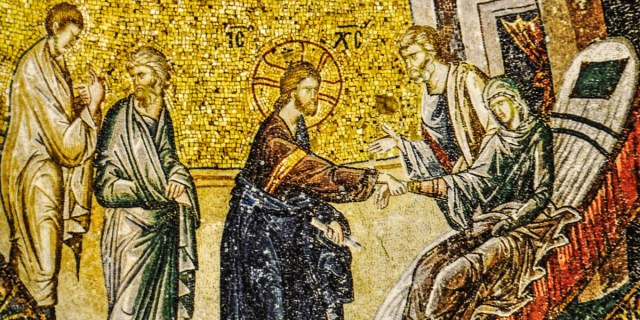
Jesus Heals Peters Mother In Law
A mosaic of Jesus healing Peter’s mother-in-law, from a Byzantine Church, c.1100 C.E.

When Jesus came into Peter’s house, he saw Peter’s mother-in-law lying in bed with a fever. He touched her hand and the fever left her, and she got up and began to wait on him.

When evening came, many who were demon-possessed were brought to him, and he drove out the spirits with a word and healed all the sick. This was to fulfill what was spoken through the prophet Isaiah:

“He took up our infirmities
    and bore our diseases.” (NIV)

One of the great realities we run headlong into with the New Testament Gospels is that Jesus has the authority to heal and transform the world… and me. Forty-one years ago, today, I experienced the reviving and revolutionizing work of Jesus Christ. I realize not everyone has a specific time they can point to when God does something miraculous, and I also do not expect that everyone’s experience of the divine must conform or be like my own. No, my encounter with God was just that, mine alone. Yet, I hope you find some encouragement and solace in my brief story.

I was probably the least likely person to become a follower of Jesus, let alone to have shown any promise toward the pastoral and religious life. I had serious reservations about the veracity of faith, the relevance of church, and the importance of religion. Although, outwardly, my family made attending our local church mandatory, inwardly, I felt the entire Christianity thing to be boring, irrelevant, and contrived. I was much more likely to behave passive-aggressively than piously.

But I began to rethink and revisit my doubts and epistemic assumptions about all things God and Christianity. The love of Christians around me stirred the internal upheaval. I had come to view the world as a cruel place and saw other people through jaded lenses. Relationships were for me a necessary evil. So, when love and grace entered my orbit, it threw me into sort of an existential angst. Having come to settled-thinking in my understanding of a dark world and having learned to navigate it with the tools of sarcasm and skepticism, genuineness and authenticity were a complete monkey wrench in my cosmology.

To put the whole matter succinctly, Jesus touched me. My small sin-sick heart was healed and enlarged. I walked away completely changed. I cannot accurately say what happened any more than I could tell you how a transplant doctor puts a new heart into the chest of a person. I can only speak to the results: newfound joy instead of nihilism; new desires to bless others and the world instead of looking for ways to disengage from people; new speech and wanting to edify and encourage people instead of sly words of putting others down; and, perhaps most surprising of all (to me) a thoroughly new desire to glorify God and enjoy him forever.

Pastor Tim

The love of God in Christ made all the difference for me – and still does, all these years later. I stand in a long Christian tradition of outsiders and misfits entering the kingdom of God through spiritual metamorphosis – going all the way back to today’s story of Jesus healing and transforming.

In the first century, Jewish women were not allowed as far inside the temple as Jewish men.  Lepers could not go in, at all.  Centurions and Gentiles could only get into the outer court, emphasizing that they were outsiders.  In the synagogue service, women sat in the back, under the balcony. There were pious men who would pray, not in a spirit of humility, but thanking God they were not women.  In this healing account of a woman, no one asks Jesus for healing; he just walks into a house and heals Peter’s mother-in-law just because he wants to!

Christ’s authority, concern, and healing power even extended to the demonic realm. It perhaps goes without saying that most people would not want to hang-out with demonized people who carry a load of problems and sickness with them; they are yet another example of the classic outsiders.  If we take seriously that Jesus is our model for ministry, then we need to take passages like this seriously and connect with outsiders and bring them to Jesus.

The Old Testament quote comes from Isaiah 53:4. Sickness relates to sin – not always personal sin, but from living in a fallen and fundamentally broken world.  In other words, when the biblical text says that Jesus took up our infirmities and carried our diseases, it is saying that Christ takes our sin upon himself. His healing acts are tied to the cross.  There is new life and spiritual health in the cross of Jesus Christ.  We come to the foot of the cross as spiritual beggars, looking for grace and mercy in our time of need because Jesus has the authority to extend healing and deliverance from every sin and every sickness and every problem known to people.

Through Jesus Christ there is and can be healing for damaged emotions, broken hearts, pain-ridden bodies, and sin-sick souls. There shall be joy through mourning. There is life through death. A new day will dawn, carrying fresh grace and unique mercies for the journey ahead. Behind it all is the God who is still in the business of renewing minds and hearts, and reforming attitudes and actions through extravagant and inexhaustible love.

God of all creation forgive my foolish thoughts and errant ways; clothe me in my right mind; and, calm my troubled heart. My soul is off, and I cannot seem to find my balance, so I stumble and worry constantly. Give me the strength and clarity of mind to find my purpose and walk the path you have laid out for me. I trust your love, God, and know that you will heal this stress, and mend my spirit. Just as the sun rises each day against the dark of night, bring me clarity with the light of God, through Jesus Christ, Savior and Lord, in the power of your Holy Spirit. Amen.

Matthew 8:1-13 – Two Amazing Healings

Jesus heals the leper
Jesus touches the leper, a mosaic from an early Byzantine Church

When Jesus came down from the mountainside, large crowds followed him. A man with leprosy came and knelt before him and said, “Lord, if you are willing, you can make me clean.”

Jesus reached out his hand and touched the man. “I am willing,” he said. “Be clean!” Immediately he was cleansed of his leprosy. Then Jesus said to him, “See that you don’t tell anyone. But go, show yourself to the priest and offer the gift Moses commanded, as a testimony to them.”

When Jesus had entered Capernaum, a centurion came to him, asking for help. “Lord,” he said, “my servant lies at home paralyzed, suffering terribly.”

Jesus said to him, “Shall I come and heal him?”

The centurion replied, “Lord, I do not deserve to have you come under my roof. But just say the word, and my servant will be healed. For I am also a man under authority, with soldiers under me. I tell this one, ‘Go,’ and he goes; and that one, ‘Come,’ and he comes. I say to my servant, ‘Do this,’ and he does it.”

When Jesus heard this, he was amazed and said to those following him, “Truly I tell you: I have not found anyone in Israel with such great faith. I say to you that many will come from the east and the west and will take their places at the feast with Abraham, Isaac, and Jacob in the kingdom of heaven. But the subjects of the kingdom will be thrown outside, into the darkness, where there will be weeping and gnashing of teeth.”

Then Jesus said to the centurion, “Go! Let it be done just as you believed it would.” And his servant was healed at that moment. (NIV)

Maybe you, like me, have had your computer pick up a nasty virus that hijacks every file and function you possess. For me, the most frustrating thing about those events is that there is nothing I can do by myself to fix it or make it better. I must humble myself and ask some computer geek to get into my system and take care of the problem. It feels weird looking at my screen and having somebody I do not know working inside my personal computer. But if I fail to get help, my computer would be worthless – unless I let someone with authority fix the blasted thing.

Jesus Christ is Lord of all. Since he has authority over everything, we must live our lives in submission to his will and way. Only through humble resignation to Christ will we experience the healing and deliverance we seek.

Jesus preached his famous Sermon on the Mount (Matthew 5-7) and taught the people as one who had authority. In that Sermon, Jesus laid out the values of God’s kingdom: humility, sorrow over sin, meekness, purity, mercy, and peacemaking. Now, in today’s Gospel lesson, we see the power and values of God’s kingdom evidenced and expressed in two stories of healing and deliverance.

The world needs saving, and that is exactly what Jesus is up to. Jesus Christ’s authority is total, and comes from his moral authority, as the very embodiment of the Beatitudes he taught. Grace always gets the last word, as Jesus healed without showing favoritism nor discrimination.

In the first story, Jesus used his authority to heal and transform a leper. Leprosy was a feared disease in the ancient world. There was no known cure, and lepers were forced to live apart from everyone else. The Old Testament book of Leviticus says that a leper must wear torn clothes, let his hair be unkempt, cover the lower part of his face and cry out “unclean! unclean!” (Leviticus 13:45-46).  Lepers were the ultimate outsiders.

A leper came to Jesus with a humble profession of faith: “Lord, if you want to, you can make me clean.” It was a clear case of genuine need, and poverty of spirit. Jesus responded by doing the unthinkable: He touched him.  In a great and wonderful reversal, Jesus did not become unclean by touching the leper but instead the leper was made clean.

If we want the world to be saved and to follow the way of Jesus, then we will emulate our Lord by touching the world. It will not do for us to stand afar off from the outsiders of our community and avoid marginalized people. It will not do for us just to provide a service without having to touch someone. Authentic Christian ministry communicates love through contact and identification with others.

Eleven centuries after Jesus walked the earth, another man, Francis, met a leper on the road as he journeyed toward Assisi. “Though the leper caused him no small disgust and horror, he nonetheless, got off the horse and prepared to kiss the leper.  But when the leper put out his hand as though to receive something, he received money along with a kiss” (Life of St. Francis by Thomas of Celano). Francis did what seemed humanly impossible because he was filled with the love and compassion of Christ. The love of Jesus allows us to touch others with compassionate care, especially to those who have been rejected and mistreated.

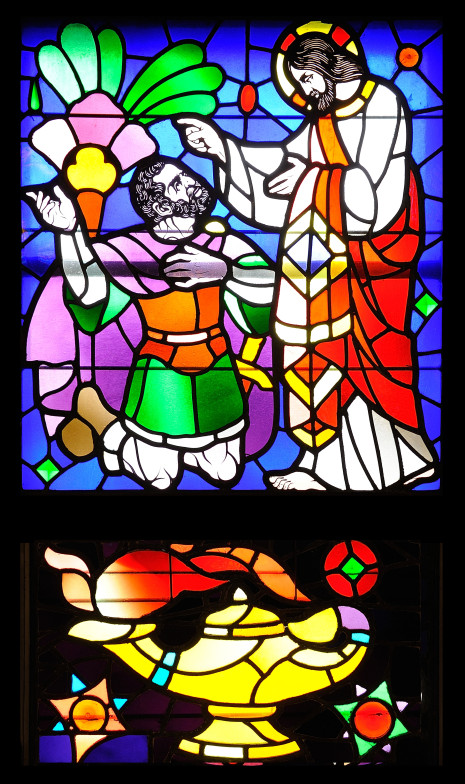
Centurion Begs Jesus stained glass
The Centurion Begs Jesus to Heal his Servant, and The Lamp of Faith, from St. Matthew Catholic Church in Detroit, Michigan.

The second story was equally eye-popping and unbelievable to the people in Christ’s day. Jesus used his authority to heal and transform a Gentile. Again, we see the Beatitudes expressed toward a Roman Centurion who felt unworthy to even have the Lord Jesus come into his house. Furthermore, the Centurion’s profession of faith amazed even Jesus: “Just say the word,” he said in recognition of Christ’s authority, which is big enough to heal without even being present.  Centurions were the backbone of the Roman military machine and hated by the Jews. Yet, Jesus the Jew not only responded to the Centurion’s request, he affirmed this Gentile’s faith as greater than any Jew.

Grace answers to need, and not to smug self-confidence. The Roman Centurion did not ask for healing for himself but for his servant, and Jesus listened and answered. The Centurion neither demanded nor claimed healing but came in a spirit of humility and asked with confidence that Jesus could heal his servant if he wanted to. The Centurion simply threw himself on God’s mercy. So, Jesus upheld the Centurion as a model of faith for us all.

Not only did Jesus affirm the Centurion’s faith, he gave a solemn warning to the self-righteous: Their lack of humility and genuine faith would land them outside the kingdom. In another great reversal, the insiders will become the outsiders, and the outsiders become the insiders. The independently proud did not experience healing and transformation because they did not even know they were sin sick. They saw no need for an intervention by Jesus because they already had their righteous deeds to boast about. They were more concerned about looking good and saving face and did not perceive their own unworthiness.

The self-righteous approach to handling problems and difficult situations is to come up with good ideas and clever strategies, relying on sheer personal effort and willpower. Prayer may or may not happen after the plans are laid, and there is no sense of beginning with beseeching God.  Our delusional thoughts of personal autonomy only separate us from the grace of God we so desperately need.

There is a spiritual dimension to every situation and trouble we face – including sickness.  If we only examine the medical end of physical problems, we may be dealing with symptoms instead of the root issue that plagues us. The Apostle James said:

Are you hurting? Pray. Do you feel great? Sing. Are you sick? Call the church leaders together to pray and anoint you with oil in the name of the Master. Believing-prayer will heal you, and Jesus will put you on your feet. And if you have sinned, you will be forgiven—healed inside and out. Make this your common practice: Confess your sins to each other and pray for each other so that you can live together whole and healed. (James 5:13-16, MSG)

Jesus healed and transformed outsiders. The followers of Christ must constantly ask: Who are the outsiders among us? Do we care about strangers?  Are we willing to touch aliens and immigrants?  Will we intercede in prayer for those who are foreign to us?  Will we search for and pursue those on the periphery of society?  Do we believe the risen and ascended Jesus can and will heal, deliver, and transform people?

Jesus cannot be domesticated into some figurehead that suits our desires and conforms to our ideas about how things ought to be. Jesus is portrayed in these stories as eager to heal, wanting to show grace to the least and the lowly among society. May we participate in word and deed the Lord’s Prayer:

Our Father in heaven,
may your name be kept holy.
May your Kingdom come soon.
May your will be done on earth,
as it is in heaven.
Give us today the food we need,
and forgive us our sins,
as we have forgiven those who sin against us.
And don’t let us yield to temptation,
but rescue us from the evil one. Amen. (Matthew 6:9-13, NLT)

Exodus 3:1-12 – God of the Impossible

Burning Bush by Yoram Raanan
The Burning Bush by Yoram Raanan

Now Moses was tending the flock of Jethro his father-in-law, the priest of Midian, and he led the flock to the far side of the wilderness and came to Horeb, the mountain of God. There the angel of the Lord appeared to him in flames of fire from within a bush. Moses saw that though the bush was on fire it did not burn up. So, Moses thought, “I will go over and see this strange sight—why the bush does not burn up.”

When the Lord saw that he had gone over to look, God called to him from within the bush, “Moses! Moses!”

And Moses said, “Here I am.”

“Do not come any closer,” God said. “Take off your sandals, for the place where you are standing is holy ground.” Then he said, “I am the God of your father, the God of Abraham, the God of Isaac and the God of Jacob.” At this, Moses hid his face, because he was afraid to look at God.

The Lord said, “I have indeed seen the misery of my people in Egypt. I have heard them crying out because of their slave drivers, and I am concerned about their suffering. So I have come down to rescue them from the hand of the Egyptians and to bring them up out of that land into a good and spacious land, a land flowing with milk and honey—the home of the Canaanites, Hittites, Amorites, Perizzites, Hivites and Jebusites. And now the cry of the Israelites has reached me, and I have seen the way the Egyptians are oppressing them. So now, go. I am sending you to Pharaoh to bring my people the Israelites out of Egypt.”

But Moses said to God, “Who am I that I should go to Pharaoh and bring the Israelites out of Egypt?”

And God said, “I will be with you. And this will be the sign to you that it is I who have sent you: When you have brought the people out of Egypt, you will worship God on this mountain.” (NIV)

The burning bush is one of those iconic objects and stories in Holy Scripture. The experience of Moses changed both his life and the lives of all the Israelites then and now. Having spent the first forty years of his life as a darling in the Egyptian court, then the next forty years far from that life on the backside of the desert with a bunch of sheep, it is an understatement to say Moses did not expect or ever envision encountering God in a burning bush.

The impossible has no possibility. Or, does it?

That incredible encounter engaged the senses of Moses: the paradoxical sight of seeing fire in a bush that isn’t burning up; the smells of sheep, the outdoors, and perhaps, even of fire; hearing the call of God from within the bush; spiritually and emotionally tasting the attentive justice of God; and, removing the sandals to touch and feel the grounding of sacred space.

The story comments on the senses of God, as well. Even though God is Spirit and is worshiped as such, God is alive with his own sensations: seeing the approach of Moses, and the misery of the Israelites; the smell of injustice wafting into God’s nostrils with a stench that brought a strong divine reaction; hearing the cries of suffering; anticipating the savory taste of showing mercy and justice together; touching Moses in such a profound way that he and the Israelites would never be the same.

Through it all, the close identification between God and God’s people is expressed. The Lord feels the humiliation and pain of the Israelites and vows to uproot them from the Egyptian factory farm of slavery and plant them firmly into rich Promised Land soil.

And what God promises to do, God has the authority and power to make good on.

An impossible situation, Moses thinks. How can hundreds of years of backbreaking bondage to a national force so mighty that nothing can be done about it be broken? Who am I, Moses, to face such odds? Ah, but God specializes in systems of oppression and miserable people. It is the Lord’s abilities which conquer the mightiest of foes and can extend mercy to the lowest and the least powerful. The entire situation is ripe for divine intervention and supernatural wonders to occur.

God will make a way where there seems to be no way. God works in ways which transcend our senses. Where we are blind, God gives sight. Where we are deaf, God opens our ears with the sound of justice. When our taste buds are shot with the gruel of poverty, God causes our tongues to dance with the zest of mercy. When our nerve endings are raw from cruel bondage, God touches us with freedom. Where our nostrils have become accustomed to the smell of death, God’s aroma of life awakens us to new hope.

My friend, I believe with all my heart that:

You already intuitively know deep in your spirit that the impossible is possible with God.

It is never a question of God’s ability, but of God’s timing. God is able – and the Lord works the impossible in its proper time so that justice and mercy will have their full effect.

God of the impossible: I believe. Help me in my unbelief.

God of mercy: I receive. Help me in my denial.

God of justice: I accept. Help me in my rejection.

God of all time: I endure. Help me in my impatience.

God of All: I submit. Help me in my rebellion.

God of power and of might: I trust. Help me in my distrust.

God of our Lord Jesus Christ: I follow. Help me in my wandering.

God of the nations: Yes, you know that I love you. Yes, Lord, you know I love you. Lord, you know all things, and you know that I love you. So, yes, I will answer your call to go. Help me in my sending. Amen.

Click God Will Make a Way by Don Moen as we believe together.