Amos 8:1-7 – A Prophet’s Perspective on the Powerful and the Poor

This is what the Almighty Lord showed me: a basket of ripe summer fruit.

He asked, “What do you see, Amos?”

“A basket of ripe summer fruit,” I answered.

Then the Lord said to me, “My people Israel are now ripe. I will no longer overlook what they have done. On that day, the songs of the temple will become loud cries,” declares the Almighty Lord. “There will be dead bodies scattered everywhere. Hush!”

Listen to this, those who trample on the needy
and ruin those who are oppressed in the world.
You say to yourselves,
“When will the New Moon Festival be over
so that we can sell more grain?
When will the day of rest—a holy day, be over
so that we can sell more wheat?
We can shrink the size of the bushel baskets,
increase the cost,
and cheat with dishonest scales.
We can buy the poor with money
and the needy for a pair of sandals.
We can sell the husks mixed in with the wheat.”

The Lord has sworn an oath by Jacob’s pride:
“I will never forget anything that they have done.” (God’s Word Translation)

I’ve been in the church most of my life. I have listened to thousands of sermons, as well as preaching thousands of them myself. I can count on both hands how many times I’ve heard a sermon from one of the twelve minor prophets in the Bible. Although I personally have preached on them more times than that, it still pales in comparison with how many sermons I’ve preached from the New Testament gospels or epistles.

This, I believe, is an indictment on us, especially those with privilege and power. If you add the major prophets, we have sixteen books contained in Holy Scripture calling out powerful and influential people’s oppression of others. To overlook such a girth of text is to stick our fingers in our ears and refuse to listen to God.

Those with power, position, and privilege must continually be vigilant to use such influence for the benefit of all persons – not just themselves or people just like them. The books of the prophets make it quite plain that God cares about justice. God will uphold the needy. The Lord will stand with the oppressed. If we fail to share a divine sense of justice and injustice, there will be hell to pay.

“Extreme poverty anywhere is a threat to human security everywhere.”

Kofi Annan

God is longsuffering. The Lord patiently awaits us to pay attention. Yet, eventually, that patience will run its course. A prophet will be sent to voice God’s concerns. Like a basket of ripe fruit now finally ready to be eaten, so God’s justice is ripe and ready for action.

The prophet Amos delivered a scathing message to the ancient Israelites about their total disregard for the poor and needy in the land. The people in positions of authority and power only looked on the less fortunate as commodities – as pawns to be taken advantage of for the rich merchants. 

Because the wealthy never took the time to listen to the poor, God would not listen to them. Judgment was coming, and it would not go so well for the power brokers of society who only thought of their business and squeezing others for more money.

The bald fact of the matter is that few people rush to have poor folk as their friends. Those in poverty are often overlooked and disregarded. Either they are ignored altogether or are given hand-outs and services without ever having any significant human contact. Even when there is help, it comes from a distance.

In other words, those in authority rarely take the time to listen and get to know the real face of poverty. If there isn’t a photo opportunity, then encounters with the poor are not likely to happen with politicians, or anyone else. After all, so many are busy making money, checking stock portfolios, and considering how to get bigger market shares…. 

Oh, my, perhaps we have an answer as to why there is no revival in the land. God shows such solidarity with the poor that to ignore them is to ignore him.  No matter our financial picture and outlook, every one of us can grace the poor with the gift of time and listening.  For in doing so we might just be listening to the voice of God.

Gracious God, you are found everywhere – both the halls of power, and the back alleys of slums.  As I seek you more and more, may I see the face of Jesus in everyone I encounter, whether rich or poor so that I can share the gift of life with them all.  Amen.

James 2:8-13 – On Mercy and Against Favoritism

“Benevolent Mercy” by Iowa artist William Butler

If you really keep the royal law found in Scripture, “Love your neighbor as yourself,” you are doing right. But if you show favoritism, you sin and are convicted by the law as lawbreakers. For whoever keeps the whole law and yet stumbles at just one point is guilty of breaking all of it. For he who said, “You shall not commit adultery,” also said, “You shall not murder.” If you do not commit adultery but do commit murder, you have become a lawbreaker.

Speak and act as those who are going to be judged by the law that gives freedom, because judgment without mercy will be shown to anyone who has not been merciful. Mercy triumphs over judgment. (NIV)

One of my bedrock foundational unshakable beliefs is that God’s big world spins on the axis of grace. Without grace we would all be living in some nightmarish dystopian novel just trying to survive. Grace is the force which overwhelms and overcomes everything. 

When I was growing up, we had a dog named Sam. Sam loved being on the farm. More than once he tussled with a skunk. In those times, I could barely get close enough to clean him up because he stunk so badly.  Favoritism stinks, and God has a hard time getting close to us when we show partiality to others. God is going to clean us up when smelling the stench of discrimination on us.

Showing favoritism to some over others is evidence the dog is running away from the bath of grace. To develop relationships and interact with people the way God wants us to, we must be free from prejudice. Favoring the rich over the poor stinks because God cares about those trapped in poverty. When Jesus began his ministry, he lifted-up the importance of poor folk by placing himself in the position of extending grace to them:

The Spirit of the Sovereign Lord is on me, because the Lord has anointed me to proclaim good news to the poor. (Isaiah 61:1; Luke 4:18, NIV)

In the Old Testament, there are seven different words for the “poor” because poverty was a pervasive reality (and still is!). The various reasons for poverty range from being born into poverty, being lazy, or being oppressed and/or in slavery. The types of poor persons run the gamut from simple beggars to the pious and humble poor.  These spiritual poor persons were called in biblical times the anawim” (Hebrew עֲנָוִ֣ים). The anawim are humble and gentle folk caught in grinding poverty with no other option but to put their trust in God.

The mistreatment, exploitation, and inattention to the needs of the poor are a chief reason why Holy Scripture is filled with references about how to treat them. The anawim are dear and near to the heart of God:

“Poor persons will never disappear from the earth. That’s why I’m giving you this command: you must open your hand generously to your fellow Israelites, to the needy among you, and to the poor who live with you in your land.” (Deuteronomy 15:11, CEB)

“If you hire poor people to work for you, don’t hold back their pay whether they are Israelites or foreigners who live in your town. Pay them their wages at the end of each day because they live in poverty and need the money to survive. If you do not pay them on time, they will complain about you to the Lord, and he will punish you.” (Deuteronomy 24:14-15, CEV)

Listen to this, you who rob the poor
    and trample down the needy!
You can’t wait for the Sabbath day to be over
    and the religious festivals to end
    so you can get back to cheating the helpless.
You measure out grain with dishonest measures
    and cheat the buyer with dishonest scales.
And you mix the grain you sell
    with chaff swept from the floor.
Then you enslave poor people
    for one piece of silver or a pair of sandals.

Now the Lord has sworn this oath
    by his own name, the Pride of Israel:
“I will never forget
    the wicked things you have done!” (Amos 8:4-7, NLT)

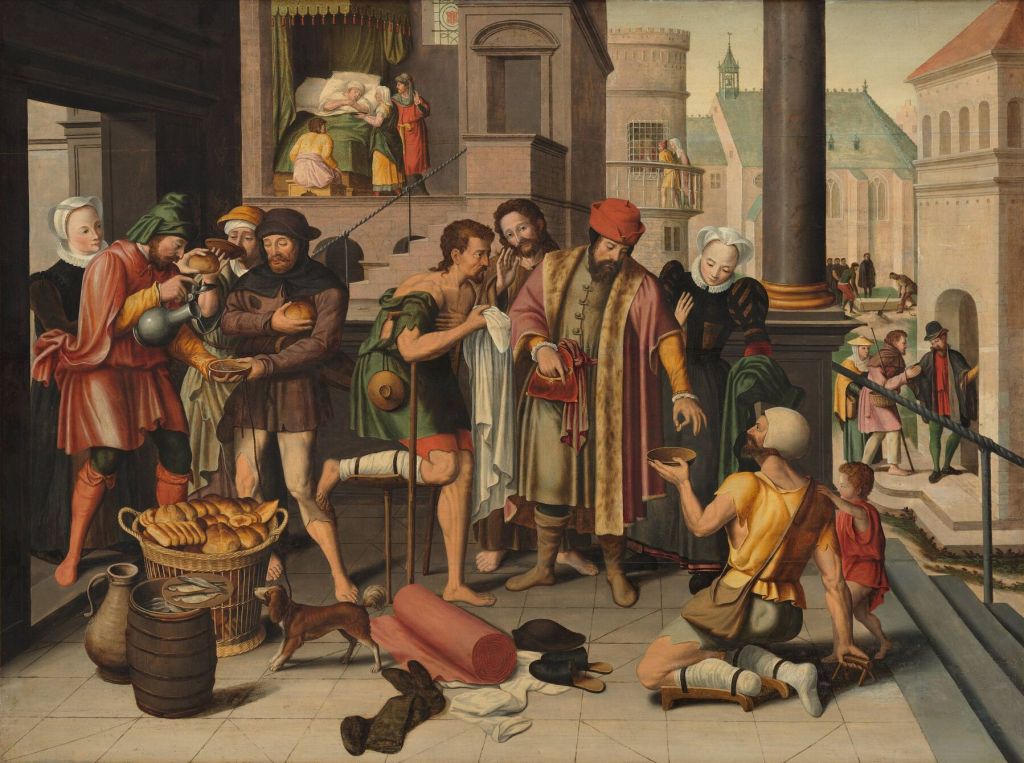
The Seven Corporal Works of Mercy by Unknown Dutch artist, 1580.

Nothing gets God’s hackles up more than unjust and unfair favoritism which is devoid of mercy and grace toward the poor. It all stinks to high heaven, and when God smells it, divine egalitarian power is not far behind.

It is the poor in spirit with no trust in stuff and ingenuity who will enter the kingdom of heaven. The humble person gives grace to another even though the person cannot offer something in return. It is easy to be merciful to people who have a deal with you about scratching each other’s backs. However, it is altogether a different thing to be gracious simply because it is the right thing to do and pleases the heart of God. 

God cares about the condition of our souls and not the balance of our bank accounts. Inattention to the poor and needy only betrays a heart of unjust favoritism – a materialistic heart full of greed. A 2012 Boston Globe article asked the following question: Does money change you?

The Globe article stated, “most people are convinced that gaining a lot of money … wouldn’t change who they are as people. Yet, a mounting body of research is showing, wealth can actually change how we think and behave—and not for the better. Rich people have a harder time connecting with others, showing less empathy to the extent of dehumanizing those who are different from them. They are less charitable and generous. They are less likely to help someone in trouble. And they are more likely to defend an unfair status quo. If you think you would behave differently in their place, meanwhile, you are probably wrong: These are not just inherited traits but developed ones. Money, in other words, changes who you are.”

The University of Minnesota’s Carlson School of Management found in their research that even the mere suggestion of getting more money makes people less friendly, less sensitive to others, and more likely to view some groups of people as inferior to others.  Another series of studies from the University of California at Berkley concluded that wealthier people tend to be less compassionate toward others in a bad situation than people from lower-class backgrounds. Their research concluded, “If you win the lottery and you want to avoid becoming an insensitive jerk, there is a simple solution: Give at least half the money away.” 

Some poor people, as in the days of the Apostle James, are willing to put up with being treated unfairly so they might get a piece of the rich person’s pie. Favoritism ignores the sin in others to gain something from them. God says that is stinking thinking.

Favoritism is flat out a violation of God’s law. The entire law is summed up in two commands: Love God and love neighbor. Favoritism violates our neighbor, and therefore, is sinful disobedience of God. Any needy human we encounter is our neighbor – no matter their social or economic status, their ethnicity, race, gender, or anything that identifies them as different. They are to be helped when we can do so.

We are to speak and act with mercy because we will eventually have to face the Judge. God is always watching us – every word and every action. Judge Jesus will respond to how we have treated each person we encountered and how we talked about other people when they were not around. We will all appear before Christ at the end of the age and must give an account of ourselves. (2 Corinthians 5:10)

Words are important, so they ought to be full of grace, seasoned with salt. Showing mercy instead of favoritism is the way love expresses itself.  Mercy is best given when we have first received it ourselves from God. A heart touched by the grace of the Lord Jesus is one which will stand in the judgment.

We rid ourselves of favoritism’s stench through the cleansing bath of God’s mercy in Jesus Christ.  There is grace available if we will receive it. God is the expert in transforming lives, renewing minds, and putting to death the pride of favoritism. The work is done with needed grace and compassionate mercy.

So, we are to make it our goal to be a grace-givers, to have willing hearts which seek to emulate the mercy of Christ. The bath of mercy and grace takes away the stank of prideful favoritism and leaves us with the sweet aroma of love, justice, peace, and joy in the Holy Spirit.

May it be so to the glory of God.

Grace to the Poor


“My dear friends, pay attention.  God has given a lot of faith to the poor people in this world.  He has also promised them a share in his kingdom that he will give to everyone who loves him” (James 2:5).
 
God’s grace is what makes the world go round.  Grace trumps everything.  An absence of grace in God’s people is offensive to him.  When I was growing up, our family dog was named “Sam.”  Sam loved being on the farm.  One time he tussled with a skunk.  I could barely get close enough to him to clean him up because he stunk so badly.  Favoritism toward those with means over those who don’t, stinks, and God has a hard time getting close to us when we show partiality to others.  And he is going to clean us up when he smells the stench of discrimination on us.  Showing favoritism to some over others is evidence that the dog is running away from the bath of grace.  In order to develop relationships and interact with people the way God wants us to, we must be free from prejudice.
 
            God cares about persons trapped in poverty.  The poor are important to him.  When Jesus began his ministry he pointed people to Isaiah 61:1 – The Spirit of the Lord is on me, because he has anointed me to preach good news to the poor (Luke 4:18).  In the Old Testament, there are seven different words for the “poor” because poverty was such a pervasive reality (and still is across the world!).  The range of meanings includes those who are poor because of laziness, those born into poverty, being poor because of inhuman oppression or slavery, simple beggars, and the pious humble poor.  These spiritual poor persons are the Hebrew anawim.  The anawim are humble persons who are caught in grinding poverty, having no choice but to put their trust in God.
 
            God has a lot to say about such persons because they are dear to his heart.  The law was quite clear about how to treat the poor.  There will always be poor people in the land.  Therefore I command you to be openhanded toward the poor and needy in your land (Deuteronomy 15:11).  Do not take advantage of a hired man who is poor and needy, whether he is a brother Israelite or an alien living in one of your towns.  Pay him his wages each day before sunset, because he is poor and is counting on it.  Otherwise he may cry to the LORD against you, and you will be guilty of sin (Deuteronomy 24:14-15).
 
            The mistreatment, exploitation, and just plain inattention to such persons were a chief reason God sent the prophets to Israel.  God had something to say concerning them:  Hear this, you who trample the needy and do away with the poor of the land, saying “When will the New Moon be over that we may sell grain, and the Sabbath be ended that we may market wheat?” – skimping the measure, boosting the price and cheating with dishonest scales, buying the poor with silver and the needy for a pair of sandals, selling even the sweepings with the wheat.  The LORD has sworn by the pride of Jacob:  “I will never forget anything they have done” (Amos 8:4-7).  Instead of being generous to the poor and allowing them to forage for grain at harvest behind the harvesters, they kept “those people” away from the fields so that they could turn a profit at every little bit they could.  And God thought it all stunk to high heaven.
 
            We must be reminded that it is only the poor in spirit who will enter the kingdom of heaven.  Only those who trust in God alone, and not in their stuff, will he accept.  The real issue here is the humility that demonstrates grace to people who cannot offer you something in return.  It is easy to be merciful to people who will turn around later and scratch our backs.  But it is altogether a different thing to be gracious from a place of humility and service to God.  God cares about the condition of our souls and not the balance of our bank accounts.  Inattention to the needy only betrays a heart far from him.  If God were to audit you, would he find your finances reflecting a spirit of humility and concern for the anawim?  God does not judge people on face value and the state of their finances, and neither should we.
 
            We are to speak and act with mercy to all persons, without prejudice.  The only way to rid ourselves of the stench of showing favoritism is to receive the cleansing bath of God’s mercy in Jesus Christ.  The shampoo of grace is available, if we will let God apply it.  God is the expert in:
 
Ø  Turning people from only associating with those they are comfortable with, to lovingly reaching out to people very different from themselves;
Ø  Changing people from the stinking thinking about what they can continually obtain and consume, to people who are loving and generous with their words and their physical resources;
Ø  Putting to death a proud spirit that looks to get ahead and accomplish an agenda by any means possible, to giving new life through humble repentance.


Ministry to the poor is a non-negotiable for the Christian church.  Beyond only dispensing benevolent funds, the poor need relationships, connections, resources, and a chance to give back in ways they can contribute.  It’s just part of being attentive to them, and extending them grace.  How does your church show their concern for the poor in your city and/or region?

Amos 8:4-12


             Four hundred years of silence….  That is the time known as the inter-testament period, that is, the time between the Old and New Testaments.  No word from God.  No prophets.  There was complete silence… until the fullness of time when the incarnation of Jesus changed everything.  Why so long to hear from God?
             The prophet Amos delivered a scathing message to the Israelites about their total disregard for the poor and needy in the land.  The people in positions of authority and power in Israel only looked on the less fortunate as commodities – as pawns to be taken advantage of for the rich merchants.  Because the wealthy never took the time to listen to the poor, God would not listen to them:  “I will send a famine on the land – not a famine of bread, nor a thirst for water, but of hearing the words of the LORD.  They shall wander from sea to sea, and from north to east; they shall run to and fro, to seek the word of the LORD, but they shall not find it.”
             We live in a day when the poor are often disregarded.  Either they are ignored altogether, or they are given hand-outs and services without ever having any significant human contact.  In other words, very few people take the time to listen and get to know the real face of poverty.  After all, we are busy making money and checking our stocks, and….  Oh, my, perhaps we have the answer as to why there is such a lack of revival in the land.  God shows such solidarity with the poor that to ignore them is to ignore him.  No matter our financial picture and outlook, every one of us can grace the poor with the gift of time and listening to them.  For in doing so we might just be listening to the voice of God himself.
             Gracious God, you are found everywhere – both the halls of power, and the back alleys of slums.  As I seek you more and more, may I see the face of Jesus in everyone I encounter, whether rich or poor so that I can share the gift of life with them all in this season of anticipation.  Amen.