
A Parable On Being Right with God (Luke 18:9-14)

The Tax Collector and the Pharisee by Peter Gallen

To some who were confident of their own righteousness and looked down on everyone else, Jesus told this parable: “Two men went up to the temple to pray, one a Pharisee and the other a tax collector. The Pharisee stood by himself and prayed: ‘God, I thank you that I am not like other people—robbers, evildoers, adulterers—or even like this tax collector. I fast twice a week and give a tenth of all I get.’

“But the tax collector stood at a distance. He would not even look up to heaven, but beat his breast and said, ‘God, have mercy on me, a sinner.’

“I tell you that this man, rather than the other, went home justified before God. For all those who exalt themselves will be humbled, and those who humble themselves will be exalted.” (New International Version)

There’s a lot to observe in Christ’s parable for today. Notice six observations of the story….

1. We Cannot Make Ourselves Right with God

I’m convinced that most Gentile Christians, standing two millennia apart from Christ’s telling of this parable, are much too hard on the Jewish Pharisees: “Well, I’m certainly glad that I am not like the Pharisee in this story!” so many tell themselves. It seems to me the Pharisees get a bad rap because of our own predilection to justify ourselves.

After all, we can only really criticize something we are already familiar with.

A temptation which every individual and community faces is the seduction toward self-justification, instead of being justified by God.

Way back in the day, when I made treadmill belts for a living, I was in charge of quality control. It was my job to make sure that the quality department provided the shipping department with a finished product, free of defects, and could stand the test of continual use. I justified the belt as being a treadmill belt of integrity; the belt did not, nor could not, justify itself, hide or fix its flaws, or make itself right.

To think that a treadmill belt could justify itself is in the same sort of crazy that believes we can make ourselves right. No, it is God alone who justifies the sinner.

The paradox of Christ’s parable is that the real sinners are those who claim to be righteous, while the truly righteous are those who recognize they cannot justify themselves and need God to make them right.

2. We Need to Be Honest about the Right Thing

In order to hear the good news about God’s ability to justify and make right, we must also hear the bad news about why we need justification to begin with. An honest look into the mirror reveals that we have been hiding behind a cosmetic façade of self-justification.

Our illusions and delusions need to be confronted and shattered. Because only then can we receive grace and realize the peace and harmony of God’s justification.

Since God justifies, I don’t have to!

I don’t need to defend myself, make myself look better than I am, nor fool myself into believing that the false façade is the true self.

The parable of Jesus is a contrast between the Pharisee who justifies himself, and the tax collector who looks to God alone for his justification.

3. The Put-Together Guy Wants to Make Himself Right

Jesus uses a Pharisee as a character in the parable because the guy represented someone who everyone else looks up to as the model of a spiritual and religious person. Christ is inviting his hearers to look beyond the façade of what we see with our physical eyes.           

We need to use our spiritual eyes to notice below the surface. Look at the attitude. The smug self-justifying disposition is flat-out sin. What’s more, self-justification is a root of all sorts of sins.

Judging ourselves to be right means that others are wrong. That attitude creates division, separates people into bad and good, fosters disharmony, and is an affront to God. 

To try and obtain what is already provided by grace is plain old-fashioned sin.

4. We’re Obsessed with the Right Lines

Adam and Eve were told by God that they could eat from any tree in the garden but were given strict instructions not to eat of the tree of the knowledge of good and evil. (Genesis 2:15-17) So, why avoid that particular tree?

Because it was a tree which spiritually and socially blinds people. Adam and Eve ate from it and their eyes were “opened” to a different reality – which was actually a “closed” view of reality that changed the way humanity deals with one another. From that point forward, people began drawing lines down the middle and placing themselves on the “good” side while vilifying those on the other side, the “bad” side.

“Apple Picking,” the fall of Adam and Eve, by Vittorio Canta

Adam and Eve immediately began justifying their actions, their attitudes, and their behavior. (Genesis 3:8-13) Adam drew a line: “That woman, Eve, gave me the fruit; she’s on the other side; it’s her fault!” Eve drew a line: “The serpent made me do it; that wasn’t really me, I’m basically good….” And ever since, the quest of making ourselves right has never stopped….

Today, we draw all sorts of lines. A popular religious line is this: “We’re good; they’re bad. Our theology is right, everybody else’s is wrong. The Bible says….” (insert a kooky interpretation of Scripture, based in self-justification and separation of people into good and bad groups)

People draw class lines, race lines, gender lines, ethnic lines, economic lines. We want clean lines, vertical lines, horizontal lines, perpendicular lines, thick lines, thin lines, any kind of line; just give me a line! Let’s go line dancing. Maybe take an airline. There are offensive lines and defensive lines. By the way, what’s the line on the Packers? We even judge the lines themselves: Long lines, short lines, front lines, back lines, and DMV lines are clearly evil, right!?

Why are we so obsessed with drawing lines? So that we can take self-justifying sides. Violence, war, and most every other sin of the world comes from the original sin project of trying to make ourselves right: “I’m okay; you’re not.”

The Pharisee (really a representative of us all) drew a very clear line between himself and the despised sinful tax collector. Notice that self-justification always compares itself with others. Those who obsessively draw lines are compulsively concerned about other people; they believe they have a right to know what’s going on with them. They remain vigilant to keep the lines drawn and distinguish themselves from those on the other side.

5. God Is On the Other Side of the Right Line

The Pharisee found that every time he drew a line, God was on the other side with the “sinners.” That makes perfect biblical sense. If God alone justifies sinners and makes them right; and if Jesus identifies with them in his life, death, and resurrection; then God is to be found on the other side of our line-drawing.  

A self-justified person sees no need for God’s justification. Therefore, God is not on their side; God is on the other side, justifying sinners by making them right.

6. The Unraveled Guy Wants To Be Made Right
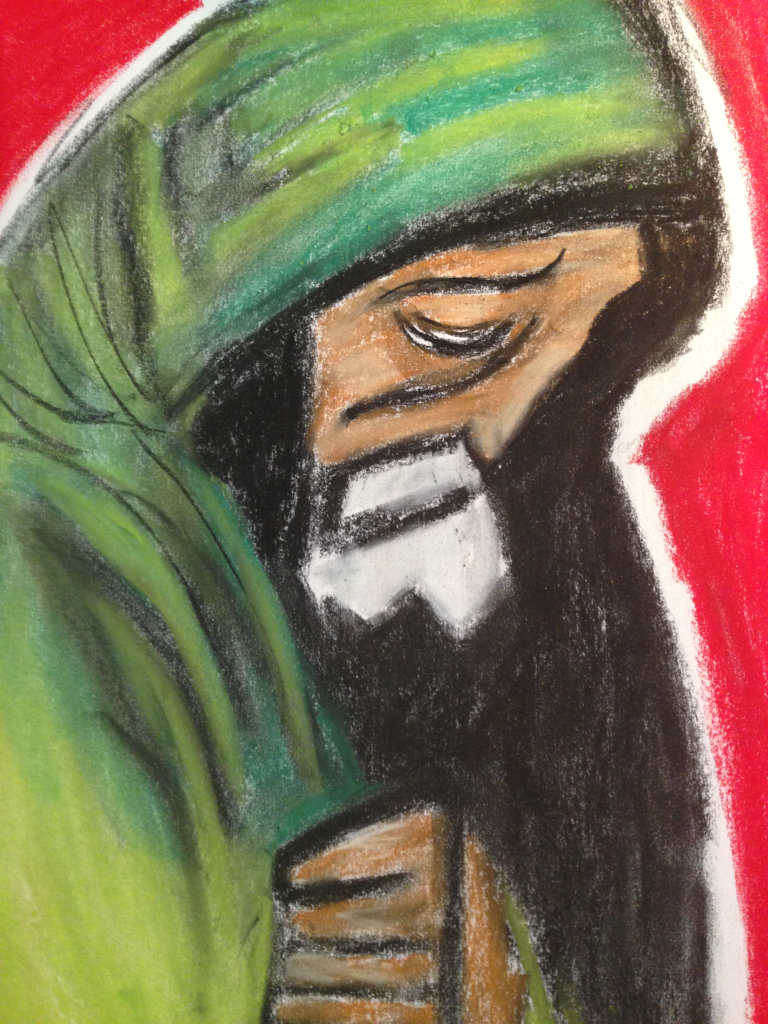
“O God, Be Merciful To Me, A Sinner,” by Ronald Raab

The tax collector’s only concern was for God to show him mercy because he is a sinner. In contrast to the proud attitude of the Pharisee, the tax collector, a sinner by anyone’s definition, humbled himself and sought justification from God alone.

  • Justification by God makes us right and:
  • Lifts the curse upon humanity and reverts everything back to its original design. (Revelation 22:1-5)
  • Erases the lines. (Romans 4:7-8)
  • Restores our souls are and strengthens our faith. (Acts 16:5; Romans 4:20)
  • Enables us to rest in Christ’s finished work. (John 19:28-30)
  • Does not condemn us. (Romans 8:1-2)
  • Eliminates comparisons because Christ is sufficient for us. (Colossians 2:13-14)
  • Replaces the anxiety and fear about how we look to others with the contentment and satisfaction of God’s love in Christ. (1 John 4:16-18)

Conclusion

Self-justification separates us from people and creates distance and division. But God’s justification connects people in love and crosses the arbitrary lines created by others.

The bad news: Many religious folk, when confronted with their self-justifying attitudes, do not change. Instead, they label the person as bad and place the offending person on the other side of their line so that they can maintain their façade of righteousness.

The good news: Jesus can be found on the other side of the line because justification is a gift. Yet, until we go to him, outside our little camp, we will continue in vain to make ourselves look good and be on the right side of everything while making others look bad.

The good and the right is to humbly – and with much flavor – cry out to God for mercy because only the Lord can save us from our plight.

Lord Jesus Christ, Son of God, have mercy on me, a sinner. 

Lord Jesus Christ, Son of God, have mercy on me, a sinner. 

Lord Jesus Christ, Son of God, have mercy on me, a sinner, and grant me your peace.

Just and right God, by your mercy we were created, and by your mercy you redeemed us through your Son, the Lord Jesus. Your mercy is the light by which all people – both sinner and saint – return to you. Your divine justice and your divine mercy exist together so that you refuse to punish us as we deserve.

Lord Jesus, it was not enough for you to take on our humanity; you died for us as well. So, we humbly and gratefully receive your gracious deliverance from sin, death, and hell. Amen.

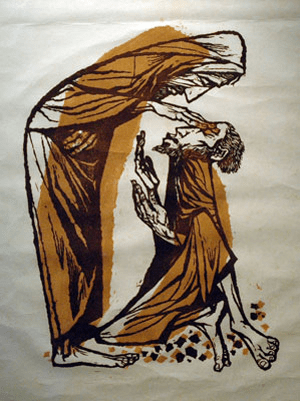
Lord, Have Mercy (Mark 10:46-52)

“Christ Healing the Blind Man” by Robert Hodgell

Then they came to Jericho. As Jesus, his disciples, and many people were leaving Jericho, a blind beggar named Bartimaeus, son of Timaeus, was sitting by the road. When he heard that Jesus from Nazareth was passing by, he began to shout, “Jesus, Son of David, have mercy on me!”

The people told him to be quiet. But he shouted even louder, “Son of David, have mercy on me!”

Jesus stopped and said, “Call him!” They called the blind man and told him, “Cheer up! Get up! He’s calling you.” The blind man threw off his coat, jumped up, and went to Jesus.

Jesus asked him, “What do you want me to do for you?”

The blind man said, “Teacher, I want to see again.”

Jesus told him, “Go, your faith has made you well.”

At once he could see again, and he followed Jesus on the road. (God’s Word Translation)

“I’d like to live my life so close to the bottom that when the system collapses I don’t have far to fall.” Dorothy Day

This is one of my very favorite stories in the entirety of Holy Scripture. And I will tell you why….

Because Jesus listens with ears of mercy

Jesus was headed to Jerusalem and had a lot on his mind and his heart. He knew what was coming, that his passion and death awaited him. No one would fault Jesus for not hearing a blind man shouting. But Jesus was listening so that he might hear someone just like the needy blind man. Rather than being distracted and lost in his head, Jesus was just the opposite – being attentive and aware of the humble folk right in front of him.

The Lord is always and continually listening for honesty and vulnerability. His ears of mercy are specially tuned, even today, for those who cry out to him from a place of genuine openness and humility.

Because Jesus speaks with words of mercy

Once Jesus listened, he responded by asking a question. I am impressed with Jesus throughout the Gospels. Christ gave people the gift of choice. He acknowledged people and respected them by not simply and indiscriminately healing, as if he were some fix-it guy. Jesus Christ bestowed on the lowliest of people the human dignity of choice by empowering them to answer a question.

Whereas everyone around Bartimaeus was looking down on him, both literally and figuratively, Jesus granted him the gift of dignity and basic human kindness – which are gifts we can all bestow on one another.

Because Jesus pays attention with a divine appointment of mercy

Our Lord took the time to heal blind Bartimaeus. Jesus could have simply healed him without even stopping his journey. He could have just waved his hand and the man would be healed. What’s more, Jesus could have even started a healing factory where everyone with a need got healed: bring ‘em in, move ‘em out, and keep the line moving!

Jesus was doing more than giving sight; he was giving a man the blessing of time and personal attention. The Gospel is never impersonal, which is why we ought to resist being non-relational in ministry to others. Christian ministry isn’t simply about meeting a need; it’s about blessing other people with the gift of relationship.

Coptic Church icon of Christ healing the blind man

Because Jesus reaches out with the touch of mercy

Jesus touched the man’s eyes (included in Matthew 20:29-34). He didn’t have to do that. The Lord of all most certainly could have healed without touching. In fact, it most likely may have been downright gross. A lot of people had eye diseases with runny pussy eyes in the ancient world.

Because the blind man didn’t listen to the crowd

I really love that! Maybe it’s the rebel in me. I just believe it is such a beautiful thing whenever someone refuses to be shamed by another and embraces their need. That is exactly what the blind man did. He not only refused to give-in to peer pressure, but he also responded to them by shouting all the louder. May his tribe increase!

Blind Bartimaeus teaches us that, when we know Love is there, we can freely acknowledge our needs, our wants, and our pain. With Jesus, who is Love incarnate, it doesn’t matter what anyone else thinks around us; there is no pretense, no propping up a false self to present for others to see. The true self is able to express what is really on the inside.

Because the blind man could actually see

In truth, Bartimaeus already had sight – not physical sight but spiritual eyes which could see better than anyone else in the crowd. One of the great ironies throughout the Gospels is that the sighted crowd seems to never see who Jesus really is, while blind folk see Christ clearly for who he is: the Son of David, the rightful king, the Savior of all.

It matters not how much faith one possesses; but it very much matters in whom that faith is placed. A thimble-full of faith is enough to move mountains, whereas a water tower full of misplaced faith in someone else cannot even provide a single glass of refreshment.

Because the blind man followed Jesus

Throughout the healing ministry of Jesus, there were plenty of persons who simply walked away and went about their lives after receiving what they desired. Yet, Bartimaeus, now given the gift of physical sight, immediately started following Jesus on the road.

This account feels a lot like my own testimony of experiencing the love of God in Christ and not ever wanting to leave it. So, I’ve been following Jesus for over forty years, still profoundly grateful in my heart for the One who loves and heals.

Because one lowly non-descript blind man made a difference

I don’t think Bartimaeus ever set out to change the world. And yet, he did. Here we are reading his testimony all these millennia later. One person, becoming a simple follower of Jesus and living a life of discipleship, changes a crowd from being a group of shushing church ladies to a robust throng of worshipers.

One individual makes a difference. Don’t let anyone tell you otherwise.

Lord Jesus Christ, Son of God, have mercy on me, a sinner.

Lord Jesus Christ, Son of David, heal me, a broken person.

Lord Jesus Christ, Son of Man, help me, a lost and lonely individual.

Lord have mercy, Christ have mercy, Lord have mercy on my love-starved soul and grant me your peace.

Amen.

From Desolation to Restoration (Jeremiah 33:1-13)

While Jeremiah was still locked up in jail, a second Message from God was given to him:

“This is God’s Message, the God who made earth, made it livable and lasting, known everywhere as God: ‘Call to me and I will answer you. I’ll tell you marvelous and wondrous things that you could never figure out on your own.’

“This is what God, the God of Israel, has to say about what’s going on in this city, about the homes of both people and kings that have been demolished, about all the ravages of war and the killing by the Chaldeans, and about the streets littered with the dead bodies of those killed because of my raging anger—about all that’s happened because the evil actions in this city have turned my stomach in disgust.

“But now take another look. I’m going to give this city a thorough renovation, working a true healing inside and out. I’m going to show them life whole, life brimming with blessings. I’ll restore everything that was lost to Judah and Jerusalem. I’ll build everything back as good as new. I’ll scrub them clean from the dirt they’ve done against me. I’ll forgive everything they’ve done wrong, forgive all their rebellions. And Jerusalem will be a center of joy and praise and glory for all the countries on earth. They’ll get reports on all the good I’m doing for her. They’ll be in awe of the blessings I am pouring on her.

“Yes, God’s Message: ‘You’re going to look at this place, these empty and desolate towns of Judah and streets of Jerusalem, and say, “A wasteland. Unlivable. Not even a dog could live here.” But the time is coming when you’re going to hear laughter and celebration, marriage festivities, people exclaiming, “Thank God-of-the-Angel-Armies. He’s so good! His love never quits,” as they bring thank offerings into God’s Temple. I’ll restore everything that was lost in this land. I’ll make everything as good as new.’ I, God, say so.

“God-of-the-Angel-Armies says: ‘This coming desolation, unfit for even a stray dog, is once again going to become a pasture for shepherds who care for their flocks. You’ll see flocks everywhere—in the mountains around the towns of the Shephelah and Negev, all over the territory of Benjamin, around Jerusalem and the towns of Judah—flocks under the care of shepherds who keep track of each sheep.’ God says so. (The Message)

The prophecy of Jeremiah is a large and rather difficult biblical book to read – not because it’s hard to understand, but for the continual words of divine judgment. Jerusalem, the center of the world and the jewel of Judaism, would be destroyed by a pagan army.

This was a very unpopular message in the city of Jerusalem. It was the sort of message which landed Jeremiah in prison, more than once. No one, in any age, wants to hear a steady stream of how their society will be crushed by enemies they despise.

Yet, consistent with all the prophetic books of the Old Testament, judgment and destruction never have the last word. There are rhythms of grace and restoration that move imperceptibly underneath the black crud of worldly injustice. And those movements will eventually create a wave of renewal which can wash away the apathy, anger, and avarice around us.

We, as readers examining the prophecy a millennia and half later, may fail to notice that God’s judgment is no spur of the moment thing. The destruction of Jerusalem by the Babylonians was centuries in the making.

The patience and continual wooing of the Lord for the people to return to fidelity of worship and practice of justice is what dominates the prophecy – and not some capricious deity who spontaneously flares in anger and scorches the earth.

All we have is now. This present moment is the one we are living. So, instead of worrying about the future – either of getting to heaven, or of avoiding hell – we are to love and serve the Lord in the now, and love our neighbor, in this present time we have to do it.

God will take care of the future. We can trust God to do what is right, just, and fair for ourselves and everyone else.

For the Christian, the gospel of Jesus Christ is a life to be lived, not just a set of rules or rituals to observe or doctrines to believe.

Every spiritual person since the dawn of time has struggled with the temptation to bifurcate the inner and outer self. That is a path of disintegration. It ends in destruction.

Jeremiah’s prophecy is an acknowledgment and naming of doing outward religious practices, while possessing an inward disposition which is very far from God.

The people were practicing “rabbit’s foot” religion, that is, believing that as long as they kept certain observances in place, then that would inoculate them from any harm – and they could do whatever they wanted.

Indeed, their hearts became hardened to the voice of the Lord and the cries of the oppressed. Yet, judgment never has the final say; grace and mercy do.

As bad as things may get, our circumstances are never too deep for God to turn them around. Restoration and renewal are divine specialties. And if a heart becomes so hard as to be petrified, the Lord is able to replace the heart of stone for a heart of flesh.

A dry and inhabitable soul can turn to a lush garden. A desolate life can be transformed to a habitation of justice, righteousness, and peace. The ire and irk of God can change to divine blessing and holy joy.

All spiritual restoration begins with silence… humility… repentance… return….

Renewal is a process, not an event. It is slow and tedious, pedantic and pedestrian. Restoration takes time. It is living one day at a time, putting one foot in front of the other, making daily choices of trust and faith which eventually add up to a beautiful life.

And along the way, the steadfast love of God never fails – always there, always supportive. Like earthly gravity, heavenly love is constant, continually keeping us grounded, even when we don’t acknowledge or understand it.

So, may today, and every day, be for you a walk of faith, trusting in the restorative presence of God to heal and transform pain and hopelessness to peace and well-being. May all desolate souls be restored. Amen.

Luke 14:1, 7-14 – How Can I Be Blessed?

Jesus eating with “sinners.”

One Sabbath, when Jesus went to eat in the house of a prominent Pharisee, he was being carefully watched….

When he noticed how the guests picked the places of honor at the table, he told them this parable:“When someone invites you to a wedding feast, do not take the place of honor, for a person more distinguished than you may have been invited. If so, the host who invited both of you will come and say to you, ‘Give this person your seat.’ Then, humiliated, you will have to take the least important place. But when you are invited, take the lowest place, so that when your host comes, he will say to you, ‘Friend, move up to a better place.’ Then you will be honored in the presence of all the other guests. For all those who exalt themselves will be humbled, and those who humble themselves will be exalted.”

Then Jesus said to his host, “When you give a luncheon or dinner, do not invite your friends, your brothers or sisters, your relatives, or your rich neighbors; if you do, they may invite you back and so you will be repaid. But when you give a banquet, invite the poor, the crippled, the lame, the blind, and you will be blessed. Although they cannot repay you, you will be repaid at the resurrection of the righteous.” (New International Version)

A lot of people live by the old adage, “You scratch my back and I’ll scratch yours.” It’s a phrase referring to reciprocity. In other words, if you give me something I want, I will then respond by giving you something you want.

That old adage works fine, that is, unless you have no ability to give or give back to another. If we only operate by the principle of reciprocity, a large chunk of people automatically get left out. And this situation is untenable and unacceptable to Jesus.

Christ observed that the religious insiders of his day were keeping entire groups of people on the outside through their practice of scratching one another’s backs.

We need to get ahold of the reality that God loves us, as well as everyone else – even the people we may not give the time of day to. God so loved the world that he sent his Son. Jesus has come to feed us all, not just some.

Jesus eats with sinners by Sieger Köder (1925-2015)

The kingdom of God is about food. The food given by Jesus is to feed the hungry by staging a banquet. It is a feast of God’s abundance. Yet, many seem to hoard the resources they have, only thinking about their friends, family, and people just like them. They act as if there is no need to invite outsiders, consumed as they are with their own daily lives.

We have an incredible abundant feast contained in Scripture – in fact, Jesus said that his food and drink was to do the Father’s will, that Scripture was his bread. (Matthew 4:4; John 4:34) 

It’s much too easy to take our blessings of food for granted. After all, when we are well-fed, it’s easy to assume that everyone else is, too. Feeling healthy, it’s easy to forget that others are hurting. Making money, it’s easy to think there are not many poor people around. Living in a community with plenty of churches and more bibles than people, it’s natural to assume that everyone knows the gospel of Jesus – but they don’t!

Then, whenever we get around to acknowledging there are people who need Jesus, we keep devising ways to reach them without having to change or accommodate our own lives to do it.

Christ’s call to faithful discipleship requires people to change from having a narrow focus on our small circle of friends, to including those who have no means to pay us back.

Table fellowship by Sieger Köder 

The gospel of Jesus Christ is open to outcasts and failures, to problem people and unimpressive persons. People with needs and flaws are especially dear to Jesus. It’s the people who outwardly have it all together who are being replaced wholesale with those who admit their need. 

We must not be picky about who we invite to participate in the largess of abundance we possess. We are to avoid the spiritual snobbery of looking down our noses at the needy and less fortunate, who have nothing to offer us in return.

Those who give need to do so without prejudice or favoritism. Even the lazy, the fool, and the sinner still need basic resources to live. By opening our hearts in almsgiving, we open ourselves to Christ, who is present in the least of those among us.

Refusing mercy to people deemed as unworthy, givers then actually shut themselves off from the very mercy God desires for them. There is no reward from God when there is only reward from others.

“If we are going to examine lives, we will never have mercy upon any human being; rather, hindered by this inopportune meddlesomeness, we will remain fruitless and destitute of all help ourselves.”

St. John Chrysostom, On Repentance and Almsgiving

It’s not only the poor who suffer when the rich fail to give. In judging whether or not a particular person is worthy of love and aid, the wealthy person rejects the spiritual fruit that he would have received by giving with humility.

Giving to the poor, simply to relieve our own conscience, is not real charity; it doesn’t consider the other. We attend fully to the other by observing their spiritual and holistic needs for community, purpose, respect, and dignity. Dispassionate giving from a distance, without relationship, refuses to acknowledge the whole person. It exploits the poor for the mental comfort of the rich.

We need to be involved in people’s lives, and that takes a lot of blood, sweat, and tears. There are too many lost people who need Jesus – and, I may add, too many Christians who are the walking wounded and need the healing touch of Jesus – for us to pay scant attention to the call of Jesus to invite the needy into our lives. 

Seeing people come into God’s great banquet, and into a joyous and vital relationship with Christ, will likely take ten times more work than what you are thinking it does right now. Yet, this is the pathway of true blessing – to having God’s stamp of approval on our lives.

How can I be blessed? Not by posturing for the best place in the room but by being a blessing to the most vulnerable and needy amongst us.

Merciful God, thank you for the abundance of life, relationships, health, comfort, and wealth you have provided to so many. Thank you that, even in times of need, despair, and brokenness, you are there. Please, put your arms around children and families in  poverty and disability so that they feel your comfort and hope. Meet their needs both physically and spiritually. And guide me so I can be your hands and feet pursuing justice for the poor and upholding the cause of the needy, in the way of Jesus Christ our Lord. Amen.