Rituals Are Important (Exodus 13:1-10)

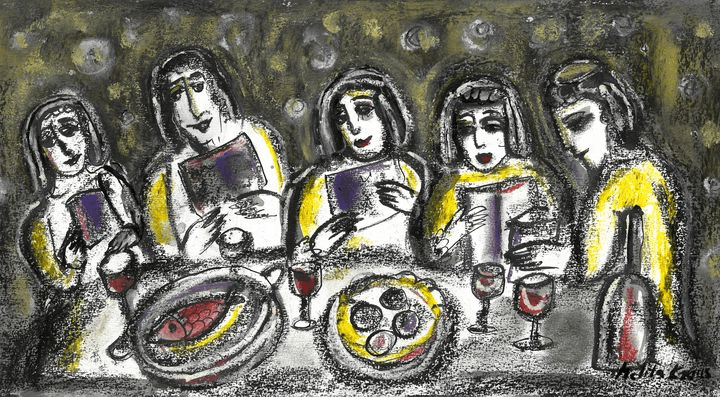
The Passover Meal (Last Supper) by Jess Santos

The Lord spoke to Moses, “Set apart every firstborn male for me. Every firstborn male offspring among the Israelites is mine, whether human or animal.”

Then Moses said to the people, “Remember this day—the day when you left Egypt, the land of slavery. The Lord used his mighty hand to bring you out of there. Don’t eat anything made with yeast. Today, in the month of Abib, you are leaving Egypt. The Lord swore to your ancestors that he would give you the land of the Canaanites, Hittites, Amorites, Hivites, and Jebusites. When he brings you into that land flowing with milk and honey, you must observe this ceremony in this month.

“For seven days you must eat unleavened bread. The seventh day will be a pilgrimage festival in the Lord’s honor. Only unleavened bread should be eaten during these seven days. No sourdough or yeast should be seen anywhere in your territory. On that day tell your children, ‘We do this because of what the Lord did for us when we left Egypt.’ This festival will be like a mark on your hand or a reminder on your forehead that the teachings of the Lord are always to be a part of your conversation. Because the Lord used his mighty hand to bring you out of Egypt, you must follow these rules every year at this time. (God’s Word Translation)

Rituals are an important part of being human. They help us to observe significant events, specials seasons, and daily routines. Ritual activities are meaningful re-telling of stories for us and others. In other words, rituals activate memory, enabling us to remember what is of value.

Religious traditions are typically filled with rituals, in order to remind the faithful of what is significant about their faith. Unfortunately, there are some Christian traditions which have a negative view of ritual, believing it to be “vain repetition.”

The problem, however, is not with rituals themselves; the issue is with the one performing the ritual. If it is done with a disconnect between head and heart, then the ritual does not accomplish it’s intended goal of helping the community to remember and giving meaning in the present time.

“Ritual is not simply an attitude or intention, just as love is not simply a feeling. At its most basic, ritual is something that you do. A man can’t plow a field just by thinking about it; he must go out to the field and get to work. If he is fully present to the work and acts with mindfulness and loving attention – if he brings his whole self along – then even as he turns over the rich soil beneath the plow, he turns it over in his mind and heart, as well. The act of tilling the soil becomes an act of tilling the soul.”

Alison Leigh Lilly

No matter whether folks are religious, or not, all people engage in rituals. For example, here are some rituals many people do in order to remember, celebrate, and renew an old story:

  • Birthdays (remembering and re-telling the birth story)
  • Graduations (remembering and re-telling the story of school)
  • Marriages & Anniversaries (remembering and re-telling the courtship story)
  • National Holidays (remembering and re-telling the patriotic story)
  • Dinner and/or Bedtime (remembering and re-telling stories from the day)
  • Morning (remembering and re-telling my story of purpose and meaning)
  • Earth (remembering and re-telling the seasons of Spring, Summer, Fall, and Winter)
  • Annual sojourns to special places such as vacations, sports stadiums, or reunions (remembering and re-telling the story of friendship and family).

The reasons people do such rituals are to

  • Re-enforce values
  • Have a sense of belonging
  • Mark time in a meaningful way
  • Form personal and healthy habits
  • Remind of us of who we are and what our purpose in this world is

Avoiding rituals can cause a lack of identity and purpose. Failing to observe rituals can also create loneliness, confusion, and emptiness.

“Rituals are those repeated actions done again and again in the interest of things like focus, grounding, tradition, cultural symbolism, predictable life rhythms, and feeling a part of something bigger than ourselves.”

Craig Kelley

The Lord gave divine instructions to the newly freed Israelites. And those commands involved instituting some ritual behavior, to be done year after year. God told them to observe a Passover ritual each year so that the story of Israel’s deliverance from Egyptian slavery would remain alive for the generations to come; and so that the event itself would have meaning for people in the present time.

Because Yahweh spared the firstborn of Israel’s children and livestock – and not the firstborn of Egypt – those same firstborn are to be given to God, in some sort of vicarious ransom. All the symbols of Passover are meant to be reminders of what the Lord had done for Israel.

The exodus event is to be actualized, made real for the generations today. By means of ritual, the relationship between God and the people is remembered and renewed for each new generation. Engaging in the ritual repeatedly helps press the story and it’s reality into both the mind and the heart.

And this is precisely what worship is supposed to do for the Christian. Ideally, a worship service is a re-enactment of Christ’s redemption for believers. Even more, it’s a dialogue between God and the people in which the Lord speaks and the worshipers respond.

One ritual which unites all Christians together is the Lord’s Table (communion, or the Lord’s Supper, or the Eucharist). Each Christian tradition has their particular views and theology surrounding it – yet it’s common to all. Observing the Table is a ritual which has been going on for two-thousand years; and which has it’s roots in the Passover and the original meal at the time of the exodus.

The Table is a time of remembrance, communion, and hope. We retell the story of Christ’s redemption and remember the Lord’s once for all sacrifice on the cross for the whole world. It is a unifying ritual, where believers commune together. And the Table expresses hope – that just as we eat and drink now, we will do so all together at the end of the age at the great supper of the Lamb.

Yes, rituals have meaning and it’s symbols are significant. They help us to express our shared humanity together.

May the love of Christ be active in your heart, be heard in your words, be seen in your actions and inform your choices today and every day. Amen.

Joshua 4:14-24 – The Importance of Visual Reminders

That day the Lord brought honor to Joshua before all Israel. They respected him all his life, just as they had respected Moses.

The Lord told Joshua, “Instruct the priests carrying the ark of the covenantal laws to come up from the Jordan.” So, Joshua instructed the priests, “Come up from the Jordan!” The priests carrying the ark of the covenant of the Lord came up from the middle of the Jordan, and as soon as they set foot on dry land, the water of the Jordan flowed again and returned to flood stage.

The people went up from the Jordan on the tenth day of the first month and camped in Gilgal on the eastern border of Jericho. Now Joshua set up in Gilgal the twelve stones they had taken from the Jordan. He told the Israelites, “When your children someday ask their fathers, ‘What do these stones represent?’explain to your children, ‘Israel crossed the Jordan River on dry ground.’ For the Lord your God dried up the water of the Jordan before you while you crossed over. It was just like when the Lord your God dried up the Red Sea before us while we crossed it.He has done this so all the nations of the earth might recognize the Lord’s power and so you might always obey the Lord your God.” (New English Translation)

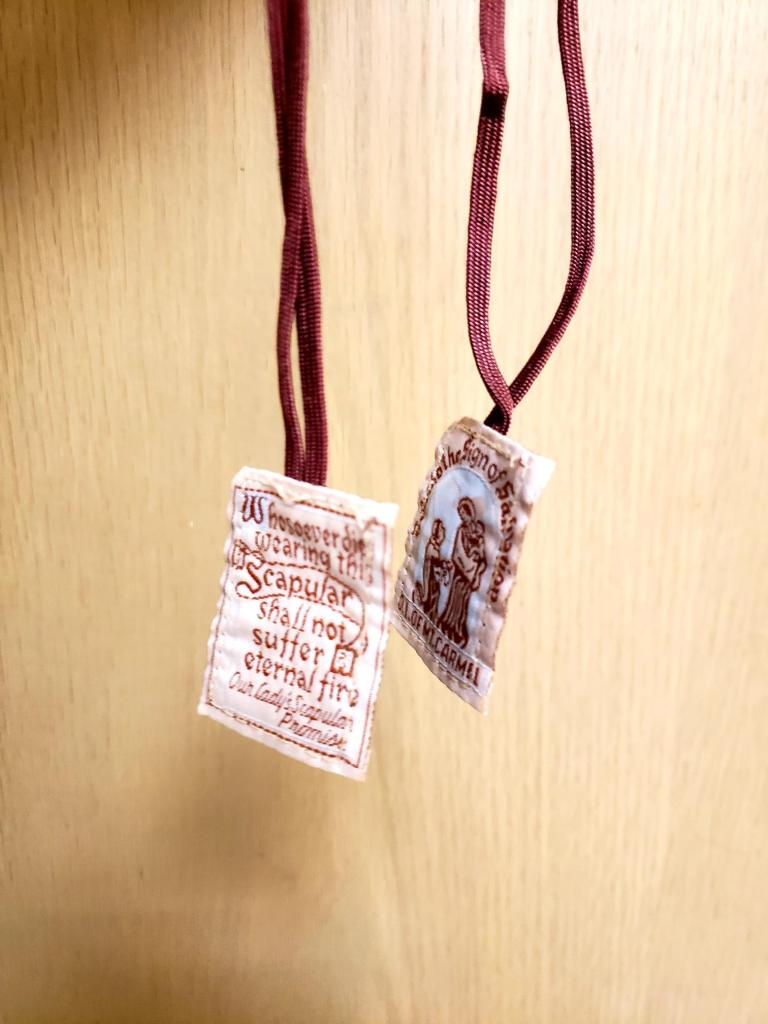
On my hospital office desk, where I can see it every day, is a scapular. “Scapular” is the Latin word for “shoulders.” A scapular typically consists of two small pieces of cloth, a few inches in size, which has a religious image on one, and a message on the other. There are two bands of cloth connecting the message or image.

The wearer places one square on the chest, rests the bands on each shoulder and lets the second square drop down the back. Worn by some Catholic faithful, the scapular serves to remind the believer of their commitment to live a Christian life.

The particular scapular I have in my possession was given to me by a patient when I was first starting out as a hospital chaplain. I was called to the room of a dying patient. He was afraid of death. So, we conversed together for an hour about his life, his fears, and his devotion to faith. At the end of the conversation, the patient took off the scapular he was wearing, which states, “Whosoever dies wearing this Scapular shall not suffer eternal fire.”

Regardless of what you think about scapulars and the particular message on this one, most important to me is what the patient said next with tears in his eyes: “I’ve worn this scapular every day for the past forty years. Here, I want you to have it. I don’t need it anymore. I am no longer afraid of death.”

The patient died. But he died at peace with God and without fear. I keep his scapular on my desk as a constant reminder of why I am a hospital chaplain, and how important the work I do is. Anytime I get discouraged or have a hard day, when I return to my office, the scapular reminds and reorients me that the spiritual care of patients is a privileged and sacred responsibility.

The ancient Israelites were finally ready to enter the Promised Land. The twelve tribes miraculously crossed the Jordan River on dry ground. God had stopped the water from flowing. After everyone crossed over, the river went back to flowing again.

Joshua, their leader, instructed people from each tribe to take a large stone from the river and place them in a heap for two didactic reasons:

1) To educate future generations inside Israel that God kept the promise to bring them into a land of abundance; and

2) To educate those outside Israel that God is mighty.

It’s important that we all have a continual awareness of why we are here on this earth and what our purpose is. Our history is significant and needs to be remembered.

Yet, there are many families and faith communities in which the children know little about how God worked in their parents’ lives, not to mention the many previous generations. Having tangible reminders of God’s past actions helps everyone remember. 

Just as people ask me about why I have a scapular on my desk, so having reminders of God’s grace in prominent visible places serves to aid all ages of folks to ask why those mementos are there.

It is good to have visual reminders of faith and the faithful people who influenced us around our homes, places of work, and communities so that others may discover and know the redemptive acts of God, that the Lord keeps promises.

Almighty God, we praise and magnify your holy Name for all your servants who have finished their course in faith and patience. May we remember them and their service well. We humbly pray that, at the day of resurrection, we and all who are members of the mystical body of your Son may be set on his right hand, and hear his most joyful voice: “Come, you who are blessed by my Father, inherit the kingdom prepared for you from the foundation of the world.” Grant this, O merciful Father, for the sake of Jesus Christ, our only Mediator and Advocate. Amen

Joshua 4:1-24 – Remembrance

When the entire nation had finished crossing over the Jordan, the Lord said to Joshua, “Pick twelve men from the people, one man per tribe. Command them, ‘Pick up twelve stones from right here in the middle of the Jordan, where the feet of the priests had been firmly planted. Bring them across with you and put them down in the camp where you are staying tonight.’”

Joshua called for the twelve men he had appointed from the Israelites, one man per tribe. Joshua said to them, “Cross over into the middle of the Jordan, up to the Lord your God’s chest. Each of you, lift a stone on his shoulder to match the number of the tribes of the Israelites. This will be a symbol among you. In the future your children may ask, ‘What do these stones mean to you?’ Then you will tell them that the water of the Jordan was cut off before the Lord’s covenant chest. When it crossed over the Jordan, the water of the Jordan was cut off. These stones will be an enduring memorial for the Israelites.”

The Israelites did exactly what Joshua ordered. They lifted twelve stones from the middle of the Jordan, matching the number of the tribes of the Israelites, exactly as the Lord had said to Joshua. They brought them over to the camp and put them down there. Joshua also set up twelve stones in the middle of the Jordan where the feet of the priests had stood while carrying the covenant chest. They are still there today.

Meanwhile, the priests carrying the chest were standing in the middle of the Jordan. They stood there until every command that the Lord had ordered Joshua to tell the people had been carried out. This was exactly what Moses had commanded Joshua. The people crossed over quickly. As soon as all the people had finished crossing, the Lord’s chest crossed over. The priests then moved to the front of the people. The people of Reuben, the people of Gad, and half the tribe of Manasseh crossed over, organized for war ahead of the Israelites, exactly as Moses had told them. Approximately forty thousand armed for war crossed over in the Lord’s presence to the plains of Jericho, ready for battle. The Lord made Joshua great in the opinion of all Israel on that day. So, they revered him in the same way that they had revered Moses during all his life.

The Lord said to Joshua, “Command the priests carrying the chest containing the testimony to come up out of the Jordan.”

So, Joshua commanded the priests, “Come up from the Jordan.” The priests carrying the Lord’s covenant chest came up from the middle of the Jordan, and the soles of their feet touched dry ground. At that moment, the water of the Jordan started flowing again. It ran as before, completely over its banks. The people came up out of the Jordan on the tenth day of the first month. They camped at Gilgal on the east border of Jericho.

Joshua set up at Gilgal those twelve stones they had taken from the Jordan. He said to the Israelites, “In the future your children will ask their parents, ‘What about these stones?’ Then you will let your children know: ‘Israel crossed over the Jordan here on dry ground.’ This was because the Lord your God dried up the water of the Jordan before you until you crossed over. This was exactly what the Lord your God did to the Reed Sea. He dried it up before us until we crossed over. This happened so that all the earth’s peoples might know that the Lord’s power is great and that you may always revere the Lord your God.” (CEB)

I like coffee. I like coffee mugs. I like buying a coffee mug from places I visit. Although it drives my wife nuts, the mugs serve as a continual reminder of a certain place or event I have experienced. As we journey with the Israelites in the Old Testament book of Joshua, we experience with them the significant places and events of their taking the Promised Land. God did a miraculous work by causing the Jordan River to congeal so that the Israelites could cross over on dry ground in entering the land.  Once they were across on the other side, God instructed them to take twelve stones, one for each tribe, and pile them up together.

Crossing Over the Jordan River by Yoram Raanan

The purpose of the heap of twelve stones is made clear in the story and had a twofold purpose: to educate future generations inside Israel that God kept the promise to bring them into a land of abundance; and, to educate those outside Israel that God is mighty.

It is important to be tethered to the past and aware of why and how we are here. Yet, there are many families and faith communities in which the children know little about how God worked in previous generations. So, having tangible reminders of God’s past actions serves everyone to remember, and especially enables children to know the past actions of God. Just as people ask me about why I have certain coffee mugs, so having reminders of God’s grace in prominent visible places serves to aid kids and others to ask why those mementos are there.

It is good to have reminders of faith and the faithful people who influenced us around our homes, places of work, and communities so that others may know the redemptive acts of God, that the Lord keeps promises. And it is a whole lot more important than a coffee mug.

Almighty God, we praise and magnify your holy Name for all your servants who have finished their course in faith and patience. May we remember them and their service well. We humbly pray that, at the day of resurrection, we and all who are members of the mystical body of your Son may be set on his right hand, and hear his most joyful voice: “Come, you who are blessed by my Father, inherit the kingdom prepared for you from the foundation of the world.” Grant this, O merciful Father, for the sake of Jesus Christ, our only Mediator and Advocate. Amen