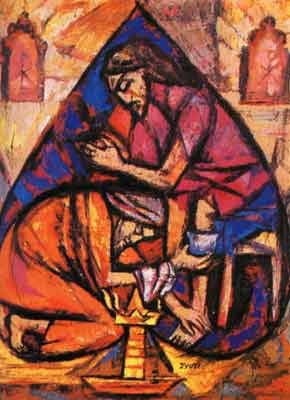
Maundy Thursday (John 13:1-17, 31b-35)

Jesus Washing the Disciples’ Feet, by Leszck Forczek (1946-2019)

Now before the festival of the Passover, Jesus knew that his hour had come to depart from this world and go to the Father. Having loved his own who were in the world, he loved them to the end. The devil had already decided that Judas son of Simon Iscariot would betray Jesus. And during supper Jesus, knowing that the Father had given all things into his hands and that he had come from God and was going to God, got up from supper, took off his outer robe, and tied a towel around himself. 

Then he poured water into a basin and began to wash the disciples’ feet and to wipe them with the towel that was tied around him. He came to Simon Peter, who said to him, “Lord, are you going to wash my feet?” Jesus answered, “You do not know now what I am doing, but later you will understand.” Peter said to him, “You will never wash my feet.”

Jesus answered, “Unless I wash you, you have no share with me.” Simon Peter said to him, “Lord, not my feet only but also my hands and my head!” Jesus said to him, “One who has bathed does not need to wash, except for the feet, but is entirely clean. And you are clean, though not all of you.” For he knew who was to betray him; for this reason he said, “Not all of you are clean.”

After he had washed their feet, had put on his robe, and had reclined again, he said to them, “Do you know what I have done to you? You call me Teacher and Lord, and you are right, for that is what I am. So if I, your Lord and Teacher, have washed your feet, you also ought to wash one another’s feet. For I have set you an example, that you also should do as I have done to you. Very truly, I tell you, slaves are not greater than their master, nor are messengers greater than the one who sent them.If you know these things, you are blessed if you do them….

“Now the Son of Man has been glorified, and God has been glorified in him. If God has been glorified in him, God will also glorify him in himself and will glorify him at once. Little children, I am with you only a little longer. You will look for me, and as I said to the Jews so now I say to you, ‘Where I am going, you cannot come.’I give you a new commandment, that you love one another. Just as I have loved you, you also should love one another. By this everyone will know that you are my disciples, if you have love for one another.” (New Revised Standard Version)

Today is Maundy Thursday. It is a time in Holy Week to reflect upon the great love of Christ for humanity, as well as much of humanity’s great resistance to that divine love.

The word “Maundy” is the Latin word for “commandment.” It’s a reference to Christ’s mandate for his followers to love one another. And Jesus gave his disciples an example of this love in a way they would never forget.

The jaw-dropping illustration of love for each other is preceded by setting the stage. It is the Last Supper, the final meal of Jesus with the disciples. Christ’s imminent crucifixion is very much tied to the Jewish Passover. Just as the festival is about to happen, dominating the spiritual landscape of Jerusalem, so the cross of Christ looms heavy in the Upper Room. The hour is nearly upon them.

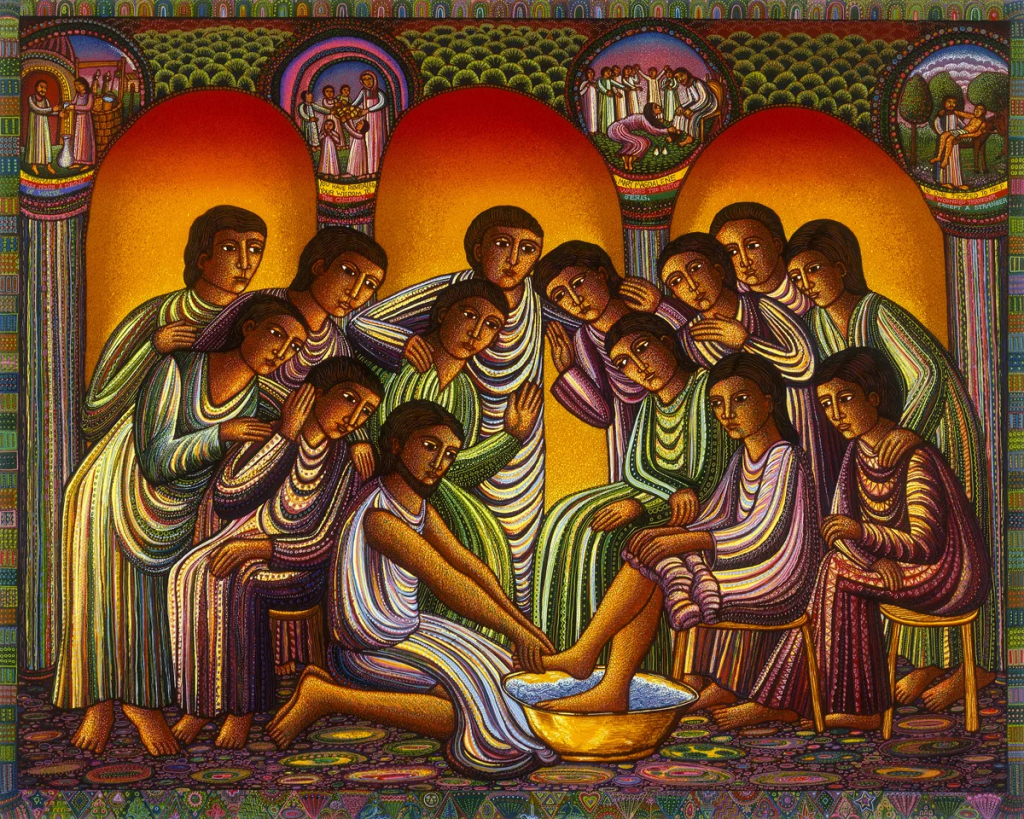
Washing of the Feet, by John August Swanson, 2000

And only Jesus seems to know the brevity of the moment. He knows that Judas is about to betray him. Events that were prophesied centuries earlier are about to be set in motion. Every word and action of Jesus at this Supper is formed and informed by what is about to take place in the next few days.

We are meant to understand, as observers to this Upper Room meal, that Jesus not only knows what is happening, but that he also has control over the unfolding events. Satan may believe that he knows what’s going on and can influence Judas for diabolical purposes; but Jesus is really the One in charge. Even the workings of the devil are used for the divine agenda. Every event – whether meant for good or for ill – shall be bent toward the will of God.

The example, the capstone of all Christ’s teaching, is now divulged and acted out. The disciples themselves are participants in the drama; and they are aghast at what Jesus is doing. Christ proceeds to divest himself, humble himself, and serve them all by washing their feet.

Jesus intends his actions to be followed. Whereas the disciples likely believed that, over the past three years, they were being groomed for ruling in God’s new government, Christ was informing them that they will be servants in that new rule and reign of God. Yes, they will be leaders; but it will be a servant-leadership that uses its authority to love others.

Not everyone was immediately on board with this type of leadership and service. That’s because there were those who found it extremely hard to accept such a love as this.

Peter had serious difficulties with this foot washing thing. Maybe Peter thought that the roles should be reversed; he should be serving Jesus, and not the other way around. It could be that Peter was simply clueless or confused. Or perhaps he believed this action to be socially inappropriate and foolish. Yet, no matter what was going through Peter’s mind, he blatantly resisted the love of Christ.

Jesus would have none of this resistance to his loving service. Sharing in Jesus involves being served by him, even in so lowly and intimate a form as foot washing. Bottom line: the disciples of Jesus must be washed by him.

Peter (bless his extrovert mouth and heart) totally changes from rejection to the foot washing, to wanting a complete bath. Even in this, however, Jesus brings the zealot spirit down a few notches. He brought Peter to where he needs to be, and not where Peter wants to be.

Jesus Washing the Feet of His Disciple by Japanese artist Sadao Watanabe (1913-1996)

The whole washing of feet is an act of love and service that Jesus performed for them. Judas is there, too, getting his feet washed, as well. The example Jesus set was not simply one of service to an elite group of believers. The love of disciples for one another includes even those people we might prefer to forget.

Slaves were the ones who performed the service of washing feet whenever guests arrived at the master’s house. For the Christian, since our own Master initiated this practice, we ought also to love one another through meeting even the most mundane and stinky of needs. After all, we are not above our Master.

Yet, Christ considers us friends, and not necessarily as slaves, and even grants us an inheritance with him. Meeting needs requires the utilization of love.

It seems that Peter wanted to make the symbolic practice of washing feet something it was not meant to be. He asked for a lavish display of cleanliness for his entire body. Perhaps Peter thought that if you’re going to make a mark and a statement, then really go all out and do it!

For sure, Peter didn’t really know what he was saying. Jesus told Peter as much. But later, Jesus assured Peter, and all the disciples, that they indeed would, in time, understand all that he was opening up for them.

Of utmost value to Jesus was to have his disciples be driven by what drives he himself: love. Being a Christ follower is only secondarily about what one knows, and primarily about how one loves.

Christians have been profoundly loved by God through Jesus Christ. And what we do with that received love is of great importance to Jesus. As the Apostle Paul would say later to a young Corinthian Church, “Knowledge puffs up, but love builds up.” (1 Corinthians 8:1)

On this Maundy Thursday, it is more than appropriate to contemplate the incredible love shown to the original disciples, and toward us, all these centuries later. Let this contemplation compel us to put a great deal of thought and conversation into the best ways of loving the people in front of us with actions that have real meaning for them.

O God of love,
giver of concord,
through your only Son
you have given us a new commandment
that we should love one another
even as you have loved us,
the unworthy and the wandering,
and gave your beloved Son for our life and salvation.
Lord, in our time of life on earth
give us a mind forgetful of past ill-will,
a pure conscience and sincere thoughts,
and hearts to love one another;
for the sake of your Son, Jesus Christ our Lord.
Amen. – A Prayer of St. Cyril of Alexandria, 5th century

Maundy Thursday (Psalm 116:1-2, 12-19)

Washing of the Feet, by John August Swanson, 2000

I love the Lord because he has heard
    my voice and my supplications.
Because he inclined his ear to me,
    therefore I will call on him as long as I live….

What shall I return to the Lord
    for all his bounty to me?
I will lift up the cup of salvation
    and call on the name of the Lord;
I will pay my vows to the Lord
    in the presence of all his people.
Precious in the sight of the Lord
    is the death of his faithful ones.
O Lord, I am your servant;
    I am your servant, the child of your serving girl.
    You have loosed my bonds.
I will offer to you a thanksgiving sacrifice
    and call on the name of the Lord.
I will pay my vows to the Lord
    in the presence of all his people,
in the courts of the house of the Lord,
    in your midst, O Jerusalem.
Praise the Lord! (New Revised Standard Version)

“Pain and suffering have come into your life, but remember pain, sorrow, suffering are but the kiss of Jesus — a sign that you have come so close to Him that He can kiss you.”

Mother St. Térèsa of Calcutta (1910-1997)

There is more to the passion of Christ than sheer suffering and sorrow; the Via Dolorosa is, paradoxically, also the road to joy.

Yes, suffering is painful and unpleasant. Yet, since we all must suffer in some way, the real issue is whether our suffering is meaningless or has purpose to it. We are able to bear our suffering if we are confident that a redemptive outcome is at the end of it.

The Lord Jesus submitted to suffering because he knew that all the mockery, torture, and abuse was the pathway to deliverance for humanity.

Because of the joy awaiting him, he endured the cross, disregarding its shame. Now he is seated in the place of honor beside God’s throne. Think of all the hostility he endured from sinful people; then you won’t become weary and give up. (Hebrews 12:2-3, NLT)

Since Jesus has gone before us, enduring shame so that it could be put to death in us, we are able to live free from guilt and the ignominy of sin. What’s more, Christ’s suffering gives shape and meaning to our own suffering.

“I cannot but wonder at the virtue that lies in suffering; we are worth nothing without the cross. I tremble and am in an agony while it lasts, and all my conviction of its salutary effects vanish under the torture, but when it is over, I look back at it with admiration, and am ashamed that I bore it so ill.”

François Fénelon (1651-1715)

On this Maundy Thursday, we remember that in the midst of suffering there is the hope of glory, and in the center of pain there is the confident expectation that it will be used as the fertilizer to help love grow and bloom in the dormant places of this world.

“Love proves itself by deeds, so how am I to show my love? Great deeds have forbidden me. The only way I can prove my love is by scattering flowers and these flowers are every little sacrifice, every glance and word, and the doing of the least actions for love.”

St. Thérèse of Lisieux (1873-1897)

There cannot be love without suffering; to love is to sacrifice on behalf of another.

Because we live in a broken world full of pride and hubris, greed and avarice, hate and envy, we are victims of loveless systems and unjust actions. We need love to rescue and redeem us from the sheer muck of existential guilt and shame, evil and injustice.

Christians around the world are journeying through Holy Week, the most sacred time of the year for followers of Christ. When we think about Holy Week, we are familiar with Good Friday and certainly Easter, but Maundy Thursday? 

On this day, the Church remembers the final evening Jesus shared with his disciples in the upper room before his arrest and crucifixion. The experiences in the upper room were highly significant because this was the last teaching, modeling, and instruction Jesus gave before facing the cross. Jesus was careful and deliberate to communicate exactly what was important to him: to love one another.

“A new command I give you: Love one another. As I have loved you, so you must love one another.  By this everyone will know that you are my disciples if you love one another.” (John 13:34-35, NIV)

Maundy Thursday marks three important events in Christ’s Last Supper with his disciples: 

  1. The washing of the disciples’ feet (the action of loving service)
  2. The instituting of the Lord’s Supper (the remembrance of loving sacrifice)
  3. The giving of a “new” commandment to love one another (the mandate of a loving lifestyle)

The message of Maundy Thursday is this: Jesus Christ loves me just as I am, and not as I should be. He loves me even with my dirty stinky feet, my herky-jerky commitment to him, and my pre-meditated sin. 

Today is a highly significant day on the Church Calendar and in the Christian Year – one which deserves to be observed, and an opportunity to remember the important words and actions of Jesus on our behalf. Through Jesus Christ we are to live always in love, modeling our life and ministry after him. 

“I have found the paradox that if I love until it hurts, then there is no hurt, but only more love.”

Mother Térèsa

In Christ, love is to characterize our life together as we proclaim God’s love in both word and deed. A watching world will take notice and desire to lay down their hate and animosity if the followers of Christ are deeply and profoundly centered in the love of God.

God our Father, you invite us to participate in the life, suffering, death, and resurrection of your Son. Inspire us by his service, and unite us in his love; who lives and reigns with you, in the unity of the Holy Spirit, one God, now and forever. Amen.

John 13:1-17, 31b-35 – Maundy Thursday

Jesus Washes Peter’s Feet

It was now the day before the Passover Festival. Jesus knew that the hour had come for him to leave this world and go to the Father. He had always loved those in the world who were his own, and he loved them to the very end.

Jesus and his disciples were at supper. The Devil had already put into the heart of Judas, the son of Simon Iscariot, the thought of betraying Jesus. Jesus knew that the Father had given him complete power; he knew that he had come from God and was going to God. 

So, he rose from the table, took off his outer garment, and tied a towel around his waist. Then he poured some water into a washbasin and began to wash the disciples’ feet and dry them with the towel around his waist. 

He came to Simon Peter, who said to him, “Are you going to wash my feet, Lord?”

Jesus answered him, “You do not understand now what I am doing, but you will understand later.”

Peter declared, “Never at any time will you wash my feet!”

“If I do not wash your feet,” Jesus answered, “you will no longer be my disciple.”

Simon Peter answered, “Lord, do not wash only my feet, then! Wash my hands and head, too!”

Jesus said, “Those who have taken a bath are completely clean and do not have to wash themselves, except for their feet. All of you are clean—all except one.” (Jesus already knew who was going to betray him; that is why he said, “All of you, except one, are clean.”)

After Jesus had washed their feet, he put his outer garment back on and returned to his place at the table.

“Do you understand what I have just done to you?” he asked. “You call me Teacher and Lord, and it is right that you do so, because that is what I am. I, your Lord and Teacher, have just washed your feet. You, then, should wash one another’s feet. I have set an example for you, so that you will do just what I have done for you. I am telling you the truth: no slaves are greater than their master, and no messengers are greater than the one who sent them. Now that you know this truth, how happy you will be if you put it into practice!…

Jesus said, “Now the Son of Man’s glory is revealed; now God’s glory is revealed through him. And if God’s glory is revealed through him, then God will reveal the glory of the Son of Man in himself, and he will do so at once. My children, I shall not be with you very much longer. You will look for me; but I tell you now, what I told the Jewish authorities, ‘You cannot go where I am going.’ 

“And now I give you a new commandment: Love one another. As I have loved you, so you must love one another. If you have love for one another, then everyone will know that you are my disciples.” (Good News Translation)

We all need love. 

Without love, relationships devolve into silent standoffs and destructive triangles. The world ceases to spin on its axis. 

But with love, all things are beautiful, personal relations have meaning and joy, and all seems right and just in the world.

This wonderful love, however, comes with a great cost. 

Because we live in a broken world filled with pride and arrogance, greed and avarice, hate and envy, we are victims of loveless, faceless, and unjust systems. 

We need Love to rescue and redeem us from the muck and crud of injustice. 

It’s as if we are constantly walking knee deep through icky sludge so thick that we can barely get anywhere. 

We need saving…. We need Jesus.

Christians everywhere around the world are journeying through Holy Week, the most sacred time of the year for followers of Christ. When we consider Holy Week, many are familiar with Good Friday and certainly Easter, but Maundy Thursday? 

On this day the church remembers the last evening Jesus shared with his disciples in the upper room before his arrest and crucifixion. 

The experiences in the upper room were highly significant because this was the last teaching and modeling that Jesus gave before facing the cross. Jesus was deliberate in communicating exactly what was important to him: Love one another.

Maundy Thursday marks three important events in Christ’s Last Supper with his disciples: 

  • The washing of the disciples’ feet (the action of loving service)
  • The instituting of the Lord’s Supper (the remembrance of loving sacrifice)
  • The giving of a “new” commandment to love one another (the mandate of a loving system). 

For Jesus, the last night with his disciples was all about love, God’s love. On that fateful night, having loved his disciples for the past three years, Jesus showed them the full extent of his love by taking the posture of a servant and washing each and every one of the disciples’ feet, including Judas. 

After demonstrating for them a totally humble service, Jesus said, “I have set you an example that you should do as I have done for you.”

Jesus Christ loves me just as I am, and not as I should be. 

Christ loves me even with my dirty stinky feet, my inconsistent half-hearted commitment to him, and my pre-meditated sin. 

Not only did Jesus wash the disciples’ feet; he also lifted the cup of wine and boldly asserted: 

“Take this and divide it among you.  For I tell you I will not drink again of the fruit of the vine until the kingdom of God comes.”  And he took the bread, gave thanks and broke it, and gave it to them, saying, “This is my body given for you, do this in remembrance of me.”  In the same way, after the supper he took the cup saying, “This cup is the new covenant in my blood, which is poured out for you.” (Luke 22:17-20, NIV)

Because of these words from Jesus, the church throughout the world, for the past two millennia, have practiced this communion so that we might have the redemptive events of Jesus pressed firmly into both our minds and our hearts by means of the visceral and common elements of bread and wine. 

We are to not just know about Jesus – we are to experience being united with him.

Having washed the disciples’ feet and proclaimed to them the meaning of his impending death, Jesus gave them a clear commandment: “A new command I give you: Love one another. As I have loved you, so you must love one another.  By this everyone will know that you are my disciples if you love one another.”

Love one another, insisted Jesus, through imitation of his humble service. We represent Christ on this earth when we carefully, diligently, and persistently practice love. 

Although love was by no means a new concept for the disciples, in the form and teaching of Jesus love was shown with four distinctions: 

  1. A new model of love: Jesus
  2. A new motive of love, that Christ first loved me
  3. A new motivator to help us love, the Holy Spirit
  4. A new mission, the evangelization of the world, utilizing the power of Christ’s love to accomplish it

Maundy Thursday is a highly significant day on the Church Calendar – one which deserves to be observed. It’s an opportunity to remember the important words and actions of Jesus on our behalf.

In Christ, we allow love to characterize our life together as we proclaim God’s love in both word and deed. A watching world will only take notice and desire to be a part of our fellowship if we are deeply and profoundly centered in the love of God in Christ. This is the reality that Maundy Thursday brings to us.

God of love, you have given us a new command to love each other. Help us to show that love in our care of creation, to all nations and ethnicities, in our communities and neighborhoods, through the Church everywhere, and with the persons closet to us and their needs. In all our thoughts, words, and actions may we be your servants and reflect your love, through our Savior, Jesus Christ, your Son, who lives and reigns with you and the Holy Spirit, one God, now and forever. Amen.

John 13:1-17, 31-35 – Maundy Thursday

Welcome, friends. The Gospel of John, chapter 13, provides the last words and final actions of Jesus Christ for his disciples. And it all centers in humble love. Click the videos below, and let us observe and remember…

Maundy Thursday, Pastor Tim Ehrhardt
Behold the Lamb (Communion Hymn) – sung by Keith & Kristyn Getty, words by Stuart Townsend, 2009

Holy God, you give us this meal of bread and wine in which we celebrate your great compassion; grant that we may work with you to fulfil our prayers, and to love and serve others as Christ has loved us; this we ask through Jesus Christ our Redeemer, who is alive with you in the unity of the Holy Spirit, one God, now and for ever. Amen.