Idolatry Is the Tail Wagging the Dog (Psalm 106:1-6, 19-23)

Praise the Lord!
    O give thanks to the Lord, for he is good,
    for his steadfast love endures forever.
Who can utter the mighty doings of the Lord
    or declare all his praise?
Happy are those who observe justice,
    who do righteousness at all times.

Remember us, O Lord, when you show favor to your people;
    help us when you deliver them,
that we may see the prosperity of your chosen ones,
    that we may rejoice in the gladness of your nation,
    that we may glory in your heritage.

Both we and our ancestors have sinned;
    we have committed iniquity, have done wickedly…

They made a calf at Horeb
    and worshiped a cast image.
They exchanged the glory of God
    for the image of an ox that eats grass.
They forgot God, their Savior,
    who had done great things in Egypt,
wondrous works in the land of Ham,
    and awesome deeds by the Red Sea.
Therefore he said he would destroy them—
    had not Moses, his chosen one,
stood in the breach before him,
    to turn away his wrath from destroying them. (New Revised Standard Version)
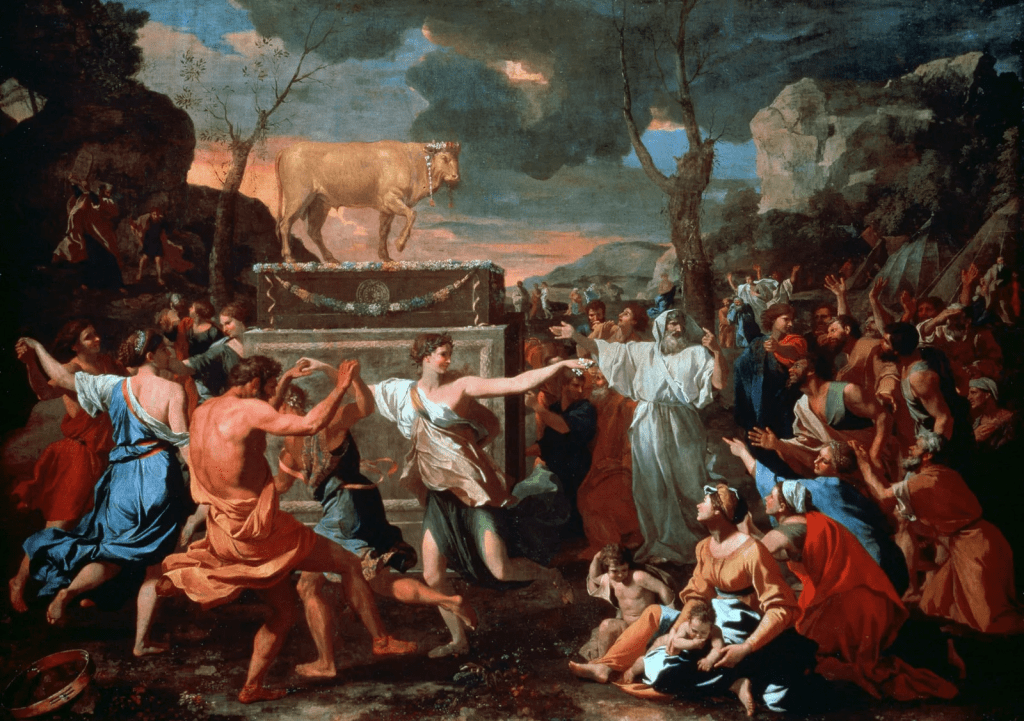
Adoration of the Golden Calf, by Nicolas Poussin (1594-1665)

When it comes to sin, especially the sin of idolatry, it’s imperative that we name it for what it is. It will do no good to fudge on it by saying that so-and-so struggles with it more than me, or that it’s not as bad as assault or murder.

No, we must call sinful idolatry just that, because the problem of idolatry is at the heart of humanity’s spiritual struggle. The first of the Ten Commandments frames it and names it squarely:

“I am the Lord your God who brought you out of slavery; do not worship other gods.” (Exodus 20:2-3, NRSV)

And the second commandment straight up prohibits any manufacturing or worshiping of idols:

“You shall not make for yourself an idol, whether in the form of anything that is in heaven above or that is on the earth beneath or that is in the water under the earth. You shall not bow down to them or serve them….” (Exodus 20:4-5, NRSV)

In the New Testament Gospels, Jesus also drew sharp lines between God and idolatry:

“No one can serve two masters, for a slave will either hate the one and love the other or be devoted to the one and despise the other. You cannot serve God and wealth.” (Matthew 6:24, NRSV)

The early church fathers (and mothers) forsook dependence on anything or anyone other than the one true God. Idolatry is an obsessive and fruitless search to satisfy a legitimate need in an illegitimate manner by giving oneself to someone or something other than the true object of the heart’s longing.

“You have made us for yourself, O Lord, and our heart is restless until it rests in you.”

St. Augustine

None of this means that the material and physical world is somehow bad – that money, possessions, food, books, nature, and other people are objects to avoid – because they are most certainly not! The problem arises whenever we seek to replace God with the things God made, God’s own creation.

By seeking to save our souls and fill the emptiness in our spirits with more and more wealth, or more and better jobs, or more time and expense for reading, or just about any other activity or possession there is, those things which were given for our use and enjoyment and to be stewarded well by us, end up becoming the users and our masters.

Inanimate objects, ideas, and activities begin calling the shots and giving the commands about what we should do and not do. What we own, now owns us. Even the poor can succumb to idolatry through the sin of covetousness by wanting things they do not have in the belief that wealth and possessions will make their lives whole and worthy. But this breaks the tenth commandment:

“You shall not covet your neighbor’s house; you shall not covet your neighbor’s wife, male or female slave, ox, donkey, or anything that belongs to your neighbor.” (Exodus 20:17, NRSV)

Nature and all the earth were formed by the Creator. And, as such, they too, give glory to God and recognize they themselves are not to be worshiped.

The heavens are telling the glory of God,
    and the firmament proclaims his handiwork.
Day to day pours forth speech,
    and night to night declares knowledge. (Psalm 19:1-2, NRSV)

Genuine wealth, prosperity, happiness and peace are found in the Creator of all good things. It is God who will:

  • wipe every tear from our eyes (Isaiah 25:1-9)
  • provide protection and guidance through the hard times of life (Isaiah 54:17)
  • be present with us as we walk through the valley of despair and ascend the mountain of celebration and joy (Psalm 23)

The reason idolatry is so insidious and difficult to name is that our affections are typically on a good thing which God has created and given for us. It’s just that, over time and through an extended process, the tail begins to wag the dog. For example:

  • Humanity serves the Sabbath instead of the Sabbath serving humanity
  • Parishioners venerate a church building instead of the church building being a tool for ministry
  • People are slaves to their hobbies instead of the hobby serving the person
  • Spouses worship one another instead of worshiping the God who brought them together
  • Groups let their traditions hold them with an iron grip, instead of traditions being held loosely by groups

It could (and does) happen to each one of us. And when it does, we need the wisdom and humility to see it for what it has become. Then, confess it as idolatry, and accept the forgiveness which is freely available from the Divine.

Almighty and everlasting God: Not to us, but to your name we give glory, for the sake of your steadfast love and your faithfulness! Yet because of the idolatry in our hearts, we have strayed far from you. We have disobeyed your commandments; we have trusted our own judgement; and we wonder why we feel distant from you. We have worshipped idols of silver and gold—and idols of self and comfort. Forgive us for not loving you as we ought, not obeying you as we were taught, and not trusting that our forgiveness has been bought. Amen.


Luke 12:13-21 – The Parable of the Rich Fool

The angel of death surprises a rich man by Jim Janknegt

A man in a crowd said to Jesus, “Teacher, tell my brother to give me my share of what our father left us when he died.”

Jesus answered, “Who gave me the right to settle arguments between you and your brother?”

Then he said to the crowd, “Don’t be greedy! Owning a lot of things won’t make your life safe.”

So, Jesus told them this story:

A rich man’s farm produced a big crop, and he said to himself, “What can I do? I don’t have a place large enough to store everything.”

Later, he said, “Now I know what I’ll do. I’ll tear down my barns and build bigger ones, where I can store all my grain and other goods. Then I’ll say to myself, ‘You have stored up enough good things to last for years to come. Live it up! Eat, drink, and enjoy yourself.’ ”

But God said to him, “You fool! Tonight, you will die. Then who will get what you have stored up?”

“This is what happens to people who store up everything for themselves but are poor in the sight of God.” (Contemporary English Version)

Let’s be honest before God because there’s no way we are going to fool him. The truth is, we all worry. 

And the more stuff we accumulate, the more worried we get. And the more worried we get, the stingier we become – to the point where we encase ourselves around more stuff, which requires bigger places to store all our stuff.

Here’s a bit of a reality check: We are not self-sufficient independent automatons who are meant to function by themselves without ever needing help.

The Rich Fool by Rembrandt, 1627

If we have some success in this independence venture, we then expect that others ought to be able to do it, too. Such thinking leads to a lack of generosity, believing that others just need to work harder or smarter or better. They’re lazy, we may reason. So, I’ve got no responsibility to share any of my largess with slackers.

We seek after whatever it is we desire. If we seek the kingdom of God, we will pursue the Lord Jesus and aim our love toward knowing him. But if we seek materialism, wealth, and the accumulation of stuff, we will never have enough because worry and fear shall always overwhelm the voice of God. 

I make it sound easy, as if the choice were so clear. On one level it is, but, like most things, it’s complicated because we are all a weird hybrid of competing loves and desires.

So, let’s make a few distinctions that might help us clarify our kingdom calling. Materialism is not the same thing as hard work. 

Materialism:

  • Is a shield we lug around to protect us from failure and poverty
  • Puts us on a performance treadmill, and is tied to our self-worth
  • Is a never-ending quest for security and protection
  • Seeks to avoid the criticism of others by seeking their approval with stuff
  • Believes that money will take away feelings of hurt, pain, and discomfort

Whereas hard work:

  • Is about healthy achievement and a patient growth of assets
  • Seeks to improve and is satisfied with a job well done
  • Takes away fear and worry 
  • Brings gratitude and joy

Any worldly fool can make money; but the wise and righteous person is able to manage resources in a way that glorifies God, builds up the church, and blesses the world. 

And it all begins with knowing the difference between depending on God versus depending on self and stuff.

The rich farmer in Christ’s story is a fool not because he is wealthy or because he saves for the future, but because he lives only for himself, and because he believes he can secure his life with his abundant possessions.

In the parable, the rich guy only talks to himself – not to anyone else. The man doesn’t express any gratitude to God. There is neither any thanking the workers who have helped him plant and harvest this bumper crop, nor any sharing his wealth through giving them a bonus.

The farmer has more than he could ever hope to use, yet he seems to have no thought of sharing it. And there is clearly no thought of what God might require of him. The rich man is outright blind to the fact that his life is not his own to secure, that his life belongs to God, and that God can demand it back at any time.

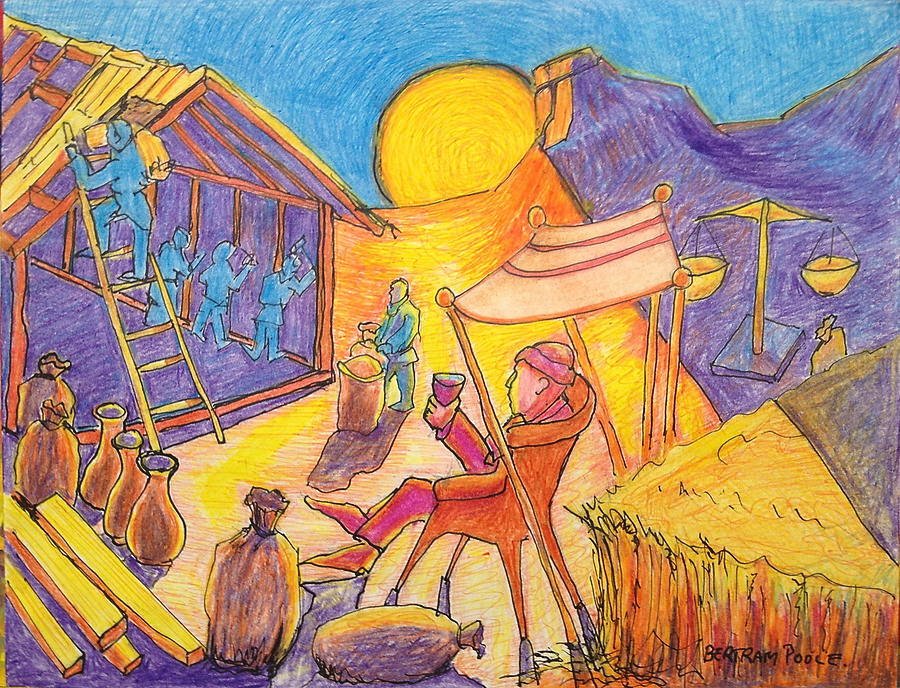
The Rich Fool by Bertram Poole

No amount of wealth can give any of us what we need most in life: healthy relationships, the love and enjoyment of friends and family, or eternal life. Nobody can buy their way into heaven or eternal bliss. What’s more, money cannot provide protection from disease and disaster.

Here’s another reality check: The rich and the poor all die, just the same. And the one who is wealthy cannot take a bit of it with him.

At issue here, for Jesus, is neither saving for retirement or for future needs, nor enjoying the good things in life. In fact, that’s wisdom.

The issue, for Jesus, is about what’s most important to God. It’s about priorities. God cares deeply about how we invest our lives and use the gifts given us. The Lord is vested in us, so he cares about how we love God and neighbor. God wants us to orient our lives toward the divine mission to bless and redeem the world.

In other words, God cares about whether we care, or not, about others.

As a hospital chaplain, I’ve seen my share of death. And I have never once heard anyone say, “Gosh, chaplain, I sure wish I hadn’t given so much money and stuff away. I wish I had kept more for myself.” But I’ve sure heard plenty of the opposite.

A spiritual reality check: We, and our resources, all belong to God.

We are merely stewards of everything we own. God gave it to us. God can take it away. Including our life.

The good news is that, since we, and everything we have, belongs to God, our future is secure in Christ.

Merciful God, thank you for giving me everything I need for life and godliness in this present world. Forgive me for ever doubting your goodness and ability to provide for me. Let my life bless the name of Jesus, and may I steward all that you have given me with care and compassion. Amen.

Amos 5:10-17 – Work It Out In the Public Square

People hate this kind of talk.
    Raw truth is never popular.
But here it is, bluntly spoken:
    Because you run roughshod over the poor
    and take the bread right out of their mouths,
You’re never going to move into
    the luxury homes you have built.
You’re never going to drink wine
    from the expensive vineyards you’ve planted.
I precisely know the extent of your violations,
    the enormity of your sins. Appalling!
You bully right-living people,
    taking bribes right and left and kicking the poor when they’re down.

Justice is a lost cause. Evil is epidemic.
    Decent people throw up their hands.
Protest and rebuke are useless,
    a waste of breath.

Seek good and not evil—
    and live!
You talk about God, the God-of-the-Angel-Armies,
    being your best friend.
Well, live like it,
    and maybe it will happen.

Hate evil and love good,
    then work it out in the public square.
Maybe God, the God-of-the-Angel-Armies,
    will notice your remnant and be gracious.

Now again, my Master’s Message, God, God-of-the-Angel-Armies:

“Go out into the streets and lament loudly!
    Fill the malls and shops with cries of doom!
Weep loudly, ‘Not me! Not us, Not now!’
    Empty offices, stores, factories, workplaces.
Enlist everyone in the general lament.
    I want to hear it loud and clear when I make my visit.”

God’s Decree. (The Message)

I believe an honest hearing of the prophet Amos would change the world.

I’m not talking about angry ranting which works people into a frenzy of fear and suspicion. I am referring to giving Amos a serious hearing, just like we give the Apostle Paul our focused attention.

Too bad so many people are unfamiliar with this prophet and his message. This unawareness, or even purposeful ignorance, could be one reason why the ancient message of Amos appears as fresh today as it was so long ago.

Poverty has always been with us – but that doesn’t mean we ought to only shrug our shoulders and say, “Meh, what’s a guy to do?” Instead, we can determine to address the issues which create a large class of poor people to begin with. Those issues include malevolence, materialism, and militarism.

Malevolence

The moral compass of many of the earth’s nations is askew, even broken. It needs to be recalibrated to the true north of biblical justice.

Back in the prophet’s day, bullying, bribery, and backstabbing were tools used for malevolent purposes. Those same implements are still being used by some today.

You must not pervert justice or show favor. Do not take a bribe, for bribes blind the eyes of the wise and distort the words of the righteous. (Deuteronomy 16:19, NET)

Those who plant injustice will harvest disaster,
    and their reign of terror will come to an end. (Proverbs 22:8, NLT)

But why would people be so unjust to other people? What would motivate someone to purposefully harm another in this way?…

Materialism

Whenever people have an exorbitant amount of stuff, generosity is typically not their first impulse (Ecclesiastes 5:10). Rather, the extremely rich among us have an equally extreme temptation to hold on tight to their wealth – so much so that money and acquiring more stuff becomes their religion. That’s why Scripture is replete with warnings about money.

Jesus said:

“No one can serve two masters. Either you will hate the one and love the other, or you will be loyal to the one and have contempt for the other. You cannot serve God and wealth.” (Matthew 6:24, CEB)

“Be on your guard against all kinds of greed, for one’s life does not consist in the abundance of possessions.” (Luke 12:15, NRSV)

It’s bad enough when individuals, families, and corporate companies devote themselves to a bloated materialism without regard to the poor; it’s even worse when entire nations, governments, and regions do it. From their perspective, what is the most effective way for them to protect all that stuff and self-interest?

Militarism

Pouring significant amounts of money into maintaining armies to safeguard resources – and the way of life which created those resources – puts the focus off the poor and onto the interests of wealth. It also diverts money which could address problems of poverty and puts it into a massive defense budget.

Throughout the Old Testament, militarism was seen as fundamentally not trusting in God. And the prophets have a well-known term for this: idolatry.

The Lord doesn’t care about
the strength of horses
    or powerful armies.
The Lord is pleased only
with those who worship him
    and trust his love. (Psalm 147:10-11, CEV)

Make sure to not build up a war machine, amassing military horses and chariots. (Deuteronomy 17:16, MSG)

Please don’t hear what I’m not saying. A standing military is a must – I’m just pointing out that we need to know precisely what we’re defending. Are we truly defending the rights of the poor, the disadvantaged, and the needy? Or are we defending someone’s exorbitant wealth?

Work It Out In the Public Square

Policies need to reflect values. Greed can and is legislated as a politic of indifference, whereas generosity can be ensconced with a politic of caring for the common good of all, not just some. This is not namby-pamby liberal drivel – it is paying attention to the biblical text.

Addressing poverty means removing the obstacles of malevolence, materialism, and militarism. And it begins with practicing lament.

The very presence of systemic racism and poverty, ecological devastation, healthcare disparities, economic policies which do not benefit all persons, and distorted notions of nationalism requires not only virtuous policy making, but also demands public lamentation.

Why lament? Because the Lord, the One who observes and sees all the wrong against the most vulnerable of the earth, demands that it be done.

Wherever there is injustice, we need people who will champion the cause of the needy through voicing aloud the deep grief from being squished by the powerful, as well as affirming trust in the Lord.

I’ll never forget the trouble, the utter lostness,
    the taste of ashes, the poison I’ve swallowed.
I remember it all—oh, how well I remember—
    the feeling of hitting the bottom.
But there’s one other thing I remember,
    and remembering, I keep a grip on hope:

God’s loyal love couldn’t have run out,
    his merciful love couldn’t have dried up.
They’re created new every morning.
    How great your faithfulness!
I’m sticking with God (I say it over and over).
    He’s all I’ve got left. (Lamentations 3:19-24, MSG)

O Creator of all living things: We are all hungry in a world full of abundance. The possibilities of food for bodies and souls overflow on this earth. We ask for the grace to see the abundance of our world and enough awareness to acknowledge our sins of greed and fear.

Give us openness of soul, courageous spirits, and willing hearts to be with our sisters and brothers who are hungry and in pain, through Jesus Christ our Lord, who with you and the Holy Spirit are One God, now and forever. Amen.

Luke 12:29-32


            We seek what we desire.  If we seek the kingdom of God, we will pursue the Lord Jesus and aim our love toward knowing him.  But if we seek materialism, wealth, and the accumulation of stuff we will never have enough because worry and fear shall always overwhelm the voice of God’s kingdom.  I make it sound easy, as if the choice were so clear.  On one level it is, but, like most things, it is complicated because we are all a weird hybrid of competing loves and desires.
             So, let’s make a few distinctions that might help us clarify our kingdom calling.  Materialism is not the same thing as hard work.  Materialism is a shield we lug around to protect us from failure and poverty; hard work is about healthy achievement and proper patient growth of assets.  Materialism puts us on a performance treadmill, tied to our self-worth; hard work seeks to improve and is satisfied with a job well done.  Materialism has a never-ending quest for security and protection, but hard work brings gratitude and joy.
             The pursuit of wealth seeks to avoid the criticism of others, seeks their approval, and wrongly believes that money will take away feelings of hurt, pain, and discomfort.  But seeking God’s kingdom as the passionate priority of our lives is the true path of taking away fear and worry.  Any worldly fool can make money; but only the wise and righteous person is able to manage resources in a way that glorifies God, builds up the church, and blesses others.  And it all begins with knowing the difference between depending on God versus depending on self.
             Merciful God, thank you for giving me everything I need for life and godliness in this present world.  Forgive me for every doubting your goodness and ability to provide for me.  Let my life bless the name of Jesus.  Amen.