Resurrection of the Lord (John 20:1-18)

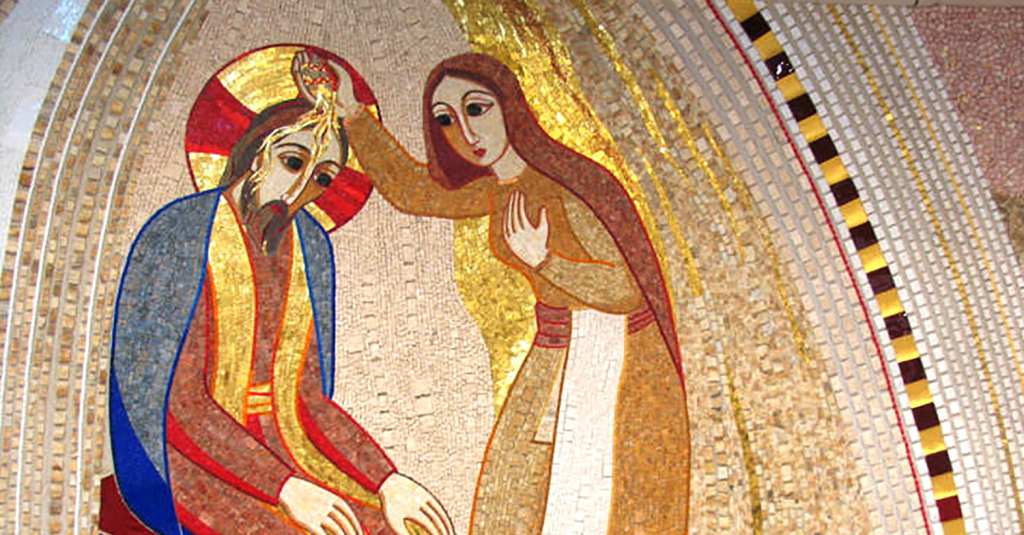
Mosaic of Mary Magdalene in the garden with Jesus, Resurrection Chapel, Washington National Cathedral, Washington D.C.

Early on the first day of the week, while it was still dark, Mary Magdalene came to the tomb and saw that the stone had been removed from the tomb. So she ran and went to Simon Peter and the other disciple, the one whom Jesus loved, and said to them, “They have taken the Lord out of the tomb, and we do not know where they have laid him.” 

Then Peter and the other disciple set out and went toward the tomb. The two were running together, but the other disciple outran Peter and reached the tomb first. He bent down to look in and saw the linen wrappings lying there, but he did not go in. 

Then Simon Peter came, following him, and went into the tomb. He saw the linen wrappings lying there, and the cloth that had been on Jesus’s head, not lying with the linen wrappings but rolled up in a place by itself. 

Then the other disciple, who reached the tomb first, also went in, and he saw and believed, for as yet they did not understand the scripture, that he must rise from the dead. Then the disciples returned to their homes.

But Mary stood weeping outside the tomb. As she wept, she bent over to look into the tomb, and she saw two angels in white sitting where the body of Jesus had been lying, one at the head and the other at the feet. They said to her, “Woman, why are you weeping?” She said to them, “They have taken away my Lord, and I do not know where they have laid him.” 

When she had said this, she turned around and saw Jesus standing there, but she did not know that it was Jesus. Jesus said to her, “Woman, why are you weeping? Whom are you looking for?” Supposing him to be the gardener, she said to him, “Sir, if you have carried him away, tell me where you have laid him, and I will take him away.” 

Jesus said to her, “Mary!” She turned and said to him in Hebrew, “Rabboni!” (which means Teacher). Jesus said to her, “Do not touch me, because I have not yet ascended to the Father. But go to my brothers and say to them, ‘I am ascending to my Father and your Father, to my God and your God.’” 

Mary Magdalene went and announced to the disciples, “I have seen the Lord,” and she told them that he had said these things to her. (New Revised Standard Version)

Do Not Hold On To Me, by He Qi

Although Peter and John have a role in this story about Christ’s resurrection, the main character is Mary Magdalene. This is significant and symbolic for several reasons:

  1. It was Mary who experienced one of the most profound and deep changes of life due to the ministry of Jesus. Mary had been an immoral woman and spiritually enslaved to the machinations of seven demons. Jesus thoroughly delivered her from her personal hell.
  2. Mary was forever thankful to Jesus for changing her life, and so, she followed Christ and supported him in any way she could. 
  3. Mary was at the foot of the cross when Jesus died. While other disciples were keeping their distance out of fear, Mary was bold in standing with the other women for all to see that they were completely devoted to Jesus. Mary never turned her back on Jesus. 
  4. It was Mary who was there on the Sunday morning of Christ’s resurrection. Whereas the other followers were nowhere to be found, Mary came to the grave, still with a heart given to Jesus and grieving over his death. 

Because Mary had been given a new chance at life, she was deeply thankful and everything she had belonged to Jesus. Mary Magdalene was forgiven much, and, so she loved much. Here she is, after her Lord’s crucifixion, death, and burial, at the grave of Jesus. 

Mary came to the tomb on Easter Sunday still living in a Good Friday world – grieving, sad, and discouraged.  She soon discovered, however, that Christ is risen!

In the midst of your days of disappointment, loss, or sadness, how have you been surprised by joy and the presence of the risen Christ?  How has your grief been turned to gratitude?  Have you seen the risen Lord?  

Let Mary Magdalene’s experience be of encouragement to you. Mary was given new life and was transformed by the Lord. Yet, on Easter Sunday she did not immediately get what the heck was going on. Jesus rising from death was not anywhere on her radar. 

The empty tomb and the angels did not immediately lead her to faith – not until she saw Jesus, and even then, she did not recognize him. Only when Jesus called her name did Mary recognize him and respond, believing it was her Lord. 

And Jesus is still calling out names. He is calling your name. Jesus had said to his disciples that the sheep listen to the shepherd’s voice; he calls his own sheep by name and leads them out (John 10:3-4). One little word can change our lives forever: our name.

Easter opens a whole new world for us, as it did for Mary – a future of announcing good news and proclaiming resurrection.

There is a simple reason why the grave clothes were left in the tomb just lying there – they were not needed anymore! We no longer need the grave clothes of discouragement, defeat, and despair. We no longer need to weep and wonder because Christ is risen! Jesus Christ has called us by name, and we hear his voice.

The twentieth century theologian, Karl Barth, said that what brings people to worship God – not just on Easter, but any day – is an unspoken question clinging to our minds and hearts: Is it true? Is it true that God lives? Is it true that Jesus is alive? Could it be true that I can live a new life in Christ? Is it true that I can rebuild my life?  Is it all true? 

Mary Magdalene approached the tomb and found that it was true: Christ Jesus is risen from death!

Today, all over the world, followers of Jesus are testifying that this day and it’s deep implications for life is real: Christ is risen, and there is new life in Jesus. Believers across the globe are worshiping the risen Lord because they declare along with us, “I have seen the Lord!”

God has always been in the business of changing lives. British author A. N. Wilson, used to be known for his scathing attacks on Christianity and proclaimed the death of God. Yet he celebrated Easter in 2009 at a church with a group of other church members, proclaiming that the story of Jesus is the only one that makes sense out of life and its challenges. Wilson said:

“My own return to faith has surprised none more than myself…. My belief has come about in large measure because of the lives and examples of people I have known—not the famous, not saints, but friends and relations who have lived, and faced death, in light of the resurrection story, and in the quiet acceptance that they have a future after they die.”

The moment Jesus calls a person’s name, the power of the resurrection is enabled—the same power that raised Jesus from the dead. 

Come now, see what you consider as immovable slabs of stone in your life—bitterness, insecurity, fear, self-doubt or cynicism. Those immense rocks can be rolled away. To know Jesus is to know the power of the resurrection. 

We don’t need to merely hear testimonies of changed lives like Mary Magdalene’s; we can experience new life ourselves.

There is one word, one name, which has forever changed the world: “Jesus.”  And Jesus wants to change the world by uttering one simple word, one name, your name, so that you can exclaim with great joy, “I have seen the Lord!”

Loving Lord Jesus, you are our freedom. When I was lost in a dark hole of guilt and shame, you liberated me. You lifted me from sin, death, and hell.

Almighty God, hear today our prayers for the salvation of the world. Grant mercy to everyone who has turned away from you. Open their hearts and minds with your gracious light. Gather your children from the east and the west, from the north and the south. 

O God, bring people everywhere out of the darkness of disease and death, and into your marvelous light. Hear our prayers and answer us. May the benevolent way of Jesus be the hope of the world; among all nations may your salvation come.

Gracious Lord, our neighbors, relatives, friends, and co-workers, along with the sick, the poor, the prisoner, the widow, and all creation are in your hands. Therefore, fill us all with your love and your mighty resurrection power! And, grant us peace through Jesus Christ, our risen Lord. Amen.


Broken and Poured Out (Matthew 26:6-13)

Jesus was in Bethany at the house of Simon the leper. While he was there, a woman came to him. She had an alabaster jar filled with expensive perfume. She poured the perfume on Jesus’ head while he was eating.

The followers saw the woman do this and were upset at her. They said, “Why waste that perfume? It could be sold for a lot of money, and the money could be given to those who are poor.”

But Jesus knew what happened. He said, “Why are you bothering this woman? She did a very good thing for me. You will always have the poor with you. But you will not always have me. This woman poured perfume on my body. She did this to prepare me for burial after I die. The Good News will be told to people all over the world. And I can assure you that everywhere the Good News is told, the story of what this woman did will also be told, and people will remember her.” (Easy-to-Read Version)

It seems that much of the world’s default response to events right in front of their eyes is to be judgmental, binary, and negative – as if everything is a simple sum of right and wrong, good and bad – and all adjudicated by our perceptions and perspectives on it.

The disciples reflexively moralized the actions of the woman and her jar of expensive perfume. What a waste, they believed. They thought they knew better and could do better.

But there was more going on in today’s Gospel lesson than what meets the eye. In the Apostle John’s account, the woman in the story is identified as Mary, a woman with a sordid background who had her life transformed through meeting Jesus. (John 12:1-11)

Near the end of Christ’s life, as he was about to enter Jerusalem and be arrested, tried, tortured, and killed, this woman, Mary, is aware of what is happening when others are not, even the disciples of Jesus. Her own brokenness cracked open to her the true reality of life.

The surface event itself is a touching and tender moment in history. This woman, whom everyone knew was a damaged person, took a high-end perfume and broke the entire thing open. She then proceeded to anoint Christ’s feet with it. You can imagine the aroma which filled the entire house with expensive perfume for all to smell. 

The woman, Mary, was affirmed by Jesus for seeing the situation as a possibility and opportunity of loving her Lord. Mary alone had the vision amongst all the disciples, and the accompanying action, to enter through the door of risk in order to connect intimately and lovingly with Jesus.

Mary’s love, radiating outward for all to see, reflected the genuine love of God for the world – a love so great that Jesus would soon experience death and burial because of that love for humanity.

The disciples were grumping and cursing about the right way to do things; whereas Jesus blessed the woman with no reference whatsoever to morality or ethics. Mary had no concern for playing the numbers game and counting money, but instead focused on the ultimate value before her.

Giving what she had to Jesus, Mary demonstrated the path of true discipleship. She helps open our eyes to the realities which are right in front of us:

  • The broken jar of perfume shows us her brokenness and our need to be broken. (Matthew 5:3-4)
  • An extraordinary and extravagant amount of perfume was used, picturing her overflowing love for Jesus. (John 20:1-18)
  • The perfume was poured on the head of Jesus, and she herself used her hair as the application (according to John); hair is a rich cultural symbol for submission and respect. (1 Corinthians 11:14)
  • The perfume directs us to the death of Jesus. (John 19:38-42)
  • The perfume highlights for us the aroma of Christ to the world. (2 Corinthians 2:15-17)
  • There is more to the disciples’ response than mere words about perfume; the Apostle John specifically names Judas as questioning this action – the one who is not actually concerned for the poor. (Matthew 26:15)
  • The woman and the disciples (specifically, Judas and Mary) serve as spiritual contrasts: Mary opens herself to the sweet aroma of Christ; Judas just plain stinks.
  • The perfume presents a powerful picture of the upcoming death of Christ, for those with eyes to see; he was broken and poured out for our salvation. (Luke 23:26-27:12)

Christianity was never meant to be a surface religion which only runs skin deep. The follower of Christ is meant to be transformed, inside and out, so that there is genuine healing, spiritual wellness, and authentic concern for the poor and needy. 

Keeping up appearances is what the Judas’s of this world do. However, the Mary’s among us dramatically point to Jesus with their tears, their humility, their openness, and their love.

In this contemporary environment of fragmented human ecology, our first step toward wholeness and integrity begins with a posture of giving everything we have – body, soul, and spirit – to the Lord Jesus. In receiving the love of God, we can then freely give that love to a world locked in the shackles of tunnel vision, judgmentalism, and incessant moralizing.

To take the risk of breaking ourselves open and becoming vulnerable, we find love. In finding love, there we see intimacy. And where there is intimacy, there is the relational connection which transforms the dark and the negative to possibility and light.

Loving Lord Jesus, my Savior, and my friend, you have gone before us and pioneered deliverance from an empty way of life and into a life of grace and gratitude. May I, and all of your followers, emulate the path of Mary and realize the true freedom which comes from emptying oneself out for you. Amen.

John 12:1-11 – Monday of Holy Week

Six days before the Passover, Jesus went to Bethany, the home of Lazarus, the man he had raised from death. They prepared a dinner for him there, which Martha helped serve; Lazarus was one of those who were sitting at the table with Jesus. Then Mary took a whole pint of a very expensive perfume made of pure nard, poured it on Jesus’ feet, and wiped them with her hair. The sweet smell of the perfume filled the whole house. One of Jesus’ disciples, Judas Iscariot—the one who was going to betray him—said, “Why wasn’t this perfume sold for three hundred silver coins and the money given to the poor?” He said this, not because he cared about the poor, but because he was a thief. He carried the money bag and would help himself from it.

But Jesus said, “Leave her alone! Let her keep what she has for the day of my burial. You will always have poor people with you, but you will not always have me.”

A large number of people heard that Jesus was in Bethany, so they went there, not only because of Jesus but also to see Lazarus, whom Jesus had raised from death.So, the chief priests made plans to kill Lazarus too, because on his account many Jews were rejecting them and believing in Jesus. (Good News Translation)

Jesus entered Jerusalem, the day before, on Sunday, with the people waving and lying down palm branches, along with shouts of “hosanna!” Although Jesus had been speaking about his death, weeks before his triumphal entry, most folks were clueless as to what was about to happen.

But Mary Magdalene did. She truly listened to the Master. Her spiritual ears and eyes were fully opened to the significance of this week. Mary was completely aware.

A woman with a sordid background, Mary Magdalene had her life thoroughly transformed through meeting Jesus. She became a follower, in every sense of the word. As an attentive disciple, Mary knew her Lord. She observed every little thing about Jesus, hung on every word, knew each voice inflection and every gesture.

Now, near the end of Christ’s earthly life, and only days from being arrested, tried, tortured, and killed, Mary sensed what was happening. She saw the pained affect on her Lord’s face that no one else noticed. She was cognizant of what was happening, while the others seemed clueless.

Mary’s own brokenness cracked open to her the true reality of life, the real meaning of the unfolding days, and the deep gravity of this week.

The surface event itself is a touching and tender moment in history. This woman, whom everyone knew as a damaged person, took a high-end perfume, and broke the entire thing open.

Mary then proceeded to anoint Christ’s feet with it. You can imagine the aroma filling the house with an expensive perfume for all to smell. Giving what she had to Jesus, Mary demonstrated the path of true discipleship.

Mary’s act of faith in anointing Jesus was deeply symbolic:

  • The broken jar of perfume shows us the brokenness of Mary and our need to be broken. (Matthew 5:3-4)
  • Mary used an extraordinary amount of perfume, picturing her overflowing love for Jesus. (John 20:1-18)
  • Mary applied the perfume to Jesus with her hair (hair is a cultural symbol of submission and respect). (1 Corinthians 11:14)
  • The perfume directs us to the death of Jesus. (John 19:38-42)
  • The perfume highlights for us the aroma of Christ to the world. (2 Corinthians 2:15-17)
  • There is more to Judas than his words about perfume; he is not actually concerned for the poor. (Matthew 26:15)
  • Judas and Mary serve as spiritual contrasts: Mary opens herself to the sweet aroma of Christ; Judas just plain stinks.
  • The perfume presents a powerful picture of the upcoming death of Christ, for those with eyes to see; he was broken and poured out for our salvation. (Luke 23:26-27:12)

Christianity was never meant to be a surface religion which merely runs skin deep. The follower of Christ is meant for deep personal transformation, inside and out, so that there is genuine healing, spiritual health, and authentic concern for the poor and needy. 

Keeping up appearances is what the Judas’s of this world do. But the Mary’s among us dramatically point others to Jesus with their tears, humility, vulnerability, openness, and love.

In our contemporary social and cultural landscape of fragmented human ecology, our first step toward wholeness and integrity begins with a posture of giving everything we have – body, soul, and spirit – to the Lord Jesus.

Sometimes it takes a woman to show us the way.

On this Monday of Holy Week, a tangible act may help us to express and deepen our faith. Take a bottle of unopened perfume or cologne, pour it completely out into a used tin can, and set the can in a central place in your home, just for the day* The aroma will likely linger into the next few days, as well. Let the smell be a continual reminder of both the sadness of death and the joy of salvation.

Loving Lord Jesus, my Savior, and my friend, you have gone before us and pioneered deliverance from an empty way of life and into a life of grace and gratitude. May I and all your followers emulate the path of Mary and realize the true freedom which comes from emptying oneself out for you. Amen.

*When you are ready, it is appropriate to dispose of the perfume by pouring it down the drain. Even this can be a ritual in which you visualize discarding your old life in order to take up a new one on Easter Sunday.

Life by Death

Photo by Pixabay on Pexels.com

A lot of people don’t like change. That is likely an understatement. Change means adjusting to a different reality and adjusting is not something we prefer doing. Many folks would much rather keep things the way they are. Routine, consistency, predictable outcomes—these are things we rely on for a sense of safety and stability in our lives.

Even good change is difficult, if for no other reason than what it takes to get there. Becoming debt-free, getting in shape, or starting a new job are all good changes to make, but to making them can take a lot of determination and effort on our part. In many cases, to change something about ourselves, we must be willing to admit what we are doing is not working and try something different.

God’s love in Jesus Christ changes everything. The kind of change Jesus talked about and died for was not making a few alterations to our lives or re-arranging some of our schedule. For Jesus, change is neither about exerting more effort nor adding things to an already full to-do list.

The change Jesus embraces is a complete transformation from the inside-out. For that to happen, to have a new life, the old life must die. What’s more, Jesus does not want us half dead because then we are only spiritual zombies, not really living the life God intended for us. No, if there is to be a resurrection and new life, there must be a death (John 12:20-33). There are three ways people need to die to live the life that God desires….

1.We need to die to our plans.

Jesus had a crowd of people following him wherever he went. He was interesting and compelling, even magnetic. Christ taught like no other person before him and healed all kinds of people. In the first century, Jesus became the latest fad.  With his fame, there were people who looked to Jesus to further their own agenda and their plans about how things should go.

Earlier in chapter twelve of John’s Gospel, the Apostle recorded a contrast between two people: Mary and Judas. Mary is a picture of dying to her own plans of how things should go. Mary took some expensive perfume, the kind that could have set her up for some needed financial security and poured it all on Jesus’ feet. Then, she humbly wiped it on him with her hair. It is a picture of giving herself completely and wholly to Jesus, no matter the cost, with no strings attached and no other agenda other than total devotion.

Judas, on the other hand, piously objected to Mary’s act of worship. We might hear him rationally pushback on what Mary was doing, saying to his fellow disciple, “My friends, this is a lot of money – money that could be used for the poor instead of needlessly wasting it. A little perfume is fine, but to use the whole bottle is over the top – it isn’t fiscally responsible!” Judas had a secret agenda. He was not thinking of giving himself completely to Jesus, but of how he could use the cash for himself and his own purposes. 

Judas is the picture of a spiritual zombie – half dead, walking around saying all kinds of spiritual things, but only devoted to Jesus and God’s kingdom when it agreed with him. Judas had his own ideas of how the kingdom operation ought to go. When he became convinced Jesus was not going to operate according to his agenda and plans, Judas betrayed him.

I have been crucified with Christ and I no longer live, but Christ lives in me. The life I now live in the body, I live by faith in the Son of God, who loved me and gave himself for me.

galatians 2:20, niv

In John 12:20-22, we have some Greeks (Gentiles) who want to see Jesus. They are interested in him. Unlike Judas and Mary, we are not told why they wanted to meet with him. But the fact that Jesus does not jump on the chance to interact with them probably says something about their motives. 

It is the nature of many people to want to observe whatever big thing is going on. They want to be in the know and talk about the latest happenings. Whenever we see “the crowd” in the Gospels, it is typically a negative connotation, a statement of by-standers, just looking on. 

Much of Christ’s ministry was to teach, heal, cajole, and do whatever he could to press the crowd, the by-standers, into not just following him as a novelty. Jesus wanted them to really follow him by dying to themselves and adopting a new life in the kingdom of God.

When I was a senior in high school the Pope came to Iowa, of all places! Never had that happened. 350,000 people came to see him. It was on a Friday, and we got two days off from school, mainly because trying to get around those two days was nearly impossible. Literally, everything shut down for the event. There were so many people that John Paul II got dropped in on one of Jimmy Carter’s presidential helicopters. 

I lived exactly thirteen miles from where the Pope spoke and had mass with the Catholic faithful. Protestants and Jews flocked to see him, as well. No car was allowed within a five-mile radius of the Pope. People had to park miles away and get shuttled-in. I knew several people from my small town that walked the thirteen miles one way just to see John Paul II. It was exciting and incredible, and is still talked about today in Iowa, forty years later.

Not everyone there that day in Iowa was a faithful Christ follower. Most people do not remember much about what John Paul II said, other than affirming the work of farmers as a needed vocation. Jesus was not at all interested in being a king in the conventional sense. He did not seek popularity or work to consolidate power through sheer force of will or personality. Instead, he died. And he calls us to die, as well – to die to our plans and to our perceived need to be in the know and hob-nob with a celebrity.

2. We must die to self.

This was the message of Jesus. There is no wiggle room to it. There are no walking dead zombies. Jesus responded to the request of the Greeks to see him by not even dealing with it but going on about what people really need to do: die to self.

To make his message clear and understandable, Jesus used the illustration of a seed that must die before it bears fruit.  Seeds wait to germinate until three needs are met: proper amounts of water, warm temperature, and good soil. During its early stages of growth, the seedling relies upon the food supplies stored within the seed until it is large enough for its own leaves to begin making food through photosynthesis. The seedling’s roots push down into the soil to anchor the new plant and to absorb water and minerals from the soil. And its stem with new leaves pushes up toward the light.

This is exactly the kind of process Jesus said needs to happen with people in the kingdom of God. People must never settle for remaining as seeds because that is not what we are designed for. Jesus wants us to be transformed, to experience new life, and to bear righteous fruit. To follow Jesus means to die being a seed and growing into a fruit bearing plant with more seeds to have the whole process occur again.

Jesus said that the person who “hates” their life will gain eternal life. That is, the person who is willing to give up everything to follow Jesus will find true life in Christ. The one who serves Jesus will follow him. Hate is simply a biblical term that means we make the choice to avoid one path in favor of another.

When living in West Michigan, my family enjoyed summers on the beaches of Lake Michigan. My girls loved being there on hot summer days. The beaches are actual sand, not with any gravel or dirt. I would tell my girls to follow me and walk in my footprints. I told them that not only because it would be easier for them to walk, but so they would not stray from me.

Lent is a season designed for us to remember Jesus, to remember we belong to God, and to repent of anything that keeps us away from the Lord.  This brings us to the third way we need to die….

3. We are to die to the world.

Now is the time for judgment on the world. The prince of this world is driven out. The death of Jesus means we can now die to the world. “World” is not the people of this world, in the sense of John 3:16 that God loves the world. This is “world” as the unjust systems that operate within it. Christ achieved victory over this world. He died so that we no longer need to be locked into the oppressive ways of bondage and evil.

Do not love this world nor the things it offers you, for when you love the world, you do not have the love of the Father in you. For the world offers only a craving for physical pleasure, a craving for everything we see, and pride in our achievements and possessions. These are not from the Father, but are from this world. And this world is fading away, along with everything that people crave. But anyone who does what pleases God will live forever.

1 John 2:15-17, NLT

Jesus lived in a vastly different manner than people expected. He was quite counter-cultural. Christ rarely submitted to the usual way of doing things. Jesus did not operate like a worldly king. He did not teach like a worldly instructor. He died not only to redeem individuals but also to redeem entire systems and transform them into instruments of godliness. 

God cares about systemic evil, about ways of operating which keep people in bondage. Jesus cares about politics, economics, and social structures. He cares about governments and municipalities. The Lord cares about school systems and family systems and, yes, even church systems. Jesus died so that we can die to the world’s broken systems. God desires all our institutional ways of operation come under the lordship of Jesus Christ.

It will not do to only focus on private spirituality because Jesus wants to redeem the entire planet, systems included. Jesus is the Judge, and he is currently about the business by means of the Holy Spirit of making all things new. Eventually, the new creation will completely take over when Jesus returns. Now, in the present time, we have this crazy mixture of good and evil everywhere we go. Christians are to follow Jesus personally and privately, as well as corporately and publicly.

For example, the “factory system” is an actual phrase. The factory system is designed to mass produce products with the greatest efficiency possible. And it works. However, in the process, people become extensions of the machines they operate. With efficiency and production as the highest priorities, people can be replaced like cogs in the machine. 

Walk into many American factories and you will see sagging morale and deep animosities between workers and management because the system itself is inherently flawed. Simply implementing some safety protocols and giving a few raises are merely zombie tactics. The system still needs redemption.

When we take seriously the call to follow Christ, we see that the world and its systems are fundamentally broken and in need of redemption. Jesus has deposed the ruler of this world, Satan, through crucifixion and resurrection. We need to die to this world and to systemic evil.

Conclusion

We all become frustrated and discouraged at times, either with ourselves and/or with the world’s evil that exists around us, making our lives hard and even unbearable. Jesus knows how you feel. His soul was troubled with all the sin of the world. And he faced agony beyond anything we will ever know by allowing himself to die. The kind of death Jesus died was awful. It was that way because that is how horrible sin and sinful systems are.

Today Jesus is calling us to die – die to our plans of how we think things should go; die to ourselves by following in his footsteps; and die to participating in the sinful structures and systems of this evil world. We are to live differently. We are to live new lives – which means not simply tweaking some things but completely re-orienting our lives to serve the Lord.

Jesus is drawing us to himself. He is making himself known. Let us not treat Jesus as a novelty, but as the rightful Ruler of the universe by dying to our plans, ourselves, and the world.