Accept Your Shadow Side (Acts 7:30-40)

“Forty years later, in the desert near Mount Sinai, an angel appeared to Moses in the flame of a burning bush. When Moses saw it, he was amazed at the sight. As he went to take a closer look, the voice of the Lord called out to him, ‘I am the God of your ancestors—the God of Abraham, Isaac, and Jacob.’ Moses shook with terror and did not dare to look.

“Then the Lord said to him, ‘Take off your sandals, for you are standing on holy ground. I have certainly seen the oppression of my people in Egypt. I have heard their groans and have come down to rescue them. Now go, for I am sending you back to Egypt.’

“So God sent back the same man his people had previously rejected when they demanded, ‘Who made you a ruler and judge over us?’ Through the angel who appeared to him in the burning bush, God sent Moses to be their ruler and savior. And by means of many wonders and miraculous signs, he led them out of Egypt, through the Red Sea, and through the wilderness for forty years.

“Moses himself told the people of Israel, ‘God will raise up for you a Prophet like me from among your own people.’Moses was with our ancestors, the assembly of God’s people in the wilderness, when the angel spoke to him at Mount Sinai. And there Moses received life-giving words to pass on to us.

“But our ancestors refused to listen to Moses. They rejected him and wanted to return to Egypt. They told Aaron, ‘Make us some gods who can lead us, for we don’t know what has become of this Moses, who brought us out of Egypt.’ (New Living Translation)

We humans are a confusing paradox of sinner and saint. We are majestic people, created in the image and likeness of a good God. We are also profoundly fallen, touched by sin in every area of our lives. Our hearts exist with both light and darkness, having the capacity for both incredible altruism as well as inexplicable evil.

So then, it will do no good to retreat into binary definitions of people as being either good or bad. No, we shine and shadow at the same time. What really gets us into a terrible mess is when we ignore or deny our shadow selves. We then demonize the other while claiming purity for ourselves.

This is precisely what occurred when Stephen stood and spoke to a group of his fellow Jews. They stubbornly refused to acknowledge their shadow side. And it resulted in Stephen’s stoning and death. Whereas Stephen lifted and brought to light the unseemly aspects of their collective heritage, the people wanted nothing to do with it.
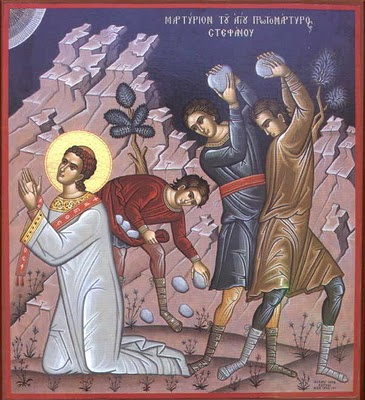
The Martyrdom of Stephen

In our present day, responses that do not want to acknowledge the shadow side include statements such as, “Quit being so negative. We focus on the positive. Expel this recalcitrant troublemaker once and for all!”

Oy. Acceptance cuts two ways. We must accept both our blessings and our curses. The acceptance of reality will not occur apart from a solid self-acceptance of who we are and how we are feeling in any given situation. On the practical level, it works something like the following story…

Several years ago, I went on a leadership retreat in the Canadian wilderness. We were so far out in the sticks that we needed special first aid training before leaving because if someone got severely injured it would be hours before any medical attention could be received. There was no cell phone service, no towns, no anything except mile after square mile of wilderness. 

One day, I was canoeing with a group of leaders, far out into the Canadian wilderness where there were no towns or people anywhere near us. It was very windy on this day in late May – which meant the water was still ice cold in Canada. One of the canoes capsized. We had to act quickly and deliberately – which was no small feat in a stiff wind. More than fifteen minutes would result in hypothermia for the two people in the water.

I did not like being in that situation. In fact, I didn’t much like the Canadian wilderness. Too many black flies and giant mosquitoes for me. My shadow side was coming out. But here I was, and I had to accept the reality I was in. One of the lessons I learned in that moment was that acceptance can sit alongside other reactions and emotions.

For example, a person can be outraged by an injustice, as Stephen was, and accept that it is a reality. Acceptance does not mean complacency or giving up. We can accept something while at the same time trying to make it better.

I also needed to accept what was happening inside of me. I was cold and worried. Trying to push those feelings away would have only added to the stress of the situation. If I failed to accept what was true about myself, I would be less able to deal with the situation, and so, would compromise my ability to help two people at risk.

I needed to accept the entire circumstance, including myself. Accepting what is inside gave me more influence over the situation, not less. Self-acceptance became the key to acceptance of unwanted conditions, and more importantly, acceptance of one another as human beings.

In that moment of rescuing two people (which ultimately proved successful) I became aware of a part of myself – the part that gets afraid and irritated – and chose not to stuff it or deny its existence.

I became the guy who talked to the panicked people in the water and kept them as calm as possible so that the others could get them out. I was able to do my part to help fearful people because I acknowledged and accepted my own fear.

Unlike my situation, however, Stephen’s experience ended in martyrdom. Just because we respond rightly, is no guarantee that everything will work out for our benefit. Rather, we say and do the things we must say and do, while leaving the results to a sovereign Lord.

It is our responsibility to work on ourselves, not others. And acceptance is the path to get there, all of it – including the shadow side – and not just part of it.

Jesus, let your mighty calmness lift me above my fears and frustrations. By your deep patience, give me tranquility and stillness of soul in you. Make me in this, and in all things, more and more like you. Amen.


Acceptance (Acts 7:17-40)

“As the time drew near for God to fulfill his promise to Abraham, the number of our people in Egypt had greatly increased. Then ‘a new king, to whom Joseph meant nothing, came to power in Egypt.’He dealt treacherously with our people and oppressed our ancestors by forcing them to throw out their newborn babies so that they would die.

“At that time Moses was born, and he was no ordinary child. For three months he was cared for by his family. When he was placed outside, Pharaoh’s daughter took him and brought him up as her own son. Moses was educated in all the wisdom of the Egyptians and was powerful in speech and action.

“When Moses was forty years old, he decided to visit his own people, the Israelites. He saw one of them being mistreated by an Egyptian, so he went to his defense and avenged him by killing the Egyptian. Moses thought that his own people would realize that God was using him to rescue them, but they did not. The next day Moses came upon two Israelites who were fighting. He tried to reconcile them by saying, ‘Men, you are brothers; why do you want to hurt each other?’

“But the man who was mistreating the other pushed Moses aside and said, ‘Who made you ruler and judge over us? Are you thinking of killing me as you killed the Egyptian yesterday?’ When Moses heard this, he fled to Midian, where he settled as a foreigner and had two sons.

Moses and the Burning Bush, by Marc Chagall

“After forty years had passed, an angel appeared to Moses in the flames of a burning bush in the desert near Mount Sinai. When he saw this, he was amazed at the sight. As he went over to get a closer look, he heard the Lord say: ‘I am the God of your fathers, the God of Abraham, Isaac and Jacob.’ Moses trembled with fear and did not dare to look.

“Then the Lord said to him, ‘Take off your sandals, for the place where you are standing is holy ground. I have indeed seen the oppression of my people in Egypt. I have heard their groaning and have come down to set them free. Now come, I will send you back to Egypt.’

“This is the same Moses they had rejected with the words, ‘Who made you ruler and judge?’ He was sent to be their ruler and deliverer by God himself, through the angel who appeared to him in the bush. He led them out of Egypt and performed wonders and signs in Egypt, at the Red Sea and for forty years in the wilderness.

“This is the Moses who told the Israelites, ‘God will raise up for you a prophet like me from your own people.’ He was in the assembly in the wilderness, with the angel who spoke to him on Mount Sinai, and with our ancestors; and he received living words to pass on to us.

“But our ancestors refused to obey him. Instead, they rejected him and in their hearts turned back to Egypt. They told Aaron, ‘Make us gods who will go before us. As for this fellow Moses who led us out of Egypt—we don’t know what has happened to him!’ (New International Version)

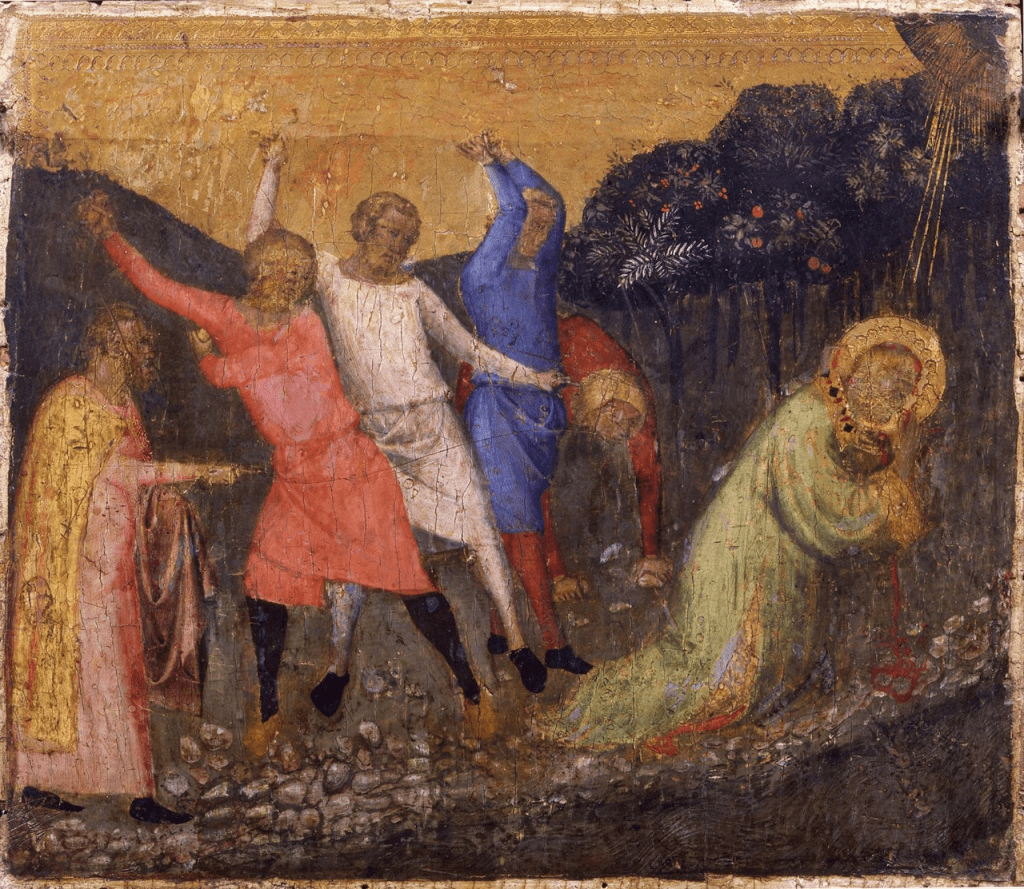
Martyrdom of St. Stephen, by Bernardo Daddi, 1345

We humans are a confusing paradox of sinner and saint. We are majestic people, created in the image and likeness of a good God.

And we are also profoundly fallen, touched by the power of sin in every area of our lives. Our hearts exist with both light and darkness, having the capacity for both incredible altruism as well as inexplicable evil.

So then, it will do no good to retreat into binary definitions of people as being either good or bad. No, we shine and shadow at the same time. The thing that really gets us into a terrible mess is when we ignore or deny our shadow selves. We then demonize the other while claiming purity for ourselves.

This is precisely what occurred with Stephen and a group of his fellow Jews who refused to acknowledge their shadow side. And it resulted in Stephen’s stoning and death. Whereas Stephen lifted and brought to light the unseemly aspects of their collective heritage, the people wanted nothing to do with it.

In our present day, the response might be something like, “Quit being so negative. We focus on the positive. Expel this recalcitrant troublemaker once and for all!”

Oy. Acceptance cuts two ways. We must accept both our blessings and our curses. And the acceptance of what is will not occur apart from a solid self-acceptance of who we are and how we are feeling in any given situation. On the practical level, it works something like the following story…

Several years ago, I went on a leadership retreat in the Canadian wilderness. We were so far out in the sticks that we needed special first aid training before leaving – because if someone got severely injured it would be hours before any medical attention could be received. There was no cell phone service, no towns, no anything except mile after square mile of wilderness. 

One day, it was very windy and several of us were on a lake canoeing to a destination. It was late May, which means the water was still ice cold in Canada. One of the canoes capsized and we had to act quickly and deliberately – which was no small feat in a stiff wind. More than fifteen minutes would result in hypothermia for the two people in the water.

I did not like being in that situation. In fact, I didn’t much like the Canadian wilderness. Too many black flies and giant mosquitoes for me. My shadow side was coming out. But here I was, and I had to accept the reality I was in. One of the lessons I learned in that moment was that acceptance can sit alongside other reactions and emotions.

For example, a person can be outraged by an injustice, as Stephen was, and accept that it is a reality. Acceptance does not mean complacency or giving up. We can accept something while at the same time trying to make it better.

I also needed to accept what was happening inside of me. I was cold and worried. Trying to push those feelings away would have only added to the stress of the situation. If I failed to accept what was true about myself, I would be less able to deal with the situation, and so, would compromise my ability to help two people at risk.

I needed to accept the whole circumstance, including myself. Accepting what is inside gave me more influence over the situation, not less. Self-acceptance became the key to acceptance of unwanted conditions, and more importantly, acceptance of one another as human beings.

In that moment of rescuing two people (which ultimately proved successful) I became aware of a part of myself – the part that gets afraid and irritated – and chose not to stuff it or deny its existence. I became the guy who talked to the panicked people in the water and kept them as calm as possible so that the others could get them out. I was able to do my part to help fearful people because I acknowledged and accepted my own fear.

Unlike my situation, however, Stephen’s experience ended in martyrdom. Just because we respond rightly is no guarantee that everything will work out for our benefit. Rather, we say and do the things we must say and do, while leaving the results to a sovereign Lord.

It is our responsibility to work on ourselves, not others. And acceptance is the path to get there, all of it, not just part of it.

Jesus, let your mighty calmness lift me above my fears and frustrations. By your deep patience, give me tranquility and stillness of soul in you. Make me in this, and in all things, more and more like you. Amen.

Revelation 1:4-8 – The One Who Is, Who Was, and Who Is To Come

John,

To the seven churches in the province of Asia:

Grace and peace to you from him who is, and who was, and who is to come, and from the seven spirits before his throne, and from Jesus Christ, who is the faithful witness, the firstborn from the dead, and the ruler of the kings of the earth.

To him who loves us and has freed us from our sins by his blood and has made us to be a kingdom and priests to serve his God and Father—to him be glory and power for ever and ever! Amen.

“Look, he is coming with the clouds,”
    and “every eye will see him,
even those who pierced him”;
    and all peoples on earth “will mourn because of him.”
So shall it be! Amen.

“I am the Alpha and the Omega,” says the Lord God, “who is, and who was, and who is to come, the Almighty.” (New International Version)

In my undergraduate college days, one of the required classes for my major was “Philosophy of History” taught by a crusty old professor who looked like he was one-hundred-and-ten-years-old. One day he came into the classroom and began his lecture by looking directly at me with those beady black eyes of his and said, as only he could say it, “Ehrhardt! Can God change history?”

The Apostle John was exiled to the island of Patmos. Late in the first century, all the other original disciples of Jesus were dead, having been martyred for their faith. Only John was left. The churches that the Apostle Paul established in Asia Minor were undergoing significant persecution. 

The trouble began with the church facing social ostracizing. Eventually, xenophobia took hold with many parts of the Roman Empire, and Christians began getting martyred. Misunderstandings of what the church is all about were rife.

If we were living during that time, we might seriously wonder if Christianity would survive, at all. Into this situation, the last Apostle, John, in exile, experienced a great vision (revelation) of Jesus concerning what is to come. While things looked awfully bleak, God graciously pulled back the veil between heaven and earth long enough for John to glimpse the great lordship of Jesus.

So, can God change history? You might be wondering about my response to the old professor. My answer was this: The question is only relevant if God were never in control and sovereign over history to begin with. There’s no need to change history if God is already actively working out divine purposes through history. Therefore, a more appropriate question is: Since God is Lord over all history, will we submit to the divine lordship? 

In difficult times, it’s only human to wonder if God is really sovereign over all the earth. With so much war, violence, and unrest in the world; with so many natural disasters and diseases all around; and whenever Christianity (and religion itself) is seen as a threat to many, we may sincerely ask ourselves, “Can God change history? Is God even in control of this present world?”

The revelation of Jesus to John, which he then shared with the struggling churches, was meant to encourage them – to give them hope that, even though Christ’s reign is invisible and seems limited and temporary, it will ultimately be visible, and is pervasive and permanent. 

Today’s New Testament lesson is meant to strengthen and bolster the believer’s faith with a vision of who Jesus is; what Jesus has done; and what Jesus will do.

Who Jesus Is

He is the faithful witness. The word “witness” is where we get our English word “martyr.” Faithful believers in the first centuries of the church witnessed to their faith and proclaimed the gospel of new life in Christ. They were effective enough to alter the social order, which brought persecution and, in some cases, death. 

These men and women died proclaiming their devotion to Jesus. They saw themselves as merely emulating and following the way of their sovereign Lord Jesus, who was himself a faithful martyr.

Jesus is the firstborn from the dead, that is, Christ has conquered death. Just as Christ rose from death, so also, we will be raised to life. Because Jesus is alive, Christians will live forever and experience bodily resurrection, as well.

Whatever happens to Jesus, happens to us. Jesus was persecuted, suffered, and died. We, too, shall suffer persecution and death. Jesus was raised from the dead and so shall we. The evil we experience in this life is very much known to God. Our solidarity with Jesus helps us to not grow weary and lose heart.

Jesus is the ruler, the king of kings and lord of lords. God reigns over the past, the present, and the future. Christ is in charge, presently now working out good plans and purposes. God bends events, situations, and hearts toward justice and righteousness. 

What Jesus Has Done

Jesus freed us from the power of sin by his blood. This is more than some nice information to know; it is truth designed for us to live a new life depending on King Jesus. Sometimes, we have horrible, no good, very bad days. We don’t respond to others well,  and then ask God’s forgiveness. Other days are wonderful, with bright sunshine and a spring in your step. We play well with others and express gratitude to God.

Jesus is Lord of both good days and bad days. Faith is not dependent upon our circumstances because it is the blood of Jesus which has freed us to live for God, no matter the situations we face. Christians overcome circumstances by the blood of Christ – and not because everything goes our way.  

We are never far from the cross of Christ. We overcome bad tempers, defeats, disordered love, fears, pettiness, and a host of other things by the blood of the Lamb. The daily goal is to not simply have a wonderful day without any adversity. Rather, the aim is to know Jesus Christ, and him crucified, dead, risen and ascended. 

Jesus has made us to be a kingdom of priests. Christians have continual access and unconditional acceptance of God through the blood of Jesus. We can intercede for others by going directly to God. Just as Jesus has unlimited access to the Father, so, the Christian has the privilege of coming to God at all times. 

Christians are a kingdom of priests where every believer intercedes for other believers, and even for the world which persecutes them. Jesus not only freed us from sin’s grip of evil for our own individual benefit, but also so that we can be agents of rescue for others. 

What Jesus Will Do

Jesus will come to judge the earth, the living and the dead. Moving deeper into Revelation, it truly becomes apocalyptic. It’s as if a group of trapped cave explorers choose one of the individuals to squeeze through a narrow flooded passage to get out to the surface and call for help. The point of the choice is more than personal salvation, it is the saving of the entire group. She is to bring help and equipment to ensure the rest get rescued.

Indeed, God elects, chooses, and calls us not only for our personal benefit but for the sake of many.

Conclusion

Jesus is worthy of our praise. He is the Alpha and Omega, the beginning and the end, the first and the last. His kingdom will never end. Since this is true, we are to faithfully serve God. In life and in death, we belong to God. We are not our own; we were bought at a price. 

“Can God change history?” is not the real question. Since God has changed history forever in the sending of the Son, the proper question is, “What will we do with the lordship of Christ over the world?”

Jesus is coming soon. When he returns, what will he find you doing?

Gracious God, we pray for Christ’s Church everywhere. Fill it with all truth and peace. Where it is corrupt, purify it; where it is in error, direct it; where anything it is amiss, reform it. Where it is right, strengthen it; where it is in want, provide for it; where it is divided, reunite it; for the sake of Jesus Christ, your Son, our Savior. Amen.

When Will We Engage Our Ministry?

Welcome, friends!

Acts 1:1-11 contains the final words of Christ on this earth. Jesus gave his followers a mandate, not to sit idly and wait for his return, but to embody their identity as witnesses to what they have seen and heard for a world in need of God’s deliverance and love. Click the videos below, and let us embrace our purpose and mission as the people of God….

Pastor Tim Ehrhardt, Acts 1:8

God of hope and courage, you call each of us to bear witness to your abundant love in a frightened world. All around us are signs the world is struggling and the future is unclear. Strengthen our confidence in your unfailing grace and grant us the courage to move onward even when we cannot see the way, knowing that you will guide our every step. Amen.