A Call to Truth and Justice (Exodus 23:1-9)

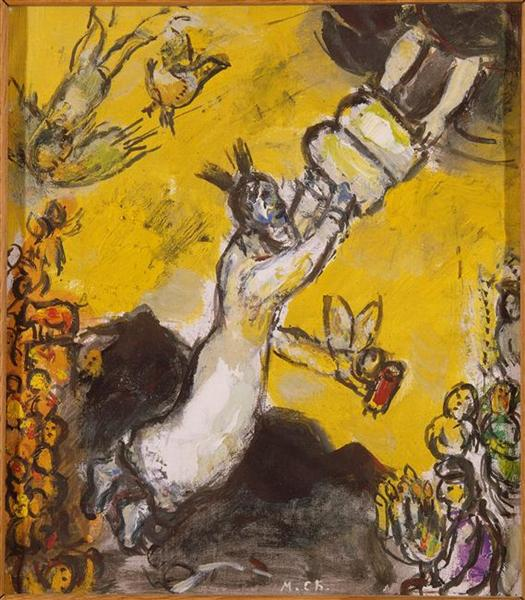
Moses Receives the Law, by Marc Chagall, 1963

“You must not pass along false rumors. You must not cooperate with evil people by lying on the witness stand.

“You must not follow the crowd in doing wrong. When you are called to testify in a dispute, do not be swayed by the crowd to twist justice. And do not slant your testimony in favor of a person just because that person is poor.

“If you come upon your enemy’s ox or donkey that has strayed away, take it back to its owner. If you see that the donkey of someone who hates you has collapsed under its load, do not walk by. Instead, stop and help.

“In a lawsuit, you must not deny justice to the poor.

“Be sure never to charge anyone falsely with evil. Never sentence an innocent or blameless person to death, for I never declare a guilty person to be innocent.

“Take no bribes, for a bribe makes you ignore something that you clearly see. A bribe makes even a righteous person twist the truth.

“You must not oppress foreigners. You know what it’s like to be a foreigner, for you yourselves were once foreigners in the land of Egypt. (New Living Translation)

On Mount Sinai, God gave Moses the Ten Commandments. These laws are basic ethical commands given to the people in their relationship to God and to one another. Following those Ten Words, the next several chapters of Exodus provide detailed instructions and commands for the Israelites in their own social, economic, and cultural context.

Today’s Old Testament lesson is part of this sequence of specific laws for the Israelites. These laws all have to do with being honest in legal matters. There is to be no perversion of justice through perjury, favoritism, bending to dishonest pressure, bribery, and false charges. What’s more, there must be no overlooking of the poor and powerless; and no disregard for the immigrant and foreigner.

All the sequences of commands – covering Exodus chapters 20-25 – are connected back to the basic Ten Commandments. The laws about justice and injustice are the fleshing-out of the ninth command to not testify falsely against your neighbor.

In other words, we are not to lie in public, especially when a person’s life or livelihood is at stake. We are to practice right relations with others; and do justice for all persons without prejudice or favoritism. We do this because God shows no favoritism and judges rightly with proper justice.

He will not judge by what he sees with his eyes,
    or decide by what he hears with his ears;
but with righteousness he will judge the needy,
    with justice he will give decisions for the poor of the earth. (Isaiah 11:3-4, NIV)

The Lord is a just God – it is inherent to the divine character. Therefore, our actions, as people created in the image of God, are to always be just, right, and truthful. There is a special place in God’s heart for the poor and powerless, and so, we ought also to consider their needs and treat them well and with respect – because true religion gives to those who we know cannot pay us back.

This, then, also is why immigrants and foreigners are mentioned. They need proper justice, and not negligence on our part to provide them with what they need. Throughout Holy Scripture we are admonished to not oppress the stranger from another place.

For through him [Christ] we both have access to the Father by one Spirit. Consequently, you are no longer foreigners and strangers, but fellow citizens with God’s people and also members of his household, built on the foundation of the apostles and prophets, with Christ Jesus himself as the chief cornerstone. (Ephesians 2:18-20, NIV)

The Lord watches over the foreigner
    and sustains the fatherless and the widow,
    but he frustrates the ways of the wicked. (Psalm 146:9, NIV)

Jesus picked up on the basic commands of God in his Sermon on the Mount – which, in many ways, is a restatement of the Ten Commandments by getting to the heart of them. Concerning the matter of giving false pledges, he said:

“Again you have heard that it was said to those who lived long ago: Don’t make a false solemn pledge, but you should follow through on what you have pledged to the Lord… Let your yes mean yes, and your no mean no. Anything more than this comes from the evil one. (Matthew 5:33, 37, CEB)

In court, we offer an oath, swearing that we will tell the truth and only the truth – and no lying. This is the only way that injustice can be avoided and justice can be established.

“I swear on a stack of Bibles I won’t…” “I will, if I get around to it….” These are a few of the caveats we give when making a promise or oath. Oaths communicate our truthful intentions of being above board with a high level of integrity.

It’s not okay when we bear false testimony concerning an event or incident that has taken place. There is no excuse for saying something is truthful when you know it isn’t quite true or all true. That makes us liars.

The Lord detests lying lips, but he delights in people who are trustworthy. (Proverbs 12:22, NIV)

Jesus wants us to clarify our values of right and wrong; make wise decisions; identify what we know is truth and error; and follow through on speaking the truth in love.

Any human society cannot stand unless it is committed to justice for all. People everywhere have a universal need for communities and nations which pursue truth, justice, benevolence, and integrity for everyone within their sphere of influence and responsibility.

Almighty God, who created us in your own image: Grant us grace to fearlessly contend against evil; and to make no peace with oppression, so that we may reverently use our freedom. Help us to employ that freedom in the maintenance of justice in our communities and among the nations, to the glory of your holy Name; through Jesus Christ our Lord, who lives and reigns with you and the Holy Spirit, one God, now and forever. Amen.

New Rules for a New Society (Ephesians 4:25-32)

We are part of the same body. Stop lying and start telling each other the truth. Don’t get so angry that you sin. Don’t go to bed angry and don’t give the devil a chance.

If you are a thief, quit stealing. Be honest and work hard, so you will have something to give to people in need.

Stop all your dirty talk. Say the right thing at the right time and help others by what you say.

Don’t make God’s Spirit sad. The Spirit makes you sure that someday you will be free from your sins.

Stop being bitter and angry and mad at others. Don’t yell at one another or curse each other or ever be rude. Instead, be kind and merciful, and forgive others, just as God forgave you because of Christ. (Contemporary English Version)

New life means being a part of a new society; and a new society means new rules to live by which benefit and uplift the entire community. Old destructive practices must be replaced with new encouraging and supportive ways of being together. Stop taking the broad easy road to destruction and start walking the hard path to life and contentment.

Stop Lying and Start Telling the Truth

Lying exists because people believe that being truthful and transparent is too traumatic. Many people don’t think that being open, honest, real, vulnerable, and genuine is worth the risk. They have believed the lie that they won’t be accepted, that they’ll lose face with others, or that people will just gossip about me if they really knew about me. So, we hide from others and avoid the truth.

In truth, we are responsible for one another – to make and keep promises to each other because that is what God does with us. Churches that love truth will make a safe place for the awkwardness of confession, forgiveness, and healing.

Truthful communities are places of hospitality where we are safe to be real. No one ought to ever suffer in silence, cry alone, or wonder whether others will forsake them. We belong to one another. Therefore, to have union with Christ is to have union with one another; you can’t have one without the other.

Stop Stealing and Start Giving

Theft comes in many forms, especially in our contemporary age. Embezzlement, shoplifting, fraud, plagiarism, and robbery are just a few examples of the ways in which we humans steal from one another.

Embezzlement is the theft of assets (money or property) by a person who has been trusted to keep those assets safe. Instead of embezzling funds, we are to steward those assets well, distributing them with care and a conscience – using them for the benefit of others, not simply ourselves.

Shoplifting involves stealing goods from retail establishments. Some people steal because they are in dire need. Many more steal because they can and want to. We must stop taking things we want, and learn to be satisfied with what we have. And we will only do this by using our own money to buy things for others who are in need.

Fraud is stealing that involves convincing the victim to surrender their money or property under false pretenses. This is nothing more than manipulating someone to get what you want. Work hard to defend the defenseless and ensure their justice, rather than commit a gross injustice against them.

Plagiarism is the practice of taking someone else’s work or ideas and passing them off as one’s own. It’s cheap. It’s easy. And don’t do it, period. Someone else worked very hard to create what you may nonchalantly use for your quick benefit. Take the pains to credit someone else’s work and document the sources you use.

Robbery is a theft that involves using violence, intimidation, or threats to obtain property. Put the threats, guns, and false confidence away. In it’s place, do whatever it takes to do things right, hold a job, and give something back to society.

Stop All the Unhelpful Talk and Start Encouraging

Corrupt or dirty talk is totally unnecessary. It’s unwholesome and benefits nobody. Rather, make it your aim to use your words for good by encouraging others.

Encouragement involves strongly urging someone to do something with an equal commitment to lovingly come alongside and help. This requires both verbal exhortations and tangible assistance. Encouragement is the glue which holds a people together. Without it, a society degenerates into watching-out-for-number-one, and destructive personal survival tactics which will say anything to get what one wants.

Stop the Bitterness and Start Forgiving

Forgiveness is choosing not to hold another’s persons offensive words or actions over their head. It is:

  • Specific to an event, action, or words.
  • A process: it takes time to truly forgive.
  • Something anybody can do, regardless of race, creed, religion, etc.
  • Hard.
  • Freeing.
  • Ongoing.
  • Gracious.

“To forgive is to set a prisoner free and discover that the prisoner was you.”

Lewis Smedes, Forgive and Forget: Healing the Hurts We Don’t Deserve

Bitterness, however, wants to hold onto a grudge and seeks to punish the one who has offended them. That’s the way of Satan, not God. Even if the person has set themselves up as your enemy, we have clear exhortations from Jesus to love our enemies and do good to them, not harm. (Matthew 5:43-48)

The world revolves on the axis of mercy, not judgment. The sooner we get in the groove of how things actually operate for us to live a good life, the better that our relationships and society will be.

Good and gracious God, we ask that you make our life journey safe as we choose integrity, not disintegration. Shed light on those who follow crooked paths. May their dishonesty be exposed so that corrections can be made before further damage occurs. Help our nations, neighborhoods, and faith communities choose a path of mercy and goodness, rather than the crooked way of lies, theft, vitriol, and grudge-bearing. May we see a new wave of integrity sweeping over our world, through Jesus Christ our Lord, by the power of your Holy Spirit. Amen.

Lynching, Lusting, Liquidating, and Lying (Matthew 5:21-37)

A Bengali depiction of Christ’s Sermon on the Mount

“You have heard that it was said to the people long ago, ‘You shall not murder, and anyone who murders will be subject to judgment.’ But I tell you that anyone who is angry with a brother or sister will be subject to judgment. Again, anyone who says to a brother or sister, ‘Raca,’ is answerable to the court. And anyone who says, ‘You fool!’ will be in danger of the fire of hell.

“Therefore, if you are offering your gift at the altar and there remember that your brother or sister has something against you, leave your gift there in front of the altar. First go and be reconciled to them; then come and offer your gift.

“Settle matters quickly with your adversary who is taking you to court. Do it while you are still together on the way, or your adversary may hand you over to the judge, and the judge may hand you over to the officer, and you may be thrown into prison. Truly I tell you; you will not get out until you have paid the last penny.

“You have heard that it was said, ‘You shall not commit adultery.’ But I tell you that anyone who looks at a woman lustfully has already committed adultery with her in his heart. If your right eye causes you to stumble, gouge it out and throw it away. It is better for you to lose one part of your body than for your whole body to be thrown into hell. And if your right hand causes you to stumble, cut it off and throw it away. It is better for you to lose one part of your body than for your whole body to go into hell.

“It has been said, ‘Anyone who divorces his wife must give her a certificate of divorce.’ But I tell you that anyone who divorces his wife, except for sexual immorality, makes her the victim of adultery, and anyone who marries a divorced woman commits adultery.

“Again, you have heard that it was said to the people long ago, ‘Do not break your oath, but fulfill to the Lord the vows you have made.’ But I tell you, do not swear an oath at all: either by heaven, for it is God’s throne; or by the earth, for it is his footstool; or by Jerusalem, for it is the city of the Great King. And do not swear by your head, for you cannot make even one hair white or black. All you need to say is simply ‘Yes’ or ‘No’; anything beyond this comes from the evil one. (New International Version)

Christ’s Sermon on the Mount by Joseph Matar

Relationships are important to God (and us!); we need one another because we are created in the image of a relational God. So, God wants us to have good relations with each other.

Murder, adultery, divorce, and oaths all have to do with interpersonal relations. These are topics from the Ten Commandments (6, 7, 9, and 10) that Jesus wanted to uphold.

Murder

Just because no blood is spilled doesn’t mean a killing hasn’t taken place. At the heart of the killing is angry contempt – which makes us all mass-murderers. The sort of anger Jesus refers to is nursing a grudge that morphs into hatred. It’s the deliberate decision to let anger sit in the pit of the gut and slow cook into deep resentment. Once that resentment is well done, murder becomes the meal.

Name-calling is the outward expression of resentful grudge bearing. “Raca” is an “airhead.” It means to be empty or stupid. The word “fool” is literally a “moron” – one who lacks both brains and morality. Both names hurt deeply, which is the expressed aim of the name caller. To have our intelligence and character questioned, cuts to the heart.

Jesus insists that harboring internal resentment comes out in external name-calling, verbally lynching people without a trial. Whenever we string a person up, divine judgment is coming to town. 

No one has a right to nurse a grudge. Repaying hatred with hatred is a highway to the grave. If you have ever wished someone dead, hated anyone, or belittled another; then, you have assassinated that person in your heart and are under the judgment of a holy God.

So, what to do in overcoming the resentment? Seek reconciliation immediately. Jesus used two illustrations to illumine the need for reconciliation with others when there are sour relations: an example of worship and an example with the court.

If you are worshiping, and remember that someone else is nursing a grudge against you, it is your responsibility to go and make things right. The Lord does not want to talk to anyone who won’t talk to their sister or brother.

Forgive us our debts, as we also have forgiven our debtors… For if you forgive other people when they sin against you, your heavenly Father will also forgive you. But if you do not forgive others their sins, your Father will not forgive your sins. (Matthew 6:12, 14-15, NIV)

None of this is meant to minimize the hurt or trauma that has taken place. Many people have faced hell in the shape of a human. Yet, because Jesus takes your hurt seriously, he calls for forgiveness and reconciliation. Without it, the pain unnecessarily continues and there is no healing.

In the illustration of court, we are to settle matters quickly and make things right so that judgment won’t happen. Let’s avoid living with the regret of vengeance because of destroying someone’s life. Forgiveness and reconciliation are always options on the table.

See to it that no one falls short of the grace of God and that no bitter root grows up to cause trouble and defile many.

Hebrews 12:15, NIV

Adultery

Adultery has its origins in mental sexual activity with another person. Jesus is not against normal gender attraction, nor sex itself (which is a gift of God). Rather, Jesus condemns the leering upon another with sexual fantasy. All adulterous relationships and inappropriate sexual relations start with the “look.”

“Lust” is to intensely desire something, to seek mastery over another. The reason people stare, and lust, is not because of the other person’s manner or dress; it’s because they already have an adulterous heart.

Managing adultery with a band aid is like trying to contain a nuclear meltdown with some duct tape; it’s an amputation we need. Jesus leaves no room to think it’s okay to lust in the heart because “I’m not hurting anybody.” Mental adultery demeans and degrades women.

Our lustful desires are powerful; yet God’s grace is more powerful. There’s no need to be burdened with shame and guilt when the cross of Christ has already taken care of it. There is a multi-billion dollar industry of pornography because our hearts are black. Now is the time for forgiveness, grace, and healing in Jesus Christ.

Sermon on the Mount by Jorge Cocco Santiago

Divorce

Today in America, more than one-third of all adults have experienced divorce. Jesus condemns the cavalier divorce, the thought of having a better spouse, even though there is no marital unfaithfulness. This is yet another form of mental adultery which believes someone else can better meet my needs. 

Jesus makes provision for divorce to occur in certain circumstances. Yet, he doesn’t bend to liquidating a marriage over unhappiness with what God has joined together. The intent of Old Testament legislation on divorce is to avoid a casual stance toward marriage (Deuteronomy 24:1-4). Over the centuries, people found creative ways of getting around the law. Although a divorce may be legal, it might not be ethical. Jesus wanted divorce practiced with concern for the woman, so that her rights and needs were considered.

For most of human history, if a husband did not like his wife (e.g. for continually burning his supper) he could divorce her. Jesus, however, insisted divorce must not happen because of a hard time getting along; or don’t love your spouse anymore; or that your spouse keeps irritating you. 

Being frustrated or unhappy are not biblical grounds for divorce. The answer to most marital problems does not lie in a new spouse, but in the hard work of identifying the idols of our hearts, overthrowing them, and re-connecting.

Christ sought to defend women who are victims. In biblical times, if a wife was given a certificate of divorce, she had four options: 1) return to her family of origin; 2) become a beggar; 3) become a prostitute to make ends meet; or, 4) marry again, which was extremely difficult to do. 

In reality, divorce is a legal testimony verifying that a separation has already occurred. It’s a recognition that disunity and division is already present, that a terrible break already happened, damaging the people involved.   

If God found it necessary to divorce his own covenant people, then it’s inevitable that divorce will happen among couples (Jeremiah 3:1-8). So, let’s be discerning in how we handle each individual situation of marital difficulty.

Oaths

“I swear on a stack of Bibles I won’t…” “I will, if I get around to it….” These are a few of the caveats we give when making a promise or oath. Oaths communicate our level or ability of getting something done, or not.

That’s fine. What isn’t fine is making excuses or false promises with no intention of doing what you say you will do. Jesus takes all that extraneous language out. Say “yes” or “no” and then follow through; if you don’t, you’re a liar.

We often lie because we don’t want to do something to begin with. “Yes” and “no” are clear boundary words. Boundaries define where I end and someone else begins, leading me to a sense of ownership. Knowing what I am to take and not take responsibility for gives me freedom.

Jesus wants us to clarify our values; make wise decisions; identify what we will accept and reject; and follow through on what we say we will do, period.

Murder, adultery, divorce, and oaths are all related. They have to do with how we relate to others, especially those closest to us and to God. We are to live responsibly by keeping our hearts large and soft.

Stop the Bad, Start the Good (Ephesians 4:25-5:2)

We are part of the same body. Stop lying and start telling each other the truth. Don’t get so angry that you sin. Don’t go to bed angry and don’t give the devil a chance.

If you are a thief, quit stealing. Be honest and work hard, so you will have something to give to people in need.

Stop all your dirty talk. Say the right thing at the right time and help others by what you say.

Don’t make God’s Spirit sad. The Spirit makes you sure that someday you will be free from your sins.

Stop being bitter and angry and mad at others. Don’t yell at one another or curse each other or ever be rude. Instead, be kind and merciful, and forgive others, just as God forgave you because of Christ.

Do as God does. After all, you are his dear children. Let love be your guide. Christ loved us and offered his life for us as a sacrifice that pleases God. (Contemporary English Version)

All of us have a hard time breaking bad habits, even and especially destructive habits which damage us and/or others. Why, despite knowing better, is it so doggone hard to change? And why, even though having the best of intentions, does that person in my life never change because I tell them to?

Probably because our approach to change dooms us from the beginning. Here are a few approaches which, frankly, do not work:

  • Telling ourselves (or others) to stop. Barking commands may alter speech or behavior for a while but it won’t stick. That’s because people need affirmation, encouragement, and love in order to change – and not by mandated rules. Judgmentalism or shaming others never effects any sort of positive change. Neither our brains nor our souls operate that way.
  • Relying on willpower. This is really an over-reliance on thinking. Yes, it’s necessary to change our thinking. It isn’t, however, enough. That’s because we are not brains-on-a-stick. We also have a body, emotions, and a spirit which needs activation, as well. What’s more, our thinking doesn’t change by sheer force of the will. Our brains are literally not wired that way.
  • Believing in positive thinking. “I think I can, I think I can, I think I can….” “Dream it and do it.” “I believe in myself.” “Nothing is impossible.” I am not suggesting we indulge negative thinking or let a bad attitude take root. I’m saying that positive thinking has its limits. It’s helpful but is not the true agent of behavioral change.
  • Pursuing self-help. Yes, we must all help ourselves. After all, we are responsible for our own behavior. However, self-help alone doesn’t bring lasting change. By only going it alone, individuals come up with hackneyed homebrewed prescriptions that will not get the job done. That’s because we are hard-wired for community and any sort of effective change of habit happens with others.

To stop doing or saying something is only half the equation. We also need to start doing and saying something else altogether.

Change always involves both putting off and putting on, laying down and picking up, removing and replacing, starting and stopping.

The Christian tradition holds that Jesus is the way, the truth, and the life. Life together is to be shaped around the person and work of Christ. Since Christians share a common confession of Jesus together, we are to share a common life together.

Therefore, we will stop non-Christian ways of relating to each other and start a Christian way of relating to each other – because we belong to one another and are inextricably connected as the community of the redeemed.

Stop lying and start speaking the truth

Too often, we put up a plastic false front. Pretending we are okay, when we are not, or even acting like life is hard, when it isn’t, is an untruthful presentation – it’s a lie. Secrecy and deception are tools of Satan, not God. Therefore, we must put off the bad habit of pretention, and put on the good habit of speaking truthfully to each other. 

Buying into the devil’s snake oil salesmanship leads one to believe we cannot be open, honest, real, vulnerable, and genuine; it’s not worth the risk. We worry about being rejected, losing face, or becoming a victim of gossip. Shame then takes the steering wheel of one’s life, instead of speaking truthfully.

We speak the truth in love because we are responsible to one another – not hiding in the shadows or avoiding the dark places of the heart – but stepping into the light and forsaking all fakery for the benefit of everyone’s needs. The only thing lying does is undermine and erode true community.

Stop stealing and start being generous

Thievery takes many forms: petty theft, identity theft, stealing intellectual property (copywrites, patents, trade secrets, etc.), fraud, plagiarism, robbery, burglary, embezzlement, shoplifting, and more. Gossip, slander, and defamation robs another person of their dignity and reputation. Likely the most insidious theft of all is the stealing and kidnapping other human beings.

Stealing will always be a way of life unless it is replaced wholesale with generosity. Learning to give back is the surest path to real change. And there a lot of ways of doing it.

We can give back to the community through donating our time, participating in charity events, volunteering at a school, hospital, or senior center, and even recycling or planting a tree, or giving blood.

Whatever it is you choose to do, connect it with the penchant toward stealing you may have. For example the one prone to gossip might replace it with gratitude; or the one who chronically steals another’s time might join an altruism group.

Stop the dirty useless talk and start encouraging others

Locker room talk and dirty jokes aren’t helpful. There’s also a lot of speech that’s just downright useless, such as: a preacher who pads the sermon with lots of unnecessary words; a relative who is vague and not specific with their words; a boss who always points out, with many words, what is wrong but barely says one word of affirmation to an employee.

Instead of tearing down others with words, replace those words with encouragement. Going out of your way to write an encouraging card or note to someone, bending down to look a child in the eye to say, “hi,” expressing sincere condolences to someone who lost a loved one, or just having a kind word for the harried cashier behind the counter or the waitress at the restaurant, are simple ways of embracing encouragement as a lifestyle.

Stop being so bitter and angry and start forgiving people

Many people either cannot or will not forgive because they want to hold onto their anger and bitterness. Somehow, in their twisted and darkened thinking, they believe that, unless they maintain their grudge-bearing, the offending person or group will get off the hook.

Please, lay down that crushing load of mental vengeance; and pick up the light backpack of grace and forgiveness.

Chances are, if you’ve been in the habit of being angry for a long time, you have a cardiologist you see on a regular basis. Do yourself a favor by changing yourself and saving your health, instead of expecting others to change and blaming them for your issues.

If you are not the person you want to be, then take a lesson from the Apostle Paul: don’t just try and stop something you don’t like but also start doing just the opposite of it, in helpful ways that are a blessing to others.

And if ever in doubt, love is always the best choice.

May the God of peace make you pure and faultless, belonging only to what is right, just and good. And may your whole self—spirit, soul, mind, body, and emotions—be kept safe and be blameless when our Lord Jesus Christ comes. Amen.