Third Sunday of Advent – The Ministry of John the Baptist (Luke 3:7-18)

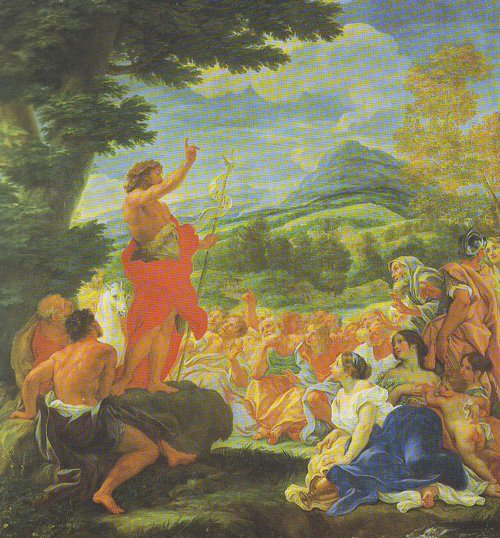
St. John the Baptist Preaching, by Giovanni Battista Gaulli (1639-1709)

John said to the crowds coming out to be baptized by him, “You brood of vipers! Who warned you to flee from the coming wrath? Therefore, bear fruits worthy of repentance, and do not begin to say to yourselves, ‘We have Abraham as our ancestor,’ for I tell you, God is able from these stones to raise up children to Abraham. Even now the ax is lying at the root of the trees; therefore every tree that does not bear good fruit will be cut down and thrown into the fire.”

And the crowds asked him, “What, then, should we do?” In reply he said to them, “Whoever has two coats must share with anyone who has none, and whoever has food must do likewise.” Even tax collectors came to be baptized, and they asked him, “Teacher, what should we do?” He said to them, “Collect no more than the amount prescribed for you.” Soldiers also asked him, “And we, what should we do?” He said to them, “Do not extort money from anyone by threats or false accusation, and be satisfied with your wages.”

As the people were filled with expectation and all were questioning in their hearts concerning John, whether he might be the Messiah, John answered all of them by saying, “I baptize you with water, but one who is more powerful than I is coming; I am not worthy to untie the strap of his sandals. He will baptize you with the Holy Spirit and fire. His winnowing fork is in his hand to clear his threshing floor and to gather the wheat into his granary, but the chaff he will burn with unquenchable fire.”

So with many other exhortations he proclaimed the good news to the people. (New Revised Standard Version)

John’s ministry was meant to be one of preparing people for the Lord’s coming. His understanding of that preparation may seem odd, even harsh, to us.

Yet, John believed that the coming of the Lord meant that Judgment Day was at hand. So, his words are consistent with that sort of theological understanding.

What John did not see at the time – nor anyone else, for that matter – was that the coming of the Lord was happening in two advents, and not just one.

The first advent, or coming, was the incarnation and earthly life of Jesus. This first coming is not yet the time for judgment. The second advent, however, will be all about judgment for both the living and the dead.

That reality, however, doesn’t mean John’s feisty words have no meaning for us. In fact, they have more meaning than ever, because the judgment he foresaw is still yet to come.

We need to hear John’s words, and have the ears to receive those words, because we are in a world that seems ripe for divine judgment.

Repentance – a change of mind and heart that leads to a new life of active justice (not judgment) – is the appropriate preparation for us in this current Advent season.

Amongst the crowds who gathered around John, some recognized how they had fallen short of loving God and neighbor. Some had a profound sense of failing to live faithfully. Others were overwhelmed and came to see and hear the Baptist preach.

Above all, however, John had a warning to the people about relying on their privilege as Jews. It isn’t pedigree that gets anyone anywhere in God’s kingdom.

Instead of putting faith in something like ethnicity or religious beliefs, people ought to be putting their efforts into living a good, right, and just life.

For us today, nobody can rely on special privileges either. It has always been humanity’s responsibility and obligation to love, not hate; serve, not always looking to be served; and showing mercy, not revenge.

The axe comes in many forms, yet it consistently exists to cut off something. Far too many persons, during this time of year, and especially in this season, feel cut off from family or friends. Many sense they are cut off from light, or sanity, as if the world is a surreal place filled with clowns and oligarchs who care nothing for others.

There’s a lot of suffering going on. And any threats of axes and separation are already a reality for too many persons. So, what are we to do with all these icky and unwanted thoughts, feelings, and situations?

John said to the crowd that they were to bear fruit that is worthy of repentance. That is a very biblically language-based way of saying that, for God’s sake, we had better start practicing forgiveness, and see one another from a different angle.

We need a changed viewpoint that leads to a changed heart and life.

There must be a new, or renewed, relationship with God.

If there is doubt about what to do, the answer lies within the problem:

  • For the money-hungry, don’t be greedy, but learn to give away resources
  • For those in authority, don’t abuse power through extortion, but learn to give it away, along with your wages
  • For those who talk a good line, don’t manipulate others, but learn to give your hands and feet to working for a better world, and for your neighbor next door

Learning how to change and be different in this season of Advent is the very best way of preparing to receive the Christ child at Christmas.

One greater than John is coming, with something better than anyone can imagine. It is the gift of a different baptism – fire and spirit – that breathes the power of God into everything it touches.

The axe may be at the root of the tree. There may already be plenty of separation and disconnection. But this year doesn’t have to end in disaster or destruction or disappointment.

You and I, along with everyone who calls on the name of the Lord, can experience deliverance from evil, and freedom to be the people we were always meant to be.

O God of the lost and the displaced, you promise restoration and wholeness through the power of Jesus Christ. Give us faith to live joyfully, sustained by your promises, as we eagerly await the day when they will be fulfilled for all the world to see; through the coming of your Son, Jesus Christ. Amen.

Second Sunday of Advent – Prepare the Way (Luke 3:1-6)

The Call from John the Baptist to Repent, by Renier de Huy, 12th century

In the fifteenth year of the reign of Tiberius Caesar, when Pontius Pilate was governor of Judea, and Herod was ruler of Galilee, and his brother Philip ruler of the region of Ituraea and Trachonitis, and Lysanias ruler of Abilene, during the high priesthood of Annas and Caiaphas, the word of God came to John son of Zechariah in the wilderness. He went into all the region around the Jordan, proclaiming a baptism of repentance for the forgiveness of sins, as it is written in the book of the words of the prophet Isaiah,

“The voice of one crying out in the wilderness:
‘Prepare the way of the Lord;
    make his paths straight.
Every valley shall be filled,
    and every mountain and hill shall be made low,
and the crooked shall be made straight,
    and the rough ways made smooth,
and all flesh shall see the salvation of God.’ ” (New Revised Standard Bible)

In this Christian season of Advent, we are reminded that God is not only high above us, transcendent, far away; God is also close to us, immanent, and with us.

We remember at this time of year that God does not remain distant, but entered our time and space at a particular moment in history, for a distinct purpose.

The Roman Empire was powerful, large, and very much in control of every place where it existed. The litany of imperial rulers and authorities which the Gospel writer Luke listed is meant to give us a feel of the Roman weight, and how much Roman might was ensconced in Judea.

The world at the turn of the common era was under the dominion of powerful people with lots of influence. But God did not come to any of them. Instead, God came to a loner – a man who spent his time out in the wilderness. His name was John, the son of Zechariah. We know him as John the Baptist.

With God coming to John at a precise point of time in a particular place, that made John a prophet with a singular message. John was born for this. (Luke 1:76)

It is fitting that a man hanging out on the fringes of society all by himself would be the one to prepare the way for Messiah.

After all, Messiah’s message would be one of bringing good news to the poor, proclaiming release to prisoners, and freeing those who are oppressed. (Luke 4:18-19; Isaiah 61:1-2)

God’s prophetic calling for John was one of preparation. John was to prepare the way of the Lord. He was to get the people ready to receive Messiah.

John went about his ministry of preparation by calling folks to repent, to change their minds and amend their ways, so that there might be forgiveness.

In a reference from the prophet Isaiah, Luke alluded to Jewish exiles returning from their Babylonian captivity. The actual physical road from Babylon to Jerusalem was a hard journey due to the distance and topography.

The “road” or the “way” in Holy Scripture is also a metaphor for the spiritual journey we take in this life. And that road has a lot of challenges to it. The very act of walking as a pilgrim over a long arduous journey changes a person.

It is rarely the destination that makes a person; it’s the journey itself which leads one to a changed life of thinking differently, and seeing things from a perspective we’ve never seen before.

The smoothing out of the road is a way of saying God is making it easier for people to return to the Lord, to get them ready for a new life with promises fulfilled and unexpected joy.

In other words, valleys raised and mountains flattened represent God’s efforts at helping us experience a complete transformation of life. The Lord will do everything possible to make renewal and restoration happen for us.

The Lord will set things right. In our contemporary world that is now largely controlled by powerful oligarchs and the super-rich, God will turn it upside-down. All of the world’s current powerful people will find themselves looking up, not down.

It would be nice and reassuring if I could give you certainty about the journey ahead. But I cannot do that. Yet, what I can do is assure us of what is at the end of the road. Look beyond the current days of self-centered leadership and popular ignorance, and understand that all flesh shall see the salvation of God.

Prepare the way of the Lord. We do that by how we go about walking the road. Each step we take every day is important and makes a difference. And when we stumble, there is plenty of grace to help get us back on our feet and moving forward.

We are all collectively journeying together to Bethlehem. And as we daily move and walk, at the end of our journey, Jesus is there.

But when the fullness of time had come, God sent his Son, born of a woman, born under the law, in order to redeem those who were under the law, so that we might receive adoption as children. (Galatians 4:4, NRSV)

And nothing can stop us or separate us from the love of God that is in Jesus Christ our Lord.

For I am convinced that neither death, nor life, nor angels, nor rulers, nor things present, nor things to come, nor powers, nor height, nor depth, nor anything else in all creation will be able to separate us from the love of God in Christ Jesus our Lord. (Romans 8:38-39, NRSV)

The journey may be arduous. You might feel like giving up. But Jesus is our Immanuel, God with us. In him, is our hope and our joy.

O Holy One of Israel, out of the embrace of mercy and righteousness, you have brought forth joy and dignity for your people. Remember now your ancient promise; make straight the paths that lead to you, and smooth the rough ways, so that in our day we might bring forth your compassion for all humanity. Amen.

Repent! (Luke 3:1-18)

John the Baptist Preaching by Frank Brangwyn (1867-1956)

In the fifteenth year of the reign of Tiberius Caesar—when Pontius Pilate was governor of Judea, Herod tetrarch of Galilee, his brother Philip tetrarch of Iturea and Traconitis, and Lysanias tetrarch of Abilene—during the high-priesthood of Annas and Caiaphas, the word of God came to John son of Zechariah in the wilderness. He went into all the country around the Jordan, preaching a baptism of repentance for the forgiveness of sins. As it is written in the book of the words of Isaiah the prophet:

“A voice of one calling in the wilderness,
‘Prepare the way for the Lord,
    make straight paths for him.
Every valley shall be filled in,
    every mountain and hill made low.
The crooked roads shall become straight,
    the rough ways smooth.
And all people will see God’s salvation.’”

John said to the crowds coming out to be baptized by him, “You brood of vipers! Who warned you to flee from the coming wrath? Produce fruit in keeping with repentance. And do not begin to say to yourselves, ‘We have Abraham as our father.’ For I tell you that out of these stones God can raise up children for Abraham. The ax is already at the root of the trees, and every tree that does not produce good fruit will be cut down and thrown into the fire.”

“What should we do then?” the crowd asked.

John answered, “Anyone who has two shirts should share with the one who has none, and anyone who has food should do the same.”

Even tax collectors came to be baptized. “Teacher,” they asked, “what should we do?”

“Don’t collect any more than you are required to,” he told them.

Then some soldiers asked him, “And what should we do?”

He replied, “Don’t extort money and don’t accuse people falsely—be content with your pay.”

The people were waiting expectantly and were all wondering in their hearts if John might possibly be the Messiah. John answered them all, “I baptize you with water. But one who is more powerful than I will come, the straps of whose sandals I am not worthy to untie. He will baptize you with the Holy Spirit and fire. His winnowing fork is in his hand to clear his threshing floor and to gather the wheat into his barn, but he will burn up the chaff with unquenchable fire.” And with many other words John exhorted the people and proclaimed the good news to them. (New International Version)

John the Baptist was the sort of guy that people either loved or hated. When I think of John, I picture a hippy driving a Volkswagen bus with bumper stickers plastered everywhere with sayings like, “Get Right or Get Left,” “Turn or Burn,” “Repent or Regret,” “Jesus Is Coming to Take Over,” “Here Comes the Judge,” “Armageddon Outta Here!” and “Axe Me What’s Next.”

He tended toward seeing things as black and white. John wasn’t much of a gray area sort of dude.

Yet, no matter what one things of John the Baptist, he was affirmed by Jesus as doing exactly what he was supposed to do: Prepare for the coming of the Lord. (Matthew 3:13-17, 11:1-19)

And the best way to prepare, as John pointed out, is to repent.

Repentance is one of those big biblical words that sometimes gets lost as being archaic and out of touch – sort of like a hippy John the Baptist. Yet, without repentance, nobody becomes a Christian and no one lives a fruitful life following Jesus. 

To “repent” simply means to change our minds – to stop doing one thing, and to start doing another. 

Orthodox icon of John the Baptist

Throughout Holy Scripture, repentance means to stop sinning and start worshiping God. “Sin” and “worship” are also words that don’t get used a lot and tend to get relegated as antiquated language.

To “sin” is to say and do things which harm others, or to fail to say and do things which are helpful. (Deuteronomy 15:9; Proverbs 10:19; Romans 14:23; James 4:17; 1 John 3:4, 5:17)

To “worship” means to bend the knee, to submit and honor a deity. (Psalm 95:6; Matthew 4:8-10; Revelation 4:10, 5:14, 7:11, 11:16, 19:10,

The prophet Isaiah saw a vision of God in the temple, a self-revealing of the One true God that caused him to be completely unraveled with repentance.

The Apostle Peter saw the Lord Jesus in his immensity and power through a miraculous catch of fish. He then fell at the Lord’s feet and said, “Go away from me, Lord; I am a sinful man.” (Luke 5:8) 

John the Apostle had a vision of Jesus Christ in all his glory and heard his voice. John fell at the Lord’s feet as though dead. (Revelation 1:12-17) 

Ezekiel the prophet had a vision of God and saw the appearance of God’s glory. Then, he fell facedown. (Ezekiel 1:25-28) 

Even Daniel, perhaps the most righteous person of all time, saw a vision of God in all his glory and fell prostrate with his face to the ground, totally overwhelmed with God’s holiness and human sinfulness. (Daniel 8:15-18)

Methinks there is so much sin in the world and so much indifference in the church because people are not seeing a vision of a glorious and holy God. Because if they did, they would be completely beside themselves and see sin’s terrible foulness and degradation; they would repent from all the ways in which they have been apathetic and complacent in living their lives.

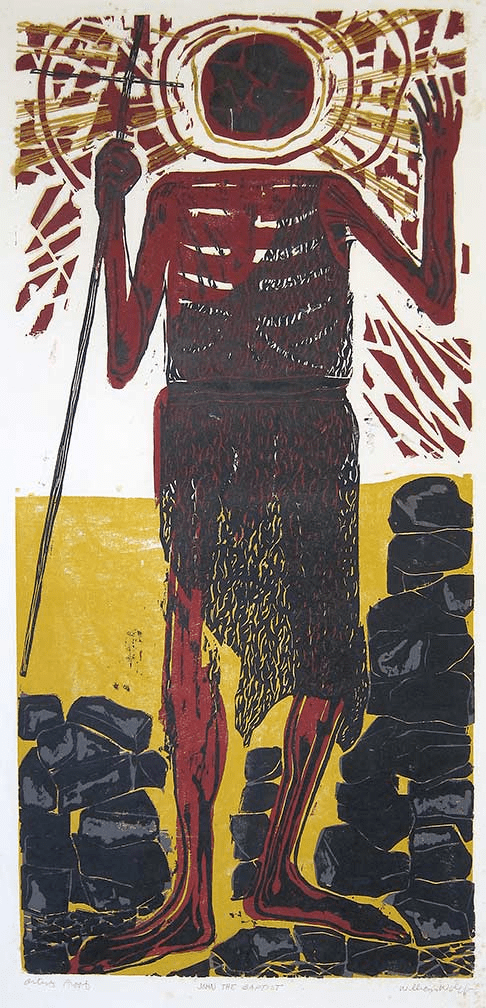
John the Baptist by William Wolff, 1968

We must, therefore, put ourselves in a position to see and hear God so that we can turn from all the obstacles that prevent us from experiencing Father, Son, and Spirit. 

And those hindrances to experiencing God are legion, including: 

  • Passiveness toward God’s Word and God’s creation, thus causing a lack of mindfulness and attention to the Holy Spirit.
  • Preoccupations and daydreams that prevents availability to the words and ways of Jesus.
  • Poverty of sleep, healthy habits, and an overall poor well-being that dulls the spiritual senses and prevents awareness of God.
  • Paucity of spiritual practices and disciplines that would put us in a position to experience a vision of God.

We must repent of all the ways we do not pay attention to God. The Lord is coming but we don’t perceive it.

  1. What, then, must we do to put ourselves in a position to see and hear God?
  2. In what ways might we corporately foster a sense of the holy God? 
  3. How will repentance fit into both our personal and corporate worship? 
  4. Have we identified and named the things that grieve the heart of God so that we can repent of them? 
  5. What is one action step you will take in response to this blog post?

None of us need to be like John the Baptist in order to be godly. We don’t have to eat locusts and be black-and-white thinkers. But we do all have to repent of the ways we make the road difficult by placing obstacles in the way of experiencing Jesus.

Most merciful God, we confess that we have sinned against you in thought, word, and deed, by what we have done, and by what we have left undone. We have not loved you with our whole heart; we have not loved our neighbors as ourselves. We are truly sorry and we humbly repent. For the sake of your Son Jesus Christ, have mercy on us and forgive us; that we may delight in your will, and walk in your ways, to the glory of your Name. Amen.