The Parable of the Good Samaritan (Luke 10:25-37)

Good Samaritan, by Olga Bakhtina

An expert in the law stood up to test Jesus. “Teacher,” he said, “what must I do to inherit eternal life?” 

He said to him, “What is written in the law? What do you read there?” 

He answered, “You shall love the Lord your God with all your heart and with all your soul and with all your strength and with all your mind and your neighbor as yourself.” 

And he said to him, “You have given the right answer; do this, and you will live.”

But wanting to vindicate himself, he asked Jesus, “And who is my neighbor?” 

Jesus replied, “A man was going down from Jerusalem to Jericho and fell into the hands of robbers, who stripped him, beat him, and took off, leaving him half dead. Now by chance a priest was going down that road, and when he saw him he passed by on the other side. So likewise a Levite, when he came to the place and saw him, passed by on the other side. 

“But a Samaritan while traveling came upon him, and when he saw him he was moved with compassion. He went to him and bandaged his wounds, treating them with oil and wine. Then he put him on his own animal, brought him to an inn, and took care of him. The next day he took out two denarii, gave them to the innkeeper, and said, ‘Take care of him, and when I come back I will repay you whatever more you spend.’ 

“Which of these three, do you think, was a neighbor to the man who fell into the hands of the robbers?” 

He said, “The one who showed him mercy.”

Jesus said to him, “Go and do likewise.” (New Revised Standard Version)

The Good Samaritan, by Paula Modersohn-Becker

Let’s establish upfront that the chief point of Christ’s parable is mercy shown from one person to another. Mercy is at the heart of Holy Scripture. Mercy is the very heart of Christ – even more than routine obedience:

“Go and learn what this means, ‘I desire mercy, not sacrifice.’” (Matthew 9:13; 12:7; Hosea 6:6)

The message of the Old and New Testaments of the Bible continually reinforces mercy to those who are in need – mercy to immigrants, strangers, the poor, the infirmed, and foreigners.

Therefore, any system – no matter whether church, neighborhood, or government – which seeks to ignore, round up, or get rid of those in need of mercy, is in direct contradiction to the instruction of Jesus, the message of the prophets, and the consistent teaching of the early church fathers (and mothers).

We get in trouble whenever we distinguish between people who “deserve” our help from those who don’t. In truth, there is no such thing. Everyone needs mercy and deserves mercy, simply because they are created in the image and likeness of God.

There are no exceptions. And if we think there ought to be, we are playing the judge and trying to take the reins of decision-making away from God, so that we ourselves can execute our own standard of who deserves mercy and who deserves judgment.

In today’s Gospel lesson, the expert in the law started out by testing Jesus. Then, he changed tactics by trying to justify himself as one who deserves to be recognized as worthy of mercy. He believed that, as one who strictly observes the law and obeys the commandments, he is more deserving than others who are less observant.

It’s this privileged mentality which continually connects adjectival words to humans, and even Christians – when, in truth, there are no adjectives to being a human and/or a Christian.

But, in order to justify ourselves, many people like their adjectives, so they can make sure to distinguish before God who is worthy and right, and who is not. The following are just a smattering of adjectives I’ve heard in the church throughout the years:

  • Backslidden Christian
  • Lukewarm Christian
  • Weak Christian
  • Liberal Christian
  • Conservative Evangelical Christian
  • Real Christian
  • Born Again Christian
  • Committed Christian
  • Fairweather Christian
  • Christmas and Easter Christian
  • True Christian
  • Baptized Christian

Yet, in reality, a Christian is a Christian. If we feel the need to add adjectives in describing how less or more of a Christian they are, then we are no longer describing Christianity at all.

When it comes to the word neighbor, there are a plethora of adjectives that we might use to describe our neighbors. Again, all the words are meant to distinguish between “us” and “them.”

I once lived in a very diverse neighborhood. One day I was outside praying, and looking at all the various houses. I prayed for my neighbors by affixing adjectives to them: my black neighbor; my nerdy neighbor; my lesbian neighbors; my single neighbor; my agnostic neighbor; my mean obnoxious neighbor.

On and on I went, until I heard that still small voice of God whisper to me saying, “Tim, these are not your neighbors with adjectives. They are just your neighbors.”

I got the message. I was praying on my holy hill for all these other folks who were different than me, using my adjectives to keep separate from them. My neighbors, however, are simply my neighbors. We live together in the same neighborhood. We are neighbors – nothing more, nothing less.

Even though my neighbors have many differences about them, we all share the need for receiving mercy and giving mercy. Without mercy, neighborliness vanishes.

My sacrificial offerings of prayer for my neighbors didn’t make me better. But both my attitude of mercy and my actual extensions of mercy toward my neighbors, no matter how little, meant a great deal to them.

The priest and the Levite who passed by the man in need, likely only saw that they would become unclean by helping this needy person. “Besides,” they may have pondered, “there’s nothing in it for me.”

There was no way for the man lying in the ditch to reciprocate or pay back the priest or the Levite. A Samaritan (despised by both priests and Levites) ended up being the one to show mercy to the man.

It didn’t matter who helped the victimized person – whether it was a priest, a Levite, or a Samaritan. It didn’t matter how any of them might describe the other. Only mercy mattered.

I admit that I desperately want to see my national government have at least a little neighborly sense. When I observe the opposite, it’s hard for me to live with. I find myself not wanting to see any mercy extended to them, to the current administration.

Yet just because politicians may not show mercy, doesn’t infer that I should withhold it from them. I really do want to take my cues from Jesus by loving my enemies and doing good to them – even if they ignore, mistreat, or oppress others.

God will sort out the judgment thing. As for me, I’m called to a gospel of grace, not a gospel of judgment.

Nobody can justify themselves. In Christianity, only God can justify the person.

Christ’s mercy is not dependent on what kind of people we are but is based simply on need. God graciously gives us the gift of faith and the mercy of deliverance.

Divine Judge, You framed the earth with love and mercy, declaring it good. Yet we, desiring to justify ourselves, judge others harshly without knowledge or understanding. Keep us faithful so that we may be filled with the knowledge of Your will, and not ignore or pass by another’s need, but plumb the depths of love in showing mercy. Amen.

The Vision of Jesus (Luke 10:21-24)

Cristo de la Concordia (Christ of Peace) in Cochabamba, Bolivia

At that time Jesus was filled with joy by the Holy Spirit and said, “Father, Lord of heaven and earth! I thank you because you have shown to the unlearned what you have hidden from the wise and learned. Yes, Father, this was how you were pleased to have it happen.

“My Father has given me all things. No one knows who the Son is except the Father, and no one knows who the Father is except the Son and those to whom the Son chooses to reveal him.”

Then Jesus turned to the disciples and said to them privately, “How fortunate you are to see the things you see! I tell you that many prophets and kings wanted to see what you see, but they could not, and to hear what you hear, but they did not.” (Good News Translation)

A healthy view of Holy Scripture is to see it as an unfolding drama of redemption. Ever since the fall of humanity, God has been on a rescue mission to reclaim, redeem, and restore people. This human project has obviously taken several millennia; and, it still has not reached its fulfillment.

The Christian tradition understands that the climax of victory and final restoration to our true state as humans will occur when Christ returns. By warning us that divine mysteries are hidden to some, and revealed to others, is Christ’s way of cautioning us toward triumphalism and self-congratulation.

Redemption is a reality; and, it’s also not a reality. It is both. Redemption is here; and it’s also coming. We are delivered from sin, death, and hell – and we still labor against the evil machinations of systemic world problems, our own sinful nature, and a demonic realm which is looking for every opportunity to exploit sin’s residue upon the earth.

This all means, on a practical level, that the good old days for some were the bad old days for others. History is always written by the winners and those in power. The hidden voices are typically squelched.

The vision of Jesus is that all kinds of people, not just a certain segment of winners, should enjoy God’s favor.

There were ancient people who longed for spiritual and physical freedom. They looked forward into history and had the hope of Messiah and God’s promises being fulfilled. History is still unfolding. There are people who yet remain locked in personal bondage; large swaths of humanity still experience oppression and a longing to enjoy the blessings which others possess and take for granted.

It is vital that we hold together both the blessings of realized freedom, along with the limits of others’ freedom. This realization helps us continue to actively work for all people, and keep praying that God’s kingdom come, and God’s will be done, here on earth, as it is always done in heaven.

I lift a voice from history which exemplifies the struggle of the black experience in the United States. The following is a small portion from a speech by the ex-slave Frederick Douglass, orated on July 4, 1852, nine years before civil war, with President Millard Fillmore and many congressional politicians in attendance:

“The feeling of the nation must be quickened; the conscience of the nation must be roused; the propriety of the nation must be startled; the hypocrisy of the nation must be exposed; and its crimes against God and man must be proclaimed and denounced. What, to the American slave, is your 4th of July? I answer: a day that reveals to him, more than all other days in the year, the gross injustice and cruelty to which he is the constant victim. To him, your celebration is a sham; your boasted liberty, an unholy license; your national greatness, swelling vanity; your sounds of rejoicing are empty and heartless; your denunciations of tyrants, brass fronted impudence; your shouts of liberty and equality, hollow mockery; your prayers and hymns, your sermons and thanksgivings, with all your religious parade, and solemnity, are, to him, mere bombast, fraud, deception, impiety, and hypocrisy — a thin veil to cover up crimes which would disgrace a nation of savages. There is not a nation on the earth guilty of practices more shocking and bloodier than are the people of these United States, at this very hour.”

Frederick Douglass

Because history is forever unfolding, freedom and blessing develop over time and come more powerfully to some than others. True spiritual discernment, with the awareness to labor on behalf of the common good, does not ultimately come through astute observation and superior intellect; it comes by divine revelation.

God both conceals and reveals according to divine purposes and not human agendas.

Christian spirituality cannot be reduced to praying a sinner’s prayer, and then maintaining a holding pattern on earth until heaven. Rather, Jesus remains present in this world through the person of the Holy Spirit, and is continually interceding on behalf of those who need freedom and blessing.

As Christ’s Body, Christians are to be the hands and feet of Jesus, animated by the Spirit to bring God’s ethical and benevolent regime to those who need it most. If we are blessed, we are to pass blessing onto others without prejudice. For the kingdom of God belongs to the poor in spirit.

Dear God, Creator of the universe and all that inhabit it, we come as your Church, and as individuals, in humble submission to your word and your way.

God, you are the Alpha and Omega, The Almighty Judge and The Forgiver of All Sins, so we come with humility and contrition on behalf of generations past, present and those yet unborn. We ask that you forgive us and create in us a new spirit.

Bind our hearts and send forth the healing power that you and you alone can give to us and this sin-sick world. Bring us into reconciliation with one another and restore us to your righteous and holy path. Amen.

Luke 10:25-37 – The Parable of the Good Samaritan

The Good Samaritan by Samuel Nixon. St. Paul’s Church, Halifax, Nova Scotia, Canada

 On one occasion an expert in the law stood up to test Jesus. “Teacher,” he asked, “what must I do to inherit eternal life?”

“What is written in the Law?” he replied. “How do you read it?”

He answered, “‘Love the Lord your God with all your heart and with all your soul and with all your strength and with all your mind’; and ‘Love your neighbor as yourself.”

“You have answered correctly,” Jesus replied. “Do this and you will live.”

But he wanted to justify himself, so he asked Jesus, “And who is my neighbor?”

In reply Jesus said: “A man was going down from Jerusalem to Jericho, when he was attacked by robbers. They stripped him of his clothes, beat him and went away, leaving him half dead. A priest happened to be going down the same road, and when he saw the man, he passed by on the other side. So too, a Levite, when he came to the place and saw him, passed by on the other side. 

But a Samaritan, as he traveled, came where the man was; and when he saw him, he took pity on him. He went to him and bandaged his wounds, pouring on oil and wine. Then he put the man on his own donkey, brought him to an inn and took care of him. The next day he took out two denarii and gave them to the innkeeper. ‘Look after him,’ he said, ‘and when I return, I will reimburse you for any extra expense you may have.’

“Which of these three do you think was a neighbor to the man who fell into the hands of robbers?”

The expert in the law replied, “The one who had mercy on him.”

Jesus told him, “Go and do likewise.” (New International Version)

Who do you relate to in the story? Which character most resonates with you in your life right now?

The Lawyer (an expert in the Old Testament Law)

The Gospel writer, Luke, gives us insight into the thought process of the person for whom Jesus told the parable to. That man sought to justify himself. In Christianity, no one justifies themselves. The kingdom of God turns on grace, and not with us working more or harder. 

Christ’s mercy is not dependent on what kind of people we are but is simply based on need. God graciously gives us the gift of faith and the mercy of deliverance. By Christ’s wounds we are healed. 

As Christians, we already possess justification by grace alone apart from human effort.

Each individual must realize they are in a theological ditch. We are all unable to get out of our predicament. Everyone needs the compassion of Christ.

But now God’s way of putting people right with himself has been revealed. It has nothing to do with law, even though the Law of Moses and the prophets gave their witness to it. God puts people right through their faith in Jesus Christ. God does this to all who believe in Christ, because there is no difference at all: everyone has sinned and is far away from God’s saving presence. But by the free gift of God’s grace all are put right with him through Christ Jesus, who sets them free. (Romans 3:21-24, GNT)

We do not need to justify ourselves.

The Priest and the Levite (experts in the Law)

The shock that hits closes to home, from Christ’s parable, is how frequently we are the ones who pass by and ignore the other. The command to “Go and do likewise,” extends about as far as the end of the story for modern hearers, landing us in the ditch between knowing the Samaritan and his compassionate generosity are set forth as an example and our tendency to ignore the cries of the downtrodden and disenfranchised.

Do not seek revenge or bear a grudge against anyone among your people but love your neighbor as yourself. I am the Lord…. When a foreigner resides among you in your land, do not mistreat them. The foreigner residing among you must be treated as your native-born. Love them as yourself, for you were foreigners in Egypt. I am the Lord your God. (Leviticus 19:18, 33-34, NIV)

The Lord defends the cause of the fatherless and the widow, and loves the foreigner residing among you, giving them food and clothing. And you are to love those who are foreigners, for you yourselves were foreigners in Egypt. (Deuteronomy 10:18-19, NIV)

We are to go and do likewise.

The Samaritan

The Samaritan, the Christ figure in the story, comes and shows the man mercy. This grace was free, lacked any sort of favoritism, and was full of sheer kindness. Without the Samaritan’s actions of binding up the man’s wounds and getting him to a safe place, the victim would have died.  

It is no coincidence that there are many hospitals throughout the country named “Good Samaritan.” Christians were at the forefront of establishing hospitals because of this very parable of Jesus. It was a significant way of living into the values of God’s kingdom.

Mercy is at the heart of all Christian ministry.

Jesus, responding to those who questioned his acts of mercy toward questionable people, said:

“Those who are well have no need of a physician, but those who are sick. Go and learn what this means, ‘I desire mercy, not sacrifice.’ For I have not come to call the righteous but sinners.” (Matthew 9:12-13, NRSV)

I appeal to you therefore, brothers and sisters, on the basis of God’s mercy, to present your bodies as a living sacrifice, holy and acceptable to God, which is your reasonable act of worship. (Romans 12:1, NRSV)

Do justice. Love mercy. Walk humbly. (Micah 6:8)

The Victim

The wounded hapless man was left for dead. In the story, we know he would die apart from help – the kind of help the man could not do for himself. He was completely dependent on someone to rescue him from his plight.

The victim in the ditch reminds us of what it feels like to be forgotten by others — and perhaps even by God. The feeling of loneliness and forsakenness invites compassion and empathy for all who experience it.

Victimization needs a voice and a champion. There are powerless people who either cannot speak or who are not heard by others. There are people, victims of abuse, who cannot get out of their traumatic ditch – overwhelmed by what another did to them.

God stands for the victim and against the robbers.

You will never again
    make victims of others
or send messengers to threaten
    everyone on this earth. (Nahum 2:13, CEV)

God will send help.

When the righteous cry out, the Lord listens;
    he delivers them from all their troubles.
The Lord is close to the brokenhearted;
    he saves those whose spirits are crushed.

The righteous have many problems,
    but the Lord delivers them from every one of them. (Psalm 34:17-19, CEB)

By his wounds we are healed.

Conclusion

The victim in the ditch is worthy of help because he carries the divine image of God.

The one who showed compassion and mercy, the Samaritan, reflected God’s likeness through his actions.

Those who passed by, the priest and the Levite, also bear the indelible mark of their Creator, yet chose to ignore their gut and got lost in their heads.

Maybe God — through Christ — comes to us as the one in the ditch or maybe as the one who shows compassion and mercy; perhaps God even comes to us as a reminder that the call to care for others frequently goes unheeded as we pass by the cries of those in need of help.

Lord God, heavenly Father, you did not spare your only Son, but gave him up for us all to be our Savior, and along with him you have graciously given us all things. We thank you for your precious, saving gospel, and we pray that you would help us to believe in the name of our Savior faithfully and steadfastly, for he alone is our righteousness and wisdom, our comfort and peace, so that we may stand on the day of his appearing, through Jesus Christ, your dear Son, our Lord. Amen.

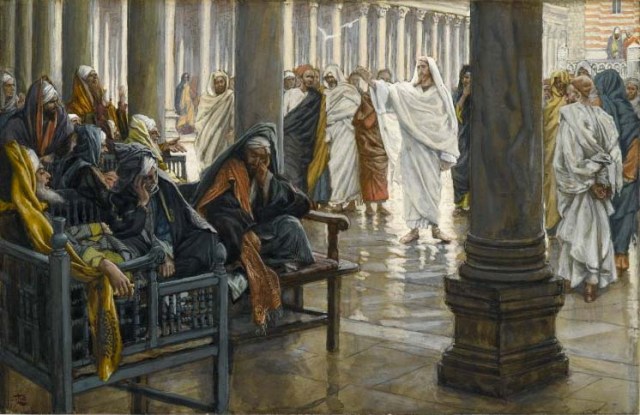
Luke 10:13-16 – Confronting Hard Hearts

“Woe unto You” by French painter James Tissot (1836-1902)

“Woe to you, Chorazin! Woe to you, Bethsaida! For if the miracles that were performed in you had been performed in Tyre and Sidon, they would have repented long ago, sitting in sackcloth and ashes. But it will be more bearable for Tyre and Sidon at the judgment than for you. And you, Capernaum, will you be lifted to the heavens? No, you will go down to Hades.

“Whoever listens to you listens to me; whoever rejects you rejects me; but whoever rejects me rejects him who sent me.” (New International Version)

Hardness of heart is the greatest malady and the most serious condition which could ever afflict a spiritual person.

A soft heart needs only gentle words and humble responses in order to continue learning and growing in life. Not so with the hard heart. It needs a mighty chisel from God to scrape the encrusted barnacles off the heart so that it might receive goodness.

This is why today’s Gospel lesson recounts some rather harsh words from Jesus. Christ had some hard things to say in order to get at the hardness of heart he was experiencing from the people. His scathing words were specifically leveled at the towns in which he had performed miraculous healings. Their inability to accept what was happening in front of their very faces testified to how hard their hearts truly were.

The miracles of Jesus, in addition to being gracious restorations of individual lives, were also meant to demonstrate that the kingdom of God has broken into history in the person of Jesus Christ. The crowd refused to acknowledge this reality. So, Jesus began leveling a rebuke to the towns who observed his ministry firsthand, and yet did nothing in response to those good works.

A hard heart observing Christ’s ministry will likely be unresponsive to Jesus. A soft heart will likely reply with humility by forsaking everything to follow him. For Jesus, the height of hubris was to simply ignore his righteous works of merciful teaching and benevolent healing.

Christ’s denunciation of the particular towns came not because he was experiencing opposition or persecution; rather, he was denouncing them for their bonehead lack of response and refusal to change their lives to conform to what they were seeing and experiencing from God.

The crowd heard Christ’s teaching and saw his miracles, and it had no effect on them. So, Jesus gave them a big “C’mon, man!”

Judgment becomes the lot of someone who is unaffected and unresponsive to the vast sea of human need around them, viewing Jesus as just another voice, and living a life of mediocrity in the face of opportunity.

The Holy Spirit has been provided, who is the power source of the Christian life. We possess all the resources of grace necessary to step into this world and make a difference, yet so many do nothing but occupy a place in the pew [or couch] because they are too afraid to sacrifice their time in meaningful ministry.

There are neighbors, relatives, and co-workers who are lost and lonely, in need of the kind of grace Jesus gives, yet too many of us are oblivious to them and instead are constantly worried about things that, in the end, don’t really matter at all.

We have opportunities to grow in the grace and knowledge of Jesus Christ through a vast array of available ministries, yet many do not take the chance to change and be spiritually stretched. For these situations and more, the words of Jesus are there in front of our faces, and yet some, out of hardness of heart, will have the audacity to read them and remain unchanged, unchallenged, and unresponsive.

If our highest values in life are sameness, stability, and security, we may very well, at the least, miss Jesus altogether, and, at worst, find ourselves under his condemnation. These verses are for those whom Jesus has become all too familiar, as if he is just another piece of furniture in the living room – the coffee table with a dusty Bible resting on it.

There are times when nice gets us nowhere and we must have hard conversations because of hard hearts.

Yes, conversations, and not verbal rockets launched from one group to another. Jesus did not denounce from a distance; he did it up close and personal. Furthermore, he was specific and not generic about why he was speaking in the way he did.

So, may you be able to pray this prayer of repentance today with heartfelt conviction:

Almighty God, Father of our Lord Jesus Christ, Sovereign Lord of the universe, Creator of humanity, we, your unfaithful children, are sorry for our sins and the lives that we have lived apart from your grace. We sincerely believe and confess in our hearts that only through the precious blood of our Lord Jesus Christ on the cross, can we obtain your forgiveness.

We repent that: in thought, word, and deed, we have committed serious offences against you and our neighbors. Through spiritual laziness and prideful lust for power, we have provoked hatred, division, despair, and hurt within our communities.

Through our greed, deceit, and indifference, we have inflicted serious damage, unnecessary conflict, and aggravated destruction to those different than us.

Through our selfishness, insensitivity, and bias (both conscious and unconscious) we have encouraged and emboldened those who inflict hurt, pain, and sorrow on those who are already oppressed and poor.

In the name of religion, doctrine, and even of Christ himself, we have wounded fellow believers and those who genuinely pursue a faith different than ours.

In stubbornness, pride, and arrogance, we have caused division and strife within your church and among your people.

Mercifully send your Holy Spirit, the Spirit of order and comfort, to cleanse us from all unrighteousness; to restore in us true faith in Christ which brings truth, peace and harmony; and, to help us walk together
with our brothers and sisters in the peace of our Lord Jesus Christ, to the glory of your name. Amen.