Love Is the Answer (Romans 13:8-14)

Reconciliation by Josefina de Vasconcellos

Let love be your only debt! If you love others, you have done all that the Law demands. In the Law there are many commands, such as, “Be faithful in marriage. Do not murder. Do not steal. Do not want what belongs to others.” But all of these are summed up in the command that says, “Love others as much as you love yourself.” No one who loves others will harm them. So love is all that the Law demands.

You know what sort of times we live in, and so you should live properly. It is time to wake up. You know that the day when we will be saved is nearer now than when we first put our faith in the Lord. Night is almost over, and day will soon appear. We must stop behaving as people do in the dark and be ready to live in the light. So behave properly, as people do in the day. Don’t go to wild parties or get drunk or be vulgar or indecent. Don’t quarrel or be jealous.Let the Lord Jesus Christ be as near to you as the clothes you wear. Then you won’t try to satisfy your selfish desires. (Contemporary English Version)

No matter the question about law, love is the answer.

There is one singular obligation that Christians have toward both the Church and others in the world: Love. The highest expression of love transcends not only the Law of Scripture, but also the law of the land around us. The unifying principle and perfect summation of law is to love your neighbor as yourself.

Love is one of those things that is not to be checked-off of some personally contrived list of things to do for the day, as if once we do our one good deed for the day, the rest of the day is ours.

No, love is the entirety and the ultimate goal of God’s continuing guidance and instruction for us throughout every day. Love also goes well beyond avoiding hurting another; love is constantly on the lookout for ways to express itself in others’ lives.

Can you imagine how much the U.S. Department of Justice would change overnight if it adopted this biblical command to have love at the center of every single decision it makes?

The love that has been given to us, from the Lover our souls, is meant to be practical, persistent, and pervasive. Love begins with seeing others and valuing them, even if they are very different from ourselves (i.e. the immigrant, the homeless, the mentally ill, etc.)

And that love is expected to grow into a concern of practical care. Love helps carries another’s back-breaking burden. Love seeks to support and advocate, to be generous and willing to sacrifice on behalf of the others. Love not only is to undergird the Law of Scripture, but it is also meant to be the base from which the law of the land is built.

“Love is a human dynamic of wrapping one’s self around another person or thing and deeply investing in it with the core of one’s being.” Nijay Gupta

At the least, and at it’s core, love is a deep human propensity toward bonding with another. For example, giving a plastic bottle of water to a homeless person is a good deed, but love seeks connection and relationship.

My late brother-in-law had a practice, when walking to work, of stopping and sitting down with a homeless person nearly every day. He brought two brown bags with him, so that he could share the other. They would sit and talk. The person was seen, acknowledged, listened to, and loved.

What we most need to grasp about the Apostle Paul and his instructions to all the churches is that the primary aspect of every Christian is to know God’s love for the world, especially its people. When that happens, God’s redeeming and transforming work comes through Christians who love – which then returns to God and loves God.

Hate has no place in God’s agenda for the people of this world. This is why Paul takes pains to point out the angry, fearful, and hateful things we are not to do, as well as the love we are to do.

But God demonstrates his own love for us in this: While we were still sinners, Christ died for us. (Romans 5:8, NIV)

Distance and detachment are the soil of hate. Anything that tries to separate us as humans has a distinct smell of fire in the air.

Love has kind and civil speech behind it. Love is a discourse between people. Love is not some sort of coldhearted need that we grit our teeth doing. I admit that love is not my first thought whenever watching the news about the current U.S. President and his Cabinet, because there is a lot of fire around its golden calf.

Yet, my response is to connect with God, and to have connections with all sorts of people, no matter what their politics and thinking are. And, yes, I can do it all in love. When you consistently pray for anyone every day for a long time, it’s hard to hate them, even though you still detest their words and actions.

To keep up dialogues with others in a political camp that is, to me, dangerous helps me to wonder “What happened to them to have such a stance?” instead of “What’s wrong with this crazy mind?” The combination of heart, will, and action serves me well; that’s because this is what love involves.

Thank God! Once you were slaves of sin, but now you wholeheartedly obey this teaching we have given you. (Romans 6:17, NLT)

The Apostle Paul’s theology is thoroughly conceived and proclaimed in love; and he used a cluster of terms to talk about the great love that he himself experienced and wanted others to experience, as well. Words such as “grace,” “faith,” “compassion,” “mercy,” and “kindness” are all ways of speaking the nuances of God’s love and the Christian’s love for neighbor.

Although Paul gets a lot of talk amongst Christians concerning faith, justification, and redemption, the very heart of all of it all is that Christ’s atonement was conceived in love within the Holy Trinity of Father, Son, and Spirit.

Love is the real distinguishing mark of Christ-following and Spirit-filled churches and Christians. Anything less is neither following in the steps of Jesus, nor possessing the Lord’s given Spirit. If you find God, then you have found love, and vice versa.

Finally, love is such a large dynamic force that we have a lifetime opportunity of growing our hearts as big as our heads. If we come to see that we don’t want to harm others or fantasize about their undoing, then we know we’re on the right track toward putting our spiritual effort into the development of love.

You will be doing the right thing if you obey the law of the Kingdom, which is found in the scripture, “Love your neighbor as you love yourself.” (James 2:8, GNT)

Holy God, you call us to righteousness and light. Teach us the undivided law of love, so that we may love people even as you do, love you with all our will and strength, and find our freedom in blessed loving speech and service to others, taught to us in word and deed by our Lord Jesus Christ. Amen.


Imitate the Right Use of Power (1 Corinthians 4:14-20)

I am writing this not to shame you but to warn you as my dear children. Even if you had ten thousand guardians in Christ, you do not have many fathers, for in Christ Jesus I became your father through the gospel. Therefore I urge you to imitate me. For this reason I have sent to you Timothy, my son whom I love, who is faithful in the Lord. He will remind you of my way of life in Christ Jesus, which agrees with what I teach everywhere in every church.

Some of you have become arrogant, as if I were not coming to you. But I will come to you very soon, if the Lord is willing, and then I will find out not only how these arrogant people are talking, but what power they have. For the kingdom of God is not a matter of talk but of power. (New International Version)

We need to talk about power.

And we need solid sacred examples of how to wield power rightly and justly.

Power is a lot like sex. Everyone wants it, but not everyone respects it and uses it well.

Humanity was created by God to exercise power. True human power has always been intended by our Creator as a means of giving love to others. Wherever you find love being extended by people in power to the powerless, there you will see that it works.

Yet, here’s the rub for many of us: This godly use of power may not (and likely will not) achieve instant results. That’s probably why we so often associate humanity’s possession of power with threats, bullying, and violence – because they usually work to get the immediate results of obtaining power and keeping others in subservience to that power.

The right use of power rarely gets rolled out smoothy without any wrinkles to it. Instead, wielding power through love makes its way by means of suffering. It comes from the humble servants like Mother Teresa, and from those who could throw their weight around, but instead choose to use their influence for self-giving love.

This sort of just and right authority is realized when we are aware of our own weaknesses and failures. Believing that “might=right” is merely a prescription for working out our own complexes on other people; it will only result in extending hate, not love, when others resist our authority.

The ones who hold true power are those who know they are unworthy of it, and incapable of using it without humility and divine help. Real power is like a shepherd looking after a flock of sheep – and not like pulling out a sword to kill the bad guys when they come to challenge authority.

Believers everywhere need awareness that the Christian message offers a profound reversal of what we think we know about power. All signs of real power lead us to the foot of the cross. National governments seems to think that power must be both achieved and sustained by the threat of violence. But the power of God’s kingdom is exercised through giving, serving, and loving.

And it is that sort of power which transforms the world in ways that probably won’t make headlines on the nightly news. The power of Christ is passed on throughout the generations of believers – learned by imitating people, like the Apostle Paul, who demonstrated humble service, instead of arrogant authority.

Faith is passed from person to person; and not just handed down from individuals reading their bibles in seclusion. Power and authority are given to those who are capable of handling it with justice and righteousness.

“You have heard me teach things that have been confirmed by many reliable witnesses. Now teach these truths to other trustworthy people who will be able to pass them on to others.”

The Apostle Paul to his protégé Timothy (2 Timothy 2:2, NLT)

Christians learn from leaders how the faith is lived out, and how power is used, by imitating what they see and hear. Therefore, an important question is this: Who do I imitate?

“Dear brothers and sisters, pattern your lives after mine, and learn from those who follow our example.”

The Apostle Paul to the Philippian Church (Philippians 3:17, NLT)

Our great desire is that you will keep on loving others as long as life lasts, in order to make certain that what you hope for will come true. Then you will not become spiritually dull and indifferent. Instead, you will follow the example of those who are going to inherit God’s promises because of their faith and endurance. (Hebrews 6:11-12, NLT)

Remember your leaders who taught you the word of God. Think of all the good that has come from their lives, and follow the example of their faith. (Hebrews 13:7, NLT)

Those who hold authority and power in the Christian Church must exemplify a proven character of persevering love in the face of pain and suffering. Such persons, having shown humility through it all, are worthy to imitate.

This does not necessarily mean that we emulate those who eruditely speak the Word of God, have superior gifts and abilities, and enjoy success in ministry. It does mean that we ought to imitate, and have as mentors, those persons who imitate Christ and are not self-promoting peacocks who go after being admired and praised.

A cocky Christian leader who has not focused on suffering love, and who has not experienced the purgative fiery trials of this life, may easily become seduced by their own importance. However, leaders who have seen their share of hard circumstances, pain, and suffering, and have come through it loving God and serving others out of grace and humility, are leaders worth imitating. 

Character shapes power, and never the other way around.

God of unchangeable and unending power: Look with mercy on your Church everywhere, and carry out your good and loving purposes through us your people. We trust that your power and love will have it’s way in this old fallen world – and that your plan of salvation shall be carried out, through Jesus Christ our Lord, in the strength of the Holy Spirit. Amen.

The Parable of the Weeds (Matthew 13:24-30, 36-43)

Jesus told them another parable: “The kingdom of heaven is like a man who sowed good seed in his field. But while everyone was sleeping, his enemy came and sowed weeds among the wheat, and went away. When the wheat sprouted and formed heads, then the weeds also appeared.

“The owner’s servants came to him and said, ‘Sir, didn’t you sow good seed in your field? Where then did the weeds come from?’

“‘An enemy did this,’ he replied.

“The servants asked him, ‘Do you want us to go and pull them up?’

“‘No,’ he answered, ‘because while you are pulling the weeds, you may uproot the wheat with them. Let both grow together until the harvest. At that time I will tell the harvesters: First collect the weeds and tie them in bundles to be burned; then gather the wheat and bring it into my barn….’”

Then he left the crowd and went into the house. His disciples came to him and said, “Explain to us the parable of the weeds in the field.”

He answered, “The one who sowed the good seed is the Son of Man. The field is the world, and the good seed stands for the people of the kingdom. The weeds are the people of the evil one, and the enemy who sows them is the devil. The harvest is the end of the age, and the harvesters are angels.

“As the weeds are pulled up and burned in the fire, so it will be at the end of the age. The Son of Man will send out his angels, and they will weed out of his kingdom everything that causes sin and all who do evil. They will throw them into the blazing furnace, where there will be weeping and gnashing of teeth. Then the righteous will shine like the sun in the kingdom of their Father. Whoever has ears, let them hear. (New International Version)

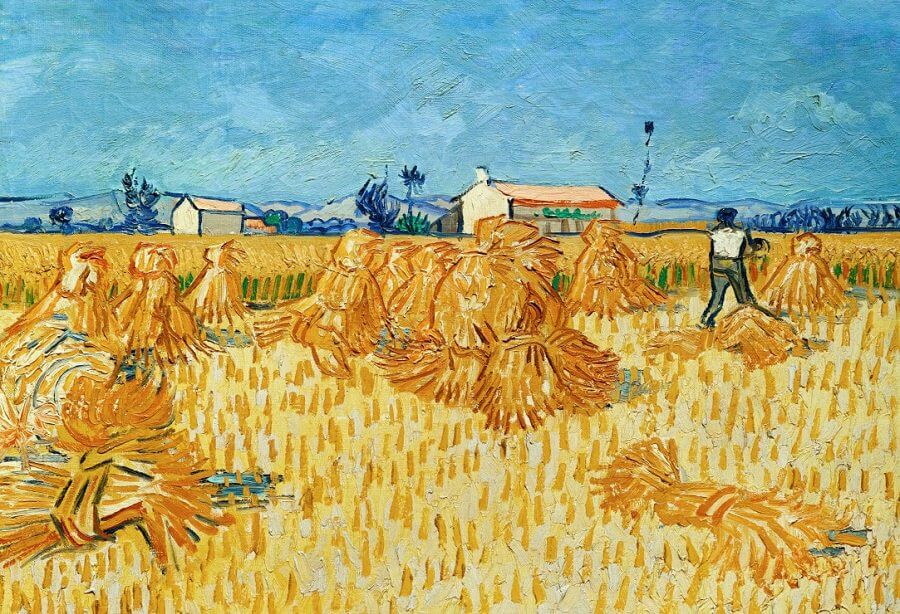
Harvest in Provence, by Vincent Van Gogh, 1888

People of every age struggle with the evil present in this world – and also within the church. For how do we make sense of those who profess Christ but have no fire and passion for their faith? How do we reconcile our own faith with folks in the church who seem to care more about getting their own way than about sacrificing themselves to reach people who do not know Christ. Jesus says, “He who has ears, let him hear.” In other words, listen!

Jesus has informed us that in this present evil age we live in, between his two advents of incarnation and Second Coming, not everything for Christians is going to be rainbows and unicorns.

There are competing pressures on the Church, and sometimes she will fail. The kingdom of God has broken into history and is present, but sin and evil is there, too. So, our focus must be on the hope we have when Christ comes again to judge the living and the dead.

In Christ’s parable of the weeds (or the parable of the wheat and the tares) the enemy of our souls seeks to distract the workers by overwhelming them with evil. If Satan cannot prevent God’s kingdom from being established in the human heart, the devil will try and corrupt the heart by throwing as much evil at it as he can. 

The devil has no problem with people saying they are Christians; the thing Satan has a problem with is people giving themselves unconditionally and unreservedly to God for kingdom business.

“Not everyone who says to me, ‘Lord, Lord,’ will enter the kingdom of heaven, but only the one who does the will of my Father who is in heaven.”

Jesus (Matthew 7:21, NIV)

Where did all these weeds come from?

I’ll frame this question in the modern form that many people have asked me over the years: “If God is a God of love, why is there so much evil in the world?” Or, “If this is Christ’s Church, why is it so messed up?”

Jesus is straightforward in his answer: An enemy did this. In other words, God didn’t plant evil – the source of evil comes from the devil, not God. God’s agenda is for the seed to take root in the human heart and grow into a full-fledged embodiment and commitment to the words and ways of Jesus.

When that growth doesn’t happen, the problem is not because God messed up; it’s because the devil has also done his own work of planting. And the devil wants the opposite of God: to have Christians nit-picking each other like a bunch of crazy chickens, and keeping a demonic pecking order; instead of being the continuing presence of Christ on this earth.

What do we do with all these weeds?

That is, how do we deal with wicked people?  The answer seems obvious: Pull the weeds up and get rid of them. Get rid of wicked people and their wicked behavior. Yet Jesus says in response to this line of reasoning in a clear and unequivocal answer of “No.” But why? Because doing violence to the weeds ends up doing violence to the wheat, as well.

Christ’s answer to the problem of evil is: Let God take care of it. Meanwhile, until that fully happens, we must co-exist with evil, rather than exterminate evil people.

There is always a temptation for believers to force people into the kingdom of God (e.g. the Spanish Inquisition). Yet, at the harvest (the final judgment at the end of the age) evil will be squarely dealt with. Judge Jesus will have the angels separate the wheat from the tares, and the weeds will be burned up.

This teaching from Jesus may open up a whole set of other questions, such as:

  • What am I supposed to do with evil? Just watch it happen? 
  • Am I to let that evil person just be evil? Shouldn’t I give them what they deserve?
  • Shouldn’t I at least tell evil people that they are no good rotten sinners? That they are going to hell because they are wicked?

This doesn’t mean we do nothing. Earlier in Matthew’s Gospel, Jesus has already said: Love your enemies and pray for those who persecute you. (Matthew 5:44)  We are to love and pray people into the kingdom, not force them in.

As for the evil, Jesus will decisively solve the problem of evil, not you, nor me! It isn’t our place to be judge, and if we make it our place, we’ll end up hurting and destroying our brothers and sisters.

Where is evil?

A sobering reality taught by Jesus in this parable is that it’s not a simple matter that we, the wheat are here, and they, the weeds, are over there. It is much more sinister than that; the enemy is within, not out there. 

We have no further to look than in our own hearts and within our own faith communities – which is why we need the lordship of Christ to completely overtake us. Evil is present in the Church, next to the good, seeking to:

  • discourage people in their commitment to Christ
  • offend and hurt others, particularly by overlooking and speaking ill of weaker people
  • step on others in order to get it’s way
  • be a stumbling block to those trying to do God’s will
  • promote ignorance of God’s Word, for no one can live by God’s will if they do not know what it is

The eventual end of sinister people is that, when Christ returns, they will be separated from the righteous and thrown into the fire, just like a harvester would do with a bunch of weeds. As the wicked went about their lives in anger, upsetting others in this life, so they will be tormented in the next.

Conclusion

We may expect God to handle evil in a hurry. But the kingdom of God doesn’t work that way; it’s intended to be planted in the ground, and takes time to grow. While it’s growing, evil is there, like a weed.

Whenever things go sideways because of wickedness, we might expect God to act quickly and drastically to uproot the evil. We may confuse God’s slowness as being uncaring, when in reality it means that God is patient, and desires people to change. And change always begins with you and me.

God Almighty, Creator of heaven and earth, we are a complacent people. While you desire us to be a beacon of light to a world in need, we are preoccupied with all the weeds in the field. We are sorry for the madness unleashed through our own selfish desires. May you plant the seed of love in our hearts for all people, not just our friends. And we shall commit to watering and nurturing that seed with your Word, through Jesus Christ our Lord. Amen.

1 Peter 3:8-12 – Bless and Do Not Curse

Ethiopian artist depiction of Jesus teaching on love

Finally, all of you be harmonious, sympathetic, affectionate, compassionate, and humble. Do not return evil for evil or insult for insult, but instead bless others because you were called to inherit a blessing. For

The one who wants to love life and see good days must keep his tongue from evil and his lips from uttering deceit.
And he must turn away from evil and do good;
he must seek peace and pursue it.
For the eyes of the Lord are upon the righteous and his ears are open to their prayer.
But the Lord’s face is against those who do evil.
(New English Version)

It’s one thing to bestow a blessing to folks when they seem worthy of it – but it’s quite another thing when you have stinkers in your life. Bless the very ones who are abusive toward me? Some might think the Apostle Peter was off his rocker to instruct believers to bless the insufferable persons in their lives.

Peter, however, was only passing on what he had learned from the Lord Jesus:

“You have heard that it was said: You must love your neighbor and hate your enemy. But I say to you, love your enemies and pray for those who harass you so that you will be acting as children of your Father who is in heaven. He makes the sun rise on both the evil and the good and sends rain on both the righteous and the unrighteous. 

If you love only those who love you, what reward do you have? Don’t even the tax collectors do the same? And if you greet only your brothers and sisters, what more are you doing? Don’t even the Gentiles do the same? Therefore, just as your heavenly Father is complete in showing love to everyone, so also you must be complete. (Matthew 5:43-48, CEB)

The instruction to bless the hateful ingrates in our lives only seems strange when the avoidance of suffering and experiencing a pain-free existence is the summum bonum of life.

I get it. We don’t like to suffer. I don’t like to suffer. It hurts! I’m not really into pain. I’m not a high tolerance pain kind of guy. I have no problem taking a pain pill at the first sign of discomfort. Even so, I know there will be times I am going to have pain – physical, mental, emotional, and spiritual – and there is going to be no way around it. 

To live in this broken world is to experience suffering. To suffer as a Christian, however, is different because we are following the way of our Lord Jesus Christ.

Just as Christ suffered, we can expect to suffer as his followers, as well. We are not above our Master. The real issue is whether we will suffer because of our own foolishness and selfishness, or because of our devotion to Christ in being kind, humble, and gracious. 

When insults come our way, we don’t need to respond in the same way with our own insults. Verbal cruelty is not the way of Christ. Anger, slander, gossip, lies, manipulative words, and belligerent bullying have absolutely no place in the kingdom of God for any reason. 

God takes a zero-tolerance policy toward hate speech, manipulation, and gaslighting.

The consistent witness of the New Testament is to bless and do not curse, to love and not to hate, to use our tongues for spreading words of encouragement and not of condemnation. Peter’s instruction and Christ’s teaching also totally jives with the Apostle Paul:

The Apostle Paul also learned from the Lord Jesus and upholds the need to bless and not curse:

Bless those who persecute you; bless and do not curse…. Live in harmony with one another…. Do not repay anyone evil for evil. Be careful to do what is right in the eyes of everyone. If it is possible, as far as it depends on you, live at peace with everyone. 

Do not take revenge, my dear friends, but leave room for God’s wrath, for it is written: “It is mine to avenge; I will repay,” says the Lord. On the contrary:

“If your enemy is hungry, feed him;
    if he is thirsty, give him something to drink.
In doing this, you will heap burning coals on his head.”

Do not be overcome by evil but overcome evil with good. (Romans 12:14-21, NIV)

Christians are to us their words for blessing, not cursing; for love, not hate; for truth, not lies; for building-up, not tearing-down; for proclaiming good news, not bad news laced with insults. 

If we suffer because of love, we shall receive blessing from God. If we suffer for giving-in to retaliation and our base desires for revenge, then we will suffer the consequences of our own stupidity.

God has called us to bless the world, not condemn it. 

Christians are to be on the front lines of spreading respect, civility, kindness, and the gospel. It is no problem showing love and respect to people we like. It’s a whole other ballgame to do the same for those who treat us with disrespect and hate.

Yet, God watches over all who obey him, and listens to their prayers. God will handle the hate-filled person; that’s not something we are to do.

Our task is to have a deep concern for humanity, both the ones we like, as well as the ones we don’t.

Loving Lord Jesus, you suffered and died on my behalf. It is a small thing for me to follow you and walk in the way of suffering. I know and have the confident expectation that blessing awaits. Keep me true to following you through all the adversity I face in this fallen broken world. Even so, come Lord Jesus, you who lives and reigns with the Father and the Spirit, one God, now and forever. Amen.