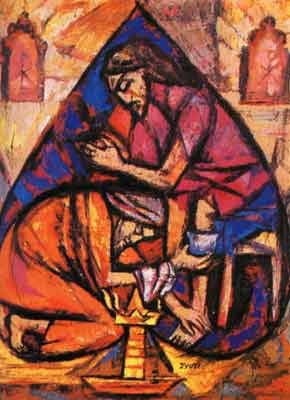
John 13:1-17, 31b-35 – Maundy Thursday

Jesus Washes Peter’s Feet

It was now the day before the Passover Festival. Jesus knew that the hour had come for him to leave this world and go to the Father. He had always loved those in the world who were his own, and he loved them to the very end.

Jesus and his disciples were at supper. The Devil had already put into the heart of Judas, the son of Simon Iscariot, the thought of betraying Jesus. Jesus knew that the Father had given him complete power; he knew that he had come from God and was going to God. 

So, he rose from the table, took off his outer garment, and tied a towel around his waist. Then he poured some water into a washbasin and began to wash the disciples’ feet and dry them with the towel around his waist. 

He came to Simon Peter, who said to him, “Are you going to wash my feet, Lord?”

Jesus answered him, “You do not understand now what I am doing, but you will understand later.”

Peter declared, “Never at any time will you wash my feet!”

“If I do not wash your feet,” Jesus answered, “you will no longer be my disciple.”

Simon Peter answered, “Lord, do not wash only my feet, then! Wash my hands and head, too!”

Jesus said, “Those who have taken a bath are completely clean and do not have to wash themselves, except for their feet. All of you are clean—all except one.” (Jesus already knew who was going to betray him; that is why he said, “All of you, except one, are clean.”)

After Jesus had washed their feet, he put his outer garment back on and returned to his place at the table.

“Do you understand what I have just done to you?” he asked. “You call me Teacher and Lord, and it is right that you do so, because that is what I am. I, your Lord and Teacher, have just washed your feet. You, then, should wash one another’s feet. I have set an example for you, so that you will do just what I have done for you. I am telling you the truth: no slaves are greater than their master, and no messengers are greater than the one who sent them. Now that you know this truth, how happy you will be if you put it into practice!…

Jesus said, “Now the Son of Man’s glory is revealed; now God’s glory is revealed through him. And if God’s glory is revealed through him, then God will reveal the glory of the Son of Man in himself, and he will do so at once. My children, I shall not be with you very much longer. You will look for me; but I tell you now, what I told the Jewish authorities, ‘You cannot go where I am going.’ 

“And now I give you a new commandment: Love one another. As I have loved you, so you must love one another. If you have love for one another, then everyone will know that you are my disciples.” (Good News Translation)

We all need love. 

Without love, relationships devolve into silent standoffs and destructive triangles. The world ceases to spin on its axis. 

But with love, all things are beautiful, personal relations have meaning and joy, and all seems right and just in the world.

This wonderful love, however, comes with a great cost. 

Because we live in a broken world filled with pride and arrogance, greed and avarice, hate and envy, we are victims of loveless, faceless, and unjust systems. 

We need Love to rescue and redeem us from the muck and crud of injustice. 

It’s as if we are constantly walking knee deep through icky sludge so thick that we can barely get anywhere. 

We need saving…. We need Jesus.

Christians everywhere around the world are journeying through Holy Week, the most sacred time of the year for followers of Christ. When we consider Holy Week, many are familiar with Good Friday and certainly Easter, but Maundy Thursday? 

On this day the church remembers the last evening Jesus shared with his disciples in the upper room before his arrest and crucifixion. 

The experiences in the upper room were highly significant because this was the last teaching and modeling that Jesus gave before facing the cross. Jesus was deliberate in communicating exactly what was important to him: Love one another.

Maundy Thursday marks three important events in Christ’s Last Supper with his disciples: 

  • The washing of the disciples’ feet (the action of loving service)
  • The instituting of the Lord’s Supper (the remembrance of loving sacrifice)
  • The giving of a “new” commandment to love one another (the mandate of a loving system). 

For Jesus, the last night with his disciples was all about love, God’s love. On that fateful night, having loved his disciples for the past three years, Jesus showed them the full extent of his love by taking the posture of a servant and washing each and every one of the disciples’ feet, including Judas. 

After demonstrating for them a totally humble service, Jesus said, “I have set you an example that you should do as I have done for you.”

Jesus Christ loves me just as I am, and not as I should be. 

Christ loves me even with my dirty stinky feet, my inconsistent half-hearted commitment to him, and my pre-meditated sin. 

Not only did Jesus wash the disciples’ feet; he also lifted the cup of wine and boldly asserted: 

“Take this and divide it among you.  For I tell you I will not drink again of the fruit of the vine until the kingdom of God comes.”  And he took the bread, gave thanks and broke it, and gave it to them, saying, “This is my body given for you, do this in remembrance of me.”  In the same way, after the supper he took the cup saying, “This cup is the new covenant in my blood, which is poured out for you.” (Luke 22:17-20, NIV)

Because of these words from Jesus, the church throughout the world, for the past two millennia, have practiced this communion so that we might have the redemptive events of Jesus pressed firmly into both our minds and our hearts by means of the visceral and common elements of bread and wine. 

We are to not just know about Jesus – we are to experience being united with him.

Having washed the disciples’ feet and proclaimed to them the meaning of his impending death, Jesus gave them a clear commandment: “A new command I give you: Love one another. As I have loved you, so you must love one another.  By this everyone will know that you are my disciples if you love one another.”

Love one another, insisted Jesus, through imitation of his humble service. We represent Christ on this earth when we carefully, diligently, and persistently practice love. 

Although love was by no means a new concept for the disciples, in the form and teaching of Jesus love was shown with four distinctions: 

  1. A new model of love: Jesus
  2. A new motive of love, that Christ first loved me
  3. A new motivator to help us love, the Holy Spirit
  4. A new mission, the evangelization of the world, utilizing the power of Christ’s love to accomplish it

Maundy Thursday is a highly significant day on the Church Calendar – one which deserves to be observed. It’s an opportunity to remember the important words and actions of Jesus on our behalf.

In Christ, we allow love to characterize our life together as we proclaim God’s love in both word and deed. A watching world will only take notice and desire to be a part of our fellowship if we are deeply and profoundly centered in the love of God in Christ. This is the reality that Maundy Thursday brings to us.

God of love, you have given us a new command to love each other. Help us to show that love in our care of creation, to all nations and ethnicities, in our communities and neighborhoods, through the Church everywhere, and with the persons closet to us and their needs. In all our thoughts, words, and actions may we be your servants and reflect your love, through our Savior, Jesus Christ, your Son, who lives and reigns with you and the Holy Spirit, one God, now and forever. Amen.

1 Peter 1:17-2:1 – Real Love Is…

Since you call on a Father who judges each person’s work impartially, live out your time as foreigners here in reverent fear. For you know that it was not with perishable things such as silver or gold that you were redeemed from the empty way of life handed down to you from your ancestors, but with the precious blood of Christ, a lamb without blemish or defect. He was chosen before the creation of the world but was revealed in these last times for your sake. Through him you believe in God, who raised him from the dead and glorified him, and so your faith and hope are in God.

Now that you have purified yourselves by obeying the truth so that you have sincere love for each other, love one another deeply, from the heart. For you have been born again, not of perishable seed, but of imperishable, through the living and enduring word of God. For,

“All people are like grass,
    and all their glory is like the flowers of the field;
the grass withers and the flowers fall,
    but the word of the Lord endures forever.”

And this is the word that was preached to you.

Therefore, rid yourselves of all malice and all deceit, hypocrisy, envy, and slander of every kind. (New International Version)

Love makes the world go round. The cycle of life brings an end to all things. Yet, the permanence of love has always existed, and will never cease to exist. (1 Corinthians 13:8-13)

Biblical godly love comes not because we first loved God, but because God first loved us and gave his Son, Jesus Christ, as an atoning sacrifice for our sins. (1 John 4:7-12)

So, the Christian’s faith and hope are completely grounded in the person and finished work of Jesus. People are so valuable to God that we were purchased from the slavery auction block with the costliest price ever: the precious blood of Jesus. 

To know this love of God in Christ, to be thoroughly captured and enraptured by it, results in a profound and deep love for others. And I’m not just referring to a nice touchy-feely love, but also a steadfast love which is committed to love regardless of what another person says or does.

Love is wonderful. But that doesn’t mean its easy. Being on the receiving end of love is a beautiful thing. Giving love, however, can sometimes get dicey.

You see, although we Christians really do believe that everything in life and ministry centers around the grace and love of God in Christ, our boots-on-the-ground loving sometimes seems compromised and conditional. That’s because it’s easy to love those who love us back. Yet, what if our love is not reciprocated or requited?

This situation brings us face-to-face with our own selves. The painful reality is that we all discover that our love is sometimes, maybe oftentimes, dependent on an assurance that we will be loved in return.

There is perhaps no more transcendent and glorious thing than mutual love. However, what happens when only one of the persons is able to give love? What do we do when grace is our only option, when we must choose to love, knowing that love won’t have a response?

Christians everywhere must come to the point of giving the same kind of love that God shows to us in Christ. We need to decide that grace is going to be our lifestyle. It comes down to this: It simply doesn’t matter what condition the other person is in. It doesn’t matter what another is going to say, or not say. Nothing on the other party’s side doesn’t matter. It…just… doesn’t… matter.

What really matters is our own loving another person deeply from the heart, regardless and in spite of everything else. That, my friends, is real Christian love.

“Love your enemies. Let them bring out the best in you, not the worst. When someone gives you a hard time, respond with the supple moves of prayer, for then you are working out of your true selves, your God-created selves. This is what God does. He gives his best—the sun to warm and the rain to nourish—to everyone, regardless: the good and bad, the nice and nasty. If all you do is love the lovable, do you expect a bonus? Anybody can do that. If you simply say hello to those who greet you, do you expect a medal? Any run-of-the-mill sinner does that.”

Jesus (Matthew 5:43-47, MSG)

Since we are redeemed people; since we have acknowledged the truth of Christ’s redemptive events of crucifixion and resurrection; since we are recipients of God’s great love to us in Jesus; we all must make the decision to live our lives full of grace and love, no matter what.  As God’s redeemed people, purchased by the precious blood of Christ, we will love one another unconditionally.

Unfortunately, over time, many Christians slowly become disconnected from this fountain of grace and love. It is likely that, at some past point, they were deeply touched by a gracious encounter with Jesus Christ. They found peace, love, and joy. Minds were swept up in the awe and wonder of God. Hearts were deeply moved for a few hours, days, or weeks. 

But then, there was a return to the routine grind of daily existence. Gradually, the demands of work and family took over. Jesus began to be treated like some old friend from another town whom we dearly loved in years past but have just lost track of. 

Of course, it was unintentional.  We simply allowed circumstances to drift us apart. We became preoccupied with something else. Now, we find ourselves with a low level irritation, frustrated with others and unable to love as we ought. We become what the late author Brennan Manning called “Christian agnostics” – people who do not deny Jesus, but just ignore him.

If your days are trivial and hectic…

If the clock determines what you do…

If you are numb to the news and headlines around you…

If you are all jangled and jittered by life’s circumstances…

If phones and computers and gadgets rule your day…

If there is little room for responding to humanity humanely…

If you have settled into a comfortable piety and a well-fed virtue…

If you have grown complacent and lead a practical life…

Then you need to be touched again by the grace and love of God in Christ by treating Jesus as if he were your very best friend as well as the awesome Son of God.

We are all still here walking on this earth because none of our failures and lack of faith have proved terminal.  We are here today because of God’s radical grace. 

The forgiveness of God is a gratuitous liberation from guilt and regret. It is an extreme amnesty. Through looking in the mirror, and seeing personal sinfulness, we amazingly end up encountering the merciful love of the redeeming God. 

The grace of God says to us, “Hush, child, I don’t need to know where you’ve been or what you’ve been up to; just let me love you.” 

When we have experienced that kind of love, we are then finally able to love one another deeply from the heart.  It is a new life of love, the kind of love that comes from God – an unconditional love that is permanent and will never go away – it is imperishable.

Therefore, as Christians loved by Christ and belonging to God:

  • We will not just show love when we are assured that we will be loved in return.
  • We will not just wait for others to show love to us first.
  • We will not expect to reach some higher level of knowledge or spirituality in order to be gracious and loving.
  • We will simply love with the love given to us by Jesus.
  • We will love with a gracious, sacrificial, vulnerable, and desperate kind of love. 

It is the kind of love that is like the waiting room in a hospital burn unit. Many years ago, I spent some time with a person in such a waiting room after her brother had been severely burned in a farm accident. In the waiting room we were all strangers. Yet, there was a loving vulnerability to our being together. I sat watching and waiting with anguished people, listening to their urgent questions: Will my husband make it? Will my child walk again even she survives? How do you live without your companion of thirty years? 

The burn unit waiting room is different from any other place in the world. And the people who wait are different. They can’t do enough for each other. No one is rude. The distinctions of race and class melt away. Each person pulls for everyone else. Vanity and pretense vanish. No one is embarrassed about crying or asking tough questions. In that moment their whole world is focused on the doctor’s next report. If only it will show improvement.

Everyone intuitively knows that loving someone else is what life is all about. 

By God’s amazing grace we will all learn to live like that without having to learn it the hard way in a place of intense anxiety and suffering.

Christ’s resurrection is not some flash-in-a-pan – it has staying power – it is real and permanent. Christ is the Christian’s hope of living a new life of gracious unconditional love. 

Jesus actually expects more failure from you than you expect from yourself. And he gives grace. So, all of our failures to love as we ought can be laid before Jesus because there is grace that covers it all – a deep love that forgives, redeems, and makes new.

Hallelujah. Thank you, Jesus.

Will Our Ministry Have Love?

Welcome, friends! Our help is in the name and with the love of the Lord who made heaven and earth. Grace and peace to you from God our Father and our Savior, Jesus Christ.

1 Corinthians 13 is the great love chapter of the New Testament. All Christian ministry and mission is to be thoroughly grounded and bathed in love. Love is a deliberate and intentional decision to meet the need of another person without showing favoritism or discrimination – because that’s what God does.

Click the videos below, and let’s consider together the essential, effective, and eternal nature of love…

Pastor Tim Ehrhardt, 1 Corinthians 13:1-13

Life is short and we have too little time to gladden the hearts of those who travel the way with us. So, be swift to love and make haste to be kind….and may the blessing of God Almighty, Father, Son and Holy Spirit be with you now and always. Amen.

1 Corinthians 13:1-13 – Will Our Ministry Have Love?

If I speak in the tongues of men or of angels, but do not have love, I am only a resounding gong or a clanging cymbal. If I have the gift of prophecy and can fathom all mysteries and all knowledge, and if I have a faith that can move mountains, but do not have love, I am nothing. If I give all I possess to the poor and give over my body to hardship that I may boast, but do not have love, I gain nothing.

Love is patient, love is kind. It does not envy, it does not boast, it is not proud. It does not dishonor others, it is not self-seeking, it is not easily angered, it keeps no record of wrongs. Love does not delight in evil but rejoices with the truth. It always protects, always trusts, always hopes, always perseveres.

Love never fails. But where there are prophecies, they will cease; where there are tongues, they will be stilled; where there is knowledge, it will pass away. For we know in part, and we prophesy in part, but when completeness comes, what is in part disappears. When I was a child, I talked like a child, I thought like a child, I reasoned like a child. When I became a man, I put the ways of childhood behind me. For now, we see only a reflection as in a mirror; then we shall see face to face. Now I know in part; then I shall know fully, even as I am fully known.

And now these three remain: faith, hope and love. But the greatest of these is love. (New International Version)

Love almost defies definition. It is so large and so deep that we can only try and describe it. That’s because love cannot be contained within puny human definitions. Every person in the world knows love exists. We have felt it, experienced it, longed for it, need it, and given it.

Throughout history, music has explored the dimensions of love. It seems that the 1970’s were especially smitten with singing about love. The ‘70’s give us a taste of how big love is in life and what it does in the human experience.

Just by looking at the song titles, we see there are all kinds of love: “Mighty Love,” “Lotta Love,” “Back in Love,” “Sweet Love,” “Radar Love,” “Hot Love,” “Puppy Love,” “Young Love,” “Sugar Baby Love,” “Easy Love,” “Burning Love,” “Our Love,” apparently “Chuck E’s in Love,” there’s even a thing called “Muskrat Love,” and, it seems, a person can have a “Love Hangover.”

Maybe the song titles give us an idea of what love is and does: “Love Will Keep Us Together,” “Love Takes Time,” “Fallin’ in Love,” “Love is the Answer,” “Love is Thicker Than Water,” “Love Will Find a Way,” “Turn Your Love Around,” “Love Grows,” “I Think I Love You,” “Don’t Pull Your Love,” “Give a Little Love,” “I’ll Never Fall in Love Again,” “Don’t Knock My Love,” and “Walk Away From Love.” 

It could be that love has something to do with attaching the word “baby” to it: “Love to Love You, Baby,” “Baby I Love Your Way,” “Lay a Little Lovin’ on Me, Baby,” “My Baby Loves Lovin’,” and Barry White is “Gonna Love You Just a Little More, Baby.”

Or perhaps love happens in certain places, such as: “Love’s Train,” “Love Rollercoaster,” “Love on a Two Way Street,” or maybe we need to slip into the ‘80’s to the “Love Shack.” Could be we just have to be a “Love Machine” (ooo-yeah!).

Indeed, when we think of love within our culture, it is something that we hope just happens to us, like the song, “I Woke Up in Love This Morning.” But when we think of biblical love, a real genuine godly love, it’s something we both give and receive. Turns out that love really is a two-way street; we all need love, to receive it and to give it. 

Without love, we die. Fish need water to swim; and we need love to survive. However, love doesn’t simply fall into our laps. Rather:

Love is a deliberate and intentional decision to meet the need of another person without showing favoritism or discrimination.

Mit Tdrahrhe

Love begins with God. God is love. Love is not only something God does; love is God’s true self and identity.  This is why love dominates so much of the Bible, as well as why our culture is so enamored with love.

Since, biblically, people are made in the image and likeness of God, there is an innate power, permanence, and presence of love deep within our souls. Even if people fail to know exactly where love comes from, we all have the collective human experience of understanding that love is supremely important.

The Apostle Paul’s beautiful description of love was penned because within the Corinthian church, there was a profound lack of love. The church was characterized by all kinds of unloving attitudes and actions, which is why they were so deeply divided among themselves. 

The Corinthian believers abused their freedom in Christ, refused to share with everyone, scorned their neighbors’ spiritual gifts, boasted about their accomplishments, sought power and recognition for themselves, and jockeyed for position in the church. So, the Corinthians needed to learn how important love is, as well as how and why to do it. Today’s New Testament lesson lets us know that love is essential, effective, and eternal. 

Love Is Essential

Love is of primary importance. Without love we might do great and impactful things, yet they will mean nothing. 

Once I decided to make a homemade pizza for my family. I spent a lot of time making my own crust, creating my own sauce, and carefully selecting the toppings. After it finally came out of the oven, it was a masterpiece!  As the chef, of course, I eagerly watched the family as they took their first bites, anticipating the rave reviews I would receive over my work of culinary art. 

But what I saw was the looks of people who were trying to be nice enough not to gag. My wise wife simply said to me, “Go ahead and have a bite.” I took one bite and spit it out of my mouth. I immediately knew what had happened. I accidentally used powdered sugar instead of flour to make my pizza crust. Even though everything else in the pizza was perfect, the one missing ingredient of flour ruined the entire meal and its experience.

Without love, it does not matter how many good works we do, how many people we help, or how much we understand the Bible and Christianity. Without love, life is just a schedule of activity with no heart to it. Apart from love, no one will ever be able to savor the good news of Jesus Christ. Religious activity in and of itself means nothing unless it is thoroughly infused with love.

Love is so large that it most certainly cannot be limited to a blog post. So we’ll pick it up in another post!….