1 Corinthians 13:1-13 – Will Our Ministry Have Love?

If I speak in the tongues of men or of angels, but do not have love, I am only a resounding gong or a clanging cymbal. If I have the gift of prophecy and can fathom all mysteries and all knowledge, and if I have a faith that can move mountains, but do not have love, I am nothing. If I give all I possess to the poor and give over my body to hardship that I may boast, but do not have love, I gain nothing.

Love is patient, love is kind. It does not envy, it does not boast, it is not proud. It does not dishonor others, it is not self-seeking, it is not easily angered, it keeps no record of wrongs. Love does not delight in evil but rejoices with the truth. It always protects, always trusts, always hopes, always perseveres.

Love never fails. But where there are prophecies, they will cease; where there are tongues, they will be stilled; where there is knowledge, it will pass away. For we know in part, and we prophesy in part, but when completeness comes, what is in part disappears. When I was a child, I talked like a child, I thought like a child, I reasoned like a child. When I became a man, I put the ways of childhood behind me. For now, we see only a reflection as in a mirror; then we shall see face to face. Now I know in part; then I shall know fully, even as I am fully known.

And now these three remain: faith, hope and love. But the greatest of these is love. (New International Version)

Love almost defies definition. It is so large and so deep that we can only try and describe it. That’s because love cannot be contained within puny human definitions. Every person in the world knows love exists. We have felt it, experienced it, longed for it, need it, and given it.

Throughout history, music has explored the dimensions of love. It seems that the 1970’s were especially smitten with singing about love. The ‘70’s give us a taste of how big love is in life and what it does in the human experience.

Just by looking at the song titles, we see there are all kinds of love: “Mighty Love,” “Lotta Love,” “Back in Love,” “Sweet Love,” “Radar Love,” “Hot Love,” “Puppy Love,” “Young Love,” “Sugar Baby Love,” “Easy Love,” “Burning Love,” “Our Love,” apparently “Chuck E’s in Love,” there’s even a thing called “Muskrat Love,” and, it seems, a person can have a “Love Hangover.”

Maybe the song titles give us an idea of what love is and does: “Love Will Keep Us Together,” “Love Takes Time,” “Fallin’ in Love,” “Love is the Answer,” “Love is Thicker Than Water,” “Love Will Find a Way,” “Turn Your Love Around,” “Love Grows,” “I Think I Love You,” “Don’t Pull Your Love,” “Give a Little Love,” “I’ll Never Fall in Love Again,” “Don’t Knock My Love,” and “Walk Away From Love.” 

It could be that love has something to do with attaching the word “baby” to it: “Love to Love You, Baby,” “Baby I Love Your Way,” “Lay a Little Lovin’ on Me, Baby,” “My Baby Loves Lovin’,” and Barry White is “Gonna Love You Just a Little More, Baby.”

Or perhaps love happens in certain places, such as: “Love’s Train,” “Love Rollercoaster,” “Love on a Two Way Street,” or maybe we need to slip into the ‘80’s to the “Love Shack.” Could be we just have to be a “Love Machine” (ooo-yeah!).

Indeed, when we think of love within our culture, it is something that we hope just happens to us, like the song, “I Woke Up in Love This Morning.” But when we think of biblical love, a real genuine godly love, it’s something we both give and receive. Turns out that love really is a two-way street; we all need love, to receive it and to give it. 

Without love, we die. Fish need water to swim; and we need love to survive. However, love doesn’t simply fall into our laps. Rather:

Love is a deliberate and intentional decision to meet the need of another person without showing favoritism or discrimination.

Mit Tdrahrhe

Love begins with God. God is love. Love is not only something God does; love is God’s true self and identity.  This is why love dominates so much of the Bible, as well as why our culture is so enamored with love.

Since, biblically, people are made in the image and likeness of God, there is an innate power, permanence, and presence of love deep within our souls. Even if people fail to know exactly where love comes from, we all have the collective human experience of understanding that love is supremely important.

The Apostle Paul’s beautiful description of love was penned because within the Corinthian church, there was a profound lack of love. The church was characterized by all kinds of unloving attitudes and actions, which is why they were so deeply divided among themselves. 

The Corinthian believers abused their freedom in Christ, refused to share with everyone, scorned their neighbors’ spiritual gifts, boasted about their accomplishments, sought power and recognition for themselves, and jockeyed for position in the church. So, the Corinthians needed to learn how important love is, as well as how and why to do it. Today’s New Testament lesson lets us know that love is essential, effective, and eternal. 

Love Is Essential

Love is of primary importance. Without love we might do great and impactful things, yet they will mean nothing. 

Once I decided to make a homemade pizza for my family. I spent a lot of time making my own crust, creating my own sauce, and carefully selecting the toppings. After it finally came out of the oven, it was a masterpiece!  As the chef, of course, I eagerly watched the family as they took their first bites, anticipating the rave reviews I would receive over my work of culinary art. 

But what I saw was the looks of people who were trying to be nice enough not to gag. My wise wife simply said to me, “Go ahead and have a bite.” I took one bite and spit it out of my mouth. I immediately knew what had happened. I accidentally used powdered sugar instead of flour to make my pizza crust. Even though everything else in the pizza was perfect, the one missing ingredient of flour ruined the entire meal and its experience.

Without love, it does not matter how many good works we do, how many people we help, or how much we understand the Bible and Christianity. Without love, life is just a schedule of activity with no heart to it. Apart from love, no one will ever be able to savor the good news of Jesus Christ. Religious activity in and of itself means nothing unless it is thoroughly infused with love.

Love is so large that it most certainly cannot be limited to a blog post. So we’ll pick it up in another post!….

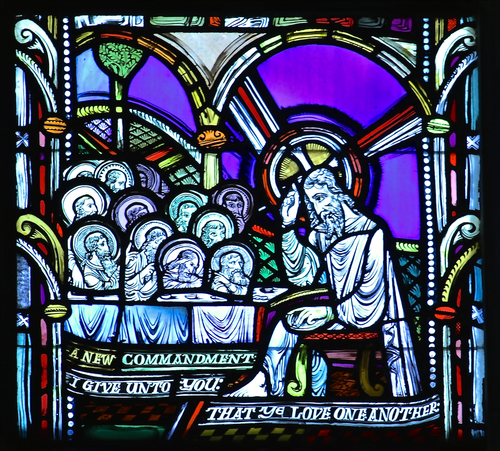
John 13:31-35 – Love One Another

Stained glass by Edgar Miller (1899-1993)

When he was gone, Jesus said, “Now the Son of Man is glorified, and God is glorified in him. If God is glorified in him, God will glorify the Son in himself, and will glorify him at once.

“My children, I will be with you only a little longer. You will look for me, and just as I told the Jews, so I tell you now: Where I am going, you cannot come.

“A new command I give you: Love one another. As I have loved you, so you must love one another. By this everyone will know that you are my disciples if you love one another.” (New International Version)

The Church was formed to represent Christ on earth. The Church is a new community of believers in Jesus, called and empowered by the Holy Spirit for mission.

Christianity was never intended to be just a personal faith; it was designed by God to be the community of the redeemed. Christian community is vital to every individual’s faith.

“No one can have God for his Father who does not have the Church for his Mother.”

John Calvin (1509-1564)

Loyalty and commitment to God translates to having a dedicated and devoted spirit to one another in the church. 

One of the last commands Jesus gave to his disciples before he went to the cross was to “love one another.” The Old Testament instructed the Israelites to love each other (Leviticus 19:18). Yet, Jesus gives new meaning to the command through four distinctions of loving one another.

A New Model of Love: Jesus

Our Lord’s life and teaching gave new meaning to the command to love each other. Notice what Jesus did in the Upper Room just before giving the command to love one another:

It was almost time for the Jewish Passover festival. Jesus knew that the time had come for him to leave this world and go back to the Father. Jesus had always loved the people in the world who were his. Now was the time he showed them his love the most.

Jesus and his followers were at the evening meal. The devil had already persuaded Judas Iscariot to hand Jesus over to his enemies. (Judas was the son of Simon.) The Father had given Jesus power over everything. Jesus knew this. He also knew that he had come from God. And he knew that he was going back to God. So while they were eating, Jesus stood up and took off his robe. He got a towel and wrapped it around his waist. Then he poured water into a bowl and began to wash the followers’ feet. He dried their feet with the towel that was wrapped around his waist. (John 13:1-5, ERV)

Jesus modeled a service-oriented love of compassionately meeting the need of another, regardless of who that person is. It is instructive to us that Jesus washed the feet of Judas Iscariot, along with all the other disciples. 

Christ died for us while we were still sinners. This demonstrates God’s love for us.

Romans 5:8, GW

We are to love everyone in the community of saints, and not just our friends or the ones we like. Loving one another also means we will be realistic in understanding that community is messy and downright hard work.  

A New Motive: Christ First Loved Me

Jesus has loved us with a love that took care of our brokenness once for all. Because of that love, we are now motivated to love each other. John would later say in his first epistle: 

God showed his love for us by sending his only Son into the world, so that we might have life through him. This is what love is: it is not that we have loved God, but that he loved us and sent his Son to be the means by which our sins are forgiven. Dear friends, if this is how God loved us, then we should love one another. (1 John 4:9-11, GNT)

Love is an attitude and a frame of mind. The motivation for the Christian is different than anyone else’s motive:  We are so thankful for Christ’s love to us, that we cannot help but extend that same love to one another in the church. 

This kind of love transcends human willpower. This is love as a grateful response for the grace shown us in Christ.

A New Motivator: The Holy Spirit

The Spirit energizes and enables us to love each other. Jesus also said in the Upper Room: 

If you love me, you will do as I command. Then I will ask the Father to send you the Holy Spirit who will help you and always be with you. (John 14:15-16, CEV)

There are times when we may lack the ability or spiritual energy needed for the work of loving each other. It is in those times that we need to check our spiritual electrical box to make sure we haven’t tripped a breaker by trying to live the Christian life on our own strength. 

We need the Spirit. The Spirit gives us the zeal we need to love one another. 

We typically don’t do anything in life unless we have the motivation for it. The Spirit is like the Christian’s personal trainer – encouraging, exhorting, getting in our face, comforting, and spurring us – toward the new way of love. 

A New Mission: World Evangelization

All people will know we are Christ’s disciples if we love one another. The way we treat each other in the church is foundational and fundamental to the mission of loving our neighbors who don’t know Jesus.

“Mission is putting love where love is not.”

St. John of the Cross (1542-1591)

When the church has a healthy and even supernatural dynamic of loving one another, they joyfully proclaim the good news to every person that Jesus is the answer to the terrible brokenness of this world.

Community is necessary to mission. Lesslie Newbigin (1909-1998) was a British missionary to India for forty years. After retiring and returning to Britain, he found his homeland was very different than when he left. He was astounded to find Britain had become very less Christian and was now predominantly un-Christian. It was clearly a post-Christian society. What to do about it? Here is Newbigin’s response:

“I have come to feel that the primary reality of which we have to take account in seeking for a Christian impact on public life is the Christian congregation.  How is it possible that the gospel should be credible, that people should come to believe that the power which has the last word in human affairs is represented by a man hanging on a cross? 

I am suggesting that the only answer, the only hermeneutic of the gospel [the only way society can discern who Jesus is] is a congregation of men and women who believe it and live by it. I am, of course, not denying the importance of the many activities by which we seek to challenge public life with the gospel – evangelistic campaigns, distribution of Bibles and Christian literature, conferences, and even books such as this one. But I am saying that these are all secondary, and that they have power to accomplish their purpose only as they are rooted in and lead back to a believing community.”

Conclusion

The implications of community for our faith are significant. If we keep other Christians at a distance and give them the stiff arm, we are really giving God the stiff arm. Jesus identifies so closely in love to his people, that to love them is to love him.

The late African-American preacher E.V. Hill told the following story about an experience with a white Christian leader in the 1950s:

“As a freshman at Prairie View College (part of the Texas A&M system) I was actively involved and was one of two students selected to go to our denomination’s annual meeting in Memphis. The trip through the South was by car—three whites and two blacks traveling together. I had no idea how we’d eat or how we’d sleep. So great was my anxiety and hatred over how the trip might turn out that I almost backed out entirely …. In all my experience I had never seen a white man stand up for a black man and never felt I would. 

But then Dr. Howard, the director of our trip and a white man spoke up. ‘We’ll be traveling together,’ he said. ‘If there isn’t a place where all of us can eat—none of us will eat. If there’s not a place all of us can sleep—none of us will sleep.’ That was all he said, but it was enough! For the first time in my life, I had met a white man who was Christian enough to take a stand with a Christian black man.” 

May the Spirit give us the courage together to love one another.

Gracious Lord, I pray for those who will believe in you through the good news of forgiveness in Christ. I pray that all of them may be one just as you are one. May they be brought to complete unity to let the world know that you sent the Son, Jesus, and have loved them even as you have loved us. Righteous God, may you help us make you known in the world so that the love you have for us may be in them through the cross of Christ. Amen.

1 Peter 4:7-19 – Show Hospitality without Grumbling

The end of all things is near. Therefore, be alert and of sober mind so that you may pray. Above all, love each other deeply, because love covers over a multitude of sins. Offer hospitality to one another without grumbling. Each of you should use whatever gift you have received to serve others, as faithful stewards of God’s grace in its various forms. If anyone speaks, they should do so as one who speaks the very words of God. If anyone serves, they should do so with the strength God provides, so that in all things God may be praised through Jesus Christ. To him be the glory and the power for ever and ever. Amen.

Dear friends, do not be surprised at the fiery ordeal that has come on you to test you, as though something strange were happening to you. But rejoice, inasmuch as you participate in the sufferings of Christ, so that you may be overjoyed when his glory is revealed. If you are insulted because of the name of Christ, you are blessed, for the Spirit of glory and of God rests on you. If you suffer, it should not be as a murderer or thief or any other kind of criminal, or even as a meddler. However, if you suffer as a Christian, do not be ashamed, but praise God that you bear that name. For it is time for judgment to begin with God’s household; and if it begins with us, what will the outcome be for those who do not obey the gospel of God? And,

“If it is hard for the righteous to be saved,
    what will become of the ungodly and the sinner?”

So then, those who suffer according to God’s will, should commit themselves to their faithful Creator and continue to do good. (New International Version)

“Hospitality means primarily the creation of free space where the stranger can enter and become a friend instead of an enemy. Hospitality is not to change people, but to offer them space where change can take place. It is not to bring men and women over to our side, but to offer freedom not disturbed by dividing lines.”

Henri Nouwen

One of the most practical and biblical ways of demonstrating love is through hospitality. Hospitality, at its heart, is an invitation to come into my home and into my life. It is a ministry of acceptance, encouragement, restoration, and healing.  The loving work of hospitality “covers a multitude of sins” through the power of influence. When we have face-to-face conversations around the table, it prevents us from engaging in sins that would otherwise be committed if left to ourselves.

Because the end of all things is near, we need our wits about us through a determined focus on prayer, love, and hospitality. The word “hospitality” literally means, “love of the stranger.” I invite someone whom I do not know very well into my home and befriend them. This is what Jesus did for us. Although we were all estranged from God and on the outside, Jesus came to eat with us.

“Listen! I stand at the door and knock; if any hear my voice and open the door, I will come into their house and eat with them, and they will eat with me.” (Revelation 3:20, GNT)

Jesus invites us into the life of God. We are to invite others into our lives. Jesus has so closely identified with his people that when we practice hospitality, we are inviting Jesus in. In fact, we may not realize that some people we host are angels: 

Do not forget to show hospitality to strangers, for by so doing some people have shown hospitality to angels without knowing it. (Hebrews 13:2, NIV)

Inviting another person into my home and heart takes time and effort. It may even create some suffering. Doing it without grumbling is a necessity. In an ideal world we always receive something back for our work of hospitality – an invitation from the other person, or, at least, a simple thank you. That does not always happen and cannot be the driving reason why we are generous.

Hospitality is a work of love which originates from a heart touched by the hospitality of God. Our earthly hospitality is a form of saying “thank you” to God for his grace to us. Complaints break into the house like unwanted burglars when we expect to receive, and do not. If you receive another person as though they were Christ himself, grumbling will likely be far from you. Instead, there will be rejoicing over the opportunity to serve Jesus.

Jesus said, “Anyone who welcomes you welcomes me. And anyone who welcomes me also welcomes the one who sent me.” (Matthew 10:40, CEV)

In the New Testament world, a concrete expression of love to other believers in Jesus was providing food and shelter for Christians traveling throughout the Roman Empire. Often, the traveling strangers were itinerant evangelists spreading the message of the gospel from place to place. 

Dear friend, you are faithful in what you are doing for the brothers and sisters, even though they are strangers to you. They have told the church about your love. Please send them on their way in a manner that honors God. It was for the sake of the Name that they went out, receiving no help from the pagans. We ought therefore to show hospitality to such people so that we may work together for the truth. (3 John 5-8, NIV)

At other times, believers were deprived of necessities due to occasional waves of persecution. The people Peter addressed were mostly Jewish Christians. As they faced persecution in Jerusalem, they fled to geographical places dominated by pagan Gentiles. As refugees, they were often poor and needy. The townspeople where they went were not hospitable. So, they had to rely on the love and hospitality of those believers they could connect with who had the means to help.

Contribute to the needs of God’s people, and welcome strangers into your home. (Romans 12:13, CEB) 

There is a great need for hospitality in our world.  Many American’s circle of friends is shrinking. According to one study the number of people who said they had no one to talk to about important matters has more than doubled in the past 10 years. 35 million Americans now live alone (which is 28% of all households). 

Hospitality cuts both ways for us. We are to invite the lonely into our hearts and homes; and the lonely are to invite others into their hearts and homes, instead of waiting for somebody to just show up.

Food is to hospitality what weightlifting is to bodybuilders; you really need food, meals, and the sharing that goes with it to make a difference in another’s life. In biblical times, eating a meal together was a sacred affair.  To have another person in your house, sitting around your table, communicated acceptance, care, and friendship. That is why the religious leaders had such difficulty with Jesus eating with “sinners.” Jesus was unequivocally loving and accepting of such persons.

No matter our gifts and abilities, each one of us can be hospitable. Something mystical happens at a dinner table that does not happen anywhere else – it opens the door to true community.

While they were eating, Jesus took a loaf of bread, and after blessing it he broke it, gave it to the disciples, and said, “Take, eat; this is my body.” Then he took a cup, and after giving thanks he gave it to them, saying, “Drink from it, all of you; for this is my blood of the covenant, which is poured out for many for the forgiveness of sins. (Matthew 26:26-28, NRSV)

For the Christian, eating and ingesting bread and wine serves as a tangible way of understanding what life is to be like. We take Jesus into the depths of our lives. We ingest him, that is, we engage in an intimate relationship whereby the two of us can never be separated.

We are meant for life together, to enjoy eating and drinking together. True life is sharing both our resources and our hearts with one another. 

Loving God, thank you for your generosity. I am a stranger in this world, yet you invite me to be your guest. You lavishly offer me your hospitality and welcome me into your family. You invite me to share in the abundance of your kingdom. Help me remember that when I offer hospitality to others, I am receiving Christ into my home. Gracious God, I open my heart to those who are wounded; those who have wounded me; those who are outcasts; and to all who are searching. I want my everyday ordinary life to please you. I am grateful that there is always room at your Table, through Jesus, my Lord. Amen.

John 15:18-20, 26-27 – Moving in with Jesus

“If the world hates you, keep in mind that it hated me first. If you belonged to the world, it would love you as its own. As it is, you do not belong to the world, but I have chosen you out of the world. That is why the world hates you. Remember what I told you: ‘A servant is not greater than his master.’ If they persecuted me, they will persecute you also. If they obeyed my teaching, they will obey yours also…

When the Advocate comes, whom I will send to you from the Father—the Spirit of truth who goes out from the Father—he will testify about me. And you also must testify, for you have been with me from the beginning.” (New International Version)

Two characters: Jesus and Emmet

Scene:  Emmet is moving in with Jesus as a roommate.

Emmet enters….

“Nice digs, Jesus. Not quite what I was expecting – looks good and clean – but just ordinary.”

“I’m glad you decided to take up my offer and come live with me in my house, Emmet. Well, it’s actually my Father’s house.”

“Yeah, well, it wasn’t working out so well with my girlfriend, Jezebel. She was into a lot of weird stuff, like some crazy real estate schemes, especially with vineyards – the woman is obsessed with buying up vineyards. Besides, she told me she hates me. That really hurt.”

“Emmet, I think you will find I’m into a different kind of vineyard and real estate. And there isn’t any hate there. It’s called ‘the kingdom of God.’”

“Kingdom, huh?  Sounds like a pretty big gig to me, Jesus.”

“Oh, yes, it is. The biggest. You know, Emmet, by living and abiding with me here you will get to know all about the kingdom.”

Sounds groovy, man… or should I say, ‘Son of Man!’ Hey, Jesus, you got any beer and chips in this joint?  I’m starving.”

“No, sorry, I’m afraid not right now. But I do have some wine and some bread.”

“Well, okay, Jesus. I’m super hungry. I could go for about anything.”

“Here you go Emmet.” (Jesus gives Emmet a wafer and communion cup – Emmet just stands there and looks at it). “Make yourself at home in my love, Emmet.”

“Um, hey, Jesus, not to be ungrateful or anything, but is this all you have?”

“Just try it, Emmet. I think you will find it rather satisfying.”

(Emmet takes the bread and drinks the cup). “Holy Communion, Jesus! Whoa! I’m actually full! What in the world is in that stuff, anyway?”

“There’s no world in it, at all, Emmet. I am the vine. You are the branch. When you drank, you ingested me.  You’re joined with me, and I with you. Apart from me you are always going to be hungry and thirsty, no matter how much other food you eat and how much beer you drink. But if you stay here and settle in with me, make this your permanent home and not just a place to hang your hat, you can be sure that I will always listen to you and do whatever you ask of me.”

“That’s heavy, man. Very cool. I can dig it!”

“I have told you this for a purpose, Emmet – that we might enjoy being roommates together. By the way, I have just one rule in my house that I expect to be obeyed, always: Love other people in the same way that I love you.  Never forget, Emmet: If you ever get locked-out of the house, it is love which opens the door to my place.  Remember, Emmet, that love is the key.”

“You know, Jesus, you’re kind of odd, but I like you, dude. I’m glad I chose to come here.”

“Emmet, you did not choose me; I chose you and brought you here because of my love. And I am sending you into the world to love. Remain here with me, abide with me in this place, and you will see things happen beyond what you can even think or imagine. Go, now, and bear the fruit of love in my kingdom, and when you come back, I’ll have a place for you to sleep and you will rest like you have never rested before.”

“I really appreciate your hospitality, Jesus. But what if I mess up? Or forget about your rule?”

“When you came here, Emmet, you probably saw someone standing just outside the door.”

“Yeah… I did see some dude who looked way out there, man, like he was from another universe, like maybe New Jersey, or something.”

“That was the Advocate. He will come whenever you mess up or forget about my love. The Advocate will help you remember the truth.”

(Jesus walks Emmet to the door). “There’s nothing to worry about. Just go and love others like I love you. Good-bye, Emmet.”

“Bye, Jesus. I’ll be back after I go spread some love around, just like you taught me….”

*Above Photo by Amina Filkins on Pexels.com