A Life-Giving Message of Grace and Love (2 Thessalonians 2:13-3:5)

But we ought always to thank God for you, brothers and sisters loved by the Lord, because God chose you as first fruits to be saved through the sanctifying work of the Spirit and through belief in the truth. He called you to this through our gospel, that you might share in the glory of our Lord Jesus Christ.

So then, brothers and sisters, stand firm and hold fast to the teachings we passed on to you, whether by word of mouth or by letter.

May our Lord Jesus Christ himself and God our Father, who loved us and by his grace gave us eternal encouragement and good hope, encourage your hearts and strengthen you in every good deed and word.

As for other matters, brothers and sisters, pray for us that the message of the Lord may spread rapidly and be honored, just as it was with you. And pray that we may be delivered from wicked and evil people, for not everyone has faith. But the Lord is faithful, and he will strengthen you and protect you from the evil one. We have confidence in the Lord that you are doing and will continue to do the things we command. May the Lord direct your hearts into God’s love and Christ’s perseverance. (New International Version)

Turn to any page in Holy Scripture, focus on it’s contents, seek to live the message you find, and you will discover a rich and full spiritual life.

Standing firm in faith, holding to the apostolic teachings, and living into the good news of grace will translate into a daily life of loving others in both word and deed.

There are several elements contained in today’s New Testament lesson to spotlight in living a solid spiritual life: gratitude; salvation; sanctification; truth; spiritual calling; sharing in God’s glory; love; grace; hope; encouragement; prayer; faithfulness; perseverance; and, deliverance.

We could even highlight just one of these words and, if seeking to do a deep dive with it, could spend unending days learning and living into its multi-faceted dimensions.

I want to pause here and do a bit of a check-in with you. How we approach this passage of Scripture, as well as any other verses which encourage us to hold onto sound teaching and living, will likely determine our level of joy, satisfaction, confidence, and success in life.

It all begins with our view of self. If we come at the Christian life and Holy Scripture with a view of self as a mere tool or object for God’s use – then we are truly objectifying ourselves.

The key point of awareness to realizing whether we have such an objectifying view is if we continually “should” ourselves. The word “should,” brings self-hatred. We primarily see only shortcomings and original sin – and are blind to the majesty of being in God’s image.

In such a view there is typically boat loads of shame for not living up to the ideal form of a devoted Christian. Belittling ourselves inwardly only translates outwardly to looking down on others for their failures. Any exhortation from me or anybody else would be seen in this view as demanding a duty.

Instead, we can approach Scripture’s admonitions, encouragements, and exhortations with the glasses of grace. After all, our text for today says that God loved us and by grace gave us this teaching. The dense amount of Christian living in such a few verses, when viewed through the lenses of grace, are merciful words of support and encouragement.

God wants to strengthen us with grace just because of love. God does not objectify us by peering down on us as pawns in some twisted divine game of cosmic pleasure. Rather, God is looking to direct our hearts toward a delight in love. Because only love and grace is what endures throughout our Christian lives.

Not everyone has faith, and that saddens the heart of God. It also puts us, at times, in awkward situations. Again, the love of God does not leave us alone. Divine love will strengthen and protect us.

The Apostle Paul never wags his finger and levels the “should” on us like some uptight legalist. Paul expresses confidence, knowing that we most certainly have the capacity to live the will of God. The Scriptures are given to engender strengthening of faith and spiritual growth rather than self-hatred – which has a nasty tendency to come out sideways in a lack of compassion and grace toward others.

The second letter to the Thessalonian Christians was written because the believers were finding it difficult to endure their hard circumstances. They began longing for heaven to such a degree that they were losing their grip on living presently in the moment of now. This is one reason why Paul encouraged them to pray for him and his colleagues. The people needed to put some focus on the now of spreading the message of God’s grace and love.

The truth be told, the chief reason I write these daily reflections on Scripture is because I need God’s Word. Yes, I do, of course, write for the reader. I want to contribute to people’s growth in grace and I have a deep desire to make the message known.

Yet, honestly, I write more for myself. This is a way for me to remind myself of God’s love and grace and utilize it every day. When I hear Paul talking in biblical texts like these, I detect some of the same reason – Paul himself wants to continue growing in grace, and when writing to and for others he is very much writing to himself.

The reading of the Bible and the dedication to living its message is meant to be life-giving, or rather, eternally life-giving.

So, today, I offer you this blessing:

May you take refuge in the wondrous grace of God, and all the little miracles of mercy which he bestows each day.

May you always be inclined to rush into God’s Holy Word and discover it working within you.

May you imitate the flower as it opens to the day’s sunshine in receiving all that God has for you this day.

May you be in solidarity with brother stone, who sits in silence, calm and secure, and be excessively gentle with yourself.

May you wisely steer clear of those vexed in spirit with only God knows what; and, when in that space of others walking all over your boundaries, may your confidence surge and God’s protection deliver you.

May you return to the glory that is yourself, learning a new respect for your heart, and the joy that has always been there, given graciously to you by a God who has invited you to share in Jesus Christ.

Amen.

It’s About Love (1 Peter 1:17-23)

Statue of Christ the Redeemer, Rio de Janeiro, Brazil

Since you call on a Father who judges each person’s work impartially, live out your time as foreigners here in reverent fear. For you know that it was not with perishable things such as silver or gold that you were redeemed from the empty way of life handed down to you from your ancestors, but with the precious blood of Christ, a lamb without blemish or defect. He was chosen before the creation of the world, but was revealed in these last times for your sake. Through him you believe in God, who raised him from the dead and glorified him, and so your faith and hope are in God.

Now that you have purified yourselves by obeying the truth so that you have sincere love for each other, love one another deeply, from the heart. For you have been born again, not of perishable seed, but of imperishable, through the living and enduring word of God. (New International Version)

Love makes the world go round. The cycle of life brings an end to all things. Yet, the permanence of love has always existed, and will never cease to exist. (1 Corinthians 13:8-13)

Biblical godly love comes not because we first loved God, but because God first loved us and gave his Son, Jesus Christ, as an atoning sacrifice for our sins. (1 John 4:7-12)

So, the Christian’s faith and hope are completely grounded in the person and finished work of Jesus. People are so valuable to God that we were purchased from the slavery auction block with the costliest price ever: the precious blood of Jesus. 

To know this love of God in Christ, to be thoroughly captured and enraptured by it, results in a profound and deep love for others. And I’m not only referring to a nice touchy-feely love, but also a steadfast love which is committed to love regardless of what another person says or does.

Love is wonderful. But that doesn’t mean it’s easy. Being on the receiving end of love is a beautiful thing. Giving love, however, can sometimes get dicey.

Although we Christians really do believe that everything in life and ministry centers around the grace and love of God in Christ, our boots-on-the-ground loving sometimes seems compromised and conditional. That’s because it’s easy to love those who love us back. Yet, what if our love is not reciprocated or requited?

This situation brings us face-to-face with our own selves. The painful reality is that we all discover that our love is sometimes, maybe oftentimes, dependent on an assurance that we will be loved in return.

Mutual love is a beautiful thing, but what happens when only one of the persons is able to give love?

What do we do when grace is our only option, when we must choose to love, knowing that love won’t have a response?   

Christians are supposed to give the same kind of love that God shows to us in Christ – which means we need to decide that grace is going to be our lifestyle. It comes down to this: It simply doesn’t matter what condition the other person is in. It doesn’t matter what another is going to say, or not say. Nothing on the other party’s side matters. It…just… doesn’t… matter.

What really matters is our own loving another person deeply from the heart, regardless and in spite of everything else. That, my friends, is real Christian love.         

Since we are redeemed people; have acknowledged the truth of Christ’s redemptive events of crucifixion and resurrection; are recipients of God’s great love to us in Jesus; we must choose to live our lives full of grace and love, no matter what. 

As God’s redeemed people, purchased by the precious blood of Christ, our default response to others is to be this: We will love one another unconditionally.

Unfortunately, over time, many Christians slowly become disconnected from this fountain of grace and love. It is likely that, at some past point, they were deeply touched by a gracious encounter with Jesus Christ. They found peace, love, and joy. Minds were swept up in the awe and wonder of God. Hearts were deeply moved for a few hours, days, or weeks. 

But then, there was a return to the routine grind of daily existence. Gradually, the demands of life took over. Jesus began to be treated like an old friend from another town whom we dearly loved in years past, but have just lost track of. 

Of course, it was unintentional. We simply allowed circumstances to drift us apart. We became preoccupied with something else. Now, we find ourselves with a low level of irritation, frustrated with others and unable to love as we ought. We become what the late author Brennan Manning called “Christian agnostics,” that is, people who do not deny Jesus, but just ignore him.

If your days are trivial and/or hectic…

If the clock determines what you do…

If you are numb to the news and headlines around you…

If you are all jangled and jittered by life’s circumstances…

If phones and computers and gadgets rule your day…

If there is little room for responding to humanity humanely…

If you have settled into a comfortable piety and a well-fed virtue…

If you have grown complacent and lead a practical life…

Then you need to be touched again by the grace and love of God in Christ by treating Jesus as if he were your very best friend as well as the awesome Son of God. 

We are all still here walking on this earth because none of our failures and lack of faith have proved terminal; we are here today because of grace and love. 

The forgiveness of God is a liberation from guilt and regret. It is an extreme amnesty. Through looking in the mirror, and seeing personal sinfulness, we amazingly end up encountering the merciful love of the redeeming God. 

The grace of God says to us, “Hush, child, I don’t need to know where you’ve been or what you’ve been up to; just let me love you.” 

When we have experienced that kind of love, we are then finally able to love one another deeply from the heart. It’s a new life of love, the kind that comes from God – an unconditional love that’s permanent and will never go away.

Therefore, as Christians loved by Christ and belonging to God, we make the following affirmations of love:

  • We will love, no matter whether we are loved in return.
  • We will take the initiative to love, not just waiting for others to love first.
  • We will love, even when we are imperfect and feel unworthy to do so.
  • We will give love with the love we received from Jesus.
  • We will love with a gracious, sacrificial, vulnerable, and desperate kind of love. 

Many years ago, I spent some time with someone in a hospital waiting room after her brother had been severely burned in a farm accident. In that place, we were all strangers. Yet, there was a loving vulnerability to our being together. I sat watching and waiting with anguished people, listening to their urgent questions: Will my husband make it? Will my child walk again, even if she survives? How do you live without your companion of thirty years? 

Burn unit and intensive care unit waiting rooms are places. And the people who wait are different. They can’t do enough for each other. No one is rude. The distinctions of race and class melt away. Each person pulls for everyone else. Vanity and pretense vanish. No one is embarrassed about crying or asking tough questions. In that moment their whole world is focused on the doctor’s next report. If only it will show improvement.

Everyone intuitively knows that loving someone else is what life is all about. By God’s amazing grace we will all learn to live like that without having to learn it the hard way in a place of intense anxiety and suffering.

Christ’s resurrection is not some flash-in-a-pan – it has staying power – it is real and permanent. Christ is the Christian’s hope of living a new life of gracious unconditional love. 

Jesus actually expects more failure from you than you expect from yourself. And he gives grace. So, all of our failures to love as we ought can be laid before Jesus because there is grace that covers it all – a deep love that forgives, redeems, and makes new.

God of goodness and grace, we your people are aware of our human frailties and foibles, and yet are overwhelmed by your love for us. We give you praise that there is no human experience we might walk through where your love cannot reach us. If we climb the highest mountain you are there, and if we find ourselves in the darkest valley, you are there. Continually teach us to love you and others, through Jesus Christ our Lord. Amen.

Come Away with Me (Song of Songs 2:8-15)

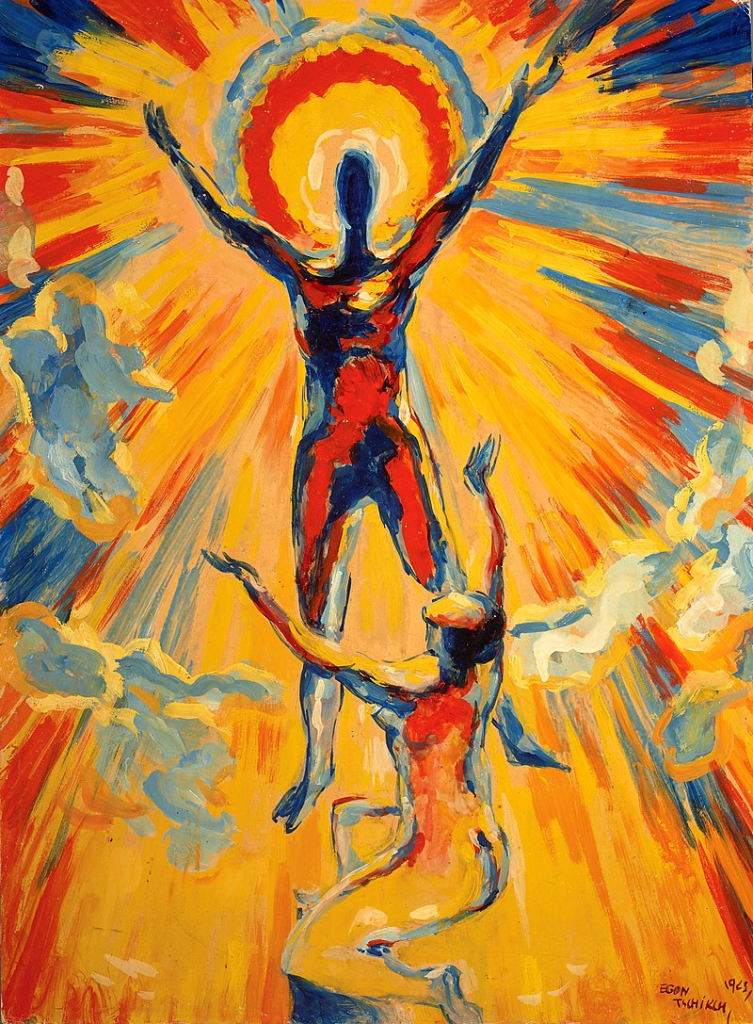
Song of Songs No. 19, by Egon Tschirch, 1923

Ah, I hear my lover coming!
    He is leaping over the mountains,
    bounding over the hills.
My lover is like a swift gazelle
    or a young stag.
Look, there he is behind the wall,
    looking through the window,
    peering into the room.

My lover said to me,
    “Rise up, my darling!
    Come away with me, my fair one!
Look, the winter is past,
    and the rains are over and gone.
The flowers are springing up,
    the season of singing birds has come,
    and the cooing of turtledoves fills the air.
The fig trees are forming young fruit,
    and the fragrant grapevines are blossoming.
Rise up, my darling!
    Come away with me, my fair one!”

My dove is hiding behind the rocks,
    behind an outcrop on the cliff.
Let me see your face;
    let me hear your voice.
For your voice is pleasant,
    and your face is lovely.

Catch all the foxes,
    those little foxes,
before they ruin the vineyard of love,
    for the grapevines are blossoming! (New Living Translation)

Spring is the season of love, the time of coming together and enjoying one another’s presence.

God is love. God is calling us. God wants to be with you.

There is a reason why so many people in this cruel and calloused world are unloving and unkind: They are unaware that God loves them, desires to be with them, and is calling out to them. 

If we neither believe nor know God’s infinite love and desire for us, then our words and our actions will reflect more of hate than love. God really truly does want to be with you and me. This is crucial. Do not forget this. Believe it. Live it. Enjoy it. Know it. Tell it to yourself until you are thoroughly bathed in it, because it is more wonderful than any ‘70’s sappy love song could ever describe it.

I believe the small Old Testament book of Solomon’s Song of Songs too often gets a weird hermeneutical spin of literalism from modern-minded simpletons. For nearly all of history, this poetic ode to love was understood as an allegory of divine love for humanity – and the believer’s reciprocal response.

Song of Songs No. 8, by Egon Tschirch, 1923

When Scripture says I am my beloved’s and my beloved is mine, and that his desire is for me, it is a wonderful way of communicating that God’s love for us is not abstract, distant, or detached. (Song of Songs 6:3, 7:10) 

The truth is: We belong to God. The Lord’s desire is for you and me. God has an intense and overpowering longing for you. Let the deep desire of God for you shape and form your thoughts so that fear is replaced with faith; loneliness with enjoyment; the fickle nature of others with satisfaction; praying as duty with praying because I want to be with the God who loves me so much.

Oh, how we need a vision of God singing over us with joy! Yes, God loves you that much! Grab a hold of what the prophet says:

The Lord will take delight in you with gladness.
    With his love, he will calm all your fears.
    He will rejoice over you with joyful songs. (Zephaniah 3:17, NLT)

Even the most unlovely of people are made lovely through God’s persistent and pursuing love for them. You are being wholly seen every single day by the infinite gaze and eternal compassion of God, who watches our every step with delight.

Christianity does not “happen” simply by knowing some beliefs about God, as if it is a mere contractual signing-off on a doctrinal statement. Rather, Christianity “happens” when individuals experience the white hot burning love of God in Jesus Christ. 

Jesus came not only for those who skip church and only occasionally read their Bibles. Christ came also for the hard-hearted prick, the immoral adulterer, the strung-out addict, the terrorist, the murderer, and for all those caught in bad choices and failed relationships. 

“I have not come to call respectable people, but outcasts.” (Matthew 9:13, GNT)

“Go out and train everyone you meet, far and near, in this way of life.” (Matthew 28:19, MSG)

“You will be witnesses for me.” (Acts 1:8, GNT)

“Love each other in the same way that I have loved you.” (John 13:34, GW)

All Christ’s words and actions are because of the Lord’s intense desire to love the world, and to love it through the divine beloved people of God.

God’s love is never based on our performance, or how good we look to others; it is never conditioned by our moods. The love of God only looks longingly at you and me with the potential of what we can become in Christ and cares for us as we are. It is a world-altering revolutionary thought that God loves me as I am and not as I should be. 

God has shown us how much he loves us—it was while we were still sinners that Christ died for us! (Romans 5:8, GNT)

Despite the erosion of church attendance, the majority of people still believe God exists. Conversely, however, many people do not believe God really loves them. We are in a crisis of love. People need to know the God who is pure Love. They need to hear and heed the call to come away with God.

Christianity never begins with what we do for God to make ourselves lovely. Christianity always starts with what God has done for us, the great and wonderful love that exists for us in Christ Jesus.

It wasn’t so long ago that we ourselves were stupid and stubborn, easy marks for sin, ordered every which way by our glands, going around with a chip on our shoulder, hated and hating back.

But when God, our kind and loving Savior God, stepped in, he saved us from all that. It was all his doing; we had nothing to do with it. He gave us a good bath, and we came out of it new people, washed inside and out by the Holy Spirit.

Our Savior Jesus poured out new life so generously. God’s gift has restored our relationship with him and given us back our lives. And there’s more life to come—an eternity of life! You can count on this. (Titus 3:3-8, MSG)

All the wrong turns in the past, the mistakes and the moral lapses, everything that is ugly or painful, all melts in the light of God’s acceptance and love for us.

If the consuming passion of Christ’s followers is not showing God’s love, then we have lost both our mission and our first love of Jesus. Perhaps we must let time evaporate, as we bow at the foot of the cross, and experientially know the great love of God in Christ for us and for the world.

May it be so, to the glory of God.

Maundy Thursday (Psalm 116:1-2, 12-19)

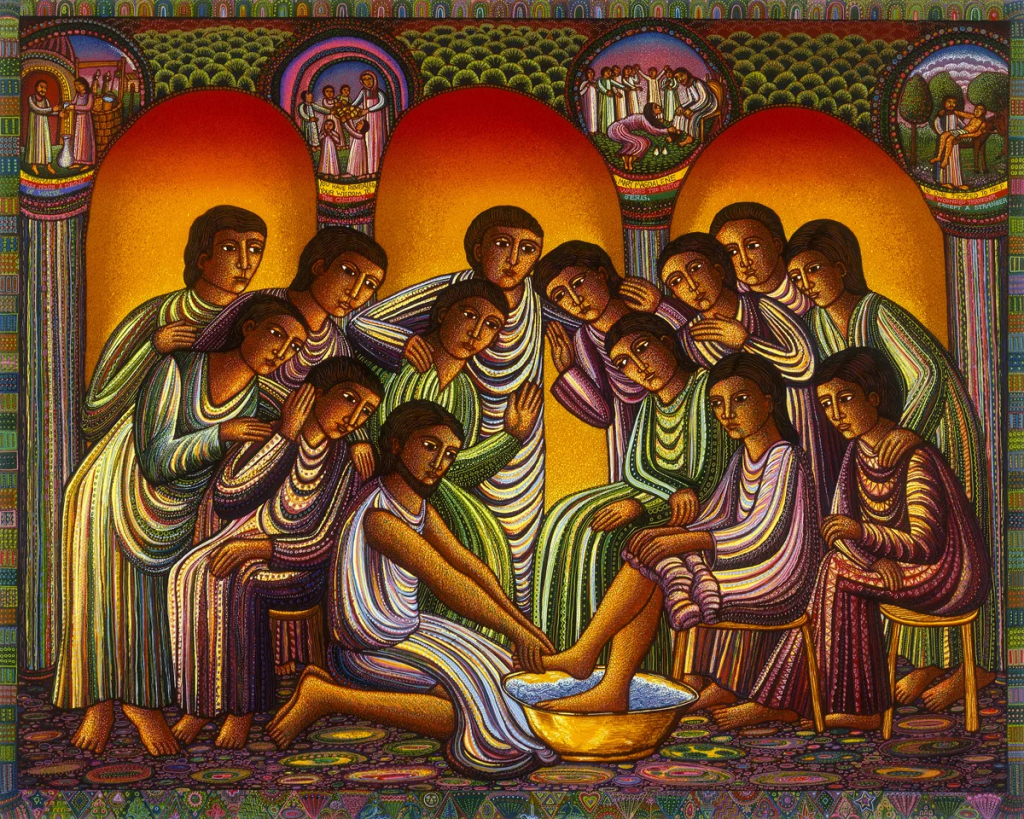
Washing of the Feet, by John August Swanson, 2000

I love the Lord because he has heard
    my voice and my supplications.
Because he inclined his ear to me,
    therefore I will call on him as long as I live….

What shall I return to the Lord
    for all his bounty to me?
I will lift up the cup of salvation
    and call on the name of the Lord;
I will pay my vows to the Lord
    in the presence of all his people.
Precious in the sight of the Lord
    is the death of his faithful ones.
O Lord, I am your servant;
    I am your servant, the child of your serving girl.
    You have loosed my bonds.
I will offer to you a thanksgiving sacrifice
    and call on the name of the Lord.
I will pay my vows to the Lord
    in the presence of all his people,
in the courts of the house of the Lord,
    in your midst, O Jerusalem.
Praise the Lord! (New Revised Standard Version)

“Pain and suffering have come into your life, but remember pain, sorrow, suffering are but the kiss of Jesus — a sign that you have come so close to Him that He can kiss you.”

Mother St. Térèsa of Calcutta (1910-1997)

There is more to the passion of Christ than sheer suffering and sorrow; the Via Dolorosa is, paradoxically, also the road to joy.

Yes, suffering is painful and unpleasant. Yet, since we all must suffer in some way, the real issue is whether our suffering is meaningless or has purpose to it. We are able to bear our suffering if we are confident that a redemptive outcome is at the end of it.

The Lord Jesus submitted to suffering because he knew that all the mockery, torture, and abuse was the pathway to deliverance for humanity.

Because of the joy awaiting him, he endured the cross, disregarding its shame. Now he is seated in the place of honor beside God’s throne. Think of all the hostility he endured from sinful people; then you won’t become weary and give up. (Hebrews 12:2-3, NLT)

Since Jesus has gone before us, enduring shame so that it could be put to death in us, we are able to live free from guilt and the ignominy of sin. What’s more, Christ’s suffering gives shape and meaning to our own suffering.

“I cannot but wonder at the virtue that lies in suffering; we are worth nothing without the cross. I tremble and am in an agony while it lasts, and all my conviction of its salutary effects vanish under the torture, but when it is over, I look back at it with admiration, and am ashamed that I bore it so ill.”

François Fénelon (1651-1715)

On this Maundy Thursday, we remember that in the midst of suffering there is the hope of glory, and in the center of pain there is the confident expectation that it will be used as the fertilizer to help love grow and bloom in the dormant places of this world.

“Love proves itself by deeds, so how am I to show my love? Great deeds have forbidden me. The only way I can prove my love is by scattering flowers and these flowers are every little sacrifice, every glance and word, and the doing of the least actions for love.”

St. Thérèse of Lisieux (1873-1897)

There cannot be love without suffering; to love is to sacrifice on behalf of another.

Because we live in a broken world full of pride and hubris, greed and avarice, hate and envy, we are victims of loveless systems and unjust actions. We need love to rescue and redeem us from the sheer muck of existential guilt and shame, evil and injustice.

Christians around the world are journeying through Holy Week, the most sacred time of the year for followers of Christ. When we think about Holy Week, we are familiar with Good Friday and certainly Easter, but Maundy Thursday? 

On this day, the Church remembers the final evening Jesus shared with his disciples in the upper room before his arrest and crucifixion. The experiences in the upper room were highly significant because this was the last teaching, modeling, and instruction Jesus gave before facing the cross. Jesus was careful and deliberate to communicate exactly what was important to him: to love one another.

“A new command I give you: Love one another. As I have loved you, so you must love one another.  By this everyone will know that you are my disciples if you love one another.” (John 13:34-35, NIV)

Maundy Thursday marks three important events in Christ’s Last Supper with his disciples: 

  1. The washing of the disciples’ feet (the action of loving service)
  2. The instituting of the Lord’s Supper (the remembrance of loving sacrifice)
  3. The giving of a “new” commandment to love one another (the mandate of a loving lifestyle)

The message of Maundy Thursday is this: Jesus Christ loves me just as I am, and not as I should be. He loves me even with my dirty stinky feet, my herky-jerky commitment to him, and my pre-meditated sin. 

Today is a highly significant day on the Church Calendar and in the Christian Year – one which deserves to be observed, and an opportunity to remember the important words and actions of Jesus on our behalf. Through Jesus Christ we are to live always in love, modeling our life and ministry after him. 

“I have found the paradox that if I love until it hurts, then there is no hurt, but only more love.”

Mother Térèsa

In Christ, love is to characterize our life together as we proclaim God’s love in both word and deed. A watching world will take notice and desire to lay down their hate and animosity if the followers of Christ are deeply and profoundly centered in the love of God.

God our Father, you invite us to participate in the life, suffering, death, and resurrection of your Son. Inspire us by his service, and unite us in his love; who lives and reigns with you, in the unity of the Holy Spirit, one God, now and forever. Amen.