Love Never Fails

“When we ask whether someone is a good man, we are not asking what he believes, or hopes, but what he loves.” St. Augustine

I believe there are few things in life which have sustainability and permanence, things which make the world go ‘round. Love is one of them; maybe even the greatest of them.

Love Language

And yet, in the English language, we really only have one word for “love.” That strikes me as curious and interesting.

I enjoy language and languages, as well as the use and smithing of words. One observation I’ve made about language is that any particular society, culture, or nation has several words for whatever is important or valuable to them.

For example, Indonesia has seven different words for the one English word “rice.” Since rice is so vital to the life of the people, it makes sense that they have several words to bring out all of the various nuances of “rice.”

By contrast, the West simply places adjectives in front of “rice” when needed (i.e. white or brown or jasmine). So, what does it say about us, about me and my fellow Americans, when we have only one word for “love?”

We certainly have plenty of words for “money.” It does little good to even use the word “money” unless one is speaking in very general terms. Americans make liberal use of words like “stocks and bonds,” “cash,” “checking and savings accounts,” etc. We even have several words for institutions which handle money: banks, savings and loans, credit unions, and mutual organizations.

Indeed, what does it say about us that we have a plethora of words for money? What’s more, in contrast to our one word for “love,” what does this tell us about Western society in general?

No wonder that American society has a love problem. Even when we borrow words for love from other languages, we seem to transform it into something else.

The Greek word “phileo” is engrafted into many of our English words such as philosophy (love of wisdom); philanthropy (love of humanity); or Philadelphia (brotherly love).

Often the last thing on our minds about the city of Philadelphia is an association with love; philanthropy is widely understood as being generous with one’s money (there it is again!); and few people think of love when describing philosophy.

Please know that it’s not my purpose to rant about American culture. I just want us to think about how we tend to use the word, and the implications of that use.

Oftentimes, I find that my own understanding of the word tends to be in contrast with so many other uses of “love.”

St. Augustine and Love

I admit to being influenced most heavily by St. Augustine and Holy Scripture. Augustine was enamored with love. That’s likely because he knew what it felt like to be on the outside of God’s redeeming love in Christ. For Augustine, love explains everything. Love is to be our true nature, and the proper direction of everything we say and do in this world, insisted Augustine.

Augustine, of course, derived his understanding from Jesus – especially from the New Testament Gospels:

“Love the Lord your God with all your heart and with all your soul and with all your mind.’ This is the first and greatest commandment. And the second is like it: ‘Love your neighbor as yourself.”

Matthew 22:37-39, NIV

Unless there is love, we go nowhere – which is precisely what seems to be happening in our world today. Apart from love, there are no social problems which can be alleviated; no wars which will stop; and no rights and respect extended to particular people. Without love, peace and happiness are nothing but a pipe dream.

It is imperative that we have a robust understanding and practice of love. If we don’t, I believe that we are ruined, no matter how savvy or powerful we are.

Designed For Love

People are designed for love; it is our very purpose. And if we go against our basic inherent design, it will be like disrespecting gravity itself by walking off the roof of the house in the wrongheaded belief that I won’t get hurt.

Fullness of life (and fullness of any religious practice) comes only through love. In Christianity, it is clearly understood that God is Love with a capital “L.” Thus, we were created in love, stamped with the image of God’s love, and expected to love one another.

Love is so ubiquitous throughout the Bible that listening to a biblical sermon on love every day for the rest of your life would not exhaust love’s height, depth, breadth, and width within Scripture.

It is an understatement to say that love is the goal of religion, the purpose for being, and the best expression of human community.

For in Christ Jesus neither circumcision nor uncircumcision has any value. The only thing that counts is faith expressing itself through love. (Galatians 5:6, NIV)

For the entire law is fulfilled in keeping this one command: “Love your neighbor as yourself.” (Galatians 5:14, NIV)

Love does no harm to a neighbor. Therefore love is the fulfillment of the law. (Romans 13:10)

Love never fails. (1 Corinthians 13:8, NIV)

And this is my prayer: that your love may abound more and more in knowledge and depth of insight… (Philippians 1:9, NIV)

The thing about love is that it can either get choked-out, or it can flourish. Love gets suppressed by attaching ourselves to things rather than people. This is a gross misuse of our capacity for love. A radical detachment from stuff may be necessary in order to gain relational connection.

On the other hand, by learning to direct our love toward God and neighbor (and, by the way, our neighbor is everyone we encounter) we begin to discover the peace of being in sync with the way the universe is wired.

We need salvation from our own worldly self. For it is this false self which the devil can so easily deceive and woo us from attachments to God and neighbor. In other words, we must be saved from ourselves, because left to ourselves, there is no hope for us.

To be lost is to be fooled by my own ego that the false self is the true self. To live and love in God is the essence of the true self.

That means humility, gentleness, peaceful relations, mercy, and purity characterize us. If it doesn’t, we’ve been fooling ourselves by believing that peace can only be achieved through unconditional winning; and that I am not responsible for my neighbor’s welfare and well-being.

Here’s a little test of where you might be in your false self/true self, and in your actual ability to love: The more importance you attach to your own ideas, your own abilities, and your own work, the more you will find yourself building up the very idea of you. This inevitably comes out by condemning other people and becoming judgmental of most things they do. If we are continually critical of others, we have lost sight of love.

The true self, however, recognizes and remembers that I am made in the image and likeness of God; that God is my very reason for existence; and that, therefore, love is my true identity because God is Love.

That’s right. Love is your genuine true character, deep down. The late Trappist monk, Thomas Merton, got it right when he said:

“If I do anything or think anything or say anything or know anything that is not purely for the love of God, it cannot give me peace, or rest, or fulfillment, or joy.” Thomas Merton, Seeds of Contemplation

This is one reason why it’s so important to love my neighbor. Since God’s love is truly within me, hardwired into my very existence, this love can come to you and me from any person, any direction, any time.

Love comes not only directly from God, but also indirectly by means of the jewel of love placed within the other person I am encountering.

For it is only in love that we at last can become real. If we feel unworthy of love, we will probably feel that other persons are not worthy of it either. This is where hate is born, and why it manifests itself so hideously in a politics of hate where large groups of people are simply labeled as “monsters” or “evil.”

But that’s really only a projection of how the person feels about themselves. And the only way out of it for the hateful person is to know that they are loved – irrespective of one’s worth.

If and when we become out of sorts, it is best to come back to love. Which means returning to my first and original love, God; and to the love that I actually have for the people in my family and my life.

Maybe it’s high time we start inventing all sorts of new words for love in the English language. Because, after all is said and done, Love never fails.

His Resurrection Is Ours

The Resurrection, by Andrea Mantegna, c.1458 C.E.

The story of Christianity, the very heart and essence of the religion, is a tale of transformation from all the obstacles, impediments, and barriers which confine or cripple. The person and work of Jesus accomplished this. In his earthly ministry, Christ continually called people to transformative change into the reality of God’s gracious and benevolent realm.

“I have come to give the good life, a life that overflows with beauty and harmony.”

Jesus (John 10:10, First Nations Version)

Christ’s resurrection made possible our own transformative new life. This is both exciting and scary. Resurrection is frightening because it’s a call to live a life without any of the walls which have defined us and/or imprisoned us.

The massive stone covering the tomb of Jesus Christ was rolled away. He walked out of the grave by the power of resurrection. The cave of death was changed into the place of liberation.

That place is a powerful image of moving aside any and all obstacles to our own faith and freedom. The prison doors have been opened. Our self-contrived inner prisons, as well as the unjust shackles placed upon us, have dropped away.

As a result, those who have been exiled, excommunicated, and treated as expendable are visited by the luminous healing presence of God’s great liberating force: resurrection.

All of these words may either seem strange and/or compelling. If this is the case, it is a sad situation. Because it’s quite necessary that we become familiar with such language. Unfortunately, the gap between the world we are presently living in, and the world our hearts yearn to know, is quickly coming to an unsustainable place of high stress.

There is now a profound disconnect between the love deep inside us, and the way in which we are living our day-to-day lives on this earth. The issue has become so great as to warrant the need for resurrection.

And I am not simply addressing Christians. In his earthly ministry, Jesus was not only talking to his own Jewish people; he came for the whole world. Jesus is for everyone – whether we acknowledge him according to Christian dogma and doctrine, or not.

The evil gaslighting sort of person wants you to believe that you are alone, bereft of any help – that somehow you need to assert yourself aggressively into the dog-eat-dog world. Wickedness always looks to chaos and war as the path to gaining the life one wants.

But Jesus is the bridge to another kind of thinking, another sort of life. He is the guide to the greatest power which exists in the world: Love. And Love is why resurrection is a reality.

Although we suffer from systemic evil and all kinds of structural “ism’s” in this world, our shackles and chains have been largely forged by ourselves, through spiritual ignorance and misunderstandings of who we are and why we are here.

Resurrection opens us to new life. It provides identity, purpose, and passion to live the good life. Even though we live in this world below, our answers to living in the here-and-now are found in the world above.

All of us have experienced walking a dark path in life. But now it is high time to walk away from uncontrolled emotions and evil ways. There are plenty of lying spirits who intend on deceiving you and I for their own selfish purposes. Instead, we can refuse and resist such evil.

We can live in ways that represent the good, the right, and the just. We can experience living a resurrected life. Let us choose the pure path of the new person in Christ, the person you and I were created to be.

The telltale signs of the person living into resurrection are a deep feeling for the pain of others, kindness, humility of heart, a gentle spirit, and long-suffering patience with others. Such persons wear forgiveness like a well-worn pair of jeans.

This is the path of resurrection, the way of unity, peace, and harmony. And these qualities will always guide us and inform us in helpful and sacred ways.

Our current global decline comes from an accumulation of greed and sheer lovelessness. But the possibility of rebirth, of resurrection, rises from our deep universal yearning for the good and the true. It comes from our radical willingness to change and live a different counter-cultural life.

Resurrection does not occur because of lofty thoughts; it comes from a humble, and contrite heart which yearns for a better and more sacred existence.

Only until we find our present life on this world as intolerable with its injustice and persistent carelessness, will we see that we must put love where love is not.

The great lesson of resurrection is that Love makes all things right.

May resurrection move from being merely a theological concept, to a powerful reality that permeates and fills your life with meaning, power, and love. Amen.

What Should We Do? (Acts 2:37-42)

Apostle Peter Preaching, by Lorenzo Veneziano, c.1370

When the crowd heard this, they were deeply troubled. They said to Peter and the other apostles, “Brothers, what should we do?”

Peter replied, “Change your hearts and lives. Each of you must be baptized in the name of Jesus Christ for the forgiveness of your sins. Then you will receive the gift of the Holy Spirit. This promise is for you, your children, and for all who are far away—as many as the Lord our God invites.” With many other words he testified to them and encouraged them, saying, “Be saved from this perverse generation.” Those who accepted Peter’s message were baptized. God brought about three thousand people into the community on that day.

The believers devoted themselves to the apostles’ teaching, to the community, to their shared meals, and to their prayers. (Common English Bible)

The Apostle Peter, follower of Jesus, had a fire in his belly and fresh wind in his lungs.

Pentecost will do that to a person.

The promised Holy Spirit came – the Spirit of fire and wind – and the result was an impassioned, reasoned, and convicting message from Peter.

The crowd of people listening to Peter understood clearly that he was saying the person and work of Jesus was the activity of God.

And Christ was killed because of his presence and ministry. But three days later, he was raised from death. And then, ascended to heaven, promising the Spirit’s continual involvement.

The people listening to Peter were cut to the heart, convicted in the depths of their soul, and beside themselves as to their culpability in Christ’s situation. They cried out to Peter and asked him what they should do, how they could possibly be a part of what God is doing in the world.

Peter’s response to the crowd was to change – to repent and be baptized, receiving the gift of the Holy Spirit. The Apostle was telling them to turn away from the old way, and turn toward the new coming kingdom of God.

Baptism assures people that God has received their repentance, and has forgiven them. It initiates the believer into the new community of the redeemed, the church.

This was not only for Jewish people, but also for Gentiles; and for everyone, both far and near.

Celebration, by John August Swanson (1938-2021)

The four qualities which characterized the earliest church were these:

  1. The new community followed apostolic teaching (the story of Jesus)
  2. The church continually engaged in fellowship (mutual encouragement and working together in unity)
  3. The believers broke bread together (kept meeting together in shared meals to remember the person and work of Jesus)
  4. They prayed (as the Lord had taught them to pray – for God’s gracious and benevolent kingdom to come, and God’s ethical and moral will to be done, right now on this earth, as it is always done in God’s heaven)

For those who are established in the faith of Christianity, all of this material raises several questions to reflect upon in how our life together as Christians is going:

How do Christians understand the word “repentance?”

Because this determines a great deal of how we live as believers. If we discern repentance as following the rules – both written and unwritten – then we are likely behaving more in the old ways that the earliest believers were to repent of.

But if we see repentance as a way of life, of continually offering prayers of confession to God, and seeking to align our life with the words and ways of Jesus, then we are living more into the spirit of Peter’s original exhortation to the people.

Is the Church living as the baptized community of the redeemed?

Again, how do we understand the word “baptism?” If baptism is nothing more than a personal decision to outwardly show one’s faith, then we have severely truncated Peter’s meaning of the word.

Baptism is the outward sign that we belong to God. And belonging to God is something God does, not us.

One good way of understanding the whole of the Christian life is that we are to ‘live into our baptism,’ that is, we are to daily live our lives cognizant that our life is not our own.

We belong to God. Long before we happened to choose God, God chose us. And we must always remember that.

Are believers in Jesus living in the Spirit?

The Spirit has been given as the continuing presence of Jesus on this earth. The Spirit reminds us of Christ’s words and ways, his person and work. To live in the Spirit is to be continually reminded that what is important to Jesus, needs to be important to us.

“You’re blessed when you’re at the end of your rope. With less of you there is more of God and his rule.

“You’re blessed when you feel you’ve lost what is most dear to you. Only then can you be embraced by the One most dear to you.

“You’re blessed when you’re content with just who you are—no more, no less. That’s the moment you find yourselves proud owners of everything that can’t be bought.

“You’re blessed when you’ve worked up a good appetite for God. He’s food and drink in the best meal you’ll ever eat.

“You’re blessed when you care. At the moment of being ‘care-full,’ you find yourselves cared for.

“You’re blessed when you get your inside world—your mind and heart—put right. Then you can see God in the outside world.

“You’re blessed when you can show people how to cooperate instead of competing or fighting. That’s when you discover who you really are, and your place in God’s family.

“You’re blessed when your commitment to God provokes persecution. The persecution drives you even deeper into God’s kingdom. (Matthew 5:3-10, MSG)

Are individual Christians and the Church communicating the promise to those who are far away? In other words, are we seeking to include others in the community?

Too many churches are closed groups who have a lot of extraneous rules and ancillary beliefs in order to truly be a part of their local church.

This does not mean we are to have no rules or guidelines or any teaching about our particular Christian tradition. However, it does mean that make sure we are proclaiming good news (which is what the word “gospel” means) because the gospel is radically inclusive, not exclusive.

Therefore, to have a community of people who genuinely love one another by spiritually changing and growing, serving and helping, sharing and encouraging, praying and opening up, is to have a group of redeemed persons who give a compelling proclamation of good news through both their gracious words and their loving actions.

If we have little Christ’s walking about this world and living according to his words and ways, and being full of the Spirit, then we give other people a big reason for faith, hope, and love in a world that is too often characterized by being overwhelmed, jaded, and hopeless.

One can never go wrong with living a blessed life as Jesus has defined it; and as the early apostles and believers lived it.

May it be so, to the glory of God, and for the blessing of the church and the world. Amen.

Work, Love, and Dignity (Proverbs 27:1-27)

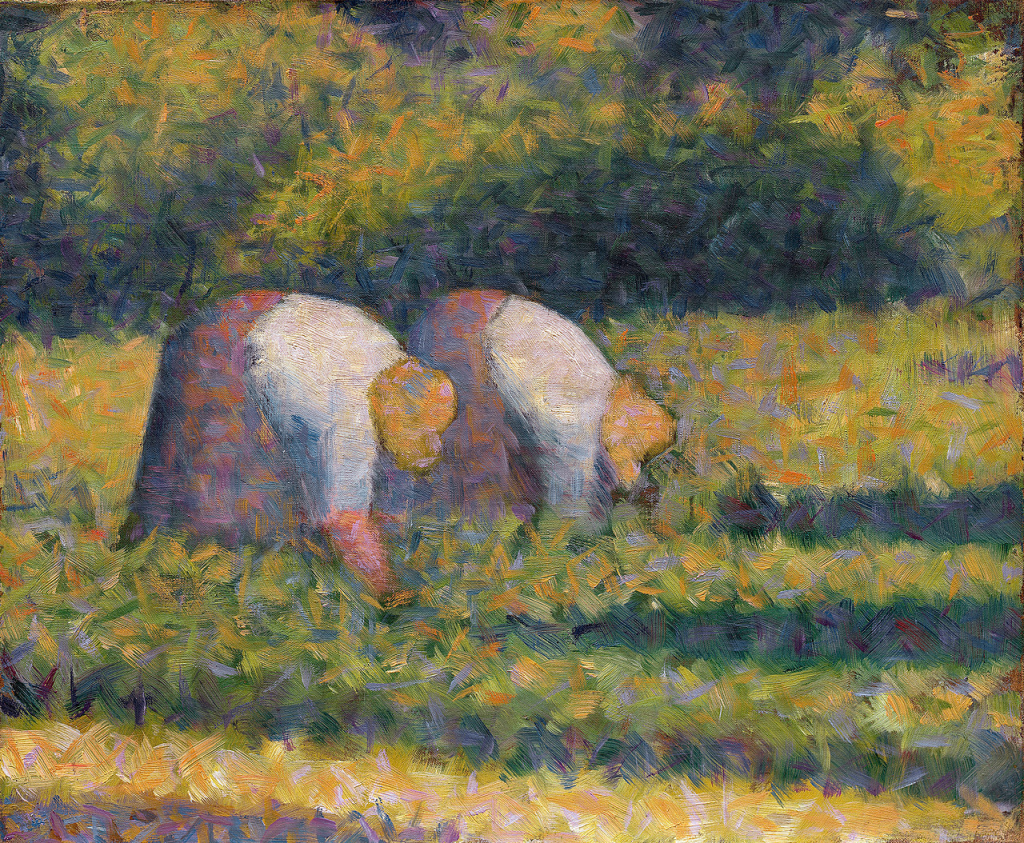
Farm Women at Work, by Georges Seurat (1859-1891)

Do not boast about tomorrow,
    for you do not know what a day may bring.

Let someone else praise you, and not your own mouth;
    an outsider, and not your own lips.

Stone is heavy and sand a burden,
    but a fool’s provocation is heavier than both.

Anger is cruel and fury overwhelming,
    but who can stand before jealousy?

Better is open rebuke
    than hidden love.

Wounds from a friend can be trusted,
    but an enemy multiplies kisses.

One who is full loathes honey from the comb,
    but to the hungry even what is bitter tastes sweet.

Like a bird that flees its nest
    is anyone who flees from home.

Perfume and incense bring joy to the heart,
    and the pleasantness of a friend
    springs from their heartfelt advice.

Do not forsake your friend or a friend of your family,
    and do not go to your relative’s house when disaster strikes you—
    better a neighbor nearby than a relative far away.

Be wise, my son, and bring joy to my heart;
    then I can answer anyone who treats me with contempt.

The prudent see danger and take refuge,
    but the simple keep going and pay the penalty.

Take the garment of one who puts up security for a stranger;
    hold it in pledge if it is done for an outsider.

If anyone loudly blesses their neighbor early in the morning,
    it will be taken as a curse.

A quarrelsome wife is like the dripping
    of a leaky roof in a rainstorm;
restraining her is like restraining the wind
    or grasping oil with the hand.

As iron sharpens iron,
    so one person sharpens another.

The one who guards a fig tree will eat its fruit,
    and whoever protects their master will be honored.

As water reflects the face,
    so one’s life reflects the heart.

Death and Destruction are never satisfied,
    and neither are human eyes.

The crucible for silver and the furnace for gold,
    but people are tested by their praise.

Though you grind a fool in a mortar,
    grinding them like grain with a pestle,
    you will not remove their folly from them.

Be sure you know the condition of your flocks,
    give careful attention to your herds;
for riches do not endure forever,
    and a crown is not secure for all generations.
When the hay is removed and new growth appears
    and the grass from the hills is gathered in,
the lambs will provide you with clothing,
    and the goats with the price of a field.
You will have plenty of goats’ milk to feed your family
    and to nourish your female servants. (New International Version)

Hard Work

The Lord God took the man and put him in the Garden of Eden to work it and take care of it. (Genesis 2:15, NIV)

Work itself is not a result of humanity’s fall. Before Adam and Eve disobeyed God, they were tasked to work and take care of the Garden of Eden. Therefore, work is inherently good. Yet, hard labor is certainly a result of the fall.

What we humans ought to have done through our created nature, now because of the fall into sin and disobedience, we have to work with focused deliberate intention. And even then, we often don’t perform our work as we would like.

“Cursed is the ground because of you;
    through painful toil you will eat food from it
    all the days of your life.
It will produce thorns and thistles for you,
    and you will eat the plants of the field.
By the sweat of your brow
    you will eat your food
until you return to the ground,
    since from it you were taken;
for dust you are
    and to dust you will return.” (Genesis 3:17-19, NIV)

This is why wise persons throughout the ages have given priority to hard work, and branded laziness as detrimental to our human welfare.

Much of our labor is menial and mundane, no matter what the work is. Yet, through vision and persistence, the fruit of our labor eventually breaks through. It is important for us to keep our nose to the grindstone, namely, because this is what it takes to produce, and to keep ourselves out of trouble!

Like a shepherd who cares for the sheep, we are to be present, pay attention, do whatever it takes to help the sheep flourish, and hang in there through the thick and thin of the job.

Diligence and consistency are vital to our hard work. The temptation of get-rich-quick schemes and other supposedly easy paths to success and wealth sometimes rear their heads to lure us away from our daily chores.

Well-kept sheep will produce wool and milk for several years. Riches and achievements and accolades, however, do not necessarily last for long.

Affectionate Love

Hard work and relationships nurtured by affectionate love are meant to go hand-in-hand. In other words, ideally, the duty and diligence of our daily tasks, and the consistency of establishing relational well-being with others, is well-balanced and works seamlessly together.

Loving another entails both encouragement and correction, heartfelt words as well as open words of rebuke. That is, we continually think of what another needs, and what is best for the community as a whole.

Our love must entail what is good for the one being loved, for the one doing the loving, and for the whole community to which both belong. Love leaves angry speeches and jealous motives behind and doesn’t utilize them, because they are tools of hate and hurt.

Gracious Dignity

Everyone is responsible to extend basic human kindness to one another, without exception. We are to listen to and honor our parents and elders; practice self-control and patience with all; and use gentle words in every communication.

Poise under pressure, and motivation to do what is right and good helps to lift the worth and dignity of others. We extend this to people for no other reason than that it is another human being who is in front of us; this is a person in God’s image.

God created mankind in his own image,
    in the image of God he created them;
    male and female he created them. (Genesis 1:27, NIV)

All persons have inherent worth as image-bearers of God. The wise person amongst us knows this and continually applies it in all their words and actions toward others.

Wise people also understand the value of hard work, and the intrinsic worth of work itself. Furthermore, they discern that love is to be the motivation and animating principle in doing work and working with others.

The bottom line of all the proverbial wise saying in today’s lesson is that we are to help and encourage others through both our words and our working actions. Our individual lives are to benefit the whole community, so that we are a blessing to others, as well as to receive blessings from those around us.

In engaging a healthy rhythm of giving and receiving, we reverse the curse, and enable the world to return to Eden.

Almighty God, we pray that You will bless all of our various labor and work in the world. Help us to pray fervently, diligently work hard, and give liberally. In all that we do, enable us to do it with all the love You provide. Amen.