Work, Love, and Dignity (Proverbs 27:1-27)

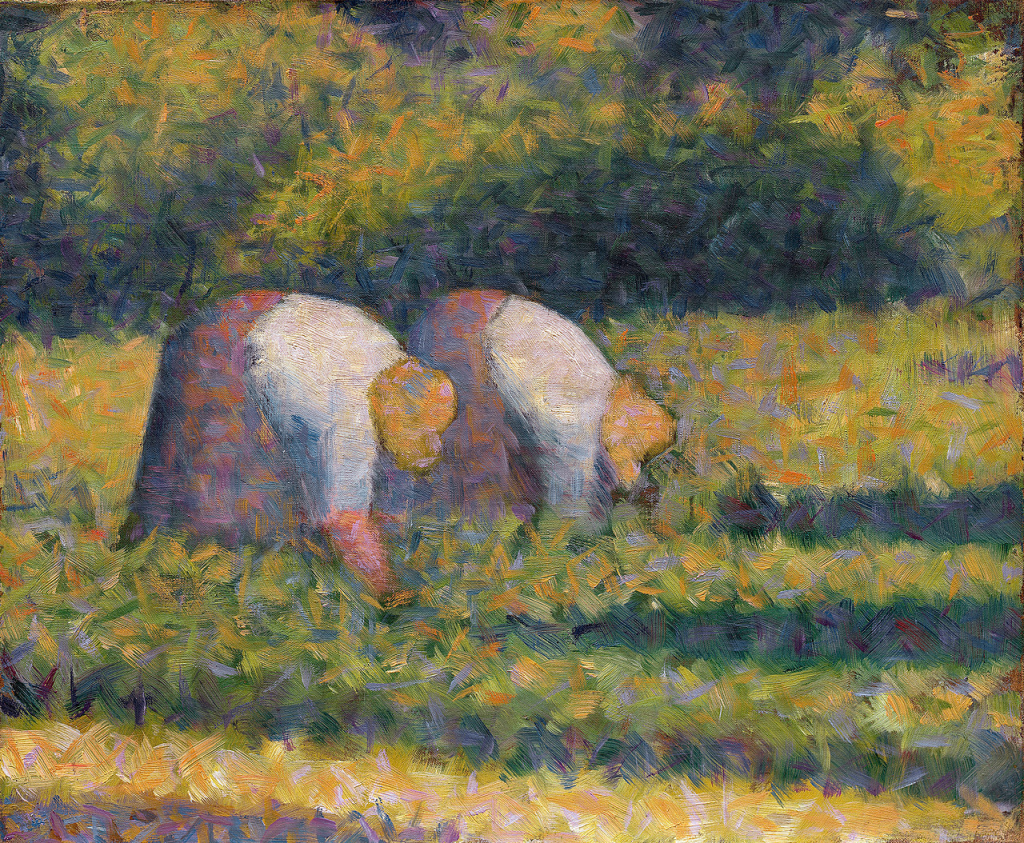
Farm Women at Work, by Georges Seurat (1859-1891)

Do not boast about tomorrow,
    for you do not know what a day may bring.

Let someone else praise you, and not your own mouth;
    an outsider, and not your own lips.

Stone is heavy and sand a burden,
    but a fool’s provocation is heavier than both.

Anger is cruel and fury overwhelming,
    but who can stand before jealousy?

Better is open rebuke
    than hidden love.

Wounds from a friend can be trusted,
    but an enemy multiplies kisses.

One who is full loathes honey from the comb,
    but to the hungry even what is bitter tastes sweet.

Like a bird that flees its nest
    is anyone who flees from home.

Perfume and incense bring joy to the heart,
    and the pleasantness of a friend
    springs from their heartfelt advice.

Do not forsake your friend or a friend of your family,
    and do not go to your relative’s house when disaster strikes you—
    better a neighbor nearby than a relative far away.

Be wise, my son, and bring joy to my heart;
    then I can answer anyone who treats me with contempt.

The prudent see danger and take refuge,
    but the simple keep going and pay the penalty.

Take the garment of one who puts up security for a stranger;
    hold it in pledge if it is done for an outsider.

If anyone loudly blesses their neighbor early in the morning,
    it will be taken as a curse.

A quarrelsome wife is like the dripping
    of a leaky roof in a rainstorm;
restraining her is like restraining the wind
    or grasping oil with the hand.

As iron sharpens iron,
    so one person sharpens another.

The one who guards a fig tree will eat its fruit,
    and whoever protects their master will be honored.

As water reflects the face,
    so one’s life reflects the heart.

Death and Destruction are never satisfied,
    and neither are human eyes.

The crucible for silver and the furnace for gold,
    but people are tested by their praise.

Though you grind a fool in a mortar,
    grinding them like grain with a pestle,
    you will not remove their folly from them.

Be sure you know the condition of your flocks,
    give careful attention to your herds;
for riches do not endure forever,
    and a crown is not secure for all generations.
When the hay is removed and new growth appears
    and the grass from the hills is gathered in,
the lambs will provide you with clothing,
    and the goats with the price of a field.
You will have plenty of goats’ milk to feed your family
    and to nourish your female servants. (New International Version)

Hard Work

The Lord God took the man and put him in the Garden of Eden to work it and take care of it. (Genesis 2:15, NIV)

Work itself is not a result of humanity’s fall. Before Adam and Eve disobeyed God, they were tasked to work and take care of the Garden of Eden. Therefore, work is inherently good. Yet, hard labor is certainly a result of the fall.

What we humans ought to have done through our created nature, now because of the fall into sin and disobedience, we have to work with focused deliberate intention. And even then, we often don’t perform our work as we would like.

“Cursed is the ground because of you;
    through painful toil you will eat food from it
    all the days of your life.
It will produce thorns and thistles for you,
    and you will eat the plants of the field.
By the sweat of your brow
    you will eat your food
until you return to the ground,
    since from it you were taken;
for dust you are
    and to dust you will return.” (Genesis 3:17-19, NIV)

This is why wise persons throughout the ages have given priority to hard work, and branded laziness as detrimental to our human welfare.

Much of our labor is menial and mundane, no matter what the work is. Yet, through vision and persistence, the fruit of our labor eventually breaks through. It is important for us to keep our nose to the grindstone, namely, because this is what it takes to produce, and to keep ourselves out of trouble!

Like a shepherd who cares for the sheep, we are to be present, pay attention, do whatever it takes to help the sheep flourish, and hang in there through the thick and thin of the job.

Diligence and consistency are vital to our hard work. The temptation of get-rich-quick schemes and other supposedly easy paths to success and wealth sometimes rear their heads to lure us away from our daily chores.

Well-kept sheep will produce wool and milk for several years. Riches and achievements and accolades, however, do not necessarily last for long.

Affectionate Love

Hard work and relationships nurtured by affectionate love are meant to go hand-in-hand. In other words, ideally, the duty and diligence of our daily tasks, and the consistency of establishing relational well-being with others, is well-balanced and works seamlessly together.

Loving another entails both encouragement and correction, heartfelt words as well as open words of rebuke. That is, we continually think of what another needs, and what is best for the community as a whole.

Our love must entail what is good for the one being loved, for the one doing the loving, and for the whole community to which both belong. Love leaves angry speeches and jealous motives behind and doesn’t utilize them, because they are tools of hate and hurt.

Gracious Dignity

Everyone is responsible to extend basic human kindness to one another, without exception. We are to listen to and honor our parents and elders; practice self-control and patience with all; and use gentle words in every communication.

Poise under pressure, and motivation to do what is right and good helps to lift the worth and dignity of others. We extend this to people for no other reason than that it is another human being who is in front of us; this is a person in God’s image.

God created mankind in his own image,
    in the image of God he created them;
    male and female he created them. (Genesis 1:27, NIV)

All persons have inherent worth as image-bearers of God. The wise person amongst us knows this and continually applies it in all their words and actions toward others.

Wise people also understand the value of hard work, and the intrinsic worth of work itself. Furthermore, they discern that love is to be the motivation and animating principle in doing work and working with others.

The bottom line of all the proverbial wise saying in today’s lesson is that we are to help and encourage others through both our words and our working actions. Our individual lives are to benefit the whole community, so that we are a blessing to others, as well as to receive blessings from those around us.

In engaging a healthy rhythm of giving and receiving, we reverse the curse, and enable the world to return to Eden.

Almighty God, we pray that You will bless all of our various labor and work in the world. Help us to pray fervently, diligently work hard, and give liberally. In all that we do, enable us to do it with all the love You provide. Amen.


It’s All About Love (Song of Songs 2:1-7)

I am a rose of Sharon,
a lily growing
in the valleys.

[ GROOM ]

Like a lily among thorns,
so is my true love among the young women.

[ BRIDE ]

Like an apple tree among the trees in the forest,
so is my beloved among the young men.
I want to sit in his shadow.
His fruit tastes sweet to me.
He leads me into a banquet room
and looks at me with love.
Strengthen me with raisins
and refresh me with apples
because I am weak from love.
His left hand is under my head.
His right hand caresses me.

Young women of Jerusalem, swear to me
by the gazelles
or by the does in the field
that you will not awaken love
or arouse love before its proper time. (God’s Word Translation)

Notice how the flowers grow in the field. They never work or spin yarn for clothes. But I say that not even Solomon in all his majesty was dressed like one of these flowers. (Matthew 6:28-29)

Love the Lord your God with all your heart, with all your soul, and with all your strength. (Deuteronomy 6:5)

As long as I have you, I don’t need anyone else in heaven or on earth.

Psalm 73:25

There is nothing quite like a field of flowers. Along the coastal plain of the Mediterranean Sea, south of Mount Carmel, is Sharon. In the ancient world, there was found crocuses, tulips, and hibiscus.

These days, in the Spring of the year, one can see bindweed and pimpernel, sage and iris, as well as orchids and poppies. In addition, lilies bloom throughout the valleys of the Middle East. In the Spring, flowers are commonplace in the valleys and countryside.

In today’s Old Testament lesson, the bride in this poetic ode to love and beauty, is saying there is nothing special about her. There are many women, and she in no way stands amongst them all.

Love says otherwise. Love picks out the individual. In the Song, the groom views the bride as if a flower among thorns. There is a beauty that attracts him to her. She may be a commoner, yet her beautiful qualities stand out and are attractive. All others pale in comparison to her.

Likewise, the bride basks in the security of the groom, finding all others tasteless compared to him. He is like an apple tree that provides shade, and whose fruit is delicious.

There is a mutual attraction that is life-giving and beautiful. It is more than a fleeting infatuation. They see within each other the qualities which will bind and sustain them when there are rough times and hard roads.

Beauty is much more than outward appearance. It is the endearing inner qualities of a good and right spirit, which is outwardly seen in a visage of compassion and caring, gentleness and humility, purity and peace.

Such beauty, in and out, causes one to swoon with love – hence, making one love-sick. Love is powerful. It is not to be corrupted by the lust which only views another as an object to be gained.

We are to let the beauty and power of love develop, grow, and mature. The flowers of the field may seem to spring up overnight. However, the seeds and the bulbs have been awaiting the right time to take root, break the ground, grow up, and flower.

Love is both endearing and enduring. Love is to be nurtured and cultivated. It cannot be hurried. Love is an attention to the whole person, and seeks to endure for the long haul. It maintains a beautiful commitment into the growing coldness of autumn, and holds vigil through the season of winter. Love isn’t going anywhere.

But I am talking about Christ the groom, and Church the bride. Spiritual commitment is not really measured in doctrinal statements and dogmatic theology. It is shown and known by embracing Love with a capital “L.”

God is Love. Yes, God does loving deeds and actions. Yet, we are told that the very nature and character of God is Love. Jesus is Love incarnate, the embodiment of what Love sees and does in this world.

I am, of course, taking a decidedly Christian approach to the Song, and an allegorical view of it. This is why, if we delight in knowing and enjoying the Song, we discover the way to genuine spirituality, and the key which unlocks the whole of Holy Scripture.

Not everyone, of course, will agree with me or choose to go down this allegorical path. Perhaps this is why we have so much religion nowadays which is devoid of love, and chooses to focus on sterile doctrinal checklists to which we must ascribe.

Please don’t hear what I am not saying. Doctrine is important. Theology is a must. But if our doctrine and theology has no beauty, and has no thoughts of love, and is not basically oriented in the direction of love, then I strongly argue that it isn’t doctrine or theology at all!

“And what is proper love? One should love the Lord with an exceeding great and very strong love so that the soul be tied to the love of the Lord, finding itself totally absorbed in it, as if he were suffering of lovesickness, when his mind is never free because of love for that woman, and he is obsessed with her, whether sitting down, or standing up, even when he is eating and drinking. More than this should the love for the Lord be in the heart of those who love him, meditating on it constantly, even as God has commanded us: ‘With all your heart and with all your soul.’” – Maimonides, Jewish Rabbi and philosopher (1138-1204, C.E.)

We were created by God for love. God longs to love us; and we are to love God with our entire self – heart, soul, mind, and strength. What’s more, our own love for one another is shaped by the love we receive from God.

Indeed, the biblical book, Song of Songs, is not only in the literal middle of the Old Testament; it is also in the very heart of it. It is all about Love.

Bless us with Love, O Merciful God;
That we may Love as you Love!
That we may show patience, tolerance,
Kindness, caring and love to all!
O Compassionate One, grant compassion unto us;
That we may help all fellow souls in need!
Bless us with your Love, O God.
Bless us with your Love. Amen.

The Compelling Love of Christ (2 Corinthians 5:6-17)

So we are always confident, even though we know that while we are at home in the body we are away from the Lord— for we walk by faith, not by sight. Yes, we do have confidence, and we would rather be away from the body and at home with the Lord. So whether we are at home or away, we make it our aim to be pleasing to him. For all of us must appear before the judgment seat of Christ, so that each may receive due recompense for actions done in the body, whether good or evil.

Therefore, knowing the fear of the Lord, we try to persuade people, but we ourselves are well known to God, and I hope that we are also well known to your consciences. We are not commending ourselves to you again but giving you an opportunity to boast about us, so that you may be able to answer those who boast in outward appearance and not in the heart. For if we are beside ourselves, it is for God; if we are in our right mind, it is for you. For the love of Christ urges us on because we are convinced that one has died for all; therefore all have died. And he died for all, so that those who live might live no longer for themselves but for the one who for their sake died and was raised.

From now on, therefore, we regard no one from a human point of view; even though we once knew Christ from a human point of view, we no longer know him in that way. So if anyone is in Christ, there is a new creation: everything old has passed away; look, new things have come into being!(New Revised Standard Version)

Christians believe that Jesus Christ is the supreme authority over all things; and that we are ruled by Christ. Yet, the sort of rule Christians submit to is without any belligerence from us. In fact, it is quite the opposite.

We are ruled by Christ’s love for us. Believers are convinced that since Christ died for all, then all of us have died. Jesus died so we would no longer live for ourselves, but for the one who died and was raised to life for us. Since love is our guide and rule in life, we are careful not to judge people by what they seem to be. Anyone who belongs to Christ is a new person. The guilt and shame of our past is forgotten; everything is made new.

Love is the distinguishing mark of the believer in Jesus Christ. A person filled and ruled by Christ’s love sees all of life in a new and different way: 

  • Positive confidence and optimism replaces negative skepticism and pessimism
  • Grace overwhelms and overrules the old judgmental spirit
  • Being attentive and mindful of others erases holding onto old hurts and animosities

The person who does not change, refuses transformation of heart, and forsakes renovation of the mind, is not being ruled by Christ’s love. 

Conversely, the person who allows the love of God in Christ through the cross to thaw their cold heart to a new white hot passionate life in the Spirit, is experiencing the resurrected existence to which we have been called.

Here is a little exercise to try today: Monitor your words and actions. And at the end of the day, ask yourself a series of questions:

  1. Were my words and actions done in love?
  2. What percentage of those words and actions were loving and unloving?
  3. Was I compelled by Christ’s love, or by some other love? 
  4. How can I bring the value of love to be more operative in my behavior and speech? 
  5. Who will I share my plan with?

The reality is this: Everything comes down to God, to the Father, Son, and Spirit. 

The distinctive manner we live is to be an expression of the triune God who exists in perfect unity, harmony, love, and mission. Whether in our families, neighborhoods, workplaces, or churches, God wants to exercise and express divine love in us and through us. God’s love compels us.

Holy Scripture says that the triune God is love (1 John 4:16). God’s nature and purpose is love itself. The reason we love God with heart, soul, mind, and strength is that God is love. 

As people created in the image and likeness of God, there is within us a deep desire to know and love God. Yet, it’s possible to lose touch with this primal instinct to love God. We may become so familiar with hearing about God that we go about our days not really know God, and the love of God in Christ.

Without knowing the God who is Love (with a capital L) people might go through the motions of living, even worshiping, without any love behind it. Like spiritual zombies, we may walk about the earth, but are really dead to what is going on in God’s wonderfully big world.

For the Christian, our first love is Jesus. We may live moral lives, operate with sound ethical principles at our jobs, and diligently serve family and church, yet miss the heart and soul of loving God. 

Jesus himself said to the church at Ephesus, who had performed good deeds, that they had forsaken their first love (Revelation 2:4). The Apostle Paul put it this way to the church at Corinth: “If I give all I possess to the poor and surrender my body to the flames, but have not love, I gain nothing.” (1 Corinthians 13:3)

A new robust life of love is possible because the Father first loved us, sent his Son as an atoning sacrifice for our sins, and gave us the Spirit in order to display God’s love toward one another. (1 John 4:10-13) 

Jesus reminded us that all of Scripture hangs on the dual command to love God and neighbor (Matthew 22:37-40). This has been understood throughout church history as The Great Commandment. 

Christ also told us that the supreme task of the Church is to make disciples of all nations (Matthew 28:19). This has been rightly discerned through Christian history as The Great Commission

In order to live into The Great Commandment and The Great Commission, we are to wholeheartedly embody the community of love which exists within the triune God. This is a single-minded loyalty to do what is right, just, and good for our neighbor; we might describe this as The Great Commitment.

Finally, here is yet another few questions for both committed believers and church leaders to ask themselves:

  1. In what ways might we, in this contemporary world, faithfully and obediently live into the calling we have been given by our Lord? 
  2. How do we effectively engage this primal quest of loving God, loving one another, and loving our neighbor?

Loving God, you demonstrated your love for us through the cross of Jesus. May my life be so filled with grace that what comes out of my mouth and what is done in my behavior is consistently characterized by the sort of divine love which is always true of you. Amen.

Abide In Love (John 15:9-17)

As the Father has loved me, so I have loved you; abide in my love. If you keep my commandments, you will abide in my love, just as I have kept my Father’s commandments and abide in his love. I have said these things to you so that my joy may be in you and that your joy may be complete.

“This is my commandment, that you love one another as I have loved you. No one has greater love than this, to lay down one’s life for one’s friends. You are my friends if you do what I command. I do not call you servants any longer, because the servant does not know what the master is doing, but I have called you friends, because I have made known to you everything that I have heard from my Father. You did not choose me, but I chose you. And I appointed you to go and bear fruit, fruit that will last, so that the Father will give you whatever you ask him in my name. I am giving you these commands so that you may love one another. (New Revised Standard Version)

We Need Love

The world, in truth, spins on the axis of love. Without love, there is no beauty. Apart from love, we would all be living in a dystopian world of mere survival. But with love, there is life, hope, purpose, and meaning; there is fulfillment, satisfaction, and security. With love, our most basic needs as people are met.

So, love is a word that must be intentionally pursued and valued; because we cannot live without it.

The very word “love” gets used in various and different ways in our world. Jesus used the word in a sacrificial sense – that love willingly gives up one’s life for the benefit of another.

Love is large. It involves the whole person – body, mind, emotions, and spirit. Love in today’s Gospel lesson is used by Jesus as an action. And it’s even more than that. Christ defined love in the Upper Room to his disciples as a willingness to die – not necessarily for a spouse or a child – but for a friend, a fellow follower of Jesus.

It seems that for most Christians, giving up one’s life for another is not at the forefront of our idea of loving another. Yet, to love our neighbor as ourselves does involve the willingness to die so that another may live. To know precisely what this is like, we need look no further than the love which exists within God.

God is Love

Love is seen above all in the love of God the Father shown forth in God the Son. Because God so loves the people of this world, the Father sent the Son, Jesus, to give his life for us. And Jesus, embodying the very love of God, willingly gave himself on our behalf. It hearkens us to Christ’s earlier words about this:

“For God so loved the world that he gave his only Son, so that everyone who believes in him may not perish but may have eternal life.”

Jesus (John 3:16, NRSV)

Just as the Father loved the Son, and the Son loved us, so we are to love others with the same sort of sacrificial love which was graciously shown to us. The Apostle John made this plain in his first epistle:

God’s love was revealed among us in this way: God sent his only Son into the world so that we might live through him. In this is love, not that we loved God but that he loved us and sent his Son to be the atoning sacrifice for our sins. Beloved, since God loved us so much, we also ought to love one another. (1 John 4:9-11, NRSV)

Therefore, it is our privilege and responsibility to abide in this divine love and let it fill us to the full, so that God’s love moves powerfully in us and through us, for the life of the world.

Remain in Love

Love is the end result of an abiding relationship and close connection between Christ and his followers. We are to remain in the love of Christ, just as Christ remains in the love of God. Jesus asks nothing of us that he has not already modeled for us in his sacrificial service to the world. Living in union with Christ, loving Jesus, and keeping God’s commands are all a single package, bound up together in a mutual relationship.

We don’t need to wonder what God wants for us and from us: Love. The commands of Jesus are not general; they are focused and specific. Christ commands that we love one another. Our continuing work on this earth is to keep on loving people as Christ has loved us and gave himself for us.

No Greater Love

There is no greater love than that shown in the giving of one’s life for one’s friends. The power of God’s love is focused in Christ. It is confirmed in Christ’s resurrection from death. And it flows from Christ giving his life on the cross for us.

Yes, Christians are servants who are committed to serving others with sacrificial love. Yet, the disciples and all those who follow Christ are much more than servants; they are considered primarily as friends of Jesus.

Through the cross and resurrection of Christ, believers have discovered the divine power of love. There is no greater love than this. And it is this sort of love that binds Christians together as united in their mission to love as Jesus loved them.

We have been called, chosen, and appointed by Jesus to embody love’s mission and purpose. What’s more, we are equipped for the active work of love.

Whatever You Ask in Love

The very name of Jesus is love itself. So, whatever you ask, “in my name,” said Jesus, “the Father will give you.”

Because Christians are united to Christ, they are to remain in and abide with Christ. This relational connection opens up the power of prayer. And the content of those prayers – if we are truly in Christ – will always come from a place of love, be directed to love, and go to great lengths to accomplish love.

Prayer is an activity which is grounded in the abiding relationship of Father, Son, Spirit, and the Christian community. Love directs our prayers. And prayers are directed toward the action of love.

A confidence in the power of prayer is an abiding trust in the power of Love. With love animating our prayers and infusing our service, we are bold to ask God for what is right, just, and good in this world. Indeed, we pray that we will give love to each other with the love we have received from God.

Love and Joy

Being called and appointed by God to love is a privilege and a joy. There isn’t any begrudging service when love is involved. Perhaps one of the greatest prayers we can pray is to pray that our hearts be filled with love. If you don’t feel love for others, then pray for it. And be assured that you will receive it.

Love and joy go together like mashed potatoes and gravy, peanut butter and jelly, grits and honey. We know we are loving others if our joy is complete in doing so.

Jesus came to this earth so that we might experience an overflowing life of abundant love and joy. Christ longs for his joy to be in us, and for us to abide in his love. Our joy comes from knowing that we have been loved by God – chosen, called, and sent out into the world with love and for the purpose of love.

And it is this divine love that has the power to renew and transform everything – even the most troubling and stubborn of people and problems that you are presently facing. Indeed, if love is not the answer, then you are not asking the right question.

Creator God, by the mercies of your son, our Lord, Jesus, compel us to turn our hearts to his way of Love, so that we might follow Christ together as your faithful people. Dear Jesus, guide us in your way. Amen.