Luke 12:32-40 – Don’t Be Afraid to Give

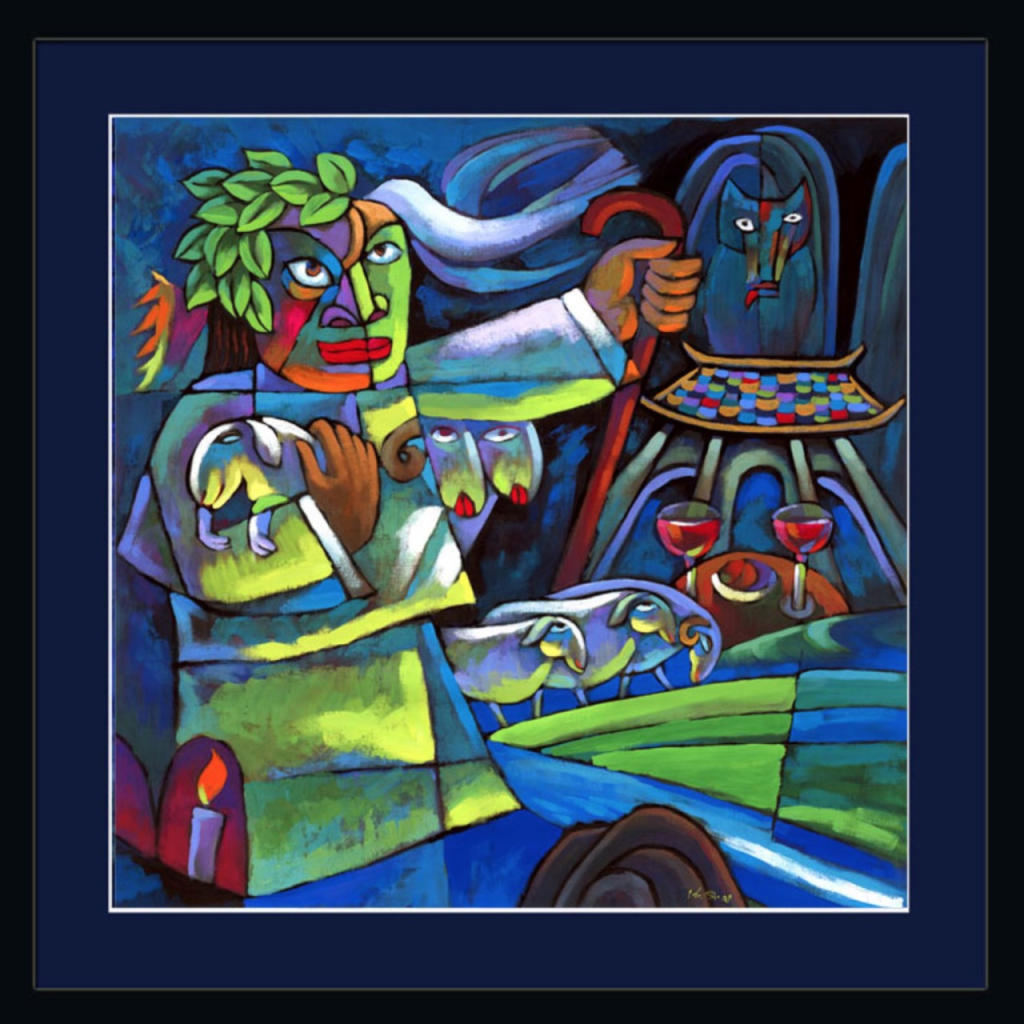
The Good Shepherd by He Qi

“Do not be afraid, little flock, for your Father has been pleased to give you the kingdom. Sell your possessions and give to the poor. Provide purses for yourselves that will not wear out, a treasure in heaven that will never fail, where no thief comes near, and no moth destroys. For where your treasure is, there your heart will be also.

“Be dressed ready for service and keep your lamps burning, like servants waiting for their master to return from a wedding banquet, so that when he comes and knocks they can immediately open the door for him. It will be good for those servants whose master finds them watching when he comes. Truly I tell you, he will dress himself to serve, will have them recline at the table and will come and wait on them. It will be good for those servants whose master finds them ready, even if he comes in the middle of the night or toward daybreak. But understand this: If the owner of the house had known at what hour the thief was coming, he would not have let his house be broken into. You also must be ready, because the Son of Man will come at an hour when you do not expect him.” (New International Version)

The most oft repeated command in all of Holy Scripture is, “Do not be afraid.” The Lord says it 365 times. It seems like we are meant to be reminded of this every day of the year.

The particular stating of the phrase by Jesus is in the context of money and possessions. Christ is telling his disciples to not fear about personal resources. Since we have a kingdom inheritance, we ought to freely give what we have to the poor without fear of being in need ourselves.

And it isn’t something we ought to procrastinate about – because the Lord could return at any time; and he doesn’t want to have to go looking for us underneath a pile of money and possessions in order to find us.

“Inaction breeds doubt and fear. Action breeds confidence and courage. If you want to conquer fear, do not sit home and think about it. Go out and get busy.”

Dale Carnegie

Fear is a real thing. Fear, at its core, is being afraid of losing what we have and getting hurt. Fear can be a helpful emotion, meant to protect us and keep us safe from harm. The problem, however, is that our fears can lead us to some unhealthy behaviors such as:

  • Vilifying another, afraid that others I don’t know or who are different from me might harm me, my family, or my community.
  • Hiding my emotions, afraid my weaknesses or failures will be exposed or exploited.
  • Serving others compulsively, afraid that I won’t have worth, meaning, or purpose without helping.
  • Achieving or winning, afraid that I will be irrelevant or unwanted, if I lose.
  • Smiling and being upbeat, afraid of facing and feeling the deep sadness within me.
  • Procrastinating projects, tasks, or conversations, afraid of being disliked or rejected.

“Fear is the path to the Dark Side. Fear leads to anger, anger leads to hate, hate leads to suffering.”

Yoda

All of those unhealthy practices keeps us at arm’s distance from the poor and needy. Getting close to poor folk creates fear with some people, that is, being afraid they might hurt me, or afraid that they will get my money.

“Fear keeps us focused on the past or worried about the future. If we can acknowledge our fear, we can realize that right now we are okay.”

Thich Nhat Hanh

Faith is the opposite of fear. Faith tethers itself to the promises of God and frees us to be generous. And faith allows us to confidently minister and build relationships with all kinds of people, especially the poor and needy.

One of the great preachers in church history, St. John Chrysostom (the fourth century Bishop of Constantinople) lived in a large city full of both rich and poor. He lamented the large class difference between them. He said this about poverty and wealth:   

“To deprive is to take what belongs to another; for it is called deprivation when we take and keep what belongs to others.  By this we are taught then when we do not show mercy, we will be punished just like those who steal.  For our money is the Lord’s, however we may have gathered it.  If we provide for those in need, we shall obtain great plenty. 

This is why God has allowed you to have more, not for you to waste on… indulgence, but for you to distribute to those in need….  If you are affluent, but spend more than you need, you will give account of the funds which were entrusted to you… for you obtained more than others have, and you have received it, not to spend it for yourself, but to become a good steward for others as well.”

“Whenever you see anyone longing for many things, esteem him of all persons the poorest, even though he possess all manner of wealth; again, when you see one who does not wish for many things, judge him to be of all persons most affluent, even if he possess nothing. For by the condition of our mind and spirit, not by the quantity of our material wealth, should it be our custom to distinguish between poverty and affluence.”

The point that Jesus makes of selling possessions and giving to the poor is not to elevate poverty over wealth – or the poor over the rich – but rather to lift generosity as a significant mark of the Christian life.

In the same way, the watchfulness Jesus commands is not an anxious hand-wringing anticipation of the apocalypse. Instead, it is an eager expectation of God’s final act of doing away with all injustice forever.

In other words, Jesus is extoling a faith that frees us to be generous; enables us to leave fear, worry, and anxiety behind; and that creates in us confidence about how the future is all going to shake-out in the end.

The Lord’s Table is meant to remind us that God is hospitable and generous.

Communion together is meant to show us that we are not alone in faith.

And the Eucharist allows us to celebrate a future we know is coming, that as often as we eat and drink the elements of bread and cup, we proclaim the Lord’s death until he returns to judge the living and the dead.

Like the feeding of the 5,000, there is plenty of bread for all – and the cup will never run dry. That’s because the Lord we serve is a God of abundance. And when we are near to such a generous God, we feel safe and secure, and are able to freely share what we have with others – without fear and without panicking that there isn’t enough. There’s always enough because God is enough.

Generous and gracious God, You came to honor the least, the forgotten, the overlooked and the misjudged. You came to give first place to the last, those left behind, and those who are misunderstood and undervalued. You came to give a warm welcome to the lost, the abandoned, and the destitute.

Help us to be your ears to listen to their cries. Help us to be your voice speaking out love and acceptance. Help us to be your feet walking beside those in need. Help us to be your hands to clothe, feed and shelter them. You came for the least, the lost and last of this world. Lord, hear our prayer. Amen.

Luke 13:31-35 – Blessed is He Who Comes in the Name of the Lord

Blessed is He Who Comes in the Name of the Lord, by José Luis Castrillo

At that time some Pharisees came to Jesus and said to him, “Leave this place and go somewhere else. Herod wants to kill you.”

He replied, “Go tell that fox, ‘I will keep on driving out demons and healing people today and tomorrow, and on the third day I will reach my goal.’ In any case, I must press on today and tomorrow and the next day—for surely no prophet can die outside Jerusalem!

“Jerusalem, Jerusalem, you who kill the prophets and stone those sent to you, how often I have longed to gather your children together, as a hen gathers her chicks under her wings, and you were not willing. Look, your house is left to you desolate. I tell you – you will not see me again until you say, ‘Blessed is he who comes in the name of the Lord.’” (New International Version)

King Herod of Judea, who was in the pocket of the Roman Empire, was issuing threats against Jesus. And those threats had some teeth behind them. Herod had recently beheaded Christ’s friend and cousin, John the Baptist (Luke 9:7-9). Yet, Jesus seemed unconcerned by the warnings. He made it clear that he was going to keep doing what he was doing, unfazed by Herod’s bluster.

Jesus had no intention of halting his travels, even because of a credible threat by the governing powers. Christ emphasizes his words by assuring his listeners that the work he is doing will be done today, and the next, and the day after that—building ultimately to his greatest work of securing redemption through his crucifixion and resurrection. 

I hope to be always journeying towards Jerusalem with a heart full of compassion that will not waver in the midst of violent killing and injustice. That isn’t easy, yet I know that my humble pilgrimage with Jesus will be worth it all, in the end.

Yet, for now, I need to make a stop in Bethlehem. I must follow the star to the place where Christ the newborn king is lying in a simple stinky feeding trough. The juxtaposition of that reality could not be more pronounced. The rightful Lord of all, far more powerful than old King Herod or the Roman Emperor, comes to earth not to be served, but to serve, and give his life as a ransom for many. (Mark 10:42-45)

What’s more, Jesus deliberately donned the clothing and postured himself as a lowly servant throughout his earthly ministry. Whereas Herod acted the predictable part of a power hungry worldly ruler, squelching all rivals to the throne, Jesus shared his authority with others, along with a promise of continual presence. (Matthew 2:16-18, 28:16-20)

“Almighty God, give us grace to cast away the works of darkness and put on the armor of light, now in the time of this life, in which your Son Jesus Christ came to visit us in great humility; So that, at the last day, when he shall come again in his glorious majesty to judge the living and the dead, we may rise to the life immortal.” 

Book of Common Prayer

Jesus is down for the struggle. He knows that injustice and systemic evil must be carefully rooted out. He understands that hearts and minds aren’t changed overnight. It will take time. Yet, Christ is in it for the long haul. The Lord is patiently, and sometimes imperceptibly, using divine power and authority to preserve the good and weed out the bad.

It will take a long time, and will be an extended process, because there are so many hard hearts. Jesus was ready, willing, and able to gather people together, as a mother hen gathers her chicks – yet there was an unwillingness to it. And Christ isn’t in the business of twisting arms and manipulating others, like Herod.

Jesus invites. He doesn’t squeeze people like an orange to get their juice. Christ carefully prepares a meal. He sets the table himself. He gives of himself. Like some wildly potent superfood, a bit of wine and morsel of bread is more than enough to fill the hungry soul and thirsty spirit.

There is always room at the Table.

There is room for you and for me. There is room for every kind of person – from every nation, race, gender, ethnicity, class – no matter the distinctions and no matter the past. It is the love of God in Christ, not the judgment, which brings people peace and salvation. It comes through a baby, not some wily old fox of a ruler.

Eventually, the phrase will be uttered, “Blessed is he who comes in the name of the Lord.” Jesus pulled this phrase from the Old Testament psalms. He did this, knowing quite well the context surrounding the verse:

The stone the builders rejected
    has become the cornerstone;
the Lord has done this,
    and it is marvelous in our eyes.
The Lord has done it this very day;
    let us rejoice today and be glad.

Lord, save us!
    Lord, grant us success!

Blessed is he who comes in the name of the Lord. (Psalm 118:22-26, NIV)

The chicks might scatter and refuse to be gathered. The builders may reject the crucial cornerstone and still try to build. Yet, it will not always be this way. As we celebrate the first advent of Christ in his incarnation, the second advent is continually in view. Christ is coming… again. The time is near….

Look! He comes with the clouds of heaven.
    And everyone will see him—
    even those who pierced him.
And all the nations of the world
    will mourn for him.
Yes! Amen! (Revelation 1:7, NLT)

The triumphal entry of Jesus on Palm Sunday is followed by a triumphal entry into my heart, and the hearts of many. And there is coming yet another triumphal entry, back to this earth. All things will made new….

“There will be no more death, no more grief or crying or pain. The old things have disappeared.” Then the one who sits on the throne said, “And now I make all things new!” (Revelation 21:4-5, GNT)

May it be so, to the glory of God.

Hebrews 1:1-4, 2:5-12 – World Communion Sunday

In the past God spoke to our ancestors through the prophets at many times and in various ways, but in these last days he has spoken to us by his Son, whom he appointed heir of all things, and through whom also he made the universe. The Son is the radiance of God’s glory and the exact representation of his being, sustaining all things by his powerful word. After he had provided purification for sins, he sat down at the right hand of the Majesty in heaven. So, he became as much superior to the angels as the name he has inherited is superior to theirs….

It is not to angels that he has subjected the world to come, about which we are speaking. But there is a place where someone has testified:

“What is mankind that you are mindful of them,
    a son of man that you care for him?
You made them a little lower than the angels;
    you crowned them with glory and honor
    and put everything under their feet.” [Psalm 8:4-6]

In putting everything under them, God left nothing that is not subject to them. Yet at present we do not see everything subject to them. But we do see Jesus, who was made lower than the angels for a little while, now crowned with glory and honor because he suffered death, so that by the grace of God he might taste death for everyone.

 In bringing many sons and daughters to glory, it was fitting that God, for whom and through whom everything exists, should make the pioneer of their salvation perfect through what he suffered. Both the one who makes people holy and those who are made holy are of the same family. So, Jesus is not ashamed to call them brothers and sisters.He says,

“I will declare your name to my brothers and sisters;
    in the assembly I will sing your praises.” [Psalm 22:22] (New International Version)

Today is World Communion Sunday. We come to the Lord’s Table with awareness of Christian sisters and brothers throughout the world, in all nations, and in all the various traditions of Christianity. We may not all agree about a lot of things in the church and the Christian life. Yet, every Christian tradition – past and present – has and does observe communion around the Lord’s Table. It is a practice which binds us and reminds us of our unity with another.

And that unity is focused and centered in Jesus Christ our Savior and Lord. Jesus is the person who holds us together. Jesus is the one in whom all the good promises of God are fulfilled. Today we remember Jesus, commune with Jesus, and express our hope in Jesus.

We remember that Jesus was made perfect through suffering – and that we, too, experience spiritual formation through suffering.

We commune with Jesus and one another because the cross of Christ achieved deliverance from spiritual estrangement and relational loneliness and gathered us into the one people of God.

We hope with confident expectation, as we celebrate Jesus at the Table along with all the saints everywhere, that Christ will return and take us to be with him forever in glory. There will be no more suffering, no more pain, no more poverty, no more oppression, no more injustice. There will be complete faith, realized hope, and absolute love for all time and forever. Amen!

Our past, present, and future all belong to Jesus. And we are not alone, for all Christians in everyplace from every race, ethnicity, class, and gender – whether they are Pentecostals in Puerto Rico, Anglicans in Africa, Catholics in Poland, Coptic Egyptians, or Orthodox Russians – the beautiful diversity of Christ’s Body comes together in harmonious unity at the Lord’s Table. It is this sacrament which raises our awareness of both solidarity with Christ and with all believers everywhere.

The purpose of the Lord’s Table is to participate in the blessings of Christ by visually re-creating the story of Jesus. There are three different terms for the Table in the New Testament, and each term is meant to convey a different aspect of the Table’s significance. 

The Lord’s Supper is a focus on remembrance, a memorial of Christ’s death that is deeply reflective and contemplative. 

What you must solemnly realize is that every time you eat this bread and every time you drink this cup, you reenact in your words and actions the death of the Master. You will be drawn back to this meal again and again until the Master returns. You must never let familiarity breed contempt.

Anyone who eats the bread or drinks the cup of the Master irreverently is like part of the crowd that jeered and spit on him at his death. Is that the kind of “remembrance” you want to be part of? Examine your motives, test your heart, come to this meal in holy awe. (1 Corinthians 11:26-28, MSG) 

The Eucharist literally means “thanksgiving.” The Lord’s Table as Eucharist means we celebrate Christ’s victory over sin, death, and hell on our behalf. 

While they were eating, Jesus took a piece of bread, gave a prayer of thanks (Eucharist), broke it, and gave it to his disciples. “Take it,” he said, “this is my body.” Then he took a cup, gave thanks to God (Eucharist), and handed it to them; and they all drank from it. (Mark 14:22-23, GNT) 

Communion means to participate in Christ and with other Christians. This emphasizes that when we partake of the Lord’s Table, we ought to do so with unity and fellowship. We are more than individual Christians. We share in the Lord together as the community of the redeemed.

When we drink from the cup that we ask God to bless, isn’t that sharing in the blood of Christ? When we eat the bread that we break, isn’t that sharing in the body of Christ? By sharing in the same loaf of bread, we become one body, even though there are many of us. (1 Corinthians 10:16-17, CEV) 

As we allow the Table to be a remembrance, celebration, and participation with each other, we engage in a ritual that helps us to know Christ better. And we are better able to realize God’s grace to us.

Participating and sharing in communion is important because we can easily be fragmented and not fellowship with one another in a local church, as well as the world-wide church. The cross of Jesus Christ has ended division. The cross has brought us peace and reconciliation between God and others. 

The suffering of Jesus on the cross has restored a broken relationship between us and God, and also between one another. Therefore, there is to be no more ignoring one another, or brothers and sisters elsewhere, because we are one unified people around the good news of Jesus – enjoying solidarity with each other in both our joys and our sufferings.

One awareness needed as we share in communion together is to be mindful of others. Not everyone is the same. We must avoid coming to the Table expecting people to be the way we want them to be. Instead, we are to come because we have staked our souls on the fact that Christ is the Way, the Truth, and the Life, and the Church is the best place to be while we all struggle to figure out what that means. We come because we’d be hard pressed to say which is the bigger of the two scandals of God: that he loves me—or that he loves everyone else. 

The Lord’s Table is the great leveler, where we all have equal footing and accept one another according to a common confession of Christ. Communion emphasizes participation in the body and blood of Christ, as well as participation with all Christians everywhere. 

Therefore, we are not alone. Communion means God is with us, and that Christ has so closely identified with us that he took our place on the cross. As a result, every believer in Jesus is linked to all the others so that, when one suffers or rejoices, all suffer or rejoice, whether it is a Pastor down the street rejoicing over a newly saved soul, or a suffering Syrian Christian trying to survive in a refugee camp.

Let us live up to what, and whom, we profess. Since we are God’s forgiven people, we are to work at living the Christian life together. This unity is symbolized by partaking together of the same loaf of bread and drinking from a common cup.

One Sunday, a group of missionaries and believers in Papua New Guinea were gathered to observe communion together.  After one young man sat down, one of the missionaries recognized that he seemed to be quite upset. Then, after a while, the young man seemed to be fine. 

The missionary leaned over and whispered to him, “What was it that troubled you?”  The young man replied, “The man who just came in happens to be the man who killed and ate the body of my father.  And now he has come in to observe communion with us. At first I didn’t think I could do that. But it is all right now.  He is washed in the same precious blood as I am.”  And so together they participated in Christian communion.

We have peace because of Jesus. Christ’s suffering and death has brought reconciliation not only between us and God, but between each other. As we approach the Lord’s Table, let us be aware not only of our personal relationship with God, but our relationships with one another in the local church, and our unity with the world-wide church. 

May our lives be shaped and formed around the cross of Jesus Christ, as we remember, celebrate, and participate together.

Almighty and everlasting God, may this time we partake of the body and blood of Jesus unite us in the community of saints who know your love and proclaim your Son with fervor and grace to a broken and hurting world. May your healing hands be the salve for ending hurt and violence in this world, even as we prepare for the next. In the holy Name of Jesus. Amen.

Mark 6:35-44 – You Want Us To Do What?

Late in the afternoon his disciples came to him and said, “This is a remote place, and it’s already getting late. Send the crowds away so they can go to the nearby farms and villages and buy something to eat.”

But Jesus said, “You feed them.”

“With what?” they asked. “We’d have to work for months to earn enough money to buy food for all these people!”

“How much bread do you have?” he asked. “Go and find out.”

They came back and reported, “We have five loaves of bread and two fish.”

Then Jesus told the disciples to have the people sit down in groups on the green grass. So, they sat down in groups of fifty or a hundred.

Jesus took the five loaves and two fish, looked up toward heaven, and blessed them. Then, breaking the loaves into pieces, he kept giving the bread to the disciples so they could distribute it to the people. He also divided the fish for everyone to share. They all ate as much as they wanted, and afterward, the disciples picked up twelve baskets of leftover bread and fish. A total of 5,000 men and their families were fed. (New Living Translation)

I once knew a dear church lady who made a pan of lasagna for a local soup kitchen. When she showed up, it turned out, other church ladies didn’t. Hers was to be one pan amongst many. Instead, it was the only one. When a long line formed of hungry impoverished people, she felt both compassion and heartsick. Her immediate thought was to go and buy several pans of lasagna. But she knew it would take too long, and she wasn’t even sure she could find enough to feed everyone.

So, rather than turning the people away, the dear woman looked up to heaven, uttered a prayer of thanksgiving to God for what little she had, and began serving. She said, “I just kept sticking my spatula into the pan, and lasagna kept coming out. By the time the last person in line came, I served the last of it. I can’t explain it. It just happened.”

No one left hungry.

Today’s Gospel lesson of Jesus feeding the five thousand men and their families is not just a nice account of something that happened a long time ago. Jesus is still doing miracles. The Lord is still expanding his benevolent reach all across God’s big world.

Jesus takes our meager resources and turns them into something with a large impact on a lot of people. For this to happen, all we need to do is follow our Lord’s simple instructions: “You feed them.” 

“But Jesus! I don’t have much money. I’m not a good organizer. I can’t do what you’re asking!”

“I don’t…” “I’m not…” “I can’t…” Jesus hears it every day.

Jesus really doesn’t want to hear about our “buts.” Maybe we ought to take the word “but” out of our language altogether. That’s because it’s not about us, at all.

Jesus can multiply whatever little we have to accomplish his benevolent work through us. 

Jesus could clearly do miracles without us having any involvement. Yet, he deliberately chooses to use us and our drop-in-the-bucket resources to participate in his work. Jesus wants to use our minds, our mouths, and the very marrow of our being to effect a miracle.

Our work is to bring Jesus our five small loaves and two fish. He’ll do the rest.

It is the compassion of Jesus which motivates him to miracles.

The crowd did not leave him alone. Rather than being annoyed by the situation because it was not on his agenda to deal with any people, Jesus looked at the large group of people and had compassion on them.  His heart went out to them.

God does not begrudgingly deal with us, as if we are an interruption to his day.

All these hungry people. What to do about it? “You feed them,” Jesus says. I perhaps detect a hint of sarcasm in the tone of the disciples reply: “We have only five loaves of bread and two fish.”  Their math was way off because they did not count Jesus. 

Through simple prayer and active obedience, we must give Jesus what we have, no matter how little or insignificant.

In this contemporary era, much of what we do is concerned to be reasonable and rational with a strong scientific or proven base for engaging ministry. Although I don’t have much of a stomach for believers who incessantly want a miracle for everything and see devils under every rock, I equally have no stomach for doing ministry as if it were an Enlightenment project, completely drained of all faith and the possibility of seeing God work in ways that are incomprehensible to our modern sensibilities.

Indeed, looking out at all the vast Western resources have accomplished with money and buildings and programs, it makes me want to explain, “This is amazing! It is incredible what we know-how American Christians can do without God!” 

I am curious what Christ’s Church would look like if we were to have an underlying presupposition and assumption that God is still in the business of doing miracles? I wonder: Would it impact the way we pray, and the way we act? 

What if we altogether forsook shame and had the boldness to say, “This might sound crazy, but what if we…”

  • “Found everyone in our city who needs food and go love on them and feed them” (instead of just going the rational route of only supplying the food pantry).
  • “Used our property to create a community garden and seek to help people grow their own food.” (instead of just giving out some food cards).
  • “Built a smart robot to plant the fields of disabled farmers and gave them the rights to the tech we developed.” (am I getting too crazy yet!?). 

In the kingdom of God, there are no boundaries – only unlimited opportunities to give our small ideas, little bits of strength, and puny resources to Jesus so that he can take it and feed the world.

Jesus is perfectly able to do his work without us and without what we have. However, he wants to use us and our meager resources to accomplish the miraculous meeting of needs far beyond what we could ever imagine. 

We too often do nothing. That’s because we mistakenly believe God either cannot or does not want to use me or what I have.

It just won’t do to stand afar off and expect God to work without us giving what we have, whether that something is time, money, conversation, food, hospitality, or whatever. Our excuses won’t do for Jesus – my home is too small, it is not clean enough, I don’t have enough money, I am not smart enough, my schedule won’t allow it, I don’t have enough resources…. All you need is something, no matter how seemingly insignificant it is.

You want me to do what? Feed thousands? The real pre-miracle work for many people is to be open, real, and transparent enough to believe Christ can do a miracle through confessing sin, participating in a ministry, having a spiritual conversation with somebody different than me, or just saying what I actually think and feel.  

The question is never, “Can God use me?” The real question is, “What miracle does Jesus want to do through me and through his Church?”

It was no accident when Jesus distributed the bread that it sounds a lot like communion.

The Lord’s Supper may seem to be irrelevant to some – as if it is only a way to remember Jesus, a mere regular ritual. Yet, God’s design is much bigger. Jesus wants to do a miracle through the distribution and ingestion of the common elements of bread and wine – a miracle of healing, a miracle of bringing true satisfaction the world can never give. 

It isn’t realistic to expect that Jesus can use the Table to feed and reach thousands. However, we don’t serve a God who is limited to work through rational means by only using our five senses. 

We serve a God who does unexpected miracles within the life of the community.

Lord, I believe. Help me in my unbelief! I open my mind and heart believing in your infinite power and possibility. I believe in your constant expression of perfect good in and through me. I know that with you all things are possible. All that I am, all I was, and all I hope to be I give to you. I am yours. Amen.

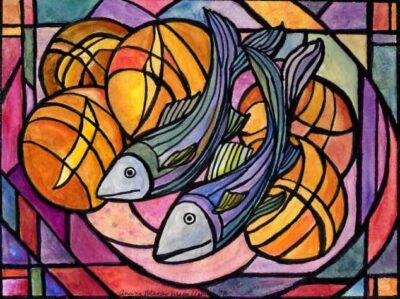
*Above painting: Feeding of the 5,000 by Laura James

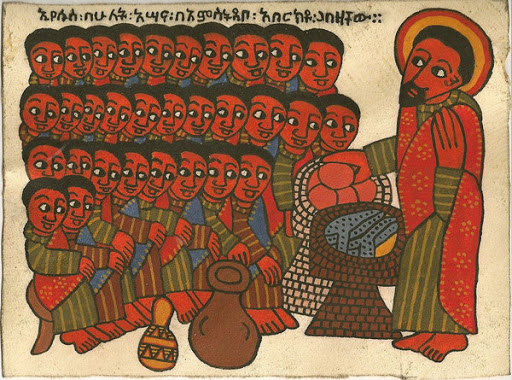
**Above: Ethiopian Orthodox Church depiction of Christ feeding the 5,000