Trust the Promises (Joshua 3:1-17)

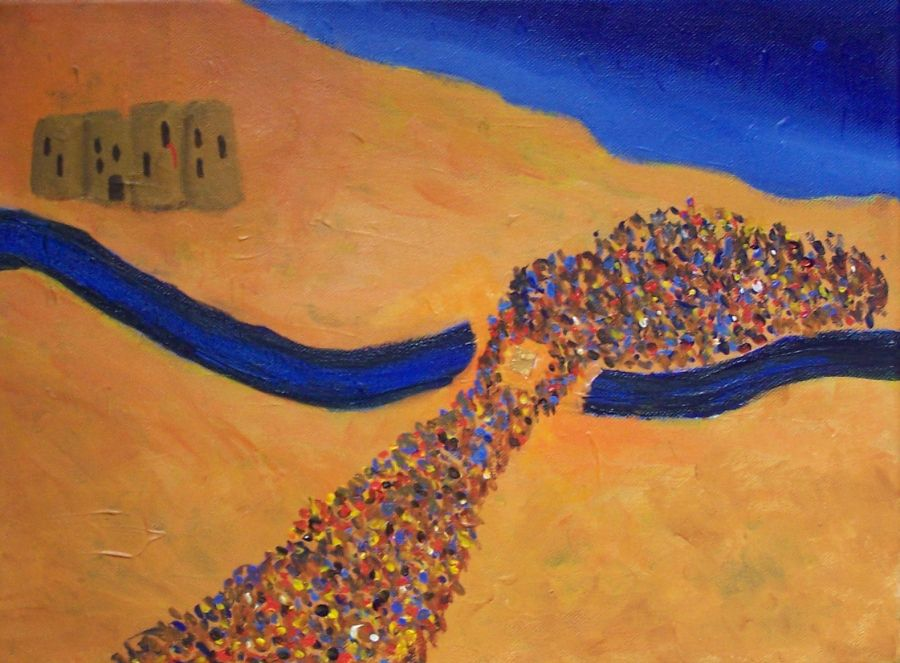
Crossing the Jordan River, by Yoram Raanan

Early in the morning Joshua and all the Israelites set out from Shittim and went to the Jordan, where they camped before crossing over. After three days the officers went throughout the camp, giving orders to the people: “When you see the ark of the covenant of the Lord your God, and the Levitical priests carrying it, you are to move out from your positions and follow it. Then you will know which way to go, since you have never been this way before. But keep a distance of about two thousand cubits between you and the ark; do not go near it.”

Joshua told the people, “Consecrate yourselves, for tomorrow the Lord will do amazing things among you.”

Joshua said to the priests, “Take up the ark of the covenant and pass on ahead of the people.” So they took it up and went ahead of them.

And the Lord said to Joshua, “Today I will begin to exalt you in the eyes of all Israel, so they may know that I am with you as I was with Moses. Tell the priests who carry the ark of the covenant: ‘When you reach the edge of the Jordan’s waters, go and stand in the river.’”

Joshua said to the Israelites, “Come here and listen to the words of the Lord your God. This is how you will know that the living God is among you and that he will certainly drive out before you the Canaanites, Hittites, Hivites, Perizzites, Girgashites, Amorites and Jebusites. See, the ark of the covenant of the Lord of all the earth will go into the Jordan ahead of you. Now then, choose twelve men from the tribes of Israel, one from each tribe. And as soon as the priests who carry the ark of the Lord—the Lord of all the earth—set foot in the Jordan, its waters flowing downstream will be cut off and stand up in a heap.”

So when the people broke camp to cross the Jordan, the priests carrying the ark of the covenant went ahead of them. Now the Jordan is at flood stage all during harvest. Yet as soon as the priests who carried the ark reached the Jordan and their feet touched the water’s edge, the water from upstream stopped flowing. It piled up in a heap a great distance away, at a town called Adam in the vicinity of Zarethan, while the water flowing down to the Sea of the Arabah (that is, the Dead Sea) was completely cut off. So the people crossed over opposite Jericho. The priests who carried the ark of the covenant of the Lord stopped in the middle of the Jordan and stood on dry ground, while all Israel passed by until the whole nation had completed the crossing on dry ground. (New International Version)
400 years of Egyptian slavery. Then deliverance from bondage. Another 40 years of wandering around the desert. It might have seemed to the ancient Israelites that getting to the Promised Land would never happen.

How can we know God is with us? Will divine promises really hold up? Can I keep trusting in the Lord, even though it is taking so darned long to get where I need to be?

Through yet another miracle of the parting of the waters and walking on dry land to get to the other side, Joshua and people of Israel (and us) are given a visual, tactile, experiential way of trusting God. By this indelible encounter, the people will know that the living God is among them, and without fail, the Lord will drive out all obstacles and opposition to entering and taking the land.

All the dramatic events that occurred were for the sake of the people, so that they would know that God is with them and will give them victory. To heighten the experience, the Jordan River was at flood stage at the time of the crossing. If you have ever been on the bank of a raging river, you know how significant a miracle this really was to behold. 

Today, we may not have the experience of seeing a rushing river stop and crossing over on dry ground; yet we have these stories that bear witness to the truth that God is among us, that God will do what was promised, and that God will give us victory.

Know that the victory came after a long liminal period of moving from one reality to another. A “liminal space” (an intermediate position characterized by transition, a place where things are either coming or going) is where the Israelites had to hang out for a very long time. Now, the promises were about to be realized.

Miracles and wonders and victories are neither easy nor cheap. They come as a result of significantly hard movements from the past into the future. In other words, our present experiences can be quite adverse and difficult. If we lose where we’ve come from, and where we’re going, we may too easily lose heart or become afraid and simply give up all hope.

That’s why God gives divine promises, so that we will be sustained with God’s words until the promised time is realized. It’s our job to encourage one another and remind each other of those promises; they are meant to buoy up our flagging spirits when things get rough.

So, keep looking and praying for that miracle. Just understand that you may need to persevere in faith, patience, and holiness for a while before it happens.

Blessed and holy God, continue the good work begun in me, so that I may increase daily in wholeness, integrity, and strength. I rejoice in your goodness and think and do that which pleases you, through Jesus Christ our Redeemer. Amen.

Breakfast In the Liminal Space

Welcome, friends! John 21:1-19 is a story of Jesus and the disciples in the six weeks between Christ’s resurrection and ascension. It’s an awkward time for the disciples, as they try and come to grips with a new reality in which all the old rules have changed. Click the videos below and let’s help each other move into a new reality….

Pastor Tim Ehrhardt, John 21:1-19

Before us it is blessed, behind us it is blessed,
below us it is blessed, above us it is blessed,
around us it is blessed as we set out with Christ.
Our speech is blessed as we set out for God.
With beauty before us, with beauty behind us,
with beauty below us, with beauty above us,
with beauty around us, we set out for a holy place indeed. Amen. –A traditional Navajo blessing

John 21:1-19 – Breakfast in the Liminal Space

Miraculous Draught of Fishes by John Reilly, 1978

Afterward Jesus appeared again to his disciples, by the Sea of Galilee. It happened this way: Simon Peter, Thomas (also known as Didymus), Nathanael from Cana in Galilee, the sons of Zebedee, and two other disciples were together. “I’m going out to fish,” Simon Peter told them, and they said, “We’ll go with you.” So, they went out and got into the boat, but that night they caught nothing.

Early in the morning, Jesus stood on the shore, but the disciples did not realize that it was Jesus.

He called out to them, “Friends, haven’t you any fish?”

“No,” they answered.

He said, “Throw your net on the right side of the boat and you will find some.” When they did, they were unable to haul the net in because of the large number of fish.

Then the disciple whom Jesus loved said to Peter, “It is the Lord!” As soon as Simon Peter heard him say, “It is the Lord,” he wrapped his outer garment around him (for he had taken it off) and jumped into the water. The other disciples followed in the boat, towing the net full of fish, for they were not far from shore, about a hundred yards. When they landed, they saw a fire of burning coals there with fish on it, and some bread.

Jesus said to them, “Bring some of the fish you have just caught.” So, Simon Peter climbed back into the boat and dragged the net ashore. It was full of large fish, 153, but even with so many the net was not torn. Jesus said to them, “Come and have breakfast.” None of the disciples dared ask him, “Who are you?” They knew it was the Lord. Jesus came, took the bread and gave it to them, and did the same with the fish. This was now the third time Jesus appeared to his disciples after he was raised from the dead.

When they had finished eating, Jesus said to Simon Peter, “Simon son of John, do you love me more than these?”

“Yes, Lord,” he said, “you know that I love you.”

Jesus said, “Feed my lambs.”

Again, Jesus said, “Simon son of John, do you love me?”

He answered, “Yes, Lord, you know that I love you.”

Jesus said, “Take care of my sheep.”

The third time he said to him, “Simon son of John, do you love me?”

Peter was hurt because Jesus asked him the third time, “Do you love me?” He said, “Lord, you know all things; you know that I love you.”

Jesus said, “Feed my sheep. Very truly I tell you, when you were younger you dressed yourself and went where you wanted; but when you are old you will stretch out your hands, and someone else will dress you and lead you where you do not want to go.” Jesus said this to indicate the kind of death by which Peter would glorify God. Then he said to him, “Follow me!” (New International Version)

The Miraculous Catch of Fish by Belgian artist Erik Tanghe

Sometimes, maybe oftentimes, it takes a bit of time to wrap both our heads and our hearts around a new reality. After all, if you’ve been used to operating a particular way for a long time, it can be hard to come around to embracing something different – even if that change is really good.

Good ol’ Peter, bless his heart, you’ve got to love him. The Lord Jesus is risen from death and he, along with some of the other disciple fishermen, are not quite up to speed on resurrection. Christ is alive, the disciples have already seen him on two separate occasions, yet they seem like a dog who has chased a rabbit and now don’t know what to do with it once they’ve surprisingly gotten it cornered.

So, Peter goes fishing. Yep, when all else seems upside-down and topsy-turvy, just go fishing. The problem is: Peter and the boys are going back to a life that doesn’t exist anymore. And that’s pretty much what we all tend to do when we are stuck in a liminal space (to be at the threshold of something new, but not quite there yet) caught in a situation of uncertainty without much of a clue what to do. We simply go back to what we’ve always done and hope we catch some fish.

But we can’t catch fish. It isn’t the same anymore. There’s a new reality. The resurrection of Jesus has completely upended the world. There is no going back to any sort of pre-resurrection days. All has changed. I’m not sure if the disciples believed they were going to catch any fish, or not. Seems they just had to go do something familiar.

Unbeknown to them, the rules changed. The old way of fishing won’t work, anymore. While they’re off trying to live from the familiar confines of the old life, Jesus shows up on shore. The disciples don’t realize its him. So, they don’t anticipate that when Jesus calls out and encourages them that they’ll end up with a nice haul of fish.

While the old life yields nothing, the new life with Christ brings abundance, blessing, and fellowship. After the big catch of fish, here are the disciples now eating breakfast with the King of Kings, yet they’re still scratching their heads. What’s going on? Who is it? Well, of course, it’s Jesus, but is it? What’s the plan? I’m so confused.

In the passage and through the journey from one reality to another – the place of familiarity to a place of a future we’ve never seen – there is both the shadow of doubt which makes everything feel so uncertain and the confidence of faith which keeps us going forward.

In this middle passage, this liminal space, there is a continual vacillating between doubt and faith. Rarely is there ever a black-and-white existence. Instead, it’s wise to become friends with the gray because most lessons we learn come while inhabiting this weird in-between space.

When the disciples encountered Christ in today’s Gospel story, it was an experience of Jesus in the middle – a six-week time between resurrection and ascension. It was also an experience of the disciples in the middle. There was no going back to a pre-resurrection time of walking and talking with Jesus as they had done before. And there is also no future where they can live in the past or pick up the fishing business just like before.

Although we have the advantage of knowing how the story shakes-out with Christ’s ascension, the giving of the Spirit, and a robustly bold group of disciples going out to change the world – the disciples cannot picture that future in their present liminal space on the beach.

This is why Jesus helps and coaxes Peter along with three consecutive questions – enabling this Rock of a disciple to move through his own liminal space to a new place of the bold and confident apostle that we find in the book of Acts.

We, too, inhabit a middle space. We are in-between the two advents of Christ. This truly is an awkward time in which we, along with disciples, experience a mix of belief and doubt because we are not yet at the end of the story.

So, a strange combination of worship and wondering exists in the here-and-now. Jesus did not chide the disciples for sometimes believing and sometimes not. And, what’s more, our Lord isn’t exasperated with us. That’s because one of the certainties for the Christian is that grace overcomes and overwhelms literally everything. Sitting down with Word and Meal creates a new space where we can begin to make sense of our sometimes very nonsensical lives.

Great God of Resurrection, help me to embrace both the meaning and the mystery of faith as I negotiate and interpret every situation in my life through the light of Jesus Christ, your Son, my Lord, who lives and reigns with you and the Holy Spirit, one God, now and forever. Amen.

Isaiah 40:1-11 – The Lord’s Glory Will Appear

Comfort, comfort my people!
    says your God.
Speak compassionately to Jerusalem,
        and proclaim to her that her compulsory service has ended,
    that her penalty has been paid,
    that she has received from the Lord’s hand double for all her sins!

A voice is crying out:
“Clear the Lord’s way in the desert!
    Make a level highway in the wilderness for our God!
Every valley will be raised up,
    and every mountain and hill will be flattened.
    Uneven ground will become level,
    and rough terrain a valley plain.
The Lord’s glory will appear,
    and all humanity will see it together;
    the Lord’s mouth has commanded it.”

A voice was saying:
    “Call out!”
And another said,
    “What should I call out?”
All flesh is grass;
    all its loyalty is like the flowers of the field.
The grass dries up
    and the flower withers
    when the Lord’s breath blows on it.
    Surely the people are grass.
The grass dries up;
    the flower withers,
    but our God’s word will exist forever.

Go up on a high mountain,
    messenger Zion!
Raise your voice and shout,
    messenger Jerusalem!
Raise it; don’t be afraid;
    say to the cities of Judah,
    “Here is your God!”
Here is the Lord God,
    coming with strength,
    with a triumphant arm,
    bringing his reward with him
    and his payment before him.
Like a shepherd, God will tend the flock;
    he will gather lambs in his arms
    and lift them onto his lap.
    He will gently guide the nursing ewes. (Common English Bible)

Advent is a time of longing, hoping, and anticipating fulfilled promises. Meanwhile, in this awkward liminal space, it’s a hard slog.

Most of the Christian’s life is lived in the mundane, yet necessary work of mission. The daily pilgrimage of faith is barely noticed by most people. Our small and seemingly obscure acts of kindness; the discreet gestures of love; and the graciously chosen words of encouragement can be undetected by so many – except for God.

I am sure the ancient Jewish people felt that, for an awfully long time, they were plodding along as faithfully as they could with often little to show for it. However, they knew it would not always be this way. God’s people anticipated that a time was coming when their pedantic service would see the light of day.

I am sure we, too, have times when it feels as if our prayers are only bouncing off the ceiling. In such times, words of comfort and assurance come as a breath of fresh air. When we least expect it, God speaks to us tenderly and with compassion. The Lord steps into our weariness and exhausting work and says, “Enough!”

Whereas our walk with God may often feel like trudging up and down hills, sloshing through muddy valleys, and traversing hard terrain, the proclamation of comfort assures us that it will not always be this way. The way to God will be made level so that we can connect with the Lord post haste.

No matter how much our worldly circumstances break us down, even shattering our expectations and dreams, we carry with us an unflagging vision of wholeness, integrity, and hope. God is our true home, our polestar, our ultimate destiny. Feeling displaced, out of sorts, or like we just do not belong are signs that we long for our place with God.

And when we find our home with God, all might be going to hell around us, yet we are buttressed and sustained by living divine words. For those with eyes to see, ears to hear, and hearts attuned to grace, there is John the Baptist, smoothing the highway to our Lord – preparing the way to Jesus. (Mark 1:1-4)

God, as the warrior who powerfully fights our battles – and the shepherd who lovingly tends to our needs – firmly takes the initiative to bring us home, going out of the way to gently pick us up and carry us back to the place we belong.

The good news is that the world is changed by God. The world around us is no longer the way we thought it was or was supposed to be. Despair gives way to confident expectation, and discouragement is slowly replaced by consolation. The long exile is coming to an end. Jesus is coming soon. All will be made right. Justice and peace will have the day.

Let your hearts be true and humble, as befits God’s holy reign. For the glory of the Lord is on the earth and will be from everlasting to everlasting.

Glory to God in the highest, and on earth, peace to people of goodwill. We praise you; we bless you; we adore you; we give thanks to you for your great glory. Amen.