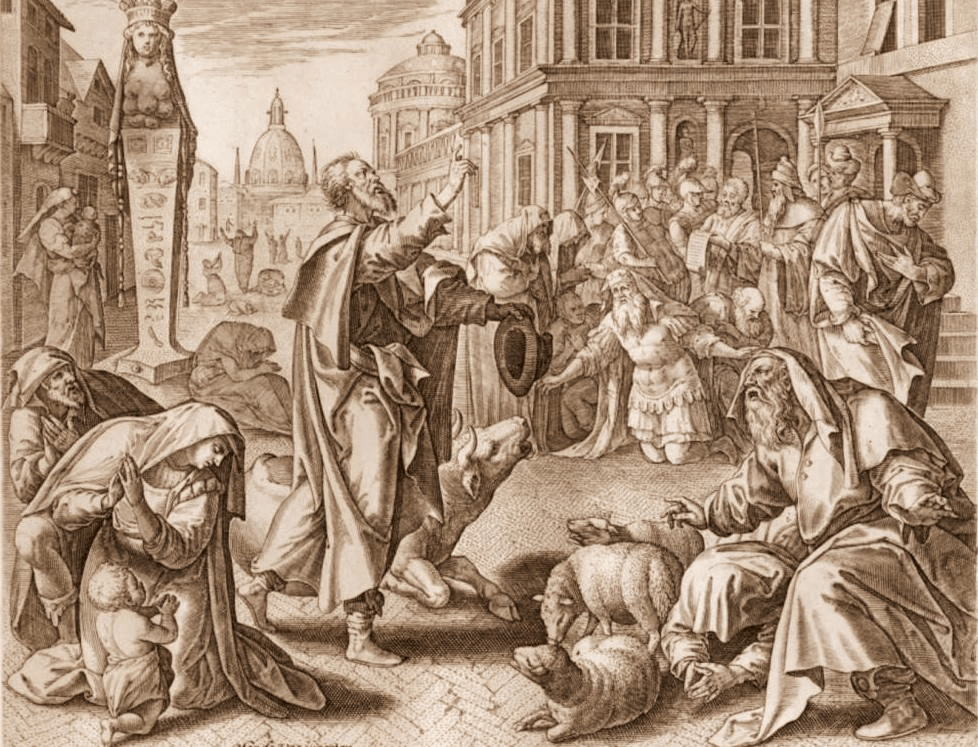
Anyone Can Change (Jonah 3:1-10)

Print of Jonah preaching to the Ninevites and their repenting, by Philip Galle 1547–1612 

The Lord’s word came to Jonah a second time: “Get up and go to Nineveh, that great city, and declare against it the proclamation that I am commanding you.” And Jonah got up and went to Nineveh, according to the Lord’s word. (Now Nineveh was indeed an enormous city, a three days’ walk across.)

Jonah started into the city, walking one day, and he cried out, “Just forty days more and Nineveh will be overthrown!” And the people of Nineveh believed God. They proclaimed a fast and put on mourning clothes, from the greatest of them to the least significant.

When word of it reached the king of Nineveh, he got up from his throne, stripped himself of his robe, covered himself with mourning clothes, and sat in ashes. Then he announced, “In Nineveh, by decree of the king and his officials: Neither human nor animal, cattle nor flock, will taste anything! No grazing and no drinking water! Let humans and animals alike put on mourning clothes, and let them call upon God forcefully! And let all persons stop their evil behavior and the violence that’s under their control!” He thought, Who knows? God may see this and turn from his wrath, so that we might not perish.

God saw what they were doing—that they had ceased their evil behavior. So God stopped planning to destroy them, and he didn’t do it. (Common English Bible)

Anyone can turn around, even the nastiest of people.

Lent (the Christian season lasting six weeks from Ash Wednesday to Easter Sunday) is the ideal time of year to change, to turn around, to repent — to return to God and re-focus our lives.

The season of Lent is something like a forty-day trial run in changing your lifestyle and letting God change your heart. Repentance is the key that unlocks the soul’s ability to connect with God. To repent means to stop going in one direction and start going in another one. It makes all the difference in the orientation of our souls. 

Repentance leads to a real change of direction, a complete re-orientation of life. The evidence of such a change is this:

  • Owning up to the problem and confronting it
  • An eagerness to make things right
  • Indignation over what has been done or said
  • A desire and energy to do what is best for those we have wronged
  • A willingness to accept whatever consequences that might result from the offense

There’s nothing romantic about repentance; it’s typically messy, usually ugly, and often painful. Yet, there must be suffering before glory. Trying to take repentance out of the equation is to eviscerate life and leave our souls vacuous and empty.

Sometimes, we may not even realize we need to repent because we get caught up in the drama of whatever we’re doing – school, relationships, family, church, or work. Our lives can become filled with distractions that take us away from the spiritual life and the need to change.

But our soul knows it’s empty. And so, often unaware, we try to fill the vacuum with meaningless stuff, busywork, and mindless activities. What we’re really doing is running from real life and from God. 

We need to connect with the Divine; we need repentance. The Ninevites instinctively knew what to do; they fasted, prayed, and changed their ways. If a group of people who were experts at human torture and abuse could know this and intentionally pay attention to God, then how much more ought we to connect with what is most important?

Godly sorrow brings repentance that leads to salvation and leaves no regret.

2 Corinthians 7:10, NIV

Throughout Holy Scripture, whenever people were confronted with divine realities, they were completely undone; they began to see their own sin for what it truly is. 

When the Apostle Peter saw the Lord Jesus in his immensity and power through a miraculous catch of fish he fell at Jesus’ knees and said, “Go away from me, Lord; I am a sinful man.” (Luke 5:8) 

When the Apostle John had a vision of Jesus Christ in all his glory, and heard his voice, he fell at the Lord’s feet as though dead. (Revelation 1:12-17)

When the prophet Ezekiel had a vision of God and saw the appearance of God’s glory, he fell facedown. (Ezekiel 1:25-28) 

Even Daniel, perhaps the most righteous prophet and person of all time, saw a vision of God in all his glory, he fell prostrate with his face to the ground, totally overwhelmed with God’s holiness and human sinfulness. (Daniel 8:15-18)

We must put ourselves in a position to hear God so that we can turn from all the obstacles that prevents us from experiencing life as it is meant to be lived. And the all the things which hinder us from repenting are legion:

  • inattention to God’s words and God’s creation
  • constant and prolonged preoccupations and daydreams that prevents availability to God
  • lack of sleep and good health habits that dulls the spiritual senses and prevents awareness of God
  • a paucity of spiritual practices and disciplines that would put us in a position to experience God

Let us, then, take a lesson from the repenting Ninevites and pay attention to God. For God is calling, yet we do not hear him. So, let’s put ourselves in a position to hear the message of God; identify the things that grieve God’s heart; and repent.

God has gone out of the way to reach us so that we can change for the better. And anyone, no matter who they are, can experience it – even a terribly sinful nation of people.

What will you do with this grace?

Almighty and everlasting God, the One who freely pardons all who repent: Redeem and renew every penitent heart with your infinite mercy and grace, forgiving all our sins, and cleansing us from an evil conscience. Amen.

Ash Wednesday (Matthew 6:16-34)

“When you fast, do not look somber as the hypocrites do, for they disfigure their faces to show others they are fasting. Truly I tell you, they have received their reward in full. But when you fast, put oil on your head and wash your face, so that it will not be obvious to others that you are fasting, but only to your Father, who is unseen; and your Father, who sees what is done in secret, will reward you.

“Do not store up for yourselves treasures on earth, where moths and vermin destroy, and where thieves break in and steal. But store up for yourselves treasures in heaven, where moths and vermin do not destroy, and where thieves do not break in and steal. For where your treasure is, there your heart will be also.

“The eye is the lamp of the body. If your eyes are healthy, your whole body will be full of light. But if your eyes are unhealthy, your whole body will be full of darkness. If then the light within you is darkness, how great is that darkness!

“No one can serve two masters. Either you will hate the one and love the other, or you will be devoted to the one and despise the other. You cannot serve both God and money.

“Therefore I tell you, do not worry about your life, what you will eat or drink; or about your body, what you will wear. Is not life more than food, and the body more than clothes? Look at the birds of the air; they do not sow or reap or store away in barns, and yet your heavenly Father feeds them. Are you not much more valuable than they? Can any one of you by worrying add a single hour to your life?

“And why do you worry about clothes? See how the flowers of the field grow. They do not labor or spin. Yet I tell you that not even Solomon in all his splendor was dressed like one of these. If that is how God clothes the grass of the field, which is here today and tomorrow is thrown into the fire, will he not much more clothe you—you of little faith? So do not worry, saying, ‘What shall we eat?’ or ‘What shall we drink?’ or ‘What shall we wear?’ For the pagans run after all these things, and your heavenly Father knows that you need them. 

But seek first his kingdom and his righteousness, and all these things will be given to you as well. Therefore do not worry about tomorrow, for tomorrow will worry about itself. Each day has enough trouble of its own. (New International Version)

Traditional Ash Wednesday services focus on the brevity of life and remind worshippers that they came from dust and will soon enough return back to the earth, dust once more. For our many of our parents in the faith, Lent was typically a sad season in which they gave up something in order to prepare themselves for eternal life.

The salvation promised and hoped for led them to look away from the joys of Spring and the beauties of the earth. Faithful Christians, in generations past, trained their eyes on heaven, forsaking time for eternity.

Yes, life is serious and risky business, and no one gets out alive. Yet is salvation really all about escaping this world of constant grief and death? Or is it seeing everlasting beauty in each passing moment?

It could be that you struggle with Ash Wednesday services and the season of Lent precisely because of its focus on giving up something, or because when you were a kid this time of year seemed like such a downer. Maybe your typical approach to Lent in the past has been a shoulder shrug and a response of “meh.”

So, therefore, I want us to get a different take on the meaning of Ash Wednesday and look at it from a different angle.

I will take away the ashes on their head, and I will give them a crown. I will take away their sadness, and I will give them the oil of happiness. I will take away their sorrow, and I will give them celebration clothes. 

Isaiah 61:3, ERV

The uncertainty of life can invite us to praise and wonder, to seize the moment—for this is the day the Lord has made and I will rejoice in it! All that I love and care for is mortal and fleeting, but mortality is the inspiration to celebration and love.

This is the sort of approach I saw in a dear friend who died fifteen years ago from a very long struggle with cancer. Bea always found ways to rejoice in her suffering, to be attentive to the working of God around her, and to bless those who needed God’s grace more than she did. More than once I found Bea, in one of her many hospital stays, out of the bed and in someone else’s room playing her dulcimer (she had once been a music teacher) and singing a hymn of praise to a fellow patient.

This Ash Wednesday, I’m not only fasting and giving up a few meals a week; I’m also letting go of everything that keeps me from rejoicing in the passing beauty of the earth.

Yes, we are dust, but we are real earthly sacred dust. Dust is good, after all, emerging from God’s intergalactic creativity. We are frail, but we are also part of a holy adventure reflecting God’s love over thousands of years.

Ash Wednesday is a time for us to pause, notice, wake up, and discover that God is in this place. This day invites us to take a much needed break and open up to the precarious yet beautiful world in which we live. So in this season of Lent, I plan on considering the lilies and the birds of the air.

In some Christian traditions, the imposition of ashes is accompanied by the words, “repent and believe the gospel.” And that I plan to do this year. I plan to turn around and be more present to the moment, appreciating God’s grandeur, and believing the good news—the embodied, everlasting, beautiful, wondrous, and gracious good news of walking with the Lord who is with me, surrounds me, and goes before me and after me.

Pastor and author, Jan Richardson, lost her husband to cancer several years ago during the season of Lent. She chose to cremate her husband so that his ashes might remind her and her family that there is beauty in the dust.  She wrote the following poem at her first Ash Wednesday without him:

Blessing the Dust

All those days
you felt like dust,
like dirt,
as if all you had to do
was turn your face
toward the wind
and be scattered
to the four corners

or swept away
by the smallest breath
as insubstantial—

did you not know
what the Holy One
can do with dust?

This is the day
we freely say
we are scorched.

This is the hour
we are marked
by what has made it
through the burning.

This is the moment
we ask for the blessing
that lives within
the ancient ashes,
that makes its home
inside the soil of
this sacred earth.

So let us be marked
not for sorrow.
And let us be marked
not for shame.
Let us be marked
not for false humility
or for thinking
we are less
than we are

but for claiming
what God can do
within the dust,
within the dirt,
within the stuff
of which the world
is made
and the stars that blaze
in our bones
and the galaxies that spiral
inside the smudge
we bear.

Amen.

Let Go and Give (Isaiah 58:1-12)

“Shout it aloud, do not hold back.
    Raise your voice like a trumpet.
Declare to my people their rebellion
    and to the descendants of Jacob their sins.
For day after day they seek me out;
    they seem eager to know my ways,
as if they were a nation that does what is right
    and has not forsaken the commands of its God.
They ask me for just decisions
    and seem eager for God to come near them.
‘Why have we fasted,’ they say,
    ‘and you have not seen it?
Why have we humbled ourselves,
    and you have not noticed?’

“Yet on the day of your fasting, you do as you please
    and exploit all your workers.
Your fasting ends in quarreling and strife,
    and in striking each other with wicked fists.
You cannot fast as you do today
    and expect your voice to be heard on high.
Is this the kind of fast I have chosen,
    only a day for people to humble themselves?
Is it only for bowing one’s head like a reed
    and for lying in sackcloth and ashes?
Is that what you call a fast,
    a day acceptable to the Lord?

“Is not this the kind of fasting I have chosen:
to loose the chains of injustice
    and untie the cords of the yoke,
to set the oppressed free
    and break every yoke?
Is it not to share your food with the hungry
    and to provide the poor wanderer with shelter—
when you see the naked, to clothe them,
    and not to turn away from your own flesh and blood?
Then your light will break forth like the dawn,
    and your healing will quickly appear;
then your righteousness will go before you,
    and the glory of the Lord will be your rear guard.
Then you will call, and the Lord will answer;
    you will cry for help, and he will say: Here am I.

“If you do away with the yoke of oppression,
    with the pointing finger and malicious talk,
and if you spend yourselves in behalf of the hungry
    and satisfy the needs of the oppressed,
then your light will rise in the darkness,
    and your night will become like the noonday.
The Lord will guide you always;
    he will satisfy your needs in a sun-scorched land
    and will strengthen your frame.
You will be like a well-watered garden,
    like a spring whose waters never fail.
Your people will rebuild the ancient ruins
    and will raise up the age-old foundations;
you will be called Repairer of Broken Walls,
    Restorer of Streets with Dwellings. (New International Version)

Let Go of the Hypocrisy and Get Real

Isaiah’s prophecy came to a community in conflict. The root of the issue was a hypocritical gap between the people’s conduct and their worship. They wondered why God had not noticed their pious fasting – why their actions before the Lord had gone unseen. Isaiah made it clear that their practice of fasting and their rituals of worship were ineffective because it was all self-serving instead of serving others.

Let Go of the Food and Get Generous

True fasting does not abstain from food just to get noticed (by God and/or others) but has the aim of a generous spirit and a giving heart. Both abstinence and generosity are necessary in the practice of fasting. 

Fasting is a much neglected spiritual practice today, so we need to make sense of the reason to do without food for a set amount of time. Fasting ought to put us in touch with our vulnerability; it should remind us of our mortality and our frailties. That’s why fasting is so often associated with the upcoming season of Lent.

Through fasting we remember that if we are not fed, we will die. Standing before God hungry, we realize that we are dependent creatures in desperate need of the Lord. By fasting, we discern that we are poor, and called to be rich in a way the world does not understand.

We are empty, called to be filled with the fullness of God. We are physically hungry, called to taste the goodness that can be ours in Christ, as we get in touch with a hunger for God.

Fasting, however, does not end with abstinence from food; and it is not merely a private individual thing. The spiritual discipline of fasting is meant to open our eyes and our hearts to the truly needy among us and in the world.  We are to be open to both the spiritual needs of people, and their very real material needs.

“When you see people freezing outside in the frigidity of unbelief, without the warmth of faith, impoverished and homeless, lead them home to the church and clothe them with the work of incorruption, so that, wrapped in the mantle of Christ, they will not remain in the grave.”

St. Jerome (347-430, C.E.)

Isaiah also addresses the very real daily tangible needs of people for the basic necessities of life. The message is this: Fasting is to personally abstain from food in order to provide food for another. 

Let Go of the Ego and Get to Praying & Repenting

Just as abstinence from and provision for food are two sides of the same coin, so fasting and prayer are, as well. We are to stop eating in order to take that time to pray and to give. Letting go of a meal puts the food that would have been eaten into the pantry for the needy. Fasting from lunch at our jobs can be done, not just to get more work accomplished, but so that we might share both our food and our friendship with those in need.

The prophecy of Isaiah has intimate connections between worship, fasting, justice, and reconciliation. They are meant to be a seamless whole, indivisible, enjoying a close bond that makes for powerful and effective ministry. All of this enables us to get back in touch with the real meaning of repentance:

  • To repair a broken relationship with God or with another person
  • To grieve over the reality of a certain situation
  • To devote oneself to service
  • To experience new life and spiritual growth

Isaiah wanted people to repent of both their individual sins and their social sins. Truth be told, we must all deal openly and honestly with our own complicity in the sins of our world, our nation, our church, and our families. The worship that God desires is inescapably corporate as well as compellingly personal. To ensure that all people around us flourish as human beings is both an obligation and a necessity to our collective fulfillment as God’s people.

The result of true fasting is a repentance that produces the fruit of renewal and restoration. Fasting connects us to God, and then leads us to repair and rebuild what has been broken and torn down. 

Let Go of Your “Precious” and Get Committed to God and Others

We fast to practice repentance, attach ourselves to God, and become more generous toward others. In the Lord of the Rings movies, Smeagol was much too attached to the power of the ring; it was his “precious,” and he was willing to do anything not to lose it or let it go.

Yet, we must all decide that we are going to let that precious thing go, at least for a time, whatever it may be. Each year at this time, before Ash Wednesday and the season of Lent, I decide in what ways I will practice fasting. In past years, I have abstained from buying certain things or watching TV. This year, however, I am going to do what fasting really is: abstaining from food for a set time. 

For most of the history of the church, Christians were expected to observe regular fasts on Wednesdays and Fridays, every week, year round.  When the season of Lent came, the church was united in their commitment to use the forty days as a time of introspection, confession, and fasting in order to prepare for the miracle of forgiveness on Good Friday and its life-giving power on Easter. It was understood to be a time of confronting sin, purging bad desires, yearning for forgiveness, and developing godly habits of living.   

For me, I think the least I can do is fast two meals a week – one on Wednesday and one on Friday (if not the whole days) to not only be in solidarity with the faithful that have gone before us, but in order to let the season of Lent do what it is intended to do.

I encourage you to consider implementing some sort of regular fast through Lent, if for no other reason, to fulfill the spirit and intent of Isaiah’s message to us so that we all connect deeply with Christ in purposeful Christian living.

Merciful God and Father, we have erred and strayed from your ways like lost sheep. We have followed too much the devices and desires of our own hearts. We have offended against Your holy laws. We have left undone those things which we ought to have done; and we have done those things which we ought not to have done – leaving us bereft of good. O Lord, have mercy upon us and restore us according to your grace, through Jesus Christ our Savior and Lord. Amen.

Philippians 2:5-11 – Descending Into Greatness

In your relationships with one another, have the same mindset as Christ Jesus:

Who, being in very nature God,
    did not consider equality with God something to be used to his own advantage;
rather, he made himself nothing
    by taking the very nature of a servant,
    being made in human likeness.
And being found in appearance as a man,
    he humbled himself
    by becoming obedient to death—
        even death on a cross!

Therefore, God exalted him to the highest place
    and gave him the name that is above every name,
that at the name of Jesus every knee should bow,
    in heaven and on earth and under the earth,
and every tongue acknowledge that Jesus Christ is Lord,
    to the glory of God the Father. (New International Version)

So, what kind of people (and what kind of church) would we be if we resembled these verses of Holy Scripture?  

The Apostle Paul said to the church in Philippi that their “attitude” or “mindset” should be the same as Christ Jesus. Their thinking ought to be like the mind of Christ. To think well, live well, and be well, we need the mind of Christ.

To relate to others in a godly way, to navigate this fallen world with integrity and truth, to make an impact on those around us, we must adopt the mindset and attitude of Jesus.  

Everything comes down to God – how we should think and how we ought to live. Within the life of the one true God, exists three persons: Father, Son, and Spirit. Within the Holy Trinity, there exists perfect love, absolute holiness, united harmony, and constant respect. 

Just as God is holy, we are to be holy.

Therefore, once you have your minds ready for action and you are thinking clearly, place your hope completely on the grace that will be brought to you when Jesus Christ is revealed. Don’t be conformed to your former desires, those that shaped you when you were ignorant. But, as obedient children, you must be holy in every aspect of your lives, just as the one who called you is holy. It is written, You will be holy, because I am holy. (1 Peter 1:13-16, CEB)

Just as God is love, so we are to love one another.

Dear friends, we should love each other, because love comes from God…. This is how God showed his love to us: He sent his one and only Son into the world so that we could have life through him. This is what real love is: It is not our love for God; it is God’s love for us. He sent his Son to die in our place to take away our sins. Dear friends, if God loved us that much, we also should love each other. (1 John 4:7-11, NCV)

Just as Jesus is a humble servant, so we are to practice humble service in all relationships.

Everyone must live in harmony, be sympathetic, love each other, have compassion, and be humble. Don’t pay people back with evil for the evil they do to you, or ridicule those who ridicule you. Instead, bless them, because you were called to inherit a blessing. (1 Peter 3:8-9, GW)

Humility is vital to Christian existence, and not optional. There is no place in the believer’s life for pride, posturing, and power-broking. Instead, we are to take the posture of lowliness, using any kind of influence for the benefit and encouragement of others – just like Jesus did while on this earth. 

In a world pre-occupied with power and control, safety and security, influence and throwing its weight around, there is Jesus. Christ did the opposite of engaging in upward mobility; he practiced downward mobility. In doing so Jesus Christ descended into greatness as Lord and Savior.

To have the mind and attitude of Christ happens through emulating our Lord’s example of humility. Jesus is God. Yet, despite that reality, the pre-incarnate Christ did not sit in heaven as the second person of the Trinity and hold onto his lofty position with tight fists. 

Jesus came to this earth with a humble willingness to open his hands and relinquish his rights and privileges as God. Christ divested himself of all his privilege. He became a slave. Jesus gladly emptied himself and held nothing back. Christ completely gave himself up for us.

Jesus became one of us, yet never ceased being the Lord of all. It’s just that he willingly put his kingly robe in the closet and put on Dickies and work boots. Jesus came among us and purposely limited himself to identify with us fully – and secured for us the greatest generosity imaginable: an answer to the problem of guilt and shame through forgiveness of sins.

Jesus became a servant, a bond-slave. Christ completely tied himself to us, not coming to this earth seeking to be served, but serving and giving his life as a ransom for many. 

What’s more, Christ kept going lower and lower to the point of descending to the greatest humiliation and shame of all – death on a cross. The King of the universe was killed by sinful humanity so that he might redeem and save those very same people from their terrible plight of bondage to the power of sin.

Therefore, we are to be humble, embracing the lowly status of being slaves to God and to one another. The Philippian church had a real problem with pride. Hear the exhortations given to the Philippian church so that they would practice humility in all their relationships: 

  • Live your life in a manner worthy of the gospel of Christ, so that, whether I come and see you or am absent and hear about you, I will know you are standing firm in one spirit, striving side by side with one mind for the faith of the gospel (Philippians 1:27, NRSV)
  • Don’t be jealous or proud but be humble and consider others more important than yourselves. (Philippians 2:3, CEV)
  • You must continue to live in a way that gives meaning to your salvation. (Philippians 2:12, ERV)
  • Do all things without murmuring and arguing. (Philippians 2:14, NRSV)
  • Brothers and sisters, imitate me, and pay attention to those who live by the example we have given you. (Philippians 3:17, GW)
  • Do not be anxious [tight-fisted control] about anything, but in every situation, by prayer and petition, with thanksgiving [open-handed humility] present your requests to God. (Philippians 4:6, NIV)

As a result of Christ’s humble obedience to the Father, he was exalted from the lowest place to the highest place. King Jesus is on the throne, above everyone and everything. Because of his descent to this earth, he ascended in glory and honor. We now see God in a new way, through Jesus – and it causes us to bend the knee and confess with the tongue that Jesus Christ is Lord.

In the ancient Roman world, Jesus as Lord was subversive language. Because if Jesus is Lord, Caesar is not, and ultimate allegiance does not belong to the Empire. And it is no different in our day. The issue of who we pledge our fealty to, still pertains to us. If Jesus is Lord, no earthly politician or religious figure is owed lordship status.

To follow Jesus, one must practice downward mobility and embrace humility.

Bowing the knee to Christ becomes second nature whenever we give our unflagging allegiance to him. We accept that we are the creatures and God is the Creator, that God is God, and we are not.

As we enter Holy Week, hear the prophet Isaiah’s words of humiliation and exaltation:

Just watch my servant blossom!
    Exalted, tall, head and shoulders above the crowd!
But he didn’t begin that way.
    At first everyone was appalled.
He didn’t even look human—
    a ruined face, disfigured past recognition.
Nations all over the world will be in awe, taken aback,
    kings shocked into silence when they see him.
For what was unheard of they’ll see with their own eyes,
    what was unthinkable they’ll have right before them.

Who believes what we’ve heard and seen?
    Who would have thought God’s saving power would look like this?

The servant grew up before God—a scrawny seedling,
    a scrubby plant in a parched field.
There was nothing attractive about him,
    nothing to cause us to take a second look.
He was looked down on and passed over,
    a man who suffered, who knew pain firsthand.
One look at him and people turned away.
    We looked down on him, thought he was scum.
But the fact is, it was our pains he carried—
    our disfigurements, all the things wrong with us.
We thought he brought it on himself,
    that God was punishing him for his own failures.

But it was our sins that did that to him,
    that ripped and tore and crushed him—our sins!
He took the punishment, and that made us whole.
    Through his bruises we get healed.
We’re all like sheep who’ve wandered off and gotten lost.
    We’ve all done our own thing, gone our own way.
And God has piled all our sins, everything we’ve done wrong,
    on him, on him.

He was beaten, he was tortured,
    but he didn’t say a word.
Like a lamb taken to be slaughtered
    and like a sheep being sheared,
    he took it all in silence.
Justice miscarried, and he was led off—
    and did anyone really know what was happening?
He died without a thought for his own welfare,
    beaten bloody for the sins of my people.
They buried him with the wicked,
    threw him in a grave with a rich man,
Even though he’d never hurt a soul
    or said one word that wasn’t true.

Still, it’s what God had in mind all along,
    to crush him with pain.
The plan was that he give himself as an offering for sin
    so that he’d see life come from it—life, life, and more life.
    And God’s plan will deeply prosper through him.

Out of that terrible travail of soul,
    he’ll see that it’s worth it and be glad he did it.
Through what he experienced, my righteous one, my servant,
    will make many “righteous ones,”
    as he himself carries the burden of their sins.
Therefore I’ll reward him extravagantly—
    the best of everything, the highest honors—
Because he looked death in the face and didn’t flinch,
    because he embraced the company of the lowest.
He took on his own shoulders the sin of the many,
    he took up the cause of all the black sheep. (Isaiah 52:13-53:12, MSG)

Lord Jesus, Son of God, you walked the earth with humility, despite being Lord of all. Your meekness confused the proud and arrogant. Your nobly attended to the needy and destitute. Teach me to model my life after you, to live with a humble spirit. Help us to never view ourselves as greater or better than others. Let our hearts always imitate your humility. Amen.