Christ’s Parable of the Weeds (Matthew 13:24-30, 36-43)

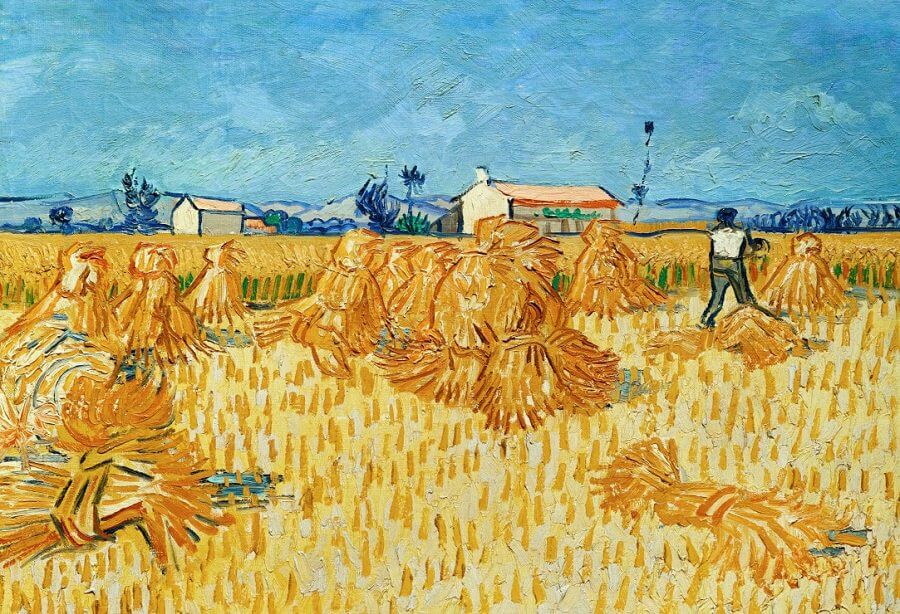
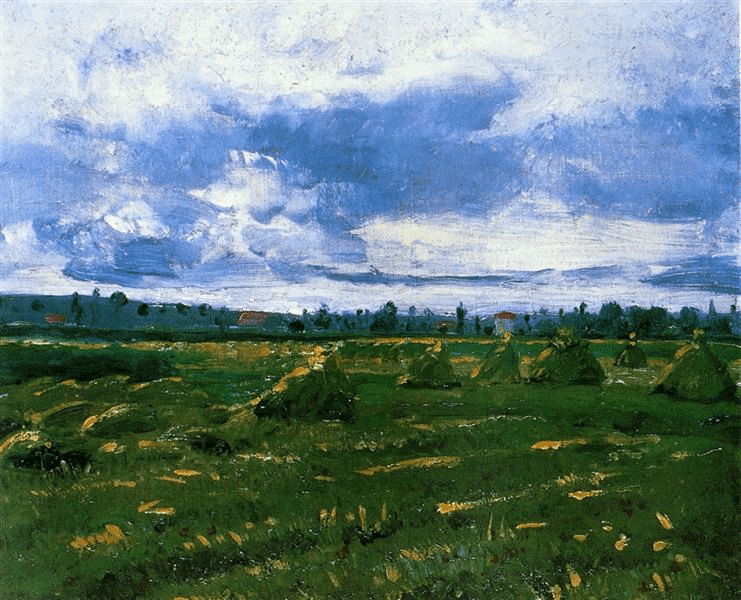
Wheat Fields with Stacks, by Vincent Van Gogh, 1888

Here is another story Jesus told: “The Kingdom of Heaven is like a farmer who planted good seed in his field. But that night as the workers slept, his enemy came and planted weeds among the wheat, then slipped away. When the crop began to grow and produce grain, the weeds also grew.

“The farmer’s workers went to him and said, ‘Sir, the field where you planted that good seed is full of weeds! Where did they come from?’

“‘An enemy has done this!’ the farmer exclaimed.

“‘Should we pull out the weeds?’ they asked.

“‘No,’ he replied, ‘you’ll uproot the wheat if you do. Let both grow together until the harvest. Then I will tell the harvesters to sort out the weeds, tie them into bundles, and burn them, and to put the wheat in the barn….’”

Then, leaving the crowds outside, Jesus went into the house. His disciples said, “Please explain to us the story of the weeds in the field.”

Jesus replied, “The Son of Man is the farmer who plants the good seed. The field is the world, and the good seed represents the people of the Kingdom. The weeds are the people who belong to the evil one. The enemy who planted the weeds among the wheat is the devil. The harvest is the end of the world, and the harvesters are the angels.

“Just as the weeds are sorted out and burned in the fire, so it will be at the end of the world. The Son of Man will send his angels, and they will remove from his Kingdom everything that causes sin and all who do evil. And the angels will throw them into the fiery furnace, where there will be weeping and gnashing of teeth. Then the righteous will shine like the sun in their Father’s Kingdom. Anyone with ears to hear should listen and understand! (New Living Translation)

As you have likely noticed, not everyone in this world is supportive of you and what you’re doing.

The good work we do – no matter how competently and expertly done – will be undermined by others. There will be people with selfish and sinister agendas who put roadblocks in our way to frustrate our ongoing work. They don’t like what we are doing and what we’re trying to accomplish.

Unfortunately, that’s just the way it is. So then, one of the big questions for all of us is this: How do we live with others trying to subvert the good work we are doing for the Kingdom of Heaven?

One of the most popular responses is to strike the enemy on their cheek just as hard or harder in the way they slapped you. It is responding to evil in kind.

But if we will ponder for a moment, we shall realize that is makes no sense to repay evil with evil. Why? Because then the Kingdom of Hell has just snagged this one with doing evil in order to defend good work – which ends-up ruining the whole enterprise.

No, instead let’s heed the words of Christ to turn the other cheek and not retaliate; and live the words of the Apostle Paul who reminded us to overcome evil by doing good. (Matthew 5:38-42; Romans 12:14-21)

Yes, all judgment belongs to the Lord, and not us. In today’s Gospel lesson the reasoning Jesus provides for non-retaliation and non-violence is both reasonable and practical.
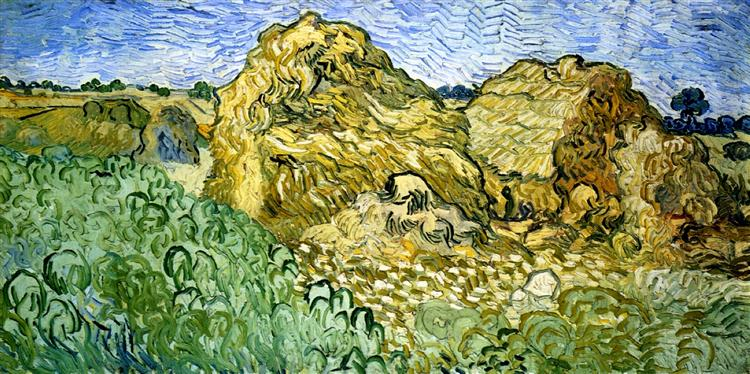
Field with Stacks of Wheat, by Vincent Van Gogh, 1890

Christ told his disciples that the enemy’s efforts at thwarting our good works are sinister enough to bring about a situation where evil is so close to the good that to eradicate the evil is to therefore also do away with the good.

If you have weeds in your field or your garden, you know that some of those nasty weeds cannot be pulled out of the ground without yanking-up the good plant along with it. Instead, you’ll have to wait until you can harvest the plant, and then you can safely get rid of the offending weed.

Let’s think, then, about our own situations right now in this world. For myself, it seems that every single day I am upset and angered over decisions made by those in political power, because they almost always involve oppressing and/or harming powerless people.

Yet, to immediately stop the offending persons and organizations would involve some wicked methods. Instead, if I want to maintain doing good, I will have my time to unseat them through the vote, or writing my Senators, or directly contacting the offices of the institutions, etc.

Some of our responses may seem tepid in comparison to the evil being perpetrated, yet we can be sure that there is a time coming in which the reality of divine judgment will handle the wicked once and for all. At the proper time, heaven’s angels will do their own good work of removing evil and eradicating it forever.

We need to put our efforts into doing the very best at living in harmony with one another, promoting peace, and being peacemakers – using our greatest and most effective tools of humility, gentleness, grace, and love. These are the proper fertilizers which will keep the plants of righteousness and justice growing and thriving, even though they are surrounded by a bunch of close weeds.

As maddening as it is to see those weeds grow up alongside the plants, nowhere in Holy Scripture are we called or encouraged to become judge, jury, and executioner to the wicked.

Furthermore, Christians are nowhere called to force onto others Jesus as King through a theocratic nation, using authoritarian means. We are called, rather, to put our faith where our fear is and exercise a faith that does good work through love. (Galatians 5:6)

Equipped by the Spirit, we urge oppressors, tyrants, and egotists to turn from their selfishness and amend their evil ways. And we are not called to force the Kingdom of Heaven on others by trying to ensconce a form of Christian nationalism. For Americans, many of our ancestors came to the New World in order to flee their home Christian nationalist countries who persecuted them and did evil to them.

“To identify any particular form of government with Christianity is a dangerous error, for it confounds the permanent with the transitory, the absolute with the contingent.” T.S. Eliot

It takes very little prodding for Christians with political power to move into glorifying violence and ignoring biblical injunctions to love enemies, seek peace, and grant grace.

God puts a high premium of looking after the poor and needy, and rescuing them from oppression and violence. The last thing we ought to be doing is becoming the violent oppressors ourselves!

Giving ourselves as ambassadors of reconciliation, speaking truth to power, and doing the work of peacemaking is a narrow and hard road to hoe. The easy way is typically the road of destruction. (Matthew 7:13-14)

As citizens of the Kingdom of Heaven, we are to labor toward the things Jesus himself did: Challenge the arrogant religious types; offer mercy to the lowly and forgotten ones; warn of judgment; encourage faith; forgive generously; and speak words of truth in all places, including the halls of political power.

It is perfectly legitimate to disagree with others, but only if we ourselves are willing to defend their equally legitimate right to be disagreeable.

So, instead of always trying to snuff-out and vanquish our opponents with overt tools of evil, let us do the good work of winning their respect, living in peace with them, and affirming our shared humanity together.

We all have the right to be different; we don’t have the right to do evil and reprise evil with evil. The organizations, institutions, faith communities, corporations, and governments of this world are only as good as the people guarding that goodness through their good work, utilizing good means toward good ends.

Anyone with ears ought to listen and understand.

God of steadfast love and grace: Teach us your way and your truth. Root us in you alone, and help us to grow in grace and love, so that we may fulfill our role and our work in the reign of Jesus Christ our Lord. Amen.

First Sunday of Advent – The Paradoxical Christ (Luke 21:25-36)

Christ Among the Doctors, by Paolo Veronese, c.1560

“There will be signs in the sun, the moon, and the stars and on the earth distress among nations confused by the roaring of the sea and the waves. People will faint from fear and foreboding of what is coming upon the world, for the powers of the heavens will be shaken. Then they will see ‘the Son of Man coming in a cloud’ with power and great glory. Now when these things begin to take place, stand up and raise your heads, because your redemption is drawing near.”

Then he told them a parable: “Look at the fig tree and all the trees; as soon as they sprout leaves you can see for yourselves and know that summer is already near. So also, when you see these things taking place, you know that the kingdom of God is near. Truly I tell you, this generation will not pass away until all things have taken place. Heaven and earth will pass away, but my words will not pass away.

“Be on guard so that your hearts are not weighed down with dissipation and drunkenness and the worries of this life and that day does not catch you unexpectedly, like a trap. For it will come upon all who live on the face of the whole earth. Be alert at all times, praying that you may have the strength to escape all these things that will take place and to stand before the Son of Man.” (New Revised Standard Version)

Do we understand the dire situation of humanity? Is there comprehension of the sinister road that many choose to walk? Or are we cut off from ourselves, fragmented and unable (or unwilling) to participate in becoming people who are wise and seek what is just?

Perhaps we are adrift, lost in our own hubris, believing that our beliefs and opinions are so right as to either force them on others; or either live and let live, as if nothing bad will ever happen.

But the Son of Man is coming. He has a lesson for us from a tree; and an exhortation to beware.

I just hope it’s not too late for many of us.

Today’s Gospel lesson is part of a longer discourse by Jesus, warning about coming persecution and impending destruction of the Temple. It’s apocalyptic stuff about famine, war, judgment, with exhortations in the midst of suffering.

This is how we are beginning the new Christian Year, and season of Advent. Dealing with judgment and cosmic cataclysm may seem out of sync with the month of December.

Advent helps us prepare our hearts in anticipation of Christ’s birth. It’s actually one of the best times to remember that just as Jesus came as a child in his first advent, a second advent is yet to come, in which Jesus returns as the judge.

The Coming of the Son of Man

The season of Advent, and Jesus himself, are paradoxical. In my estimation, all of Christianity is inherently paradoxical. A paradox brings two contrasting truths or images together. Jesus is God. Jesus is human. Both are true. Jesus is a paradox. Jesus came. Jesus is coming. His advent is a paradox.

Jesus and his teaching may seem self-contradictory. But it nonetheless shows us truth. That’s what a paradox does. It expresses things like Jesus being both a baby and a savior, an infant and a king, a servant and a sovereign.

Christ brings peace. And Christ brings division. To keep your life, you must lose it. In order to be first, you must be last.

The Lesson of the Tree

Trees are some of our greatest teachers, that is, if we will but listen to them and observe them. The tree teaches us the paradox that with the changing of the leaves, death can be beautiful. In using the tree’s wood, we learn there is new life through destruction.

The dormancy of the tree in winter appears as if it will last forever. Yet, when Spring arrives, we discover that the bare branches and lifelessness is temporary, not permanent. The tree blossoms, almost exploding with life and color.

Our earthly trials and tribulations will not last. God will vindicate the righteous. Redemption is near. There is the paradox of suffering that leads to glory, and tears which will give way to great comfort.

The Exhortation to Watch

But we must watch. Jesus tells us to beware. With paradox, and in the apocalyptic view of things, events that happen on this earth that we see are mere reflections of much greater workings on an unseen plane of existence.

Paradoxically, the struggle between good and evil is both earthly and celestial; it is playing out on multi-dimensional levels. There is always more going on than what meets the eye. Therefore, watch out, because you do not really know what’s happening unless you’re looking with both physical and spiritual eyes.

So, stay awake. Pay attention. Be prepared. Keep awareness of yourself and your situations.

As we move into the busyness and bustle of this month, let us not overprepare for something transitory and impermanent. Let’s remember to use our vision to see a large and expansive world in need of the paradoxical Christ.

If you are reading this, or listening to this, then there is hope. This present existence is not permanent; it won’t last forever.

For what is at stake is the coming of the kingdom of heaven, a realm of existence that is both already here, and not yet here. In allowing such a rule to come and take over our lives, we find freedom and peace and permanence.

Tying our hopes to earthly rulers and all of their construction of petty kingdoms and fiefdoms will only end in darkness and disappointment.

The Servant King, who rules through loving service, is coming. And the Universal Judge, who controls all things with a powerful gracious force, is also coming.

The paradoxical Jesus was here, is here, and is to come.

Almighty God, give us grace that we may cast away the works of darkness, and put on the armor of light, now in the time of this mortal life, in which your Son Jesus Christ came to visit us in great humility; that in the last day, when he shall come again in his glorious Majesty, to judge both the living and the dead, we may rise to life immortal; through him who lives and reigns with you and the Holy Spirit, now and forever. Amen.

Jesus the King (Mark 11:1-11)

Entry Into the City, by John August Swanson (1938-2021)

As they approached Jerusalem and came to Bethphage and Bethany at the Mount of Olives, Jesus sent two of his disciples, saying to them, “Go to the village ahead of you, and just as you enter it, you will find a colt tied there, which no one has ever ridden. Untie it and bring it here. If anyone asks you, ‘Why are you doing this?’ say, ‘The Lord needs it and will send it back here shortly.’”

They went and found a colt outside in the street, tied at a doorway. As they untied it, some people standing there asked, “What are you doing, untying that colt?” They answered as Jesus had told them to, and the people let them go. When they brought the colt to Jesus and threw their cloaks over it, he sat on it. Many people spread their cloaks on the road, while others spread branches they had cut in the fields. Those who went ahead and those who followed shouted,

“Hosanna!”

“Blessed is he who comes in the name of the Lord!”

“Blessed is the coming kingdom of our father David!”

“Hosanna in the highest heaven!”

Jesus entered Jerusalem and went into the temple courts. He looked around at everything, but since it was already late, he went out to Bethany with the Twelve. (New International Version)

We are presently in the 12 Days of Christmas (December 25–January 5), the annual celebration of Christ’s birth on the Christian Calendar. It may seem odd that the Revised Common Lectionary daily readings have included a text associated with Palm Sunday. However, this is reminder to us that Jesus was born a king – which is why old King Herod saw a little baby as such a threat. (Matthew 2:1-18)

“Christ” is not the surname of Jesus, but instead is a title, meaning “anointed one.” In other words, in the New Testament Gospels, Jesus is referred to as an anointed king. It was broadly understood, within the religious milieu of the ancient Jews, that the Messiah (the Hebrew term for Christ) would come and beat up God’s enemies, restore God’s people to their former glory, and usher in an everlasting state of peace.

Jerusalem had a history as the royal city – the place where ancient Jewish kings lived and ruled. So, most ancient Jews made a clear connection between the Messiah, the king, returning to reign in Jerusalem. They anticipated that the City of David would once again be the seat of power, without any meddling Gentiles to complicate things.

Nativity, by John August Swanson

So, when Jesus entered Jerusalem – in what turned out to be the final week of his earthly life – many people looked upon this as a triumphal entry. He was close to ascending the ancient throne. The disciples of Jesus were waiting for this, and ready for a future of greatness and glory alongside their Rabbi.

Not only did people lay their palm fronds on the road in front of him declaring the ancient refrain, “Blessed is he who comes in the name of the Lord!” (Psalm 118:26) but they also added an explicit reference to the days of King David stating, “Blessed is the coming kingdom of our ancestor David!” The city was awash in the messianic hope of no longer being subject to foreign rule.

Yet we know the tragic and ironic end of the week. Jesus knew it, too, even at the time. He knew what fate awaited him by entering Jerusalem (Mark 8:31; 10:33-34). And Jesus knew without a shadow of a doubt that he was not going to be a king who gains and keeps power through military might and the bloodshed of war. Instead, only his own blood would be offered, as a sacrifice for many. The power of Love will overcome any and every earthly power.

Those with the eyes to see and the spirit to discern could understand this Jesus riding on a humble donkey instead of the proud warhorse. It made complete sense. Jesus did not enter this world with the fanfare of the rich and powerful, but quietly slipped onto the earth in a non-descript and poor Jewish family. His birth, life, and ministry, were all counter cultural. So, why not also his eventual death, resurrection, ascension, and glorification?

Yes, Jesus is a king. But no, he is not a king in any conventional sense. It is Jesus, beginning with his incredible and unexpected incarnation, who helps us reimagine what power and authority can and ought to look like.

All the trappings of control we can get so enamored about, such as wielding influence through economic wealth, social status, political power, and religious weight, all get tossed aside as mere stuffed animals compared to the real deal of moral dignity, ethical love, and compassionate justice shown to people who had absolutely no ability to either pay back Jesus or prop up a throne for him to sit upon.

Jesus is a king who gives his life for the healing of humanity – all people everywhere – including the ones we don’t much like or care about. I have no problem calling Jesus a king, just as long as we understand what sort of kingship we are actually talking about.

I serve King Jesus because he throws a monkey wrench into oppressive systems that seek to keep other people under a heavy hand of injustice. My allegiance is with Christ the Lord because he uses his prodigious authority to bring peace, light, wholeness, and integrity to all the places of the world (and the human heart) that are dark and clueless.

Today I celebrate in this Christmas season the birth of a baby who was born to die to the world and for the world. I rejoice with the angels that Christ is born in Bethlehem, the king of kings and lord of lords, the prince of peace who himself became peace so that we might live in peace.

May you discover deliverance from guilt, shame, and regret, through the One who came and was wounded for us so that we might be healed. Amen.

The Parable of the Weeds (Matthew 13:24-30, 36-43)

Jesus told them another parable: “The kingdom of heaven is like a man who sowed good seed in his field. But while everyone was sleeping, his enemy came and sowed weeds among the wheat, and went away. When the wheat sprouted and formed heads, then the weeds also appeared.

“The owner’s servants came to him and said, ‘Sir, didn’t you sow good seed in your field? Where then did the weeds come from?’

“‘An enemy did this,’ he replied.

“The servants asked him, ‘Do you want us to go and pull them up?’

“‘No,’ he answered, ‘because while you are pulling the weeds, you may uproot the wheat with them. Let both grow together until the harvest. At that time I will tell the harvesters: First collect the weeds and tie them in bundles to be burned; then gather the wheat and bring it into my barn….’”

Then he left the crowd and went into the house. His disciples came to him and said, “Explain to us the parable of the weeds in the field.”

He answered, “The one who sowed the good seed is the Son of Man. The field is the world, and the good seed stands for the people of the kingdom. The weeds are the people of the evil one, and the enemy who sows them is the devil. The harvest is the end of the age, and the harvesters are angels.

“As the weeds are pulled up and burned in the fire, so it will be at the end of the age. The Son of Man will send out his angels, and they will weed out of his kingdom everything that causes sin and all who do evil. They will throw them into the blazing furnace, where there will be weeping and gnashing of teeth. Then the righteous will shine like the sun in the kingdom of their Father. Whoever has ears, let them hear. (New International Version)

Harvest in Provence, by Vincent Van Gogh, 1888

People of every age struggle with the evil present in this world – and also within the church. For how do we make sense of those who profess Christ but have no fire and passion for their faith? How do we reconcile our own faith with folks in the church who seem to care more about getting their own way than about sacrificing themselves to reach people who do not know Christ. Jesus says, “He who has ears, let him hear.” In other words, listen!

Jesus has informed us that in this present evil age we live in, between his two advents of incarnation and Second Coming, not everything for Christians is going to be rainbows and unicorns.

There are competing pressures on the Church, and sometimes she will fail. The kingdom of God has broken into history and is present, but sin and evil is there, too. So, our focus must be on the hope we have when Christ comes again to judge the living and the dead.

In Christ’s parable of the weeds (or the parable of the wheat and the tares) the enemy of our souls seeks to distract the workers by overwhelming them with evil. If Satan cannot prevent God’s kingdom from being established in the human heart, the devil will try and corrupt the heart by throwing as much evil at it as he can. 

The devil has no problem with people saying they are Christians; the thing Satan has a problem with is people giving themselves unconditionally and unreservedly to God for kingdom business.

“Not everyone who says to me, ‘Lord, Lord,’ will enter the kingdom of heaven, but only the one who does the will of my Father who is in heaven.”

Jesus (Matthew 7:21, NIV)

Where did all these weeds come from?

I’ll frame this question in the modern form that many people have asked me over the years: “If God is a God of love, why is there so much evil in the world?” Or, “If this is Christ’s Church, why is it so messed up?”

Jesus is straightforward in his answer: An enemy did this. In other words, God didn’t plant evil – the source of evil comes from the devil, not God. God’s agenda is for the seed to take root in the human heart and grow into a full-fledged embodiment and commitment to the words and ways of Jesus.

When that growth doesn’t happen, the problem is not because God messed up; it’s because the devil has also done his own work of planting. And the devil wants the opposite of God: to have Christians nit-picking each other like a bunch of crazy chickens, and keeping a demonic pecking order; instead of being the continuing presence of Christ on this earth.

What do we do with all these weeds?

That is, how do we deal with wicked people?  The answer seems obvious: Pull the weeds up and get rid of them. Get rid of wicked people and their wicked behavior. Yet Jesus says in response to this line of reasoning in a clear and unequivocal answer of “No.” But why? Because doing violence to the weeds ends up doing violence to the wheat, as well.

Christ’s answer to the problem of evil is: Let God take care of it. Meanwhile, until that fully happens, we must co-exist with evil, rather than exterminate evil people.

There is always a temptation for believers to force people into the kingdom of God (e.g. the Spanish Inquisition). Yet, at the harvest (the final judgment at the end of the age) evil will be squarely dealt with. Judge Jesus will have the angels separate the wheat from the tares, and the weeds will be burned up.

This teaching from Jesus may open up a whole set of other questions, such as:

  • What am I supposed to do with evil? Just watch it happen? 
  • Am I to let that evil person just be evil? Shouldn’t I give them what they deserve?
  • Shouldn’t I at least tell evil people that they are no good rotten sinners? That they are going to hell because they are wicked?

This doesn’t mean we do nothing. Earlier in Matthew’s Gospel, Jesus has already said: Love your enemies and pray for those who persecute you. (Matthew 5:44)  We are to love and pray people into the kingdom, not force them in.

As for the evil, Jesus will decisively solve the problem of evil, not you, nor me! It isn’t our place to be judge, and if we make it our place, we’ll end up hurting and destroying our brothers and sisters.

Where is evil?

A sobering reality taught by Jesus in this parable is that it’s not a simple matter that we, the wheat are here, and they, the weeds, are over there. It is much more sinister than that; the enemy is within, not out there. 

We have no further to look than in our own hearts and within our own faith communities – which is why we need the lordship of Christ to completely overtake us. Evil is present in the Church, next to the good, seeking to:

  • discourage people in their commitment to Christ
  • offend and hurt others, particularly by overlooking and speaking ill of weaker people
  • step on others in order to get it’s way
  • be a stumbling block to those trying to do God’s will
  • promote ignorance of God’s Word, for no one can live by God’s will if they do not know what it is

The eventual end of sinister people is that, when Christ returns, they will be separated from the righteous and thrown into the fire, just like a harvester would do with a bunch of weeds. As the wicked went about their lives in anger, upsetting others in this life, so they will be tormented in the next.

Conclusion

We may expect God to handle evil in a hurry. But the kingdom of God doesn’t work that way; it’s intended to be planted in the ground, and takes time to grow. While it’s growing, evil is there, like a weed.

Whenever things go sideways because of wickedness, we might expect God to act quickly and drastically to uproot the evil. We may confuse God’s slowness as being uncaring, when in reality it means that God is patient, and desires people to change. And change always begins with you and me.

God Almighty, Creator of heaven and earth, we are a complacent people. While you desire us to be a beacon of light to a world in need, we are preoccupied with all the weeds in the field. We are sorry for the madness unleashed through our own selfish desires. May you plant the seed of love in our hearts for all people, not just our friends. And we shall commit to watering and nurturing that seed with your Word, through Jesus Christ our Lord. Amen.